Friday, 15 October 2010

Stokesley: What a Difference a Fair Makes!

Stokesley on the edge of the North York Moors is a delightful market town. It has a little river that runs through it on which the ducks paddle searching for crusts of bread. There are butchers and bakers and quite possibly candle-stick makers, banks, hairdressers, newsagents, grocers, boutique clothing outlets, and stationers.

You can happily walk up one side of the street and down the other, popping into a choice of churches, cafes, pubs and restaurants and (if you are like my brother-in-law Mr Smartypants) doffing your cloth cap at 'my good neighbour' spoken in a peculiar vernacular of Yorkadian (Yorkshire/Canadian). It doesn't matter what you do out in the big blue yonder, when you are in Stokesley all is well with the world.


And then the fair comes to town.

The Stokesley Fair transforms a sleepy village hamlet into a pulsating, flashing street of screams and vomit. The aromas are diesel fumes, fat and sugar as machines with names like Extreme, The Edge, and Over the Top rotate and revolve in three different ways. Airbrushed pictures of tropical palms cannot mask the northern brick red roofs as the half moon bravely tries to shed scenic light above a terrace.

Nothing has changed in the cheese factor of the fair's music: Bonnie Tyler and Phil Collins boom out against the Black Eyed Peas and some bint urging us to 'take it off' - not in North Yorkshire where it's cold and raining, surely. Klaxons and computer-generated enthusiasm fill the air with audio pollution as King Frog, Crazy Frog, Crazy Circus and the bumper cars vie for attention with not altogether friendly competition.


You can win goldfish at the hoopla or throw or shoot things for a Spongebob Squarepants or Toy Story prize - every time! Even the rewards are passe and desperate. 'Are you ready?' 'Yeah, baby!' Force yourself to be jolly - choose your weapon of transatlantic confection: wilting bags of pallid candy-floss; sizzlers; 1/4 burgers; roast pork 'American style'.
  
Children are primed for an adulthood of brief excitement and lengthy disappointment. Their miniature rides mimic those of the adults and despite the tame tea pots and the mini wheel twinkling fairy-like through the trees, they ride the energy storm with their hands in the air like they just don't care and squeal with the best (and worst) of them. Gypsies Rose, Lee and Bothwell can predict their future from the caravan or motor home, but teenage pregnancy, benefit dependency and spiritual unfulfilment isn't tricky to foretell.


Giant teddies bear rictus grins and dead eyes. Theatre may be shabby back stage but out front it is magic. The fierce tawdriness of this fair is all pervasive and I doubt any are deceived. Down this end of town they play Only the Lonely and try to ignore the poignancy. The Captain Cook Brewery seems a much better proposition and we drink our way along the bar. Sunset (4%) - a smooth, nutty, session ale; Slipway (4.2%) - a dry, hoppy ale with a touch of citrus tang and a lingering bitterness; Endeavour (4.5%) - a darker session beer with a clean palate, malty flavour and no bitter aftertaste. 'Almost too plain'; Black Porter (4.3%) - like velvet with sweet notes of licorice and chocolate.

Tuesday, 12 October 2010

All the King's Men

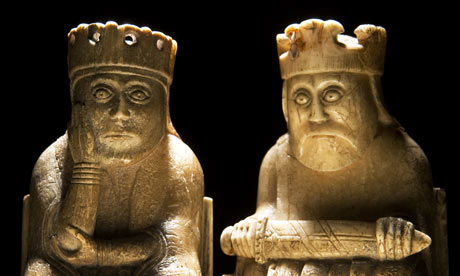
Continuing my punishing schedule of cultural experiences in Edinburgh, I head to the National Museum of Scotland to see the Lewis Chessmen. These charismatic little pieces are advertised all over the city and have piqued my interest. Created in the late twelfth or early thirteenth century from elaborately worked walrus ivory and whales’ teeth, they were discovered in 1831 on the Isle of Lewis and came to public notice through an article in The Scotsman.

I like their expressive faces – the bulging eyes and Dwayne Dibley teeth. They are very intricate, even down to the strands of hair and ornamental carvings in the chairs on which they sat. They seem to follow slightly different patterns which could possibly be due to different craftsmen making them from the same workshop, and some are clearly replacement pieces made later on – there are about 70 pieces all together.

The history of the pieces is shrouded in tales of murder, deception, folklore and legend. A local man, Malcolm MacLeod, said his cattle were grazing on Uig Bay sand dunes (which suggests they must be grassy sand dunes) when he discovered the chessmen. The minister of Lewis preached against idols (the island was strictly Protestant) so Malcolm was afraid of what he had found and took them to the minister in great trepidation. The story before that (or how they came to be in the sand dunes) is that a young boy washed up on shore with them in a bag (the exhibition includes a carved buckle which may have come from this bag) and met a man who promised he would lead him to safety, but instead hit him on the head with a rock and stole them.

Archeological problems are posed by these pieces because nothing else like them has been discovered. Walrus ivory is a popular material for work in Trondheim and Dublin, which makes sense because they were part of the Viking trading route: Greenland; Iceland; Trondheim; Shetland/ Orkney/ Lewis Islands; Isle of Man; Dublin. In the 790s the Vikings raided the Western Isles with a series of brutal attacks on coastal communities and monasteries. Tradition says there was a monastery at Mealasta but there is no evidence of this. Lewis was a Scandinavian island and didn’t revert to Scottish rule until 1266.

The characters are in the likeness of warders, kings, queens, pawns, knights and bishops. They were probably used at chess, tables (a predecessor of backgammon), and a game called hnefatafl. There is nothing like this from similar times in the otherwise progressive Islamic artistic tradition where craftsmen were reluctant to portray humans for religious reasons.

The kings each hold a sword in two hands as though in the act of drawing it – classic mythology says kings did this while listening to the words of Odin. The queens, resting their cheek on their hand, all look vaguely fed up. The bishops were a new feature on chessboards when these were made – this may reflect the importance and patronage of archbishops based in Trondheim (Trondheim was the seat of archbishops).

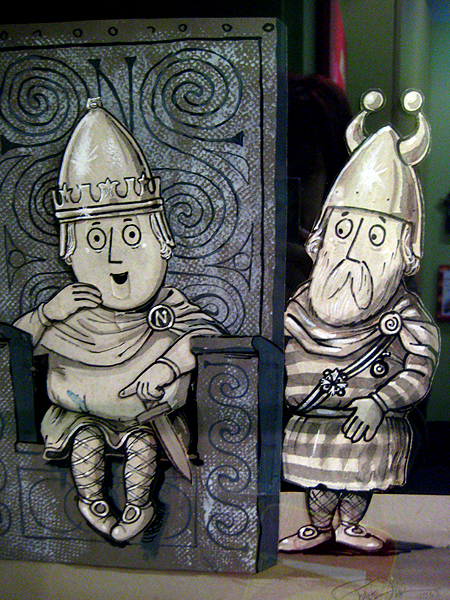
In true Wikipedia fashion, the exhibition provides information as to how and where these figures have been used in popular culture: they are the inspiration for J.K. Rowling’s wizard chess; the template for Rosemary Sutcliffe’s Chess-Dream in a Garden; and the motivation for Oliver Postgate’s Noggin the Nog. He writes that he noticed, “far from being warlike, it was clear that these were essentially kindly, non-belligerent characters, who were thoroughly dismayed by the prospect of contest.”


Friday, 8 October 2010

Britannia Rules the Waves

‘A yacht is a necessity and not a luxury for the Head of our British Commonwealth, between whose countries the sea is no barrier but the natural and indestructible highway.’
HRH Queen Elizabeth II

And yet the Royal Yacht Britannia was taken off the Queen for reasons unknown, but which probably have a lot to do with mealy-mouthed envy. But you can still look around it and admire the royal floating life, from the docks at Leith, so we did.

The admiral’s rooms (and when the Queen is on board she is piloted – or whatever you do with boats – by an admiral) aren’t so smart and are actually a wee bit shabby. The whole ship retains its 1950s chintzy décor – the Queen apparently wanted country-house comfort rather than formal grandeur and she rejected the original plans as too elaborate.
 
It is spotless, however and a junior yachtsman had to scrub the deck every day before 8am. Tasks were all carried out in silence so as not to disturb the royal family, and the crew tried to stay out of sight so that the royal family wouldn’t have to constantly acknowledge their salutes.


In some ways the yacht is actually impractical and the master of modification. ‘Modesty balconies’ prevent skirts blowing up in the wind when the royal family were posing for photographs; high-positioned windows avoid any accidental glimpses into royal apartments; the Rolls Royce or Landrover was housed in a garage – as it was difficult to manoeuvre the vehicle into this space, replacements were ordered for the destination and the erstwhile garage was used for beer storage.

The Queen’s favourite room was apparently the sun lounge with its picture windows, drinks cabinet and rum tub, where she took morning and afternoon tea (not actually in the rum tub). The Queen and the Duke had separate bedrooms (other rooms could be used by other members of the royal family, but these were reserved specifically for them) and all but one room had single beds. Prince Charles had a double bed brought on board for his honeymoon – who says he wasn’t romantic?


There are jolly japes in the wardroom antechamber where the officers met for drinks before dinner. They played tennis with a stuffed toy (meant to be a wombat but looking nothing like one) and took it in turns to hide a wooden monkey around the room. At dinner itself the youngest member had to entertain the others with an amusing anecdote, and the gin pennant indicated who was buying drinks in the officer’s bar.

In the state dining room it took three hours to set the table; there were placings for 56 (guests included Mandela, Ghandi, Churchill, Clinton, Reagan and Thatcher) and menus were given to guests (seated on Hepplewhite chairs) to take away as souvenirs. The walls are lined with gifts from locations visited – The Galapagos, Easter and Pitcairn Islands; Bangkok; Papua New Guinea; Fiji; Australia; New Zealand; Trinidad – and the room could be converted to a cinema or a dance floor.

The Queen did a lot of work on board and she had a sitting room in which to do it. The Duke had a study which is absolutely symmetrical and connected by telephone. Every detail is considered – the centre of the mirror in The Queen’s sitting room is exactly at her eye level.

Chintz sofas and deep armchairs decorate the drawing room used for relaxation and reception, which could accommodate 250 guests, and a piano on which Noel Coward played is bolted to the floor to stop it pitching in high ‘C’s (Ha!). The Queen originally wanted an open coal fire in here but that would have necessitated a sailor to be on permanent stand-by with a fire bucket, so that idea was abandoned in favour of a more prosaic (and practical) electric fire. Flowers were always displayed in this room – they were either given to royals by admirers on their voyages, or they came from the gardens of Windsor Castle and were stored in a cool room – one of the stewards had to double as the royal flower arranger.

Although the chief petty officers were allowed spirits as well as beer, it was an invitation to drink at the petty officer’s mess that was most highly sought-after. Privacy was non-existent and the sleeping quarters were very cramped, but at least it was better than the hammocks (which had been used until 1970).

Some of the men were trained as divers and dived beneath the boat every day, and into every berth before they entered, to check for terrorist devices. The Royal Marines Band played them ashore – they had to know everything from classical to ceilidh and the national anthem of every country they visited, and they played the Beat Retreat after state banquets. The band rehearsed daily (as far from the royal apartments as possible) and had up to 26 different uniforms for band special occasions – all neatly stored in their tiny lockers.

There was exercise and competition to be had – a fiercely-contested Golden Welly was presented to the winning team of six runners who ran four times round the upper deck with the other team in pursuit. A mail office and a shop onboard catered for all incidentals (including sweets which the royal children were allowed to buy, and where fudge is still made and sold).


Britannia could be converted into a hospital ship in 24hours, although she was never used as such, and the sick bay doesn’t look particularly appealing. The laundry, however, was very busy, reaching temperatures of 45°C. Uniforms were changed up to six times a day, and 600 shirts were washed an ironed daily – to preserve decorum the royal family had their laundry done on different days from the crew.

You can take tea in the tearooms, which we did (Britannia lemon drizzle cake and a pot of Darjeeling), then continued our tour with a glimpse of the gleaming engine room. Details include 12,000hp; a team of 80 engineers; a speed of 21 nautical miles and hour; the ability to recycle steam to water and back; and a back-up diesel generator known as chitty chitty bang bang.


The Queen herself chose the blue paint (rather than black) and approved the gold line painted in 24 carat gold leaf paint. She enjoyed visiting the Western Isles and loves sailing generally, as does her husband and children. Prince Philip raced Tui at Cowes, and Charles and Anne learned to sail on the 12 metre class yacht, Bloodhound.


‘Sailing on a sunny day is the nearest thing to heaven anyone will ever get on this earth.’
Princess Anne

Monday, 4 October 2010

Show me the money!

A random aside: The Royal Bank of Scotland may be part of the same financial group as Natwest, but it has no access to their accounts. I know that now after having to make a special trip to the Natwest on George Street to withdraw more money. I am handed a motley collection of twenty pound notes all from different banks in a plethora of purples.


When gangsters flip open briefcases to reveal wads of cash - millions of notes of the same denomination - you will note they never use Scottish pounds; it just wouldn't look right.


Friday, 1 October 2010

Festival Fireworks

As a finale for the festival, fireworks explode over Edinburgh Castle. I try to take photographs, which is very tricky without a tripod to hold the camera steady and not knowing exactly when they will ignite the sky with brilliance - it is pitch black a fraction of a second beforehand. I like the colours and the flashes of light.
 
I also like the way they trail off leaving streaks of flaming cordite against the night sky. We have been drinking whisky as part of our tourist activities, so perhaps I am just seeing stars anyway. Here are some examples of my work. Any tips on how to photograph fireworks would be greatly appreciated.


Tuesday, 28 September 2010

My newest favourite thing: Whisky

Okay, so if we’re honest – and why wouldn’t we be – whisky isn’t exactly a new favourite thing for me. Luckily it wasn’t one of those drinks of which I partook too freely when too young and can now no longer stomach (that would be tequila) so I can still appreciate a fine dram along with the best of them.
 
So we met up with our parents, my cousin and his brother and friend to explore the Scotch Whisky Experience. A little ride in an open barrel takes us through the procedure of making whisky – Dad reckons that with only three ingredients (barley, water and yeast), it should be easy enough to make. As he immediately forgets one of the three (yeast) however, I don’t much fancy his chances. It’s cute and an actor is filmed pretending to be a guiding ghost – there are a lot of those in this city apparently – but you don’t learn anything you didn’t already know (or don’t immediately forget).

We sit in a room with colour-coded sniff pots to detect which flavours we like (smoky for me) from the four main whisky producing regions of Scotland: Lowlands, Highlands, Speyside and Islay. One of them (Speyside) is alternatively described as floral (me) or soap (Cousin Rachael). We also isolate the aromas cloves and vanilla pretty quickly and then we get to sip the nectar. We choose which of the four regions we wish to taste and we get to keep the tasting glass at the end of the tour (we even manage to transport ours all the way back to New Zealand – heartily scrubbed of course).

The Diageo Claive Vidiz Scotch Whisky collection, into which we are ushered, is the largest in the world and housed behind glass. This is the highlight of the tour for many – unable to keep their mouths closed, they may be hoping to catch some of the Angel’s share: the two percent of each bottle that evaporates.

Interestingly there are blends as well as single malts in this collection. Our guide tells us that there is incredible art in blends – the whisky blender has to use exactly the same quantities of each whisky to replicate the taste that the Bells and Teachers fans quaff in their thousands. We grudgingly admit that they are probably very talented, but we would all rather stick to the malts, thank you very much.
 

We have tasting trays of the four main types of whisky brought to us and a map on the wall highlights what we’re drinking. I’ve read review comments that this tour is expensive and a bit cheesy, which it is, but we enjoyed it. For a mixed group with a variety of levels of knowledge about whisky it was fun and a good way to spend an hour or so. I can imagine it would be a good work’s do or an ice-breaker for a hen night or collection of folk who don’t know each other very well (yet).

Various members of our group drift away and a little hard core faction continue our own drinking experience in some Royal Mile pubs. The Scotch Whisky Experience is right up the top by the castle, so it really is all downhill from here!