Wednesday, 17 October 2012

The City of the People of the World: Museum of London (Part Three)

A timeline of events and quotes contains photographs and costumes – dresses, Pearly King and Queen outfits – and a picture of Bolton winning the FA Cup Final at Wembley.
“It is not a pleasant place; it is not agreeable or cheerful or easy or exempt from reproach. It is only magnificent.” Henry James, 1869
“If I stand for a moment under the pavement in the heart of London… the great avenues of civilization meet here and strike this way and that. I am in the heart of life.” Virginia Woolf from The Waves (1931)
Meanwhile, the dates: Jack the Ripper stalks the city (1888); Tower Bridge is completed (1894); New Zealand grants women the vote (1894); Harrod’s store installs London’s first escalator (1898) – nervous shoppers are offered smelling salts – Queen Victoria dies (1901); The Ritz opens (1906); London hosts its first Olympic Games (1908); World War I begins (1914); Votes for Women (1918).

Selfridge's lift - sheer hedonism
Carlo Gatti’s Italian ice cream house combined the taste of a treat with the face of immigration. Selfridge’s bronze lift is on display – introduced in 1928 and operated by a uniformed young woman. Displays such as this, and images of the Savoy, highlight the disparity of rich and poor. This was the era of prostitution and suicide. Women took work as baby farmers, laundry facilitators, and matchbox assemblers. Men were brickmakers, or dockers, and unemployment benefit was introduced in 1911. Water pumps were made available and public baths were run by the Council as part of the war against disease, smell, dirt and lice.

Banners from the Salvation Army and Barnardo’s indicate that some attempts were made to relieve the poor. Charles Booth’s Map of Poverty (1889-1891) is on display. It divides London street-by-street into socio-economic areas defined as ‘semi-criminal’, ‘very poor’, ‘poor’, ‘mixed’, ‘fairly comfortable’, ‘middle class’ and ‘upper middle class’.


An array of his volunteers walked the streets taking notes for the survey to enable the categories to be imposed. A rough working-class area was defined as one with open doors, broken windows, prostitutes, thieves, and ‘a row always going on between warlike mothers’. Flowerpots, lace curtains, scrubbed doorsteps and hanging birdcages were the ‘hallmarks of a respectable neighbourhood’.

Displays include the Illustrated Police News with a story on the Whitechapel Murders, Suffragette posters and banners, WWII propaganda posters, travelling trunks and gas masks, bomb fragments, ration books, and photos of the blitz – bomb shelters made out of tube stations, and buses among the rubble. St Paul’s Cathedral was a symbol of hope during the war and remains the heart of London for some. A film of Jewish immigrants explains that they worked as domestic servants because ‘compared with instant death, it was a glorious opportunity’.

There is a mock-up of the Lyon’s tea rooms and a couple of gorgeous paintings by Christopher Richard Wynne Nevinson – Amongst the Nerves of the World (1930), and London, Winter (1928). Even street furniture was changing with the introduction of the K2 telephone kiosk: Giles Gilbert Scott won the GPO competition to design one in 1926 and, although he wanted them to be green and silver, they had to be red to stand out more and constitute less of a hazard. Traffic lights were introduced to assist motorists, and a model of the underground/overground reveals the complexities of that particular endeavour.

Amongs the Nerves of the World by Christopher Richard Wynne Nevinson
Museum items tell stories: the toy coach souvenir of the Coronation; the fashion over the ages of winklepickers, kitten heels, platform shoes and Dr Marten’s boots; the freedom and statement implied in a Vespa; the Mary Quant dresses of Swinging London; and the end of National Service leading to fears of juvenile delinquency.

A trolley from Heathrow airport indicates global Londoners, and they do come from everywhere: 250 languages are spoken in London and 20% of Londoners are of ethnic minority. Protest placards, silver jubilee memorabilia and psychedelic clothing embrace this diversity – you have a ‘punk’ outfit of mohair jumper and bondage trousers beside a ‘Vexed generation’ hijab to demonstrate that this is ‘the city of the people of the world’.

Tuesday, 16 October 2012

Rising from the Ashes: Museum of London (Part Two)

After the Great Fire, all buildings had to be made of brick or stone. Bridges built at Westminster and Blackfriars spread growth south of the river. The docks were established in 1800. Regent Street and Trafalgar Square added to the grandeur of the city. A side exhibit has the pleasure gardens revealing people parading in masks, bonnets, flamboyant costumes and hats – such as the design of a ship or antlers. The gardens had outdoor lighting, food and drink, tree-lined walks and often an orchestra. Many cities copied London and called their gardens Vauxhall, after the most famous gardens of all.


With fans, pistols, jewellery and a wonderful display of shoes, the Museum stresses that London’s manufacturing industries were thriving; it had more shops than any other European city (hence Napoleon’s ‘nation of shopkeepers’ jibe) and needed skilled immigrants. Workers in the same trades in England, Scotland, Wales, Ireland and the continent formed associations and unions for better pay and conditions. In 1776 the wages of workmen in London were double those of their counterparts in Edinburgh.

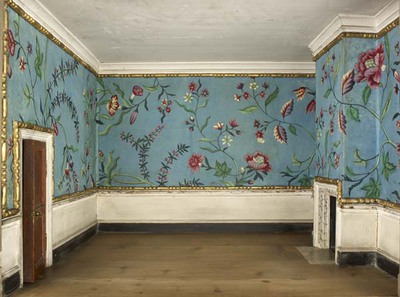
Exhibits from this era include Anne Fanshawe’s dress (the embroidered hops, barley, anchors and bales represent Anne’s father’s trade as a brewer and a Merchant of the City of London), musical clocks, fine glassware, a dentist’s surgery (complete with tools, medicines, spectacles and teeth), a tailor’s workshop, the Blackett dolls’ house (with hand-painted wallpaper and a spit-roasting mechanism in the kitchen), and a wax diorama by Samuel Percy of Turk’s Coffee House in the Strand where folk were meeting to discuss ideas.

Anne Fanshawe's dress
The Blackett's dolls' house
Wallpaper detail
There’s an admission form from the Foundling Hospital where mothers left children they couldn’t afford to raise – a piece of cloth was cut in two; one half given to the mother; the other left with the child in the hope of being reclaimed (very few ever were). There is also a door from Newgate Prison and the walls of a Wellclose prison cell, carved with pictures of houses and churches, and a poem from 1759 which declares, ‘The cup is empty/ To Our sorrow/ But hope it will/ Be full tomorrow.’ Positivity in adversity!

Among items from this ‘new city’ are reminders of its foundations; portraits of Omai and Benelong; a Royal Standard barge banner; a pair of paintings by Henry Nelson O’Neal – Eastward Ho! (a colourful depiction of cheerful, smiling soldiers, kissing wives and babies as they board a ship in Gravesend leaving to fight in the ‘Indian Mutiny’, or first Indian War of Independence), and the companion work, Home Again as they return, many wounded.

Eastward Ho! by Henry Nelson O'Neal

Home Again by Henry Nelson O'Neal
A work from the Community Link course at Barnet College entitled Goods from the British Empire is a cotton tablecloth bearing china cups containing silk, sugar and coffee (the building was originally a warehouse for such goods), representing both the positive exploratory aspects of Empire and the negative associations such as slavery.

You can stroll along the reconstructed Victorian Walk with a pawn broker’s, pub, bank, pharmacy, and tailor’s. The gentleman’s outfitters contain cloth, tweed, silks, suits, collars, coats, trousers and top-hats, with the paraphernalia to make them – scissors, tape measures, rulers, fashion plates, dressmaker’s dummies, buttons, and twists of material and thread. There is also a milliner’s, a barber’s, a tobacconist, a stationer’s (with cards, post cards and paper dolls), a grocer’s (with biscuit boxes, scales for measuring, and glass and earthenware jars), and a toyshop (with trains, dolls, puzzles, toy soldiers, marbles, and an ark with all the animals).

The Victorian Walk, looking a lot like Diagon Alley
There’s a baker’s, a confectioner’s, a tea and coffee warehouse, a glass showroom (with stunning glasses, decanters and mosaics), and a watch-maker’s. I love all their writing desks and sets of drawers. The street is furnished with lampposts, a penny-farthing, an old urinal, a cart/wagon, a piano organ, and beer bottle boxes and barrels.

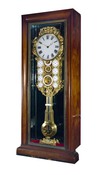
I liked the Eight Day Regulator Clock from 1860, exhibited at the International Exhibition of 1862. It shows the time in GMT and has 24-hour dials for Sydney, Madras, New York, Canton, Calcutta, Paris, St Petersburg and Constantinople.

Sunday, 14 October 2012

Great Walls and Fire! Museum of London (Part One)

The Museum of London had been recommended to me by my super-in-law, so I took a tube there one day while in the city.

As the Olympics have been held in London three times, and everyone has caught the fever, there was an exhibition in the foyer on the subject. This one hopes to be the most sustainable games to date – for example, the top ring of the Olympic stadium is made from surplus gas pipes.

I skipped through exhibitions about London before London and Roman London (not literally skipped, you understand, that would be weird). The city was burned in AD60 by Boudicca and was then rebuilt and expanded. By AD100 it replaced Colchester as the capital of Britannia. Glass cases contained bones and pottery, models of amphitheatres, stone sculpture tools, coins and horseshoes, but I was being selective, and pressed on.

I was intrigued by the remaining part of the London Wall, however. The first fort was built in AD120 for the soldiers in Londinium. There were remaining mosaics from AD 200 when these walls were strengthened and incorporated into a city wall to protect London. In AD410 the Romans abandoned London; the city declined as it was empty for nearly 400 years and the wall began to collapse.


The Saxons moved in (in AD886), repaired the walls, and added towers for extra protection against Viking attack. They built houses right up against the wall, but they were destroyed in the Great Fire of London (1666). In the nineteenth century, warehouses and shops again abutted the wall. World War II bombing caused extensive damage to both the wall and the buildings, and when archaeologists dug up the ruins, they found sections of the original wall, one of which is displayed here, looking secretive in the summer sunshine. I love how the stones are steeped in history.

Real children were playing in a reconstructed house in the Medieval Britain section. Here the displays feature weapons, keys, chain mail, pottery, preserved doors and altarpieces, rings, paintings, books, manuscripts (bibles and primers from the 1400s) and illustrated letters. There’s a collection of London Delftware pottery, and the Cheapside Hoard, a treasure of Elizabethan and Jacobean jewels discovered in 1912 under the cellar floor of a seventeenth century house in Cheapside.

Again, I raced through this bit, but was morbidly interested by the display on the Plague, Black Death and Pestilence caused by the stink and filth of the city. The ‘War Plague and Fire’ section also interested me as it has a model of the Rose Theatre from 1587 and the three copper plates of the 1559 Copper Plate Map – fifteen plates made up a map of London, and only these three survive, although there is no contemporary printed map.


Oliver Cromwell’s death mask is also on display here. He is claimed to have said, in a 1656 interview, “I am as much for a government by consent as any man; but where shall we find that consent?”

London was teeming – furniture, models of 1660s timber houses, and pictures of the Great Fire illustrate this state. Donald Lupton wrote in London and the Countrey (1632), “London is the great beehive of Christendom... she swarms with people of all ages, natures, sexes, callings... she seems to be a glutton, for she desires always to be full.”

One-fifth of the population died in 1665 due to the Great Plague. In an effort to ward it off, people wore bunches of herbs; lavender, cloves, and pommo d’ambre (a mixture of whale vomit, animal scents and flowers – thought to be efficacious). And then came the Great Fire.


London booksellers stored all their books and papers in the crypt of St Paul’s Cathedral for safety, but it was covered in wooden scaffolding which caught fire, the lead in the roof melted, the cathedral burned down, and everything was destroyed. Fortunately London Bridge had a gap between shops in it (from a previous fire), which prevented the fire from spreading to Southwark, and causing further loss of life.

The gaolers took pity on the debtors in prison at Newgate, and released them to fend for themselves. People pulled down houses and Charles II himself helped with throwing water on the conflagration which raged for five days, destroying 13,000 homes – the King arranged for bread to be delivered each day to feed the many homeless.

Friday, 12 October 2012

Friday Five: Bond Themes

The new James Bond theme is sung by Adele. Now, I've got nothing against Adele. I think she has a great voice, although I don't really like her songs. Teeange angst used to embarrass me even when I was a teenager suffering from it myself. Now it amuses and annoys me in equal measure.

I hate those earnest unrequited love songs (usually sung by women) about how you're yearning forever and he should be so sorry because he doesn't know what he's missing. Yes, he does. 'I hate to turn up out of the blue uninvited'? Well, don't, then; he doesn't want you there. 'Without me, his world would go on turning.' Yes, it would. And it does. Stop making a fool of yourself. Get angry; do something about it; and for God's sake, stop whining!

I digress.

The James Bond Theme is not something to be taken lightly. It has a rich pedigree. This is average. It's not as bad as A-ha (shudder) but I don't think it rates among the greats. It has the necessary swooping orchestration and the stand-out powerful voice, but the tempo is constant (and dull), the lyrics are weak and the sex-appeal is entirely absent.

I'm not including the great James Bond Theme from Dr No (1962) in this list, as it is purely about the songs. Nor am I including Another Way to Die from Quantum of Solace (2008) because, although it's a fine song, I don't think it fits as a James Bond theme tune. There are several honourable mentions, and Duran Duran's A View to a Kill would have been sixth with their 80s twist on the classic form, but I set these rules, so I should stick to them.

The 5 Best James Bond Theme Tunes:
  1. Nobody Does It Better by Carly Simon from The Spy Who Loved Me (1977). Indeed. Quintessential Bond. So good.
  2. Goldfinger by Dame Shirley Bassey from Goldfinger (1964) - Any of DSB's tracks could be in here (Moonraker and Diamonds are Forever) but this has to be the best. That voice!
  3. Live and Let Die by Paul McCartney and Wings from Live and Let Die (1973) - Fabulous tension and drama in this song not to mention groovy backing vocals.
  4. Thunderball by Tom Jones from Thunderball (1965) - yet another great composition by John Barry, who seems to be pretty good at this writing sterling theme tunes business.
  5. The World is Not Enough by Garbage from The World is Not Enough (1999) - just to prove that there has been a good title track since the seventies, although I'm still waiting for one in this century...

Friday, 5 October 2012

Friday Five: Beetroot Brilliance

I read today that Australians eat more beetroot per capita than any other nation. I have a friend who describes it as the devil’s vegetable (I disagree- that is surely turnip) and another who uses it to make her chocolate cakes moist – no, I don’t know how. I have also heard tell that you can slice it finely and sautee it as a crisp. Personally, I would rather just buy crisps.

And I’ve never been a huge fan of the pickled variety. I do like pickled things – eggs; onions; gherkins; herrings; 40-something year olds in the pub on their birthday – but I think it’s a shame to do that to a vegetable with such inherent vibrant personality.

Aussies (and Kiwis) put it in their hamburgers to make them quintessentially antipodean apparently (and they also often add an egg, which is irrelevant to this post). This seems slightly odd as beetroot is originally a southern European vegetable and is now most commonly found in North America, Central America and Britain.

It has several health-giving properties and is a rich source of anti-oxidants, nutrients and vitamins. Obviously the colour is an issue – it will stain everything you wear or touch it with. Disposable gloves are a good idea, but opening the door wearing red-stained surgical gloves is not, unless you want to get rid of cold-callers of course. I find it also pays to remember you’ve eaten it either you will give yourself one hell of a health scare when you next go to the toilet.

5 Top Ways to Serve Beetroot:
  1. Roast it with other winter vegetables with a touch of olive oil and rock salt
  2. Turn it into borscht – I prefer it hot with crusty buttered rolls
  3. Shredded in a salad, with carrot, fennel, walnuts and feta; colourful and tasty
  4. Hummus – add it to the chick peas, olive oil, garlic, lemon, cumin and tahini for a spectacular dip or accompaniment
  5. Add it horseradish and ginger for a perfect pink addition to baked salmon

Friday, 28 September 2012

Friday Five: Rent Requirements


We are looking for a place to rent. There are a lot of possibilities, so we have to narrow them down. At the same time it will probably be a short-term lease so we're not looking to stay there forever.

The location is important. I would like somewhere with trees and close proximity to water. It is also paramount that I be able to walk to the shops/cafes and there is a bit of a village feel, rather than a soulless suburb in a cultural wasteland.

But let's focus solely on the house - and preferrably it is a detatched house rather than an appartment or a terrace. Although, of course, we could mostly live anywhere if necessary, there are some things that are very high on the wish list, and yes, I realise this is exactly what we own.

5 Things I Want in a House:
  1. Three bedrooms - our room, guest room and office (preferrably one with an ensuite)
  2. Open plan living areas - I'm happy to be in the kitchen cooking if I can still mingle with the conversation in the front room; good flow to the outdoor area also works for entertaining
  3. A garage or large lockable shed - I don't care about the car, but we need somewhere safe and dry to put the bikes (and the beer)
  4. A bath - it's not a bathroom if it hasn't got a bath
  5. Must take pets - our cat goes where we go; that really is non-negotiable

Monday, 24 September 2012

Join the Rebellion!

The Rebellion Beer Company have an open day on the first Thursday of the month – for £10 you get five pints and a talk/tour of the brewery. My Dad and I were some of the first there, but eventually there were a few hundred people present; when it rained we all huddled among the brewing equipment to drink our beer without getting wet.

I began with a Blonde (4.3%); ‘using only pale and lager malts, giving the beer a very light golden colour’, it is a fair and refreshing ale, smelling of hay and tasting of summer meadows. I moved on to Flagship (4.2%), a stimulating amber number with strong notes of toasted hazlenuts and a smooth mouthfeel that I considered to be very sessionable. So did many others, apparently, as it was soon sold out. The mild also sold out early on, so I didn’t get to try it on this occasion.

The IPA (3.7%) was so much better than one I had previously had at a pub (I won’t mention the name as I think it may just have been a one-off). It was nutty and tasty with complex flavours. This and the Mutiny were my favourite. The Mutiny is more malty and darker in colour, but the hops add a nice balance and it’s stronger at 4.5%.

(Admission – I was drinking while note-taking through this talk, so some of this may be not entirely factually correct – i.e. made up. Feel free to send in amendments.)

The tour was taken by Mark Gloyens, one of the brewery founders, and, although we had had several beers by now, it was still entertaining and informative. In the 1970s, Britain went from having 7,000 breweries to 200. The big breweries took over (80% were owned by the conglomerates) and it was all about the pubs. In 1989 Margaret Thatcher’s government introduced the beer orders, restricting the number of tied pubs that could be owned by large brewery groups in the UK to 2,000, and required large brewer landlords to allow a guest ale to be sourced by tenants from someone other than their landlord. (Shock – she actually did something decent!) There are now around 400 microbreweries in the country.

Rebellion makes 70,000 pints a week – they use this figure because people can picture it better than 200-300 brewers’ barrels. Next year will be their 20th in business, so a little history...

Two boys from Sir William Borlase’s Grammar School used to perk up to the smell of brewing from local Marlow brewery, Wethered’s (on Wednesday afternoons as I recall – I used to make the detour on my way home from school). The earliest record of a brewer on the site is from Thomas Wethered’s brewing of 1750. However, due to some of the reasons stated above, Wethered’s closed down in 1987, and the town (and local drinkers) suffered. For example, The Hand and Flowers (well-known haunt to all Borlase pupils) had to get their beer from Cheltenham (more than 100km distant).

So one day as the ex-Borlase boys were having a drink after a game of cricket, they promised to re-start Marlow’s brewing industry. 1993 was not a good year for the brewing industry, and the banks wouldn’t give them a £2,000 unsecured loan, so Mark sold his house and used the capital to start the business. He explained that they could double as a brewery museum, since most of their equipment comes from other local breweries which have closed in the last 30 years. Their test-batch was made in second-hand equipment from Courage’s brewhouse in Reading.

They started employing three people and making 5,000 pints a week. Now they produce 70,000 and employ 50 people. As there are about 400 people in attendance at the tour, it’s fair to say they are popular and successful. They sell 20% of their beer in the shop, 20% in bottles, and 60% in pubs. Their recent growth is 15% (through word of mouth, mainly), and they are now at 110% capacity and don’t want to grow any more.

Hence they have made a concerted effort to cut down on ‘exports’, which they consider to be anything outside of Buckinghamshire, Berkshire and Oxfordshire. This is because the closer to a brewery it is, the better the cask-conditioned real ale (made with yeast and sugar) will be. To this end, they have stopped selling to supermarkets (except Waitrose) by pushing the price up until the supermarkets stopped buying it.

Ideally they don’t want to sell Rebellion further than a distance of 30 miles from the brewery. They maintain that if you go to Yorkshire there will be a microbrewery within 20 miles selling beer as good as (or possibly even better than) theirs, and they would rather you drink that and keep the local microbrewing industry alive.

They paid the same duty rate as big breweries, which almost caused them to close ten years ago, and then Gordon Brown as Chancellor introduced progressive beer duty relief for small breweries in 2002. The measure halves duty tax for brewers making less than 50,000 litres a week, and tapers duty up to 300,000 litres. Rebellion now pays 60% of the duty, and all their profit comes from duty saved.

Twenty years ago the boys took a strain of yeast from another brewery (RHC Brewery in North Somerset, I think) and kept it alive. It has naturally mutated over the past two decades and has become specifically Rebellion Yeast, which has been put in the DNA bank so that it will remain the same and result in consistency of brewing.

At Rebellion the water is ‘Burtonised’ – a process by which sulphate is added (often in the form of gypsum) to bring out the flavour of the hops. Many minerals have been removed by the chalky Chiltern water and need to be replaced. (Burton-on-Trent brewed what was deemed perfect pale ale in the early eighteenth century, and people have attempted to recreate that water ever since.) The calcium reduces the pH which should be about 4 for beer (wine is 3); if it is too high the beer will be soapy, so sulphate is added. The final fermentation of the beer is completed at between 10-12°, and then an opened cask of beer needs to be drunk in two days – happy to help!