Monday, 29 April 2013

Finishing School

School for Wives

The Playhouse, Canberra Theatre Centre
October 2012

I had been very impressed with Bell Shakespeare’s Macbeth, so thought it would be okay to take Him Outdoors along to their production of School for Wives, although Molière can be a tough sell. We were both tired and hungover so it would have to be a top-notch production to keep us entertained, and fortunately it was.

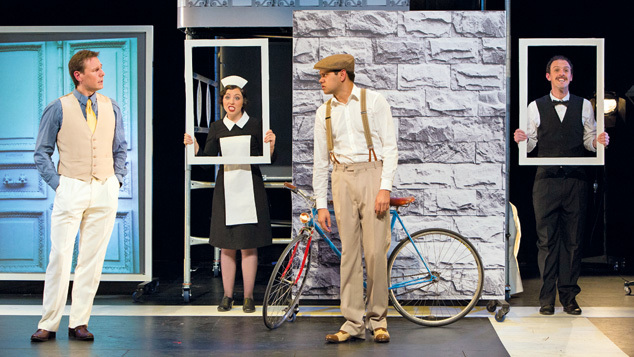
The language has been translated and modernised with an Australian flavour (huge plaudits to Justin Fleming), but the rhyming scheme has been kept, which adds an extra self-aware dimension. The entire production is self-aware, or post-modern if you will, using limited props, and wheeling in backdrops to create scenes in conjunction with seriously intelligent lighting (set built by Malthouse Theatre; lighting designer, Niklas Pajanti).

It begins with two characters chugging along in a motor car, providing all their own ‘special effects’. This sets the tone for the rest of the show, which is fast, funny, wry and sardonic. It’s entertainment, but it’s not light.


The story is preposterous, as you would expect from a seventeenth-century comedy featuring disguise and mistaken identity, but the audience is invited to mock the plot while caring for the characters – a difficult feat accomplished superbly by director Lee Lewis. She and the designer, Marg Horwell, have explored every detail in the 1920’s Parisian setting, from fabulous costumes (Costume supervisor, Taryn Van Kan) to mannerisms of loveable rogues and caddish fops – the mixture of references gels seamlessly to create a timeless montage.

The banter is brilliant once your ears become accustomed to the rhythm (it took about five minutes of intense concentration, more than adequately rewarded with the ability to anticipate gag placement), and the physical comedy conversely elevates the performance to a higher plane. It would be wrong to use the term slapstick, as that may suggest a base art-form. In several sequences the puppet-like movements, particularly from the taciturn servants Alan (Andrew Johnston) and Georgette (Alexandra Aldrich), are almost balletic (Movement director, Penny Baron). They have a touch of Manuel and Polly meet Peirrot and Columbine.

All the acting is faultless and, although the main characters could be one-dimensional, all are given depth. Harriet Dyer plays Agnes, the ingénue, with such candour that she is way more than the drippy but pretty simpleton this role would usually imply. Her purity and passion collide convincingly, and she offers hope for the future of love, marriage and (perhaps not in the original but certainly in this adaptation) equality.


Her love interest, Horace (Meyne Wyatt) is a loveable fool with a ready laugh and evasive wit, cleverly avoiding a patronising Aborigine stereotype with a layered performance. And although we should dislike the villain of the piece, Arnolde, who attempts to manipulate the suggestible Agnes into matrimony, John Adam imbues him with enough integrity of action, not to mention audience rapport and undeniable charm, that he is a firm favourite. Even the role of friend, Chris, who is mainly present to provide exposition and explanation, is handled with aplomb by Damien Richardson.

Mention must also be made of the music (Composer, Kelly Ryan), which underpins and highlights each action, reaching a crescendo in the show-stopping bows. I’m not entirely sure what my expectations were, but they were well and truly exceeded.

Friday, 26 April 2013

Friday Five: Figurative Flowers

5 Emblematic Blooms:

Remembrance poppies at the Australian War Memorial

  1. Poppy – The symbol of sleep, peace and death. Sleep because of the opium extracted from them and death because of their blood-red colour. Memorable images include the magical poppy field in L. Frank Baum’s The Wonderful Wizard of Oz in which Dorothy are chums are almost lulled to eternal sleep, and the blood red blooms on Flanders’ fields that recall more than a million sacrifices. Lest we forget.
  2. Red Rose – UK Labour Party; House of Lancaster; England Rugby; socialism; romantic love – combined with the white rose of York to become the Tudor Rose and national flower of England. With its combination of powerful scent, dramatic beauty and viscous thorns, it is beloved of playwrights and poets form Shakespeare and Robert Burns to Gertrude Stein and Poison.
  3. Daffodil – Wales and the Cancer Society. As daffodils are part of the narcissus family, they also represent vanity. Appearing at spring in the Northern hemisphere, the yellow daffodil is associated with new beginnings and particularly Easter (the German word for daffodil is ‘Osterglocke’, meaning Easter bell). Thanks to William Wordsworth’s (in)famous poem, it also represents The Lake District for many.
  4. Sunflower – Honesty; Happiness; Faith; Adoration; Vegan Society; Cancer Support – individually they are remarkable and together they are glorious. From the fields of gold the cyclists ride past in the Tour de France to Van Gogh’s crazy brilliant blooms or Ai Weiwei’s Tate/Unliever-commissioned sculpture of ten tonnes of porcelain seed husks, they have stunning visual impact. It was thought that the sunflower (girasol) turns its head to follow the sun until sixteenth-century romance-busting botanist John Gerard pointed out this was only true of the immature buds but the adult plants grew out of it. Despite that, this is still a beautiful flower quote from the film Calendar Girls:
    "The flowers of Yorkshire are like the women of Yorkshire. Every stage of their growth has its own beauty, but the last phase is always the most glorious. Then very quickly they all go to seed. Which makes it ironic my favourite flower isn't even indigenous to the British Isles, let alone Yorkshire. I don't think there's anything on this planet that more trumpets life that the sunflower. For me that's because of the reason behind its name. Not because it looks like the sun but because it follows the sun. During the course of the day, the head tracks the journey of the sun across the sky. A satellite dish for sunshine. Wherever light is, no matter how weak, these flowers will find it. And that's such an admirable thing. And such a lesson in life."
  5. Forget-me-Not – True love; Faithfulness; Remembrance; Freemasonry; Alzheimer’s Association – Henry IV adopted the flower as a symbol of his exile in 1398. It grows madly in English spring gardens and woodlands, particularly by riverbanks as it prefers moist habitats and can tolerate partial sun and shade. I love the delicate little blooms and the subtle fragrance which develops in the evenings although they have little scent during the day, and I incorporated it into my bridal bouquet.

Thursday, 25 April 2013

My Newest Favourite Thing: Letters

I’ve already told a bit of an untruth here. My love of letters isn’t a new thing; I’ve always been in their thrall. Although I’ve never liked the phone, I could always write letters to friends I saw all day at school, and often got into trouble for tearing pages out of my rough book to write notes in class to people who sat at the desk in front of me. I even once had a clandestine correspondence with someone a couple of years above me who sat at the desk in my form room on Mondays for Latin while I was elsewhere – probably in one of the labs studying chemistry. We never wrote much of any interest but it was the highlight of my day. Did I mention it was Monday? And I had chemistry?

I was reminded of my love of letters by a couple of recent events. Yesterday I was setting off for a run when the postman came round on his moped. He passed me with a smile, calling out, ‘You’re in luck; there’s nothing for you today.” I was disappointed and confused – how could a lack of letters possibly mean I was in luck? And then I remembered that a friend told me when she went away for a month, she returned home to a stack of mail – all of it bills and ‘friendly’ reminders from the bank. If people aren’t getting news from friends and family in their letterbox, no wonder they are not thrilled by the prospect of the postman ringing, no matter how many times.

My mum and I write to each other quite a lot. I really enjoy seeing her handwriting on the envelope and knowing I will receive interesting articles clipped from newspapers, and little nuggets of information from home, from which birds have been spotted in the garden, to what they (my parents, not the birds) went to see at the pictures. Mum, in turn, tells me that she feels closer to me when she receives my letters from abroad. And that has to be a good thing. I am, after all, as geographically far from her as I can be on this planet, so it is reassuring to think she can put her feet up with a cup of tea and feel as though I am near.

When I was a child my aunt and cousin were often in various exciting places around the world, from Egypt and Saudi Arabia to Portugal, California and Kwajalein. I absolutely loved receiving letters from them. It wasn’t just the colourful stamps or the distinctive blue aero-paper, but the contact I was keeping with people close to my heart. When I left home and lived in Paris I sent letters home regularly and poured my heart and soul into some of those envelopes. I hung around the mailbox in hopes of collecting reciprocal communications, and I have kept them all – I have shoeboxes full of old letters.

I don’t know if anyone has bothered to keep my letters – I was never conceited enough to keep copies, but I’m sure I could trace my development as a writer and indeed a human being through them. Recently I met A.J. (Sandy) Mackinnon at a readers and writers festival in the Snowy Mountains. He is a published author of travel anecdotes and a thoroughly charming chap. He said that he had never kept a diary of his travels; rather he always sent letters to people describing his exploits. He explained that by writing a letter, you are already interpreting events to an intended audience and moulding your words and experiences into a story that you hope will be entertaining. I found that a fascinating point.

Today is Anzac Day; a national day of remembrance in Australia and New Zealand that commemorates those citizens who have served and died in all wars, conflicts and peacekeeping operations and honours the contribution and suffering of all those who have served. I recently made a trip to the Australian War Memorial in Canberra. It’s a very impressive building full of well-presented and thought-provoking exhibitions. Many are based upon letters that combatants sent home to mothers, sisters, wives and girlfriends (hardly ever Dads, for some reason). Nearly all of them beg for more letters in return and news of home.

Despite being more ‘connected’ than ever before through electronic communication, we send fewer letters these days than ever before. I think this is sad. Letters bring comfort in a way that an email or Facebook or text message never could. If they stopped being delivered, I would miss them desperately. But if no one writes them, there will be nothing to deliver. It doesn’t take long to jot down a few lines on a card to say ‘hello’ or ‘thank you’ or ‘thinking of you’. In honour of loved ones everywhere, why not write one today?

Monday, 22 April 2013

Under Milk Wood: Respect the words, and the audience

Under Milk Wood
Canberra Repertory Theatre
12-27 April 2013

No production of Under Milk Wood can afford not to give due reverence to the language. Dylan Thomas was a poet as much as, if not more than, a playwright. This play is famously one for voices, so it is these voices the audience long to hear. The poetry must be delivered clearly and lyrically; not pretentiously but with respect. This is a fine balance and one which is relatively well achieved by the company.

Duncan Driver as First Voice, our narrator and guide through Llareggub, is excellent. He delivers the humour and the nuances of his commentary on the villagers. He is aware of all their fancies and foibles, being both one with them while simultaneously standing, or sitting, apart.

Some of the scenes – such as the icy dining room of the Pughs and the loving memories of Captain Cat for Rosie Probert – are beautifully executed. Others, including the Cherry Owens’ recitation of a drunken night out, or Mrs Organ Morgan’s dissertation on the ‘nesting’ habits of Waldo and Polly Garter, are too rushed to provide full emotional engagement.

The ensemble is slightly uneven, with some performers appearing a little out of their depth in the sea of amazing imagery. They are at their best when they succumb to the magic of the words, such as the moving incantation of Mae Rose Cottage as she ‘blows love on a puffball’, or the weary dead husbands of Mrs Ogmore-Pritchard as they recite their daily tasks ‘in order’ to their unbearably virtuous widow.

The scenes where they play stereotypes for laughs, such as the children’s kissing games or the gossiping neighbours, are less effective. Incidentally, it is a surprise and a delight to see such a strong male cast on an amateur theatre stage, where typically talented female actors dominate. Director, Duncan Ley is to be congratulated for gathering such aptitude about him.

Obviously the play follows the passage of the day, but the lighting level is often too gloomy (lighting design by Chris Ellyard). The audience must adjust to the language; they shouldn’t have to strain to see the stage as well. First Voice instructs, “only you can see”, but actually, we can’t. When the sets are finally revealed, they are superb (set design by Anne Kay) and adapt brilliantly to their myriad uses.

Music is used throughout to good effect (sound design by Neil McRitchie) and the inclusion of the Welsh rugby crowd is a pleasing, if obvious, touch, but live singing rather than recorded choirs would have been preferable. Polly Garter’s ode to Little Willy Wee is touching in its simple poignancy, but more of this would make better sense of the Reverend Eli Jenkins’ “Praise the Lord! We are a musical nation.”

Ley references the play-for-voices issue by having the actors file on to sit, scripts in hand, arranged across the stage, in a nod to Goons-style performances where actors read their lines without movement. A flick of a switch alters everything and the audience is credited with enough imagination to interpret the colourful characters and their incredible actions.

Swift and effective costume changes enhance the transformations (costume design by Heather Spong) with a shawl or headscarf here, an apron or cloth cap there, indicating another of the 50+ characters. In these days of all too frequent meta-detail, explanatory back stories and paint-by-numbers directing, it is a pleasure for an audience to be treated with respect.

Sunday, 21 April 2013

Perfume Update

Further to my post about choosing a perfume to suit my character in the Tempo Production of The Hollow, I have settled on Paloma Picasso. It is variously described as, 'seductive; strong; smoldering; distinctive; vivacious; dramatic; luxurious; voluptuous’. I think that should do the trick!

Friday, 19 April 2013

Friday Five: Parental Perambulations

Burnt out trees on Black Mountain
My parents were here to visit last week and it was lovely to have them to stay. While mother isn't particularly keen on skipping about the place, father wanted to do some hill bagging, so we marched up a few. I also dragged mother around a couple of little strolls.

Father likes to talk while he walks. Actually, this isn't strictly true. What he really likes to do is ask succinct questions which require you to provide lengthy answers as you plod uphill. Canny old beggar!

Mum and Dad outside Centennial Winery
Five Walks with Ma and Pa:
  1. Urambi Hills - little bumps out the back of my house that provide good views of South Canberra
  2. Berrima - a walk through the 'historic town' of the Southern Highlands, which culminated in a visit to a winery
  3. Mt Ainslie - in the middle of Canberra, the best views of the city as the Griffins intended it should look. Dad also saw a big fluffy laughing kookaburra on the way up, which made him very happy
  4. Black Mountain - after a walk through the Botanic Gardens spotting native flora and fauna we headed up the hill where we came across lots of lizards, but the view is protected unless you are prepared to pay to go up the tower, which we weren't.
  5. Mount Taylor - also close to my house, a short walk to the top with information panels naming the hills and lakes you can see below. Dad also saw lazy kangaroos dozing under the trees which, again, made him happy.
Dad admiring the view from Mt Taylor

Friday, 12 April 2013

Friday Five: Songs about 'That Woman'


So Margaret Thatcher has died and I have yet to read a report or obituary that doesn't describe her as 'divisive'. I think that's probably the nicest way of putting it, so let's leave it there.

Many people are celebrating and, although I partied hard when she left Downing Street, I can't find joy in the death of a woman who was a mother and a daughter and leaves behind a grieving family. Whatever else, she was a human being - although Him Outdoors and thousands of Liverpool fans disagree.

I am sorry that her legacy of privatisation, personal greed and destruction of communties continues, however, and it is for this reason that today's post has little positive to note, although a couple of the tunes are jolly.

5 Songs about 'That Woman':
  1. Promised Land - James - Not only were they one of my favourite university bands, but this song got to me. 'Promise us a home; sell us what we own. The people of my country are divided by her greed. Money is directed to ambition, not to need.' Can't argue with that.
  2. I Want to Kill Somebody - S*M*A*S*H - admittedly a little violent, the single was released for one day and reached number 26 on the UK chart, back in 1994 when charts still meant something. Not just anti-Thatcher, but anti-Tori in general. Feelings were running high.
  3. Days Like These/ Between the Wars/ Ideology/ There is Power in a Union / Which Side are You on?/ It Says Here - Billy Bragg - Actually pretty much anything by Billy would probably do it. It wasn't just the North that was affcted by her and her party's pernicious politics.
  4. Tramp the Dirt Down/ Shipbuilding - Elvis Costello. They don't like her much in Liverpool.
  5. One in Ten - UB40/ Stand Down Margaret - The Beat. Or Birmingham.