Showing posts with label Bell Shakespeare. Show all posts

Friday, 15 December 2017

Friday Five: Recent Theatre Excursions

And here are another five shows I have seen and enjoyed, to various extents.
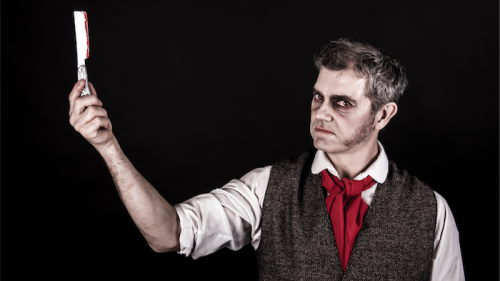
David Pearson as Sweeney Todd
  1. Sweeney Todd: The Demon Barber of Fleet Street produced by Dramatic Productions at Gunghalin College Theatre - The staging of this show is problematic, as the pivotal scenes (such as the action in the barber's shop and the hellish production detail of the pie-shop) are shunted too far up-stage to receive the full attention they deserve. As is often the case with amateur musicals, director Richard Block has largely jettisoned acting ability in favour of singing voices. David Pearson as the titular barber has strong presence and a commanding voice, but doesn't bring sufficient contrast to his performance, striking the same sneering pose throughout. Kate O'Sullivan in an understudy role as Mrs Lovett has better acting chops than most, although she struggles a bit with the higher register. Demi Smith is the complete opposite bringing a piercing clarity to her singing that is noticeably absent from her dialogue; Lachlan Agett as Antony Hope does neither, and Max Gambale's Judge Turpin does a fine job of bring the sleaze and cynicsm. While some of the set pieces (No Place Like London; Pirelli's Miracle ElixirGod, That's Good!By the Sea) are entertaining, they are incongruous with the tone of the whole, and generally filling the stage with chorus members doing a number does this show a disservice. It should contrast the demonic with the divine, but instead comes across as dull and dismal.
  2. The Merchant of Venice produced by Bell Shakespeare at The Playhouse, Canberra Theatre Centre - My problem with Bell Shakespeare is that they often re-interpret the bard's plays to fit their own sensibilities by re-arranging the words and forcing modern meanings into the text. Admittedly The Merchant of Venice is a tricky play with its tones of antisemitism, but the ending is generally one of couplings, suggesting a more tolerant and understanding future, not one of heart-rending guilt. When Jessica says 'I am much ashamed', it is in Act II and refers to her dislike of being seen in male clothing by her lover. Bell Shakespeare moves these lines to the end of the play as she rocks back and forth and pretend they reveal her feelings about the treatment of her father, Shylock. This may work for schools (and the slick production values and strong acting styles will certainly please teens used to one-dimensional characters and plots) but is insulting to the intelligence of anyone who appreciates the intrigues and subtleties of Shakespeare.
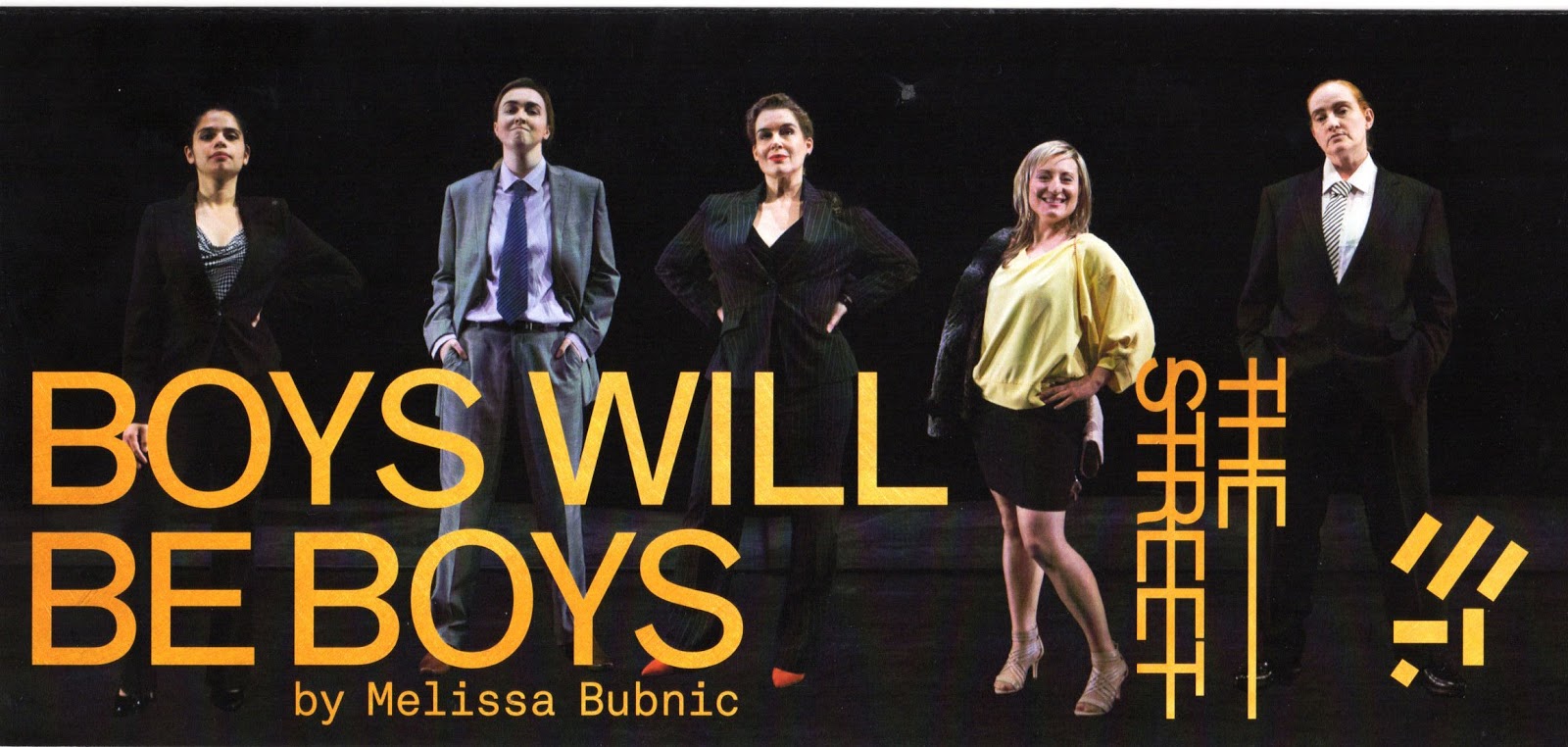
  3. Boys Will Be Boys produced by The Street at The Street - Caroline Stacey directs this hard-hitting boardroom drama in which all the men are played by women in sharp suits and cutting dialogue. The world of financial politics is clinical and unforgiving with no room for compassion, and everyone has a price. The stark set of mirrors and neon reflects the emptiness of the characters' souls, but there is also nowhere to hide. This is a problem for some of the weaker actors who are simply not strong enough to wield the crushing testosterone wrecking balls indicated by the text. Pippa Grandison stands out as Astrid, the woman with the most at stake who strikes the hardest deals and dares reveal a softer side only in song.
  4. Love/ Chamberlain produced by Moral Panic and Ainslie and Gorman Arts Centres at Ralph Wilson Theatre, Gorman Arts Centre - Playwright Bridget Mackey imagines that Courtney Love and Lindy Chamerlain might have a lot in common. Despite coming from contrasting backgrounds with seemingly disparate outlooks, they were both pilloried by the media for not responding to grief and trauma the way women are expected to react. In her play directed by Cathy Hunt, Love (Emma Macmannus) and Chamberlain (Heidi Silberman) meet several times in several contexts as they jump back and forth in time across the Federal Highway; strewn with the paper detritus of old news. They are aided and abetted by the versatile barb barnett in a dozen different and well-developed roles, but even as the Oracle (dispensing advice from a cardboard booth like Lucy in Peanuts) she doesn't have all the answers. It's great to see new work by local theatre artists, especially when it is as thought-provoking as this.
  5. Australia Day produced by Canberra Repertory at Theatre 3 - What is the purpose and relevance of the national celebration? Jonathan Biggins opens this can of worms in his satire set in a fictional country town. Lofty ideals clash with political expediency, torrential rain and an outbreak of food-poisoning. Anyone who has ever sat through tedious committee meetings will appreciate the contrasting personalities and sensitivities encompassed in the preparations conducted in a scout hall, which is freezing in the winter and boiling in the summer. The set is basic, and so is the acting and the direction by Cate Clelland, but this is not necessarily a criticism, as the script is allowed to take centre-stage where it belongs without distracting interpretations or excessive 'input'.
Friday, 28 April 2017

Friday Five (Seven Actually): Recent Theatre Excursions

I have seen a fair bit of theatre recently but have not had time to write full reviews, so here are some edited highlights:

Pip Utton as Winston Churchill
  1. Churchill & Maggie by Pip Utton, produced by Imagination Workshop and Street Contemporary Drama at Street 2 - Pip Utton performs solo shows on consecutive nights, portraying political giants Winston Churchill and Margaret Thatcher. He weaves anecdotes, musings and facts into his 70-minute monologue on Churchill, a colossus of his time: "History will be kind to me for I intend to write it." During his embodiment of That Woman he invites questions from the audience, while achieving the voice, mannerisms and dismissive tone so successfully it made my skin crawl. His enthusiasm is boundless and his knowledge equally indefatigable.  
  2. Wait Until Dark by Frederick Knott, produced by Canberra Repertory Society at Theatre 3 - Jordan Best directs this classic thriller with attention to detail on a meticulous set (designed by Michael Sparks) as a blind woman (Jenna Roberts as Susie) comes under threat from unscrupulous criminals looking for drugs they believe are stashed in her apartment. The tension was lacking from previous productions I've seen perhaps because I knew the story so well, perhaps because Roberts never displayed any vulnerability or uncertainty, or perhaps because the villains were neither as charming or as threatening as they might have been.
  3. Cold Light adapted by Alana Valentine based on the novel Cold Light by Frank Moorhouse produced by Street Contemporary Drama at The Street - Trying to personalise politics in the most bureaucratic town in Australia is tricky. Sonia Todd plays Edith Campbell Barry, a (fictional - although many people are deceived) woman who tries to make her mark in international relations. It packs a great deal of history into a lengthy piece with multiple threads and tangents. The ensemble cast perform multiple roles with varying degrees of aplomb, but almost mimicing the projection of Canberra's street design, there is a feeling that we are being driven around in circles and getting lost in cul-de-sacs.

  4. The Age of Bones

  5. The Age of Bones produced by Satu Bulan, Teater Satu, Performing Lines and Ainslie and Gorman Arts Centres at Gorman Arts Centre - A mixture of Indonesian shadow puppetry, music, digital projections and contemporary satire tells the story of Ikan, an Indonesian boy who goes fishing one day and fails to return. He is imprisoned 'down under' in an oceanic world where he is befriended, pursued and judged by fantastical creatures (bubble-headed deep sea divers, a shark and an octopus). We are clearly meant to draw parallels with the plight of Indonesian boys incarcerated in adult jails throughout Australia for their involvement in human trafficking. While this is an original and commendable approach, certain technical aspects (such as the English surtitles failing to coincide with the spoken words) hamper the production, while the attempt to appeal to all ages (childlike repetitive motions alongside hard-hitting issues of abuse) means the production overall fails to connect with any particular audience.
  6. Chicago produced by Canberra Philharmonic Society at Erindale Theatre - Interesting staging and directorial choices (by Jim McMullen) highlight different aspects of the play to usual - including the fact that the characters really are all horrifically unpleasant. Vanessa de Jager and Kelly Roberts as Roxie and Velma are both excellent in isolation but their dancing duets remain individual; Shell Tully has a great voice but no depth as Mama Morton; Will Huang presents a lawyer who seems merely slightly smarmy rather than truly repulsive; and Miss Mary Sunshine (Ben WIlson) is utterly peripheral. Most of the songs are still good (although Class was especially disappointing) but other facets, such as the sloppy follow spots, are mediocre. Curious staging makes us question whether we are in a gaol at all, as the protagonists pop out to the lawyer's office in their underwear. The fact that there are far too many people unnecessarily on stage literally jumping through hoops spoils what should be tight choreography, and the hanging scene is hugely underwhelming. The menace and terror of being locked up and possibly awaiting the death sentence is entirely absent: it's more like a circus in which everyone gets to run around and show off how good they look in a corset. 
  7. Trelawny of the Wells by Arthur Wing Pinero produced by Canberra Repertory Society at Theatre 3 - Tony Turner directs a spirited cast in this touching and amusing late-nineteenth-century drama. The revolving set (designed by Ian Croker) allows for all the scenes to be played in the balance of affectation and naturalism which was becoming popular at the time and which is crucial to the play's ethos. Deliberately bombastic performances from the flamboyant characters such as Sir William Gower (Jerry Hearn), Mrs Mossop (Elaine Noon) and  Avonia Bunn (Jess Waterhouse) provide a delightful counterpoint to the more subtle sentimentality of Rose Trelawny (Alessandra Kron) and Tom Wrench (Robert de Fries). Slapstick extremes are tempered with emotional speeches, and the entire effect is a beautiful piece about acting and performance. 
  8. Richard III by William Shakespeare, produced by Bell Shakespeare at the Playhouse (Canberra Theatre Centre) - Bell Shakespeare have taken the history out of the history play and turned it into a tragedy, in which the lead performer (Kate Mulvany as RIII) hams it up deliciously as Tricky Dicky, and the rest of the cast frolic about in a drawing room, like one of those frightful parties where you don't really like the host. As the actors do not leave the stage, there is no difference between intimate and group scenes, leading to a lack of tension and confusion as to the identity of many of the characters. The political is no longer important; it's all about the personal. This is the modern world, where I fear we have lost more than we have gained.
Kate Mulvany as Richard III

Wednesday, 13 November 2013

Henry 4: Mess with the master at your peril


Henry 4
Bell Shakespeare
Canberra Theatre Centre, The Playhouse, 27 Feb - 9 Mar 2013

The point of Shakespeare’s history plays is that they are written about specific people at precise times and for explicit reasons – the clue is in the name really. So, while I appreciate Bell Shakespeare’s decision to condense Henry IV Parts One and Two into a three hour version, I fear they have lost a lot more than they have gained by this treatment.

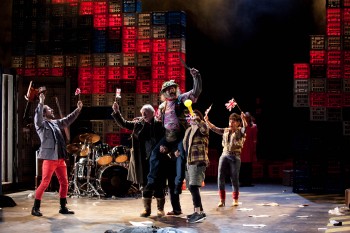
The set of milk crates in a Union Jack formation, while effective visually and contextually – it is broken apart to allow characters to enter and depart – is an instant anachronism, as the first union flag of England and Scotland was not created until 200 years after Henry IV’s death. Instantly the entire power struggles, righteous rebellions and questionable route to claiming kingship is rendered irrelevant. Later lines, such as the usually gut-wrenching, “How I came by the crown, God forgive me. Plain and right must my possession be”, and “Lord knows what crooked way I have earned this crown”, are robbed of all potency.

At the interval, many of the young adults in the audience (I went to a matinee plagued with school groups) were asking each other what it was all about and did anyone know what was happening? Well might they ask, because most of the battle tactics, political and historical aspects are mercilessly cut leaving a hollow mess.

Harry Hotspur (Jason Klarwein), rather than being a worthy and brave opponent over whose dead body Prince Hal (Felix Jozeps) intones, “Fare thee well, great heart”, becomes a subject of ridicule. He is portrayed in commando gear; a macho action man, well-built and crass, whom Hal mimics and affords no respect. Hotspur’s impatience is translated as childish petulance and his banishment of his wife from his bed implied to be from homosexual motives and steroid use.


Although Henry IV (David Whitney) uses Jerusalem as a battle hymn, the fight with knives, chains and lead piping has no dignity. The attempt to link the Percy Rebellion or Northern Rising with the Cronulla Riots is cheap and illogical. Similarly Falstaff’s (John Bell) edited discourse on honour loses all impact because there is nothing glorious with which to contrast his cowardly actions. The lack of regal motivation is woefully absent and the speeches are bereft of any beauty and nobility.

So, what does remain? Director (and adaptor) John Bell seems to want to focus on the coming of age of Prince Hal from playboy Prince to shining ruler. There are two problems here. Firstly, the taverns of Cheapside and the company of Falstaff, Mistress Quickly (Wendy Strehlow) et al are meant to be attractive. There is nothing enticing about the pole-dancing joints and dingy bubble-wrap covered sofas and bus seats in which the young prince carouses. The tavern scenes are drenched in booze and debauchery and are tawdry and dull rather than appealing.


The rubber gloves and plunger favoured by Mistress Quickly are indicative of the proverbial bargepole with which one wouldn’t want to touch Sir John Falstaff – embodied here as a disgusting and greasy old rocker shambling about in an ill-fitting waistcoat. If he is meant to offer an alternative father figure of fun for Prince Hal, it is an extremely unattractive one.

The other problem is that is hard to believe in Prince Hal’s kingly qualities. In this performance he was played by an understudy and perhaps the original casting (of Matthew Moore) was much stronger. Felix Jozeps was cast as Boy (amongst other roles) and this would have suited him far better. He acts like the irritating adolescent in the Zits cartoon strip – all lanky limbs, floppy hair, ill-bred mannerisms and self-entitlement. When Henry IV berates his son, the king is far more dynamic than either character had been in the previous foreshadowing scene between Hal and Falstaff. With his feet on the sofa and slouching posture Hal is awkward in front of his father, and King Henry IV literally walks rings around him.


King Henry IV is harsh, bold and unfriendly, surrounded by men in suits who think his son is a waster – and they’re right. Prince Hal may want his father’s love and respect, but he doesn’t go out of his way to earn it. In his army costume and beret he looks like a Thunderbird puppet, and his hugging and hogging of the crown during his father’s death scene is pathetic rather than potent.

Hal’s eventual denouncement of Falstaff seems petty and vindictive rather than necessary for the health and future of the nation. We are not chilled as we should be when Falstaff claims, “The laws of England are at my commandment” because we haven’t been led to believe that the stakes are particularly high. Neither is there anything revealed in the portrayal of Prince Hal to indicate that he will “imitate the sun” and “show more goodly, and attract more eyes/ Than that which hath no foil to set it off.” It is impossible that this sullen teenager will become one of England’s greatest ever monarchs.

The production contains some excellent acting – namely Sean O’Shea who has crisp delivery as Shallow, and Yalin Ozucelik who brings a much-needed amicability to the loyal companion character of Poins. The frenetic band, incorporated into the action with the drummer seated on stage also enhances the pace of the action, but the direction is inconsistence with a muddle of metaphors.


The integrity of the ambushed fight scene is weakened by the introduction of German tourists for cheap laughs. Shallow and Silence are supposedly watching football (or soccer, as Australians insist on calling it, although the flags are totally wrong) adding unnecessary business to detract from their speech as though they are worried that the plot alone cannot hold the audience’s attention. The overall effect is as though the company don’t trust the words, even adding modern speech to the policemen and making lame reference to slices of lime in necks of corona bottles for the line, “There’s lime in this sack”.

Messing with the rhythms and beauty of Shakespeare’s language is practically criminal. Primary school viewers may enjoy the match the pictures to the words approach, but Bell Shakespeare are guilty of throwing the baby out with the bathwater.

Monday, 29 April 2013

Finishing School

School for Wives

The Playhouse, Canberra Theatre Centre
October 2012

I had been very impressed with Bell Shakespeare’s Macbeth, so thought it would be okay to take Him Outdoors along to their production of School for Wives, although Molière can be a tough sell. We were both tired and hungover so it would have to be a top-notch production to keep us entertained, and fortunately it was.

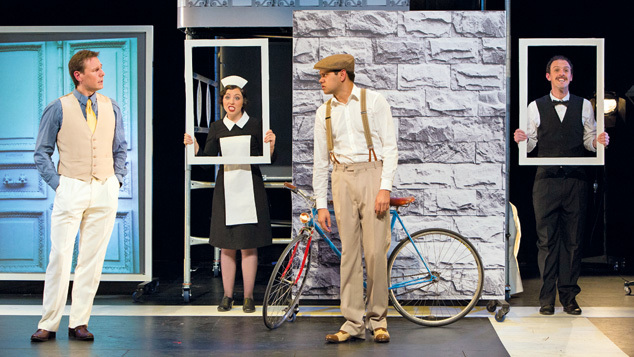
The language has been translated and modernised with an Australian flavour (huge plaudits to Justin Fleming), but the rhyming scheme has been kept, which adds an extra self-aware dimension. The entire production is self-aware, or post-modern if you will, using limited props, and wheeling in backdrops to create scenes in conjunction with seriously intelligent lighting (set built by Malthouse Theatre; lighting designer, Niklas Pajanti).

It begins with two characters chugging along in a motor car, providing all their own ‘special effects’. This sets the tone for the rest of the show, which is fast, funny, wry and sardonic. It’s entertainment, but it’s not light.


The story is preposterous, as you would expect from a seventeenth-century comedy featuring disguise and mistaken identity, but the audience is invited to mock the plot while caring for the characters – a difficult feat accomplished superbly by director Lee Lewis. She and the designer, Marg Horwell, have explored every detail in the 1920’s Parisian setting, from fabulous costumes (Costume supervisor, Taryn Van Kan) to mannerisms of loveable rogues and caddish fops – the mixture of references gels seamlessly to create a timeless montage.

The banter is brilliant once your ears become accustomed to the rhythm (it took about five minutes of intense concentration, more than adequately rewarded with the ability to anticipate gag placement), and the physical comedy conversely elevates the performance to a higher plane. It would be wrong to use the term slapstick, as that may suggest a base art-form. In several sequences the puppet-like movements, particularly from the taciturn servants Alan (Andrew Johnston) and Georgette (Alexandra Aldrich), are almost balletic (Movement director, Penny Baron). They have a touch of Manuel and Polly meet Peirrot and Columbine.

All the acting is faultless and, although the main characters could be one-dimensional, all are given depth. Harriet Dyer plays Agnes, the ingénue, with such candour that she is way more than the drippy but pretty simpleton this role would usually imply. Her purity and passion collide convincingly, and she offers hope for the future of love, marriage and (perhaps not in the original but certainly in this adaptation) equality.


Her love interest, Horace (Meyne Wyatt) is a loveable fool with a ready laugh and evasive wit, cleverly avoiding a patronising Aborigine stereotype with a layered performance. And although we should dislike the villain of the piece, Arnolde, who attempts to manipulate the suggestible Agnes into matrimony, John Adam imbues him with enough integrity of action, not to mention audience rapport and undeniable charm, that he is a firm favourite. Even the role of friend, Chris, who is mainly present to provide exposition and explanation, is handled with aplomb by Damien Richardson.

Mention must also be made of the music (Composer, Kelly Ryan), which underpins and highlights each action, reaching a crescendo in the show-stopping bows. I’m not entirely sure what my expectations were, but they were well and truly exceeded.