Showing posts with label musical. Show all posts

Friday, 15 December 2017

Friday Five: Recent Theatre Excursions

And here are another five shows I have seen and enjoyed, to various extents.

David Pearson as Sweeney Todd
  1. Sweeney Todd: The Demon Barber of Fleet Street produced by Dramatic Productions at Gunghalin College Theatre - The staging of this show is problematic, as the pivotal scenes (such as the action in the barber's shop and the hellish production detail of the pie-shop) are shunted too far up-stage to receive the full attention they deserve. As is often the case with amateur musicals, director Richard Block has largely jettisoned acting ability in favour of singing voices. David Pearson as the titular barber has strong presence and a commanding voice, but doesn't bring sufficient contrast to his performance, striking the same sneering pose throughout. Kate O'Sullivan in an understudy role as Mrs Lovett has better acting chops than most, although she struggles a bit with the higher register. Demi Smith is the complete opposite bringing a piercing clarity to her singing that is noticeably absent from her dialogue; Lachlan Agett as Antony Hope does neither, and Max Gambale's Judge Turpin does a fine job of bring the sleaze and cynicsm. While some of the set pieces (No Place Like London; Pirelli's Miracle ElixirGod, That's Good!By the Sea) are entertaining, they are incongruous with the tone of the whole, and generally filling the stage with chorus members doing a number does this show a disservice. It should contrast the demonic with the divine, but instead comes across as dull and dismal.
  2. The Merchant of Venice produced by Bell Shakespeare at The Playhouse, Canberra Theatre Centre - My problem with Bell Shakespeare is that they often re-interpret the bard's plays to fit their own sensibilities by re-arranging the words and forcing modern meanings into the text. Admittedly The Merchant of Venice is a tricky play with its tones of antisemitism, but the ending is generally one of couplings, suggesting a more tolerant and understanding future, not one of heart-rending guilt. When Jessica says 'I am much ashamed', it is in Act II and refers to her dislike of being seen in male clothing by her lover. Bell Shakespeare moves these lines to the end of the play as she rocks back and forth and pretend they reveal her feelings about the treatment of her father, Shylock. This may work for schools (and the slick production values and strong acting styles will certainly please teens used to one-dimensional characters and plots) but is insulting to the intelligence of anyone who appreciates the intrigues and subtleties of Shakespeare.
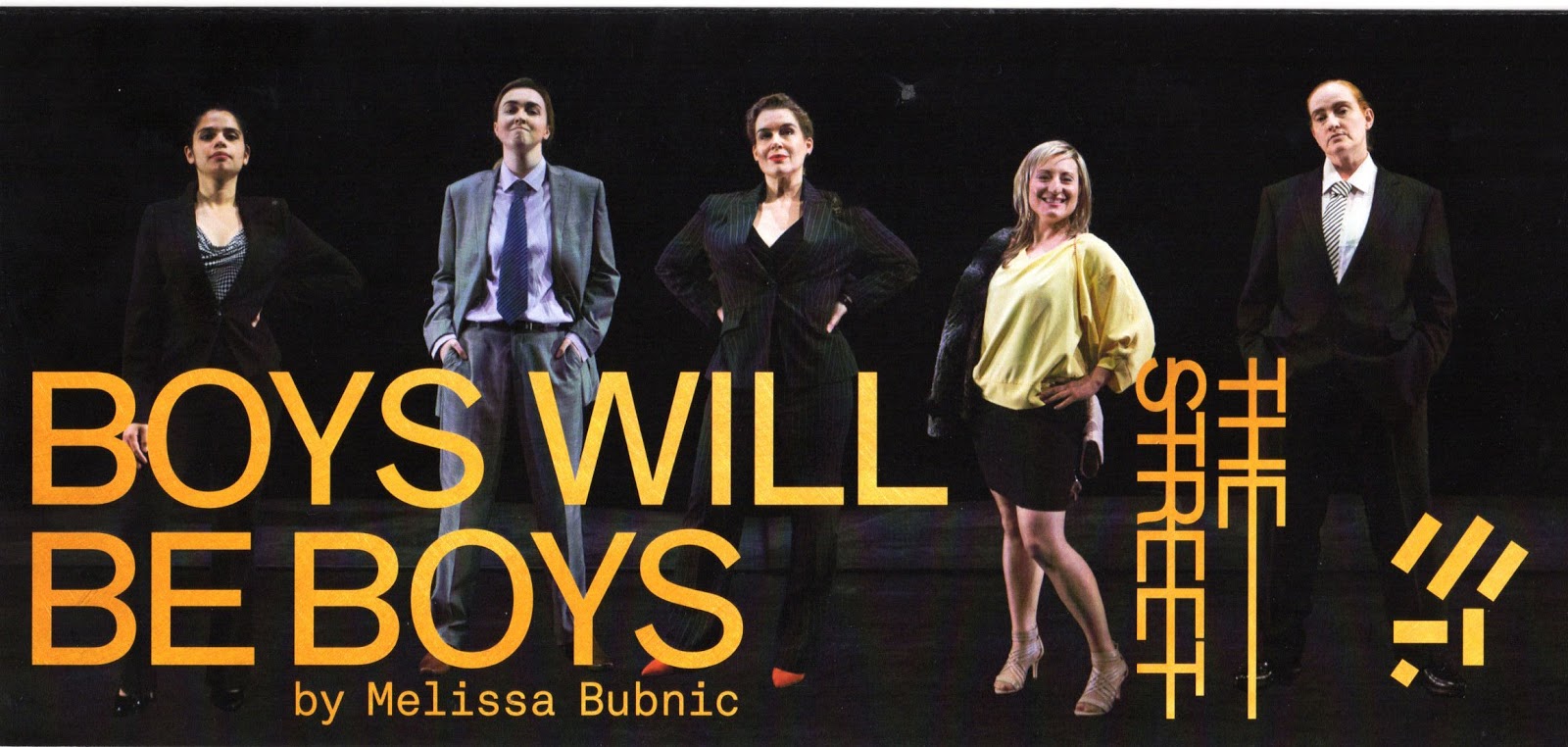
  3. Boys Will Be Boys produced by The Street at The Street - Caroline Stacey directs this hard-hitting boardroom drama in which all the men are played by women in sharp suits and cutting dialogue. The world of financial politics is clinical and unforgiving with no room for compassion, and everyone has a price. The stark set of mirrors and neon reflects the emptiness of the characters' souls, but there is also nowhere to hide. This is a problem for some of the weaker actors who are simply not strong enough to wield the crushing testosterone wrecking balls indicated by the text. Pippa Grandison stands out as Astrid, the woman with the most at stake who strikes the hardest deals and dares reveal a softer side only in song.
  4. Love/ Chamberlain produced by Moral Panic and Ainslie and Gorman Arts Centres at Ralph Wilson Theatre, Gorman Arts Centre - Playwright Bridget Mackey imagines that Courtney Love and Lindy Chamerlain might have a lot in common. Despite coming from contrasting backgrounds with seemingly disparate outlooks, they were both pilloried by the media for not responding to grief and trauma the way women are expected to react. In her play directed by Cathy Hunt, Love (Emma Macmannus) and Chamberlain (Heidi Silberman) meet several times in several contexts as they jump back and forth in time across the Federal Highway; strewn with the paper detritus of old news. They are aided and abetted by the versatile barb barnett in a dozen different and well-developed roles, but even as the Oracle (dispensing advice from a cardboard booth like Lucy in Peanuts) she doesn't have all the answers. It's great to see new work by local theatre artists, especially when it is as thought-provoking as this.
  5. Australia Day produced by Canberra Repertory at Theatre 3 - What is the purpose and relevance of the national celebration? Jonathan Biggins opens this can of worms in his satire set in a fictional country town. Lofty ideals clash with political expediency, torrential rain and an outbreak of food-poisoning. Anyone who has ever sat through tedious committee meetings will appreciate the contrasting personalities and sensitivities encompassed in the preparations conducted in a scout hall, which is freezing in the winter and boiling in the summer. The set is basic, and so is the acting and the direction by Cate Clelland, but this is not necessarily a criticism, as the script is allowed to take centre-stage where it belongs without distracting interpretations or excessive 'input'.
Tuesday, 13 June 2017

La La Land: a note to follow So-So Land


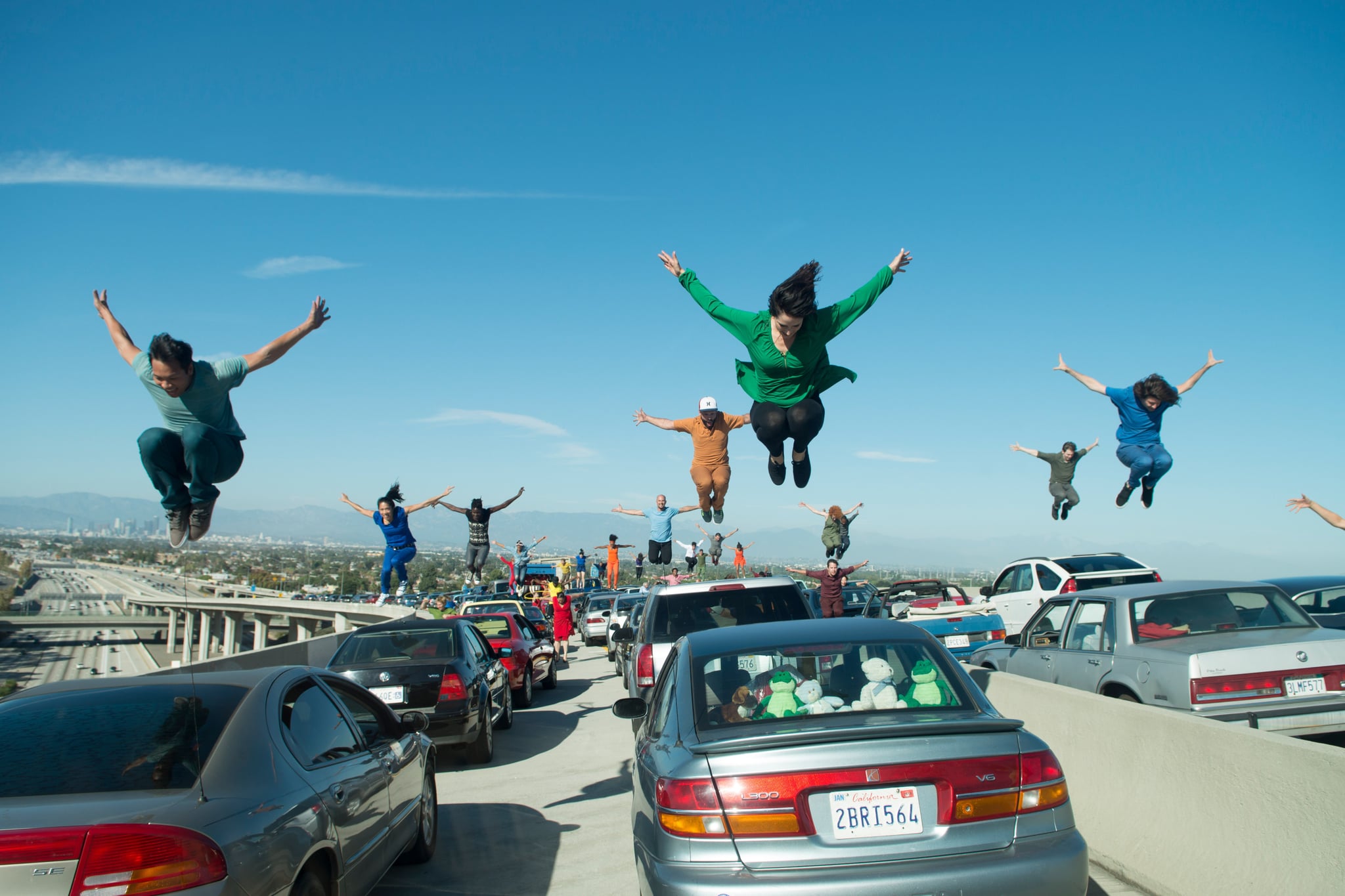
It starts with a traffic jam: suddenly someone gets out of their car and starts singing and everyone else joins in and dances through the stationary cars to music which is being played by the token illegal immigrants hidden in the back of a lorry. Then they all get back in their cars and the blockage mysteriously clears and they all drive off except ditzy Emma Stone who is looking at a map to tell her how the hell to get out of this mess before it's all too late. The bloke in the car behind her (Ryan Gosling) blares his horn and overtakes her in a disgruntled manner which is highly understandable being as he's had to sit through a West Coast version of Fame for the last ten minutes.


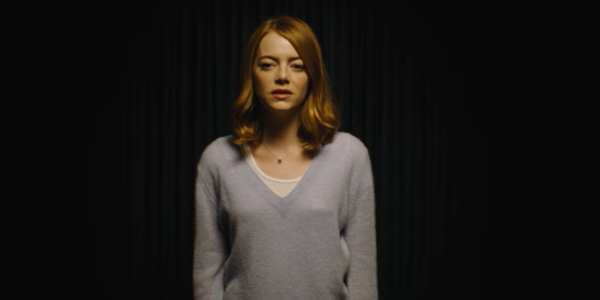
Emma Stone goes to a coffee shop in a film studio where she works, and stars swan in and out and people spill coffee on her. She goes to auditions where people are rude to her, and when she doesn't get the part it is the end of the world. She lives with three other models in primary-coloured dresses who go to parties, but she feels out of place there because it's oh-so-hard to be beautiful and misunderstood. They dance around like The Wiggles or The Spice Girls Minus One (Probably Mel C; the one with the talent) - 26 seems a bit old to still be going through this adolescent angst, but she does it with a very pretty pout.

The Bland Girls
After ten tedious minutes of her story, we return to the traffic jam (we really are getting nowhere fast) and take it up from the point of view of the hornblower (Ryan). He talks to his sister in a scene in his flat which is meant to indicate how poor he is because there is a stain on the wall and he's got no furniture. They swap lines like 'Unpaid bills are not romantic' and 'I want to be on the ropes. I'm letting life hit me until it gets tired and then I'm going to hit back', but don't worry about getting to know the sister because once she has set up the exposition, she disappears never to be seen again.

Ryan Gosling gets fired from his job as a pianist in a restaurant for blatantly disobeying his boss's directions to only play the set-list. He is so upset that he rudely barges past Emma Stone who was coming to tell him how much she had enjoyed his playing. Time passes (we know because the titles helpfully tell us that we have moved through the seasons) and Emma Stone indulges in more bad auditions and pool parties - poor love.

Play something we know!
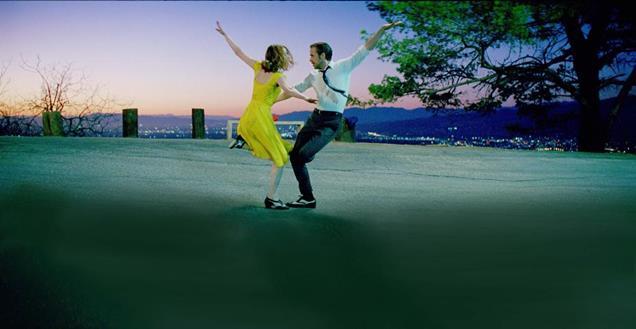
She meets Ryan again at a party where he is playing keyboards in an 80's tribute band. To get her own back for his previous rudeness, she requests the band play 'I Ran', which he later tells her is an insult to a serious musician (36 is definitely too old to be having adolescent pretensions). He should be so lucky; it's the best piece of music in the whole film. As they walk back to their cars they have a 'moment', which provides the opportunity for the typical teen I-Hate-You-But-I-Love-You routine. Cue for a song about a Waste of a Lovely Night, which has some decent lyrics and choreography, like something out of a Doris Day film, but only if you couldn't care less about Doris, and she couldn't sing or dance.


Ryan then pops to the coffee shop where Emma works (drawn, one supposes by her looks, because there is nothing attractive or even apparent about her personality) and she tells him how much she loves it there and dreams of being an actor. He reciprocates by explaining that he dreams of being a musician and having his own club. Things look up briefly when she says she doesn't like jazz, but plummet rapidly when he attempts to justify how great it is and we have to endure some random musical noise.

Although she wants to be an actor she has never seen Rebel Without a Cause, which shocking oversight can only be explained by her utter self-absorption. Ryan, who is slightly more aware that there may be other players in the entertainment field, says he'll take her to the pictures 'for research' and then walks along a pier into a beautiful sunset, singing a merry song and nicking an old bloke's hat.

Where did you get that hat?
Next day Emma gets a callback which is supposedly brutal (but actually realistic) and looks forward to going out with Ryan until her boyfriend turns up and takes her out to a meal about which she had forgotten - both the meal and the boyfriend it seems. You needn't get attached to him either because, after hearing some piano music that reminds her of Ryan, Emma ditches the dinner and the boyfriend, and runs to the cinema. She selfishly stands in front of the projected image at the front of the screen (thus blocking the view of all the other patrons - but since when did she care about anyone else?). Just as Emma and Ryan are about to snog in the cinema, the projector burns through the screen and she still never gets to see how to make a decent film.

Serious code violation
Instead, the couple continue their date at Griffith Observatory where the fight scene from Rebel Without a Cause was filmed (see how multi-layered this thing is?). Apparently it is a gravity-free zone and they are soon floating around among the stars like a cross between E.T. and Mary Poppins, and they finally get to kiss. This is clearly inspirational as Emma Stone then writes a play (as you do) and her model chums pop up for one more scene to be told that it is a one-woman play and they are soon to be left on the cutting-room floor.

ET meets Mary Poppins

More seasons pass (we are helpfully told by the addition of inter-titles, such as are used in silent films - if only...) and there is a montage of Emma and Ryan visiting things, going to parties, laughing youthfully, riding cable cars and walking had-in-hand. He plays pianos in bars while she dances unselfconsciously in the middle of the pub. They are in love. And, presumably, living together.

Look at me, everybody!
Some bloke in a tight yellow polo-neck offers Ryan a job but he says he'll Never Work With Him. In the next scene Ryan Works With Polo-Neck Bloke and takes the gig (partly because Emma has pointed out that he might actually earn some money). The band they play for lays dub and techno over trad jazz - which is apparently what the young people want, because no one is interested in old jazz anymore and all the innovators are dead. Emma goes to see the band, but they are popular, which disappoints her and she looks like someone has strangled a puppy because success is so vulgar. He goes on tour with this band and is highly successful and makes lots of money but is Away A Lot and doesn't call every day.


Meanwhile Emma quits her day job (despite all the obvious advice) at the cafe by symbolically handing in her apron, and she becomes a writer, by shaking hands with people and scattering pieces of paper all over the floor - it really is that easy it seems! Once more we move through the seasons until we hit Fall, which is a METAPHOR!

Ryan comes home for a surprise visit and cooks a giant chicken or a fatted calf or some enormous hunk o' meat. He tells her he is going to stay in the band for a few more years and keep touring and making money. They fight because this may be The Dream but it is not His Dream and he has sold his soul to the Electrical Keyboard Devil. Then Ryan sets the kitchen on fire and the smoke alarm takes over the high-pitched whining, and Emma runs away (her penchant for escaping mid-meal is clearly the latest in Hollywood dieting chic).

Emma books a theatre to perform her play, which only about half a dozen people attend, which isn't surprising as Ryan has told her to 'write something as interesting as you are.' The performance clashed with a photo shoot for his band so Ryan didn't make it, which is a deal breaker and she goes home to Middle of Nowhere Land to give up on her dreams. But, a casting director was at her play and really liked it and phones Ryan to ask Emma to audition for a thing in Paris. He goes to find her (by parking in suburban streets and blaring his horn) and passes on the message - she has a needy, whiny 'I'm not good enough' moment, but he is all supportive and they drive back to Hollywood to Make It Happen.

Self referential audition 'song' about how hard it is to be an actor
At the audition she is asked to tell a story and, displaying a gross ineptitude at following directions, she sings a song instead - perhaps the film has suddenly remembered it is meant to be a musical? Of course she gets the part because this is all unbelievable nonsense. Fast forward five years and she is a big star, married to Someone Else, and buying her coffee from the cafe where she used to work.

Emma and Someone Else go out to dinner and stumble into a basement bar which would you Adam and Eve it, of all the jazz joints, in all the towns, of all the world... Ryan is also living his dream and their eyes meet and there is a dance number montage of how life could have been if they had stayed together. If only the whole film had been like this without the tedious bits in the middle, it would have been quite good.  But it wasn't. And it isn't. The End.


Friday, 28 April 2017

Friday Five (Seven Actually): Recent Theatre Excursions

I have seen a fair bit of theatre recently but have not had time to write full reviews, so here are some edited highlights:

Pip Utton as Winston Churchill
  1. Churchill & Maggie by Pip Utton, produced by Imagination Workshop and Street Contemporary Drama at Street 2 - Pip Utton performs solo shows on consecutive nights, portraying political giants Winston Churchill and Margaret Thatcher. He weaves anecdotes, musings and facts into his 70-minute monologue on Churchill, a colossus of his time: "History will be kind to me for I intend to write it." During his embodiment of That Woman he invites questions from the audience, while achieving the voice, mannerisms and dismissive tone so successfully it made my skin crawl. His enthusiasm is boundless and his knowledge equally indefatigable.  
  2. Wait Until Dark by Frederick Knott, produced by Canberra Repertory Society at Theatre 3 - Jordan Best directs this classic thriller with attention to detail on a meticulous set (designed by Michael Sparks) as a blind woman (Jenna Roberts as Susie) comes under threat from unscrupulous criminals looking for drugs they believe are stashed in her apartment. The tension was lacking from previous productions I've seen perhaps because I knew the story so well, perhaps because Roberts never displayed any vulnerability or uncertainty, or perhaps because the villains were neither as charming or as threatening as they might have been.
  3. Cold Light adapted by Alana Valentine based on the novel Cold Light by Frank Moorhouse produced by Street Contemporary Drama at The Street - Trying to personalise politics in the most bureaucratic town in Australia is tricky. Sonia Todd plays Edith Campbell Barry, a (fictional - although many people are deceived) woman who tries to make her mark in international relations. It packs a great deal of history into a lengthy piece with multiple threads and tangents. The ensemble cast perform multiple roles with varying degrees of aplomb, but almost mimicing the projection of Canberra's street design, there is a feeling that we are being driven around in circles and getting lost in cul-de-sacs.

  4. The Age of Bones

  5. The Age of Bones produced by Satu Bulan, Teater Satu, Performing Lines and Ainslie and Gorman Arts Centres at Gorman Arts Centre - A mixture of Indonesian shadow puppetry, music, digital projections and contemporary satire tells the story of Ikan, an Indonesian boy who goes fishing one day and fails to return. He is imprisoned 'down under' in an oceanic world where he is befriended, pursued and judged by fantastical creatures (bubble-headed deep sea divers, a shark and an octopus). We are clearly meant to draw parallels with the plight of Indonesian boys incarcerated in adult jails throughout Australia for their involvement in human trafficking. While this is an original and commendable approach, certain technical aspects (such as the English surtitles failing to coincide with the spoken words) hamper the production, while the attempt to appeal to all ages (childlike repetitive motions alongside hard-hitting issues of abuse) means the production overall fails to connect with any particular audience.
  6. Chicago produced by Canberra Philharmonic Society at Erindale Theatre - Interesting staging and directorial choices (by Jim McMullen) highlight different aspects of the play to usual - including the fact that the characters really are all horrifically unpleasant. Vanessa de Jager and Kelly Roberts as Roxie and Velma are both excellent in isolation but their dancing duets remain individual; Shell Tully has a great voice but no depth as Mama Morton; Will Huang presents a lawyer who seems merely slightly smarmy rather than truly repulsive; and Miss Mary Sunshine (Ben WIlson) is utterly peripheral. Most of the songs are still good (although Class was especially disappointing) but other facets, such as the sloppy follow spots, are mediocre. Curious staging makes us question whether we are in a gaol at all, as the protagonists pop out to the lawyer's office in their underwear. The fact that there are far too many people unnecessarily on stage literally jumping through hoops spoils what should be tight choreography, and the hanging scene is hugely underwhelming. The menace and terror of being locked up and possibly awaiting the death sentence is entirely absent: it's more like a circus in which everyone gets to run around and show off how good they look in a corset. 
  7. Trelawny of the Wells by Arthur Wing Pinero produced by Canberra Repertory Society at Theatre 3 - Tony Turner directs a spirited cast in this touching and amusing late-nineteenth-century drama. The revolving set (designed by Ian Croker) allows for all the scenes to be played in the balance of affectation and naturalism which was becoming popular at the time and which is crucial to the play's ethos. Deliberately bombastic performances from the flamboyant characters such as Sir William Gower (Jerry Hearn), Mrs Mossop (Elaine Noon) and  Avonia Bunn (Jess Waterhouse) provide a delightful counterpoint to the more subtle sentimentality of Rose Trelawny (Alessandra Kron) and Tom Wrench (Robert de Fries). Slapstick extremes are tempered with emotional speeches, and the entire effect is a beautiful piece about acting and performance. 
  8. Richard III by William Shakespeare, produced by Bell Shakespeare at the Playhouse (Canberra Theatre Centre) - Bell Shakespeare have taken the history out of the history play and turned it into a tragedy, in which the lead performer (Kate Mulvany as RIII) hams it up deliciously as Tricky Dicky, and the rest of the cast frolic about in a drawing room, like one of those frightful parties where you don't really like the host. As the actors do not leave the stage, there is no difference between intimate and group scenes, leading to a lack of tension and confusion as to the identity of many of the characters. The political is no longer important; it's all about the personal. This is the modern world, where I fear we have lost more than we have gained.
Kate Mulvany as Richard III

Tuesday, 20 November 2012

Improbable Fiction, 'Unofficial Soundtrack'

Whenever I 'do' a play (act, direct, crew), I compile a soundtrack for it. This excludes musicals, obviously, which have kindly provided their own. 

Music is very closely linked to memory in my mind, so I find the 'soundtrack' a useful device and aide memoire. It picks up on certain lines or characters, and focuses my mind as I drive to rehearsals. It also manages to keep me awake as I drive home late and exhausted after rehearsals. I've not got to bed before midnight for over a week and we open on Friday so I need it.

For people unfamiliar with Alan Ayckbourn's Improbable Fiction, this playlist may seem a little odd. For those who do know the play, it may seem even more so. But these are the tracks that come to mind when I'm working on the play. "They're in order, but... well, you'll see..."
  1. Paperback Writer - The Beatles
  2. I Close My Eyes and Count to Ten - Dusty Springfield
  3. City Hobgoblins - The Fall
  4. Build Me Up Buttercup - The Foundations
  5. Writer's Block - Just Jack
  6. The Social Network Song (Oh Oh - Uh - Oh Oh) - Valentina Monetta
  7. I Write the Songs - Tom Jones
  8. Everyday I Write the Book - Elvis Costello
  9. Java Jive - The Ink Spots
  10. Oxford Comma - Vampire Weekend
  11. Invisible - Alison Moyet
  12. Thunder in the Mountains - Toyah
  13. Something Canged - Pulp
  14. Just an Illusion - Imagination
  15. Once in a Lifetime - Talking Heads
  16. We Are Detective - The Thompson Twins
  17. Hot Soup - Da Vinci's Notebook
  18. I've Committed Murder - Macy Gray
  19. Where's Your Head At? - Basement Jaxx
  20. Wasted Life - Stiff Little Fingers
  21. Spaceman - Babylon Zoo

Thursday, 28 October 2010

It's only Rock and Roll...


Rock and Roll Suicide stars (from left) Shaun Vining, as Idol, Max Gunn (17), as Joe Rockstar, and Pearly McGrath, as Susie Diva, Joe's girlfriend, pose during the company's first dress rehearsal with the band, in the Arrowtown Athenaeum Hall, on Wednesday night. The rock opera debuts in the hall on Wednesday and plays until Friday. Photo by James Beech.
Rock and Roll Suicide
Athenaeum Hall, Arrowtown
October 27-29, 2010

When I was 13 I wrote a story for my cousin comprised entirely from the lyrics of David Bowie songs – she lived in the US and I in the UK, and he was the single artist we both admired who translated across the Atlantic. It would be fair to say that even before I was finally defeated by Cat People (there’s only so many times you can attempt to put out fire with gasoline after all) it was a woeful effort.

Fortunately for us all, UnderGround Productions have done an infinitely better job with Rock and Roll Suicide; a rock opera featuring the music of David Bowie. Margaret O’Hanlon directs a vibrant and enthusiastic cast through some novel interpretations of familiar and lesser-known songs. The band on stage are excellent if occasionally the music mix on opening night meant they drowned some of the singers, but the sound fills the hall with depth and rhythm, almost as if at a real gig.

The story isn’t too original or hard to follow which is good because you can concentrate on the music (and that is great!) although a few spoken words might enhance the clarity, especially for those who don’t know Bowie’s lyrics already, as these are sometimes hard to decipher. Joe Rockstar (Max Gunn) wants to be a rock star so he heads to London with his trusty guitar where he is fatally impressed by the star of the moment, Idol (Shaun Vining). He also meets groupie Suzy Diva (Pearly McGrath) and promises her a whirlwind romance which becomes more of a torrid maelstrom of drugs and destruction.

Pulling the strings like malevolent puppet masters are the manipulative record producers, Jupiter (Martin D Grounds) and Vex (Margaret O’Hanlon). Like a pair of scary clowns they command and wheedle; bully and badger until they get what they want – money – at any cost. In garish costume, pancake make-up, dreadlocks (him) and fishnets (her) they wheel on a magician’s cage with plush red curtains and iron bars; fame may look alluring but it is also an illusion; a trap from which there is no escape.

The chorus work and expert choreography (Anna Stuart) makes the ensemble numbers a delight. From the spine-chilling vocal harmonies of Life on Mars – played out against flickering images from the silver screen – to a dozen human cameras flashing their shutters in synchronicity in Fame, the company numbers are a highlight. Golden Years, with arm twirling and finger clicking, is a classic rock song which the lighting emphasises perfectly, and when things get dark in the second half, the choreography for Tonight has a touch of Jai Ho to bring us out of the gloom.

A propos of which, there are some very dark themes indeed as Joe Rockstar succumbs to heroin, hallucinations and attempted suicide. The young Max Gunn handles these excellently and though he may not have the vocal experience to carry the angrier punchy numbers (Changes; Suffragette City) he really hits his stride with the soulful duet When I Live My Dream and the drugged-up Always Crashing in the Same Car.

As he sits vacantly on the sofa during Lady Grinning Soul (another vocally superb cameo for Margaret as Medusa), Anna Ashton performs acrobatics on the pole that has dominated the set since the beginning. It is a fantastic display of strength and flexibility that also (I suspect due to the skimpy 'outfit') drew appreciative whistles from half of the audience. If this is one for the boys, then Pearly McGrath’s fantastic rendition of Heroes as a disappointed and neglected lover struck a chord with the girls and brought the house down. The reprise of Heroes/ When I Live My Dream/ Starman is touchingly tender, although the preceding scene needs polishing in terms of acting and mechanics to deliver the full impact

Shaun Vining puts in a stellar performance as the fallen hero who is discarded for a younger model. His pained demise in Bewley Brothers elicits skin-crawling sympathy as he descends into madness with the assistance of projected images of his distorted face. Tom Lynch and Tom-Tom Productions do a fabulous job with the technical aspects and visual backdrop which enhances the poignancy of the piece with quotes and images of those who died too young through abuse of substances and their mental health.

Incidentally, I wouldn’t have included Michael Jackson (who seemed to be the odd one out), but I would have added Ian Curtis to the likes of Joey Ramone, Sid Vicious, Marc Bolan, Jimi Hendrix, Michael Hutchence, Phil Lynott, Keith Moon, Jim Morrison, Janis Joplin, Johnny Thunders, Elvis Presley, Kurt Cobain... you can discuss this later at home. The programme includes the phone number for Wakatipu Victim Support for anyone who wishes to speak to a health professional about any issues raised by this production and there are some powerful moments as it treads a fine line between the highs and lows of adulation – never pulling any punches.

Just as Idol was thrown on the scrap heap, so Joe Rockstar follows suit when Jupiter sees he is no longer fresh and brings in a new pin-up, the effervescent Sam Hillman as DJ. He introduces a modern note (although his song, DJ, is from 1979 proving the versatility of the great man) and a hip-hop style with which the cast seem more familiar. It is indeed a credit to Margaret and Marty to get such sterling performances out of people who weren’t even alive when Bowie was at his best. The selection of songs is clearly a personal one, but perhaps more emphasis on the ‘good time’ era might explain why one would pursue such giddy heights in the first place.
 
There are some technical issues which need improvement and may shape up further into the run – the skylight needs to be blacked out or it ruins the lighting effects in the first half; the transition of microphones for the final number, Ziggy Stardust, is a bit shambolic; there are several occasions between numbers where the cast don’t know where to put themselves – it is a very small stage and can look crowded and messy – and it was entirely obvious that the encore was unplanned, although Fame was a good choice. On the whole, however, this is a thoroughly entertaining show.

Rock and Roll Suicide demonstrates how good a musical can be when you actually let the music do the talking. In the words of my favourite Bowie song, ‘Hot tramp; I love you so!’

Monday, 26 October 2009

Oliver! overload

I seem to be suffering from Oliver! overload. In what seems like a dreadfully short space of months I’ve seen it performed at Porirua and Alexandra. The Auckland Theatre Company are currently in the throes of the musical and I have just heard that my local musical society (Showbiz Queenstown) have lined it up to be next on their programme. Please God, don’t let any of my friends play the lead role of Nancy (as they did in the last two productions I saw) or I shall have to go and see it again.

It’s not that it’s bad (it can actually be pretty good), but it is certainly problematic. These are the main problems as I see them:

· The staging – there are many different scenes and settings. They range from the workhouse and the undertaker’s parlour, to the thieves’ kitchen and public house, and out into the street by way of an upper-class family home. That’s a lot to contend with.

There are some intimate scenes and some large rousing numbers. Do you have the Company at the forefront of the stage where they can dance, confining the more personal moments to the sides or the back of the stage with connotations of privacy? This is all well and good but can lose the dramatic impact if the cast are too far away from the audience.

For example the flirtation between Mr Bumble and the Widow Corney is amusing and effective if played up-close, but dull and dreary if positioned towards the back of the stage. Similarly, Nancy’s altercation with Bill can get lost if not sufficiently highlighted, and yet it is a pivotal moment of the production.

An apron extending past the proscenium arch might be a successful way to deal with this, but is potentially cumbersome and costly in many a town hall with limited space and resources. Sliding flats have similar benefits and drawbacks. Having forked out a small fortune on a revolve, Showbiz Queenstown would be mad not to utilise it to solve this predicament.

· The lighting – I once read a
Guardian guide to critic-speak in which the term ‘crepuscular lighting’ was translated to mean ‘I couldn’t see a thing’. This is a problem. Yes, Dickensian London was dark and dingy – especially in the alleyways and orphanages – but the stage doesn’t have to be.

It’s necessary to convey the atmosphere while still being able to see the characters. In one performance, Nancy walked from side to side of the stage through a big black hole. I only knew she was there because she was singing at the time. If you combine the ‘can’t see’ factor with the ‘can’t hear’ factor mentioned above, you have two major difficulties that would plague any musical.

· The leads – the problem with many amateur musical societies (which most are) is that they tend to cast singers who can dance, and if they can act a bit that’s a bonus. Almost more than any other musical (with the possible exception of My Fair Lady), this show demands actors who can sing, and if they can’t dance, find them something else to do on stage. This is why, among local shows, I would always go and see whatever Geoff Turkington directs.

Apparently in one of the shows, there was a 16-year old girl recalled for the part Nancy. I’m sure she looked pretty and sang nicely, but if you have a schoolgirl playing the part of the archetypal ‘tart with a heart’ then it makes all her customers and associates appear twisted and perverted in a way that isn’t going to do your show any favours.

Incidentally, both of the Nancy’s I saw were excellent – both were past 30 and had an understanding of character that made them react well with children and abusive lovers alike.

Fagin needs to be strong and convincing. Whether you decide to play him as callous or misguided is up to the director, but you have to have conviction and consistency. I’ve seen elements of comedy, cruelty, paternalism and paedophilia in this role. That’s a lot to ask from an actor. Alec Guinness, Timothy Spall and Ben Kingsley, among others have answered the call. Just because it is a musical, there is no need to skimp on the acting talent – Rowan Atkinson is receiving plaudits for his role in the latest Drury Lane revival.

· The cameos – this is a musical that proves the adage about there being no small parts...
Mr and Mrs Sowerberry, the funeral directors, are essential to establish the mood in the third scene before they disappear from the story, and Mr Brownlow, who also only turns up in the second half has a tough task to be sympathetic but not saccharine.

Bill Sykes doesn’t appear at all in the first act, and only a couple of times in the second – yet his brooding and menacing presence overshadows everything. With or without his dog, when I first read the book, this man gave me nightmares. One of Dickens’ great talents as an author that has kept him relevant throughout the ages is his brilliant creation of ‘minor’ characters. To ignore that in any version of his work is heretical.

· The children – I may have mentioned my feelings about children on stage before. This show has a lot of them. Unless they are excellent actors with proven ability, the advice would be: give them something to do and keep it strong but simple. Otherwise you get a heap of kids shuffling about on the stage looking at their feet and murmuring – their parents will find it adorable but no one else will.

Oliver is not a great character – he is a pawn in everyone else’s game and after he asks (for some reason frequently with a lisp), ‘Please sir, can I have some more?’, he doesn’t actually do a lot. He gets to sing the mawkishly manipulative Where is Love? and is then thankfully subsumed by Fagin’s gang of ragamuffins. He is possibly the one character who needs to look cute.

I fell in love with the Artful Dodger as a child. He gets all the best lines and songs and swaggers with an early eighteen-hundred cockney cockiness. Not a modern ‘what’s up bro’ or a down with the homies attitude; this could ruin his character. He has to know what it is to be in context, and act accordingly. Not many kids can do this and it can threaten the credibility of the entire production.

· The company numbers – there are some great songs in this show for the chorus. Whatever you think of Food, Glorious Food, Consider Yourself, It’s a Fine Life, and Who Will Buy?, you know the songs. Lionel Bart wrote some catchy numbers and there are plenty of sing-along tunes and some decent harmonies. The question is what to do with the people on stage? If they stand about singing there is no visual impact and if they are too busy with movement they will invariably drop their voices.

Again, a large stage with additional areas or moving furniture could help here, along with an understanding of the context. Oom Pah Pah can be the world’s worst dirge or the supreme social commentary depending on the staging. A look at a
Hogarth painting suggests its true potential. Better yet, a read of the pub scene in the original book will reveal that it’s not all beer and skittles.

· The story – Dickens is renowned for his convoluted plots with outrageous coincidences that make everything alright in the end. If you haven’t read Oliver Twist you may well ask, as my friend did when we saw the musical production, ‘Who the hell is that woman?’ Oliver’s mother, Agnes, died in childbirth while at the workhouse and his father is mysteriously absent.

There is a locket, a picture, a resemblance and a dying secret, all of which is explained in the novel and glossed over in the musical. Basically, it makes very little sense – you just have to hope that no one really cares. But in the way that they are diverted by the spectacle of the show and the strength of the characterisation, not in the way of the teenager in the seats behind us who tried to persuade her mother to leave at the intervel because, 'this is so boring!'

· The social conscience – Another of Dickens’ great talents was his mastery of social commentary. He wrote with grim realism and merciless satire of the effects of Industrialism on nineteenth century England. He criticised the Poor Laws and the capitalist ethic which led to greed and debauchery and extreme poverty and crime. A pure heart was the only way to overcome this, with weapons of charity and love.

If the show emphasises the ‘knees up Mother Brown’ motif to the detriment of the dark side of Dickensian London then it simply hasn’t done its job. Musicals aren't always light entertainment - some pack a punch. If done correctly, this can be a knock-out. However, to continue the boxing metaphor, if you're not even going to try and address the social issues, you might as well just throw in the towel.

Monday, 27 April 2009

There'll Always Be An England


Happy as a Sandbag, Wellington Repertory Theatre
Newtow
n Community Centre Theatre, 21-26 April

I wasn’t really sure what to expect from this show – it is a revue of 1940s skits and songs depicting war-time life in England – but I was very pleasantly surprised. It pays homage to the fighting spirit that saw a nation through times of loss, hardship and deprivation. Through skits about topics ranging from the Home Guard to the ammunitions factories, warmth and humour are served up alongside nostalgia.

The basic choreography and simple directing (Ewen Coleman) focus attention on the stories. There are scenes of air-raid shelters full of courting couples and evacuees trying to wet the bed so that they will be sent home to their parents. There are American GIs who are ‘over-paid, over-sexed and over here’, and women working hard on the land.

Moments of humour are represented by radio programmes and stand-up comedians; Max Miller is played fabulously by David Adams in his flamboyant suit. David also plays Hitler, which is slightly unnerving – not least because he is Neville Chamberlain less than a minute later.

The make do and mend spirit is alive and well, with a recycling spirit that would do today’s eco-warriors proud. Rationing and creative cooking is gently mocked in an excellent skit performed by Felicity Cozens who manages to look truly ecstatic at the sight of an onion. Wilton pie, made without meat but vegetables such as carrots to aid night vision, is not such a thrill it would seem.

I’m not sure which of the men delivers the Churchill speeches, but they are intensely stirring. The words, ‘We shall never surrender’ or ‘This was their finest hour’ bring an instant lump to the throat, just as Hitler’s speech, projected onto a screen on stage, settles a chill on the heart. There are also tears to be shed at the vignettes of loss – when Julie Homan sings the ‘Ballad of the Soldier’s Wife’ shivers run down my spine. It’s not just the lyrics – that woman can sing! The dramatic piano solo of the Warsaw Concerto (played by Saar Cohen-Ronen) is equally moving.

Originally the show was written for ten parts, but this larger cast of nineteen spreads the talent around. It is unfair to single out specific actors as the whole ensemble works well together. Susan Page, lighting operator, told me she felt a sense of camaraderie develop during the season. Despite the sadness and reticence, the shared emotion finds a voice in the 1940s sing-a-long. The music hall favourites are sung with brio (You are my Sunshine; Knees up Mother Brown; Roll out the Barrel) and it’s a delight to see the audience members join in.

The patriotic numbers are belted out without a hint of ridicule or derision. It is generally unacceptable these days in this country to be proud to be English, but hearing those songs (There’ll always be an England, Rule Britannia, Land of Hope and Glory, The White Cliffs of Dover) made me feel exactly that.

I’m grateful to Wellington Repertory for presenting this show without sneering irony. I’m grateful to the men and women who suffered so much for future generations to enjoy their hard-won freedom. And I’m grateful for being given the opportunity to remember with respect.

Bless ‘em all