Showing posts with label Hotspur. Show all posts
Wednesday, 13 November 2013
Henry 4: Mess with the master at your peril
Henry 4
Bell Shakespeare
Canberra Theatre Centre, The Playhouse, 27 Feb - 9 Mar 2013
The point of Shakespeare’s history plays is that they are written about specific people at precise times and for explicit reasons – the clue is in the name really. So, while I appreciate Bell Shakespeare’s decision to condense Henry IV Parts One and Two into a three hour version, I fear they have lost a lot more than they have gained by this treatment.
The set of milk crates in a Union Jack formation, while effective visually and contextually – it is broken apart to allow characters to enter and depart – is an instant anachronism, as the first union flag of England and Scotland was not created until 200 years after Henry IV’s death. Instantly the entire power struggles, righteous rebellions and questionable route to claiming kingship is rendered irrelevant. Later lines, such as the usually gut-wrenching, “How I came by the crown, God forgive me. Plain and right must my possession be”, and “Lord knows what crooked way I have earned this crown”, are robbed of all potency.
At the interval, many of the young adults in the audience (I went to a matinee plagued with school groups) were asking each other what it was all about and did anyone know what was happening? Well might they ask, because most of the battle tactics, political and historical aspects are mercilessly cut leaving a hollow mess.
Harry Hotspur (Jason Klarwein), rather than being a worthy and brave opponent over whose dead body Prince Hal (Felix Jozeps) intones, “Fare thee well, great heart”, becomes a subject of ridicule. He is portrayed in commando gear; a macho action man, well-built and crass, whom Hal mimics and affords no respect. Hotspur’s impatience is translated as childish petulance and his banishment of his wife from his bed implied to be from homosexual motives and steroid use.
Although Henry IV (David Whitney) uses Jerusalem as a battle hymn, the fight with knives, chains and lead piping has no dignity. The attempt to link the Percy Rebellion or Northern Rising with the Cronulla Riots is cheap and illogical. Similarly Falstaff’s (John Bell) edited discourse on honour loses all impact because there is nothing glorious with which to contrast his cowardly actions. The lack of regal motivation is woefully absent and the speeches are bereft of any beauty and nobility.
So, what does remain? Director (and adaptor) John Bell seems to want to focus on the coming of age of Prince Hal from playboy Prince to shining ruler. There are two problems here. Firstly, the taverns of Cheapside and the company of Falstaff, Mistress Quickly (Wendy Strehlow) et al are meant to be attractive. There is nothing enticing about the pole-dancing joints and dingy bubble-wrap covered sofas and bus seats in which the young prince carouses. The tavern scenes are drenched in booze and debauchery and are tawdry and dull rather than appealing.
The rubber gloves and plunger favoured by Mistress Quickly are indicative of the proverbial bargepole with which one wouldn’t want to touch Sir John Falstaff – embodied here as a disgusting and greasy old rocker shambling about in an ill-fitting waistcoat. If he is meant to offer an alternative father figure of fun for Prince Hal, it is an extremely unattractive one.
The other problem is that is hard to believe in Prince Hal’s kingly qualities. In this performance he was played by an understudy and perhaps the original casting (of Matthew Moore) was much stronger. Felix Jozeps was cast as Boy (amongst other roles) and this would have suited him far better. He acts like the irritating adolescent in the Zits cartoon strip – all lanky limbs, floppy hair, ill-bred mannerisms and self-entitlement. When Henry IV berates his son, the king is far more dynamic than either character had been in the previous foreshadowing scene between Hal and Falstaff. With his feet on the sofa and slouching posture Hal is awkward in front of his father, and King Henry IV literally walks rings around him.
King Henry IV is harsh, bold and unfriendly, surrounded by men in suits who think his son is a waster – and they’re right. Prince Hal may want his father’s love and respect, but he doesn’t go out of his way to earn it. In his army costume and beret he looks like a Thunderbird puppet, and his hugging and hogging of the crown during his father’s death scene is pathetic rather than potent.
Hal’s eventual denouncement of Falstaff seems petty and vindictive rather than necessary for the health and future of the nation. We are not chilled as we should be when Falstaff claims, “The laws of England are at my commandment” because we haven’t been led to believe that the stakes are particularly high. Neither is there anything revealed in the portrayal of Prince Hal to indicate that he will “imitate the sun” and “show more goodly, and attract more eyes/ Than that which hath no foil to set it off.” It is impossible that this sullen teenager will become one of England’s greatest ever monarchs.
The production contains some excellent acting – namely Sean O’Shea who has crisp delivery as Shallow, and Yalin Ozucelik who brings a much-needed amicability to the loyal companion character of Poins. The frenetic band, incorporated into the action with the drummer seated on stage also enhances the pace of the action, but the direction is inconsistence with a muddle of metaphors.
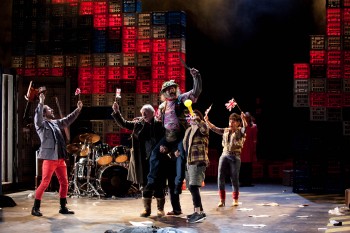
The integrity of the ambushed fight scene is weakened by the introduction of German tourists for cheap laughs. Shallow and Silence are supposedly watching football (or soccer, as Australians insist on calling it, although the flags are totally wrong) adding unnecessary business to detract from their speech as though they are worried that the plot alone cannot hold the audience’s attention. The overall effect is as though the company don’t trust the words, even adding modern speech to the policemen and making lame reference to slices of lime in necks of corona bottles for the line, “There’s lime in this sack”.
Messing with the rhythms and beauty of Shakespeare’s language is practically criminal. Primary school viewers may enjoy the match the pictures to the words approach, but Bell Shakespeare are guilty of throwing the baby out with the bathwater.
Labels:
Bell Shakespeare,
David Whitney,
Falstaff,
Felix Jozeps,
Henry 4,
Henry IV,
Hotspur,
Jason Klarwein,
John Bell,
Prince Hal,
review,
Shakespeare,
theatre
Thursday, 21 October 2010
Henry IV, Part One: Buzzing on the Banks of the Thames
Henry IV, Part One
Shakespeare’s Globe Theatre
July 8 – October 3, 2010
Dominic Dromgoole’s production of Henry IV, Part One at The Globe is sensitive and rambunctious; traditional and contemporary; and overall compelling viewing. It ranges from royalty to riff-raff; battlefields to brothels; city to countryside and high politics to low humour, and all of it is immensely entertaining.
The play examines the troubled relationship between sons and their fathers (both real and surrogate), and the nature of friendship as it alters with power, responsibility and age. Prince Hal has diametrically opposed father-figures, although he eventually rejects both of them, ‘breaking through the foul and ugly mists’ to emerge blazing as his own man.
I’ve always thought the part of Henry IV was a bit ineffective but Oliver Cotton delivers his conscience-wrestling quandary with dignity, sincerity and a great command of the language. On the other hand, there is the irrepressible Roger Allam as Falstaff. Falstaff is an unashamed scene stealer, milking every nuance to just the right extent, working his audience like a stand-up comedian so that we feel part of the show. He is morally reprehensible with a terrible attitude to life and impeccable comic timing. Whether he is exaggerating his part in a duel or delivering an in-depth and unfavourable analysis of honour – musing on philosophy as he casually devours a tub of ice-cream – he is a joy to witness.
The fact that Allam doesn’t dominate the entire play, however, is due to the comprehensive direction and the brilliance of the other characters. Jamie Parker has made me fall in love with Prince Hal and Henry IV, Part One all over again. From the moment he emerges from a trapdoor with his pants around his ankles and a twinkle in his eye, his conflict of self-interest is fantastic. The trading of insults with Falstaff is sublime: if only pub slanging matches were so witty. Hal maintains his irreverent sense of fun even as he matures before our eyes through the course of the play.
He can be noble and resolute and not afraid to shirk responsibility when it falls upon him. He knows what will be expected of him, and is itching to get down to the job. He mocks his father when he imitates him in a pub, but he defends him bravely in battle and foreshadows his steely rejection of Falstaff, ‘like bright metal on sullen ground’. The opposing natures of the young prince are both excellently explored. Will the real Prince Hal please stand up? I desperately want him to play Henry V – I’d follow him into a breach any time.
Hal also has to contend with Harry (Hotspur) Percy as a model of valour. Sam Crane indulges his fiery nature to provoke humour but also respect. He may be all-too prepared to fight for his beliefs, but at least he has some. Glendower (Sean Kearns) tries to restrain him with a steady hand and a mellifluous voice, but Hotspur remains tempestuous. He may be heated in battle, but lacks passion in his domestic relationships, much to the frustrated chagrin of his wife, Kate (Lorna Stuart). She behaves a little as though she is auditioning for The X-Factor and is too focussed on herself to interact with the others, although once again, you can hear every word that she intones.
The play (and its sequel) contain a good deal of principles and affairs of state, but the scenes are acted so well and spoken so clearly that you are never lost in the potential mire that could be English ‘War of the Roses’ history. Politics are given edge (literally) in sword fights and tavern scenes. The set, designed by Jonathan Fensom, incorporates rustic qualities as minimal touches elicit maximum effect. Heraldic banners hang from all the banisters and a simple backcloth unfurls to denote our locations, from the Boar’s Head tavern to the battle encampment or the King’s bedchamber. It is a delight and an honour to experience this production in its spiritual home.
It may be a traditional production in period dress but don’t be fooled into thinking it is sedate. It is infused with high energy from the riotous mummers’ performance at the beginning to the sardonic dance at the end which sends the audience out buzzing to the banks of the Thames. Music and singing enhances the play throughout with musicians augmenting the slick scene changes to ensure the action never flags.
Shakespeare’s Globe Theatre
July 8 – October 3, 2010
Dominic Dromgoole’s production of Henry IV, Part One at The Globe is sensitive and rambunctious; traditional and contemporary; and overall compelling viewing. It ranges from royalty to riff-raff; battlefields to brothels; city to countryside and high politics to low humour, and all of it is immensely entertaining.
The play examines the troubled relationship between sons and their fathers (both real and surrogate), and the nature of friendship as it alters with power, responsibility and age. Prince Hal has diametrically opposed father-figures, although he eventually rejects both of them, ‘breaking through the foul and ugly mists’ to emerge blazing as his own man.
I’ve always thought the part of Henry IV was a bit ineffective but Oliver Cotton delivers his conscience-wrestling quandary with dignity, sincerity and a great command of the language. On the other hand, there is the irrepressible Roger Allam as Falstaff. Falstaff is an unashamed scene stealer, milking every nuance to just the right extent, working his audience like a stand-up comedian so that we feel part of the show. He is morally reprehensible with a terrible attitude to life and impeccable comic timing. Whether he is exaggerating his part in a duel or delivering an in-depth and unfavourable analysis of honour – musing on philosophy as he casually devours a tub of ice-cream – he is a joy to witness.
The fact that Allam doesn’t dominate the entire play, however, is due to the comprehensive direction and the brilliance of the other characters. Jamie Parker has made me fall in love with Prince Hal and Henry IV, Part One all over again. From the moment he emerges from a trapdoor with his pants around his ankles and a twinkle in his eye, his conflict of self-interest is fantastic. The trading of insults with Falstaff is sublime: if only pub slanging matches were so witty. Hal maintains his irreverent sense of fun even as he matures before our eyes through the course of the play.
He can be noble and resolute and not afraid to shirk responsibility when it falls upon him. He knows what will be expected of him, and is itching to get down to the job. He mocks his father when he imitates him in a pub, but he defends him bravely in battle and foreshadows his steely rejection of Falstaff, ‘like bright metal on sullen ground’. The opposing natures of the young prince are both excellently explored. Will the real Prince Hal please stand up? I desperately want him to play Henry V – I’d follow him into a breach any time.
Hal also has to contend with Harry (Hotspur) Percy as a model of valour. Sam Crane indulges his fiery nature to provoke humour but also respect. He may be all-too prepared to fight for his beliefs, but at least he has some. Glendower (Sean Kearns) tries to restrain him with a steady hand and a mellifluous voice, but Hotspur remains tempestuous. He may be heated in battle, but lacks passion in his domestic relationships, much to the frustrated chagrin of his wife, Kate (Lorna Stuart). She behaves a little as though she is auditioning for The X-Factor and is too focussed on herself to interact with the others, although once again, you can hear every word that she intones.
The play (and its sequel) contain a good deal of principles and affairs of state, but the scenes are acted so well and spoken so clearly that you are never lost in the potential mire that could be English ‘War of the Roses’ history. Politics are given edge (literally) in sword fights and tavern scenes. The set, designed by Jonathan Fensom, incorporates rustic qualities as minimal touches elicit maximum effect. Heraldic banners hang from all the banisters and a simple backcloth unfurls to denote our locations, from the Boar’s Head tavern to the battle encampment or the King’s bedchamber. It is a delight and an honour to experience this production in its spiritual home.
It may be a traditional production in period dress but don’t be fooled into thinking it is sedate. It is infused with high energy from the riotous mummers’ performance at the beginning to the sardonic dance at the end which sends the audience out buzzing to the banks of the Thames. Music and singing enhances the play throughout with musicians augmenting the slick scene changes to ensure the action never flags.
Subscribe to:
Posts (Atom)
