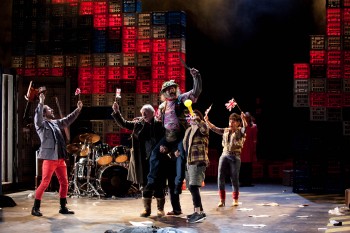
Henry 4
Bell Shakespeare
Canberra Theatre Centre, The Playhouse, 27 Feb - 9 Mar 2013
The point of Shakespeare’s history plays is that they are written about specific people at precise times and for explicit reasons – the clue is in the name really. So, while I appreciate Bell Shakespeare’s decision to condense Henry IV Parts One and Two into a three hour version, I fear they have lost a lot more than they have gained by this treatment.
The set of milk crates in a Union Jack formation, while effective visually and contextually – it is broken apart to allow characters to enter and depart – is an instant anachronism, as the first union flag of England and Scotland was not created until 200 years after Henry IV’s death. Instantly the entire power struggles, righteous rebellions and questionable route to claiming kingship is rendered irrelevant. Later lines, such as the usually gut-wrenching, “How I came by the crown, God forgive me. Plain and right must my possession be”, and “Lord knows what crooked way I have earned this crown”, are robbed of all potency.
At the interval, many of the young adults in the audience (I went to a matinee plagued with school groups) were asking each other what it was all about and did anyone know what was happening? Well might they ask, because most of the battle tactics, political and historical aspects are mercilessly cut leaving a hollow mess.
Harry Hotspur (Jason Klarwein), rather than being a worthy and brave opponent over whose dead body Prince Hal (Felix Jozeps) intones, “Fare thee well, great heart”, becomes a subject of ridicule. He is portrayed in commando gear; a macho action man, well-built and crass, whom Hal mimics and affords no respect. Hotspur’s impatience is translated as childish petulance and his banishment of his wife from his bed implied to be from homosexual motives and steroid use.
Although Henry IV (David Whitney) uses Jerusalem as a battle hymn, the fight with knives, chains and lead piping has no dignity. The attempt to link the Percy Rebellion or Northern Rising with the Cronulla Riots is cheap and illogical. Similarly Falstaff’s (John Bell) edited discourse on honour loses all impact because there is nothing glorious with which to contrast his cowardly actions. The lack of regal motivation is woefully absent and the speeches are bereft of any beauty and nobility.
So, what does remain? Director (and adaptor) John Bell seems to want to focus on the coming of age of Prince Hal from playboy Prince to shining ruler. There are two problems here. Firstly, the taverns of Cheapside and the company of Falstaff, Mistress Quickly (Wendy Strehlow) et al are meant to be attractive. There is nothing enticing about the pole-dancing joints and dingy bubble-wrap covered sofas and bus seats in which the young prince carouses. The tavern scenes are drenched in booze and debauchery and are tawdry and dull rather than appealing.
The rubber gloves and plunger favoured by Mistress Quickly are indicative of the proverbial bargepole with which one wouldn’t want to touch Sir John Falstaff – embodied here as a disgusting and greasy old rocker shambling about in an ill-fitting waistcoat. If he is meant to offer an alternative father figure of fun for Prince Hal, it is an extremely unattractive one.
The other problem is that is hard to believe in Prince Hal’s kingly qualities. In this performance he was played by an understudy and perhaps the original casting (of Matthew Moore) was much stronger. Felix Jozeps was cast as Boy (amongst other roles) and this would have suited him far better. He acts like the irritating adolescent in the Zits cartoon strip – all lanky limbs, floppy hair, ill-bred mannerisms and self-entitlement. When Henry IV berates his son, the king is far more dynamic than either character had been in the previous foreshadowing scene between Hal and Falstaff. With his feet on the sofa and slouching posture Hal is awkward in front of his father, and King Henry IV literally walks rings around him.

King Henry IV is harsh, bold and unfriendly, surrounded by men in suits who think his son is a waster – and they’re right. Prince Hal may want his father’s love and respect, but he doesn’t go out of his way to earn it. In his army costume and beret he looks like a Thunderbird puppet, and his hugging and hogging of the crown during his father’s death scene is pathetic rather than potent.
Hal’s eventual denouncement of Falstaff seems petty and vindictive rather than necessary for the health and future of the nation. We are not chilled as we should be when Falstaff claims, “The laws of England are at my commandment” because we haven’t been led to believe that the stakes are particularly high. Neither is there anything revealed in the portrayal of Prince Hal to indicate that he will “imitate the sun” and “show more goodly, and attract more eyes/ Than that which hath no foil to set it off.” It is impossible that this sullen teenager will become one of England’s greatest ever monarchs.
The production contains some excellent acting – namely Sean O’Shea who has crisp delivery as Shallow, and Yalin Ozucelik who brings a much-needed amicability to the loyal companion character of Poins. The frenetic band, incorporated into the action with the drummer seated on stage also enhances the pace of the action, but the direction is inconsistence with a muddle of metaphors.
The integrity of the ambushed fight scene is weakened by the introduction of German tourists for cheap laughs. Shallow and Silence are supposedly watching football (or soccer, as Australians insist on calling it, although the flags are totally wrong) adding unnecessary business to detract from their speech as though they are worried that the plot alone cannot hold the audience’s attention. The overall effect is as though the company don’t trust the words, even adding modern speech to the policemen and making lame reference to slices of lime in necks of corona bottles for the line, “There’s lime in this sack”.
Messing with the rhythms and beauty of Shakespeare’s language is practically criminal. Primary school viewers may enjoy the match the pictures to the words approach, but Bell Shakespeare are guilty of throwing the baby out with the bathwater.
Congratulations to Roger Allam, who won the Best Actor Olivier Award 2011 for his portrayal of Falstaff in the Dominic-Dromgoole-directed Henry IV Parts 1 and 2.
Of course, the fact that I saw these shows at the Globe Theatre when I was home in England last year makes me especially happy. Although I knew they were excellent at the time, it never does any harm to have that opinion validated by so-called experts.
I feel honoured to have been able to see such great work, which was both thought-provoking and thoroughly enjoyable. I still think of it six months later and crave the opportunity to see such stirling theatre on a regular basis.
The Merry Wives of Windsor
Shakespeare's Globe Theatre
August - October 2010
The Merry Wives of Windsor rounds out the trio of ‘Falstaff plays’. Whether or not it is true that Queen Elizabeth I commissioned the play because she wanted to see ‘the fat knight in love’ is a moot point (not least because he never is actually in love, apart from with himself and his own advancement) but the tone is certainly lighter than the previous two parts of Henry IV.
It may best be described as a mixture between an early rom-com and a blatant farce, with a main plot and another couple of subplots both hindering and enhancing the action. Running out of money, Sir John Falstaff (Christopher Benjamin) attempts to win the affection of a wealthy mistress and sends identical letters to Mistress Ford (Sarah Woodward) and Mistress Page (Serena Evans) with the intention of seducing them into bed and out of their fortunes. When they discover his plan they easily outwit him, pretending to go along with his adulterous intentions only for him to be ‘discovered’ unless he escapes in humiliating ways (hidden in a laundry basket and subsequently dumped in The Thames or disguised as the witch of Brentford who is soundly beaten by her enemies).

 Falstaff thinks he is irresistible to women despite the fact that he is grotesquely overweight and old – somehow Benjamin’s embodiment of this and his descriptions of his humiliations make him warm and loveable rather than arrogant and offensive. He is also somewhat diminished by Mistresses Ford and Page who prove to be more than a match for him. Woodward and Evans are both excellent in their distinction between acting and overacting when they are ‘caught out’ in the presence of the would-be Lothario. Their girlish scheming is a joy to watch and their daring antics could teach those whey-faced desperate housewives a thing or two.


Henry IV, Part One
Shakespeare’s Globe Theatre
July 8 – October 3, 2010
Dominic Dromgoole’s production of Henry IV, Part One at The Globe is sensitive and rambunctious; traditional and contemporary; and overall compelling viewing. It ranges from royalty to riff-raff; battlefields to brothels; city to countryside and high politics to low humour, and all of it is immensely entertaining.
The play examines the troubled relationship between sons and their fathers (both real and surrogate), and the nature of friendship as it alters with power, responsibility and age. Prince Hal has diametrically opposed father-figures, although he eventually rejects both of them, ‘breaking through the foul and ugly mists’ to emerge blazing as his own man.