Tuesday, 8 October 2013

Australian Galleries 1

"Painting is an argument between what it looks like and what it means" - Brett Whiteley
Having been confounded by contemporary art in the Art Gallery of New South Wales, I reassured myself with work that I actually like. Each time I come to Australian art galleries I familiarise myself more with local artists, themes and styles. I have just included in this post some of my favourites.

Whiteley's return to Australia in 1969 heralded a new preoccupation with colour and beauty. Inspired principally by Matisse, but also by his house at Lavender Bay on Sydney Harbour's north shore, he created a series of large scale paintings of expansive interiors and views evoking the marine beauty of the harbour. I like this expansive blue canvas dotted with boats and the faint white line-drawing of the bridge.

The Balcony 2 (1975) by Brett Whiteley
John Olsen is possibly best known for creating the mural, Salute to Five Bells, in the Sydney Opera House, inspired by Kenneth Slessor's poem. He wrote of this painting:
"Five bells was my first commission to paint in situ to cover a wall … I didn’t hesitate. I brushed a line around the core theme, the seed-burst, the life-burst, the sea-harbour, the source of life. Inside and around this core, I painted images drawn from metaphors and similes in [Kenneth] Slessor’s poem of our harbour city, and from my own emotional and physical involvement with the harbour, and with my young family in Watsons Bay …I wanted to show the Harbour as a movement, a sea suck, and the sound of the water as though I am part of the sea ... The painting says directly what I wanted to say: ‘I am in the sea-harbour, and the sea-harbour is in me’." - John Olsen
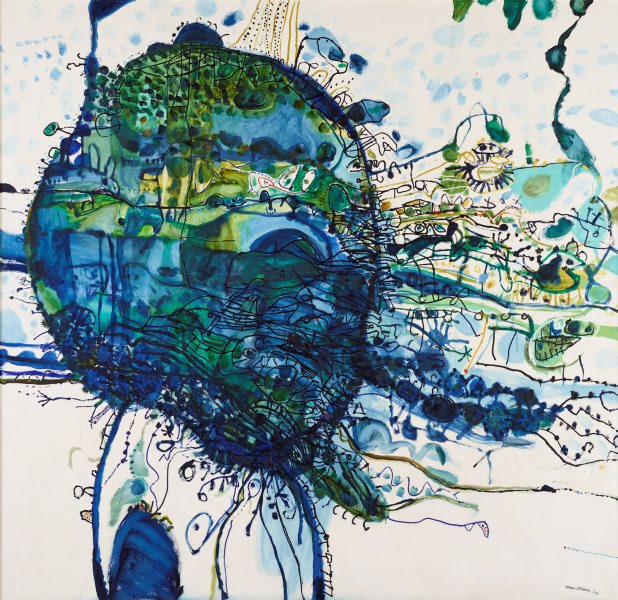
Five bells (1963) - John Olsen

John Brack uses repeated angular forms for his painting of a woman mid-conversation. Communication is usually a positive thing but in this sepia tinted rendition it is strained and isolating. The viewer, positioned as a direct and close observer, is drawn into the stark geometry of the composition.
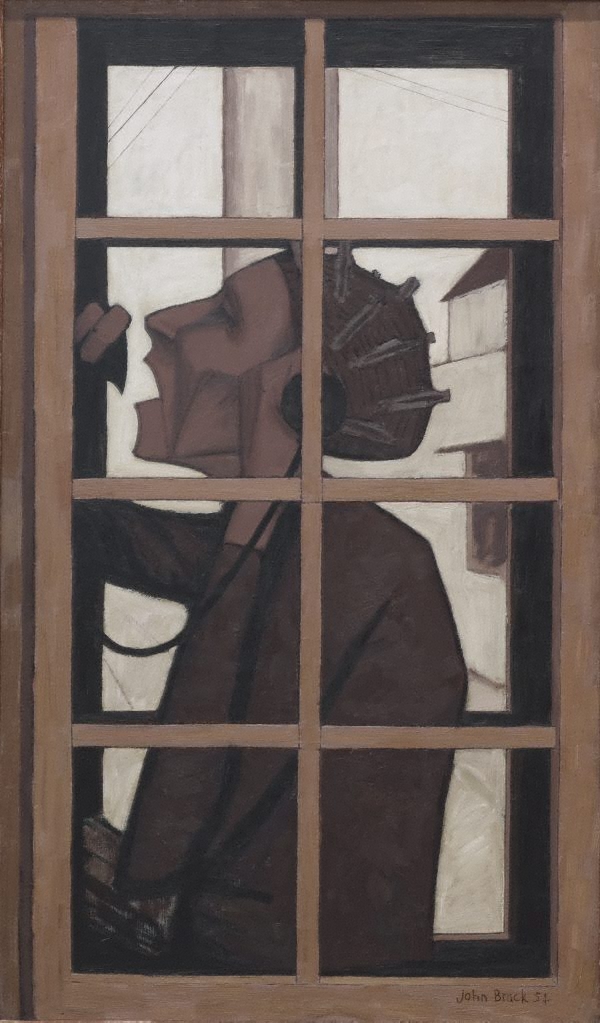
The Telephone Box (1954) by John Brack
Arthur Boyd's Nebuchadnezzar on fire falling over a waterfall features a bright meteor plunging toward a waterfall in the Austalian bush, with its distintive greens, olives, blues and yellows. The figure's splayed fingers recalls the Old Testament punishment of Nebuchadnezzar who was punsihed by God by being driven insane, ‘his nails like birds’ claws’ (Book of Daniel). There are further similarities with both the legend of Icarus and the self-immolation of Vietnam War protestors.

Nebuchadnezzar on fire falling over a waterfall (1966-68) by Arthur Boyd
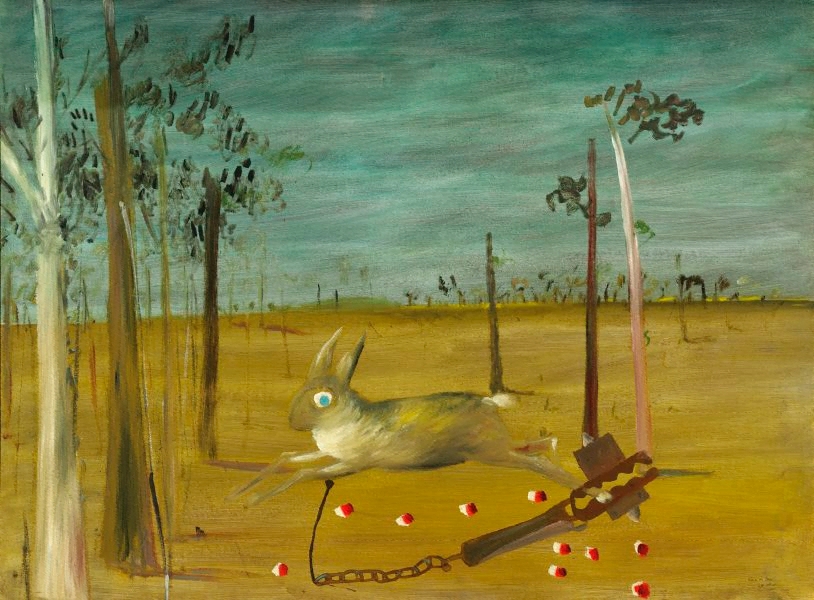
"With its startling blue eye conveying fear, pain and a desperate struggle for freedom, Hare in Trap is powerfully autobiographical. Nolan himself suggested that the hare’s eyes relate to an incident during a car trip to northern Victoria, when the painter and his father came across a hare caught in a trap – the resultant look in his father’s blue eyes struck Nolan vividly. This beautiful, enigmatic painting, which can be read as a self-portrait, is revered universally by scholars and Nolan’s admirers as one of his finest masterpieces."


Hare in Trap (1946) - Sidney Nolan
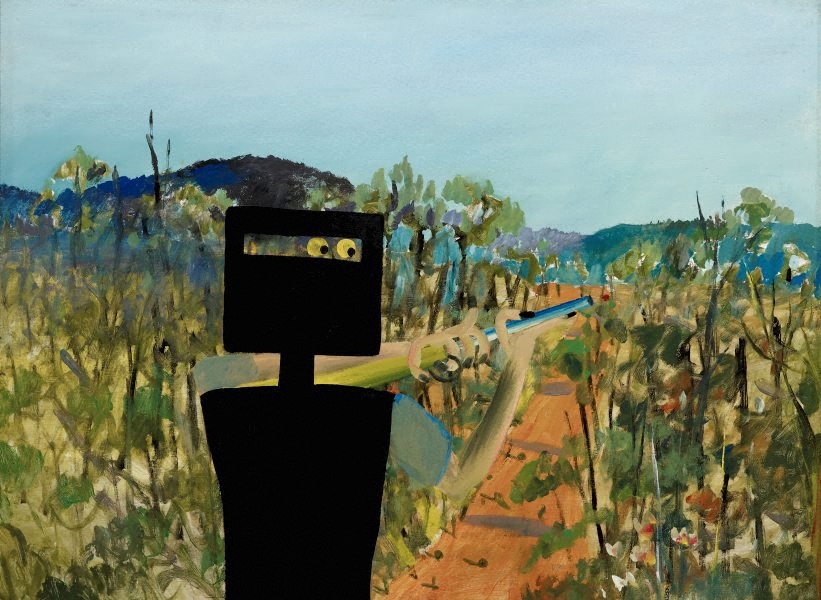
First-class marskman shows the isolated figure of Ned Kelly in the solid black armour that is Nolan’s most inventive pictorial device, its flat abstracted shape incongruously placed against a landscape of lyrical delicacy. The title refers to an incident which took place in Victoria’s Wombat Ranges, when Kelly and his gang were practising their marksmanship, firing hundreds of rounds at surrounding trees from a bullet-proof hide-out.

First-class marksman (1946) - Sidney Nolan
Albert Tucker, friends with Sidney Nolan, was impressed with the photographs the latter brought back from the 1952 Queensland drought. Many of them show the harsh effects of the climactic conditions in dessicated carcasses.
Apocalyptic horse (1956) - Albert Tucker
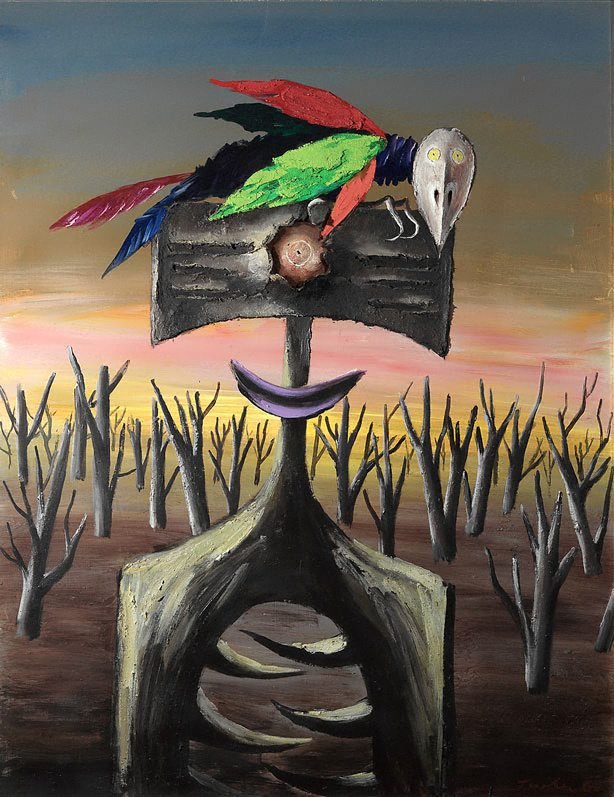
Faun attacked by parrot 3 is a direct reference to Nolan's style, with the exposed ribs and square head against the bleak landscape of burnt tree trunks echoing the paintings of the Ned Kelly series. The bright-feathered parrot, however, with the 3D beak and quirky face is typical of Tucker.

Faun attacked by parrot 3 (1968) - Albert Tucker


Sunday, 6 October 2013

Quote for today: And the point is...


Reading Aloud - Julius LeBlanc Stewart
"The point of a story is that it is that, a story, not a tract developing a moral. It is itself and it tells you." - Marion Halligan, The Apricot Colonel

Friday, 4 October 2013

Friday Five: University Novels


I am currently rehearsing for a play by Helen Machalias called In Loco Parentis. It is set on campus at university and explores the question of just who is responsible for the welfare of the students. It raises some interesting issues and as I am working with young folk who are still undergoing the graduate experience I am amazed at how much it has changed in the past twenty years. In other ways it hasn't. To wit: people still do the incredibly stupid things that we used to, but now they look to blame someone else for the consequences.

Anyway, it led me to think about the novels I have read set in universities and how they have changed over time. It seems the biggest difference has been in 'elitism' which has now come to be a dirty word. People used to go to universities because they were academically bright. Now they go because everyone can and it stops them having to get a 'real' job for a few more years. In general the attitude towards those attending (both students and lecturers) has become less respectful or mysterious and a lot more antagonistic and commonplace.

I have never read Brideshead Revisited by Evelyn Waugh, or any of Tom Sharpe's varsity novels, although I'm told they're hilarious. I was also told that about Lucky Jim by Kingsley Amis, although I didn't find it to be so. I read it at a fairly young age, but I found it callous, cruel, sexist and with a chip on its shoulder. I feel the same way about Bret Easton Ellis' novels, with an added dose of shiny narcissism and lackustre prose, so I am discounting The Rules of Attraction.

Although James Joyce's Ulysses nearly destroyed me (it is the novel it has taken me the most attempts to read), I actually read A Portrait of the Artist as a Young Man at the first try. I'm not a fan of the stream-of-consciousness novel, however, so it's not one of my favourites. Nor is Europa by Tim Parks for the same reason, although there were some light moments buried amid the lengthy paragraphs.

Thomas Hardy's Jude the Obscure is a powerful tragedy but it made me laugh out loud, which cannot be a good thing. Maybe I am lacking in sensitivity, but I felt Thomas trampled all over subtlety, as did Donna Tartt in The Secret History. This is highly praised by many of my friends (whose opinions on such matters I respect) but I failed to see anything above the obvious in this over-long and condescending novel. I do consider J M Coetzee's Disgrace to be a piece of brilliance, but it strays from campus early on, so probably doesn't count as a university novel.


5 Favourite Varsity/Campus Novels:
  1. Still Life/ The Biographer's Tale - A.S. Byatt: the woman can write! And no, before you ask, I've not yet read Possession. It has been on my bookshelf for years, calling to me for a special occasion - this Christmas perhaps?
  2. Deaf Sentence - David Lodge: the first novel of his that I have read. I doubt it will be the last.
  3. Jill - Philip Larkin: his poetry can be a bit annoyng, but his prose style is sublime.
  4. Gaudy Night - Dorothy L Sayers: life at a women's college in Oxford, struggling for equality in both academic and social spheres - but such fun!
  5. Degrees for Everyone - Bob Jones: academic satire, which is cutting, acerbic and sadly true. 

Wednesday, 2 October 2013

Every Cloud Has One

Silver Linings Playbook could be the worst representation of a film by trailers ever. I didn’t think I would particularly enjoy it (but am cursed by a need to see all Oscar-nominated films), but five minutes into it I realised that I read the book (by Matthew Quick) four years ago and loved it.

Maybe my memory is going and I should have remembered the title, but being as they changed the lead character’s name and ethnicity, the importance of the minor characters (who are truly minor in the novel), the ending and the whole point of the story, it may not be quite so surprising. I still liked the film – very loosely based on the novel – but the question remains; did Jennifer Lawrence deserve that Oscar for best actress?

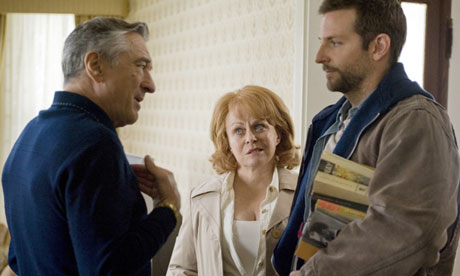
The answer is possibly, but no more so than Bradley Cooper as best actor, but then, the Academy had already decided to give that to Daniel Day Lewis in Lincoln, which meant the best aspect of this film went unrewarded. Cooper plays Pat Solatano Jnr., who checks out of a mental health institution against medical advice. He was committed after assaulting his wife’s lover and has served his sentence, but has also been diagnosed with bi-polar disorder.

One of the conditions of his release is that he moves home with his parents – father Pat Snr. is a study in OCD played by Robert de Niro, while mother, Dolores, is an anxious conciliator played by Jacki Weaver. Pat Jnr. has a couple of ambitions: to get back his old job as a substitute teacher, and to get back with his ex-wife, Nikki. He believes he can accomplish his goals through healthy living (he runs every day) and positive thinking, looking for silver linings in every situation, and remaking himself by avoiding negativity, “a poison like nothing else”.

In keeping with his new up-beat mentality, Pat Jnr. reads only the books on the English language syllabus that have happy endings – he throws Hemingway out of the window. Neither does he approve of Lord of the Flies in which he deplores that humanity is nasty, and there are no silver linings. Even if he weren’t suffering a mental illness, he would find it tough to remain resilient in the face of his brother, Jake’s (Shea Whigham) insistence on talking of all the things that are going right for himself and wrong for Pat Jnr.

He also worries about his father’s commitment to the Philadelphia Eagles, who seem to suffer from an inferiority complex, getting close to success and then blowing it. Pat Snr. attempts to control the results of the games through various rituals with handkerchiefs and envelopes. The sport, however, is the way that they bond, and, although his father has been banned from the stadium, they go to watch a game together, with Dolores’ advice to, “Don’t drink too much; don’t fight anybody.”

His old friend, Ronnie (John Ortiz), invites him to dinner with his domineering wife, Veronica (Julia Stiles) and her sister, Tiffany (Jennifer Lawrence), dealing with her husband’s death through reckless promiscuity. If this is supposed to offer an alternative home scenario, it is not a particularly appealing one. Everyone has problems and is undergoing a variety of therapy. Ronnie goes to the garage when he gets angry, where he plays loud music and punches things to work out his aggression.


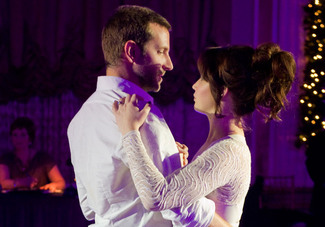
Besides sex, Tiffany uses dance as a physical outlet. She is the first to admit, “I’m not that great a dancer, but who cares – it’s therapy and I like it” She needs a partner to perform a routine, so she teaches Pat Jnr to dance, sharing intimacy and touch. More than the necessary steps, he learns to let go of the past and painful memories and begins to live in the present, assimilating valuable lessons of focus, collaboration and discipline.

Pat Jnr knows that he lacks a filter when he talks, which allows him to ask inappropriate questions no one else would broach. While this can be awkward, it also leads to occasional humorous circumstances. Yes, this film is actually billed as a romantic comedy, in defiance of all categorising constructs. Who knew that restraining orders, neuroses, grievous assault, pain, anger and sorrow were funny? The mother, father, and son trio form a lonely and dysfunctional unit, which seems unlikely to provoke laughs.

The camera-work is hand-held jerky although at the low end of the nausea scale, and the direction (David O. Russell) is light although slightly inconsistent. Russell also wrote the screenplay and he has made the main characters much more likeable and ‘fixable’. There are some continuity issues with costume and jewellery, but I’m prepared to overlook them for the mostly fabulous soundtrack featuring a range of great music from the Clash and the White Stripes through to The Stranglers and the Sex Pistols.

Tuesday, 1 October 2013

Crossing the Line: 'Contemporary Art'

I love art. I love the whole concept of transmitting ideas through visual media. I spend a lot of time in art galleries, wandering about, looking and thinking and feeling. I often feel like that robot in Short Circuit who needed input, and I search for it such places. Obviously I like some stuff more than others – we all do. There’s nothing wrong with that. Art is largely subjective, and that’s completely acceptable and, in fact, what makes it so interesting.

Sometimes, however, I feel as though it is April Fool’s Day, and I find myself looking for the candid camera, such as at the Contemporary Gallery of the Art Gallery of New South Wales in Sydney. I realise some people might like this, and fair play to them, but for me there is a line and this is where I draw it. These really are the Emperor’s New Clothes.

If the explanation is more artistic than the execution, it is a failed project. The real artist is the curator or whoever has written this guff – the more you need to write; the less successful the artwork. Now, I’m all for words and words for all, and I agree that great art can be complex and evade easy interpretation; it can draw you in and make you think, but these particular pieces just made me laugh. And not in a good way. See for yourself.

Wall Drawing #337 and Wall Drawing #338 by Sol Lewitt
Sol Lewitt has an artwork here called Rectangle Open: it’s a large white frame in the shape of a rectangle. Yup, that’s it.

His Wall Drawing #337 looks like a series of test paint colour spots on the wall, as a home rennovator decides which shade of magnolia they want in the hallway. Apparently they are created by ‘professional draughtspeople following Lewitt’s instructions’ thus making the instructions themselves the work of art. Seriously, that's what it says. 

The descriptor adds that the works are manifested by others – all are slightly different and no single work is the definitive version. The pretentious artist piffles on that it is ‘as though I am writing a piece of music and somebody else is going to play it on the piano.’ There are another 336 of these? They are certainly four-letter drawings beginning with 'w'. 

Canopy LI by Brian Blanchflower
Poor Brian Blanchflower is seemingly 'little known outside his native Perth.' Shame. Many more poeple could do with a laugh. The hapless viewer is instructed that these works (there are four of them) of oils on wax medium and pumice powder on laminated hessian exude energy in their technique.

The coarse thickness of paint on the support and then repeated gestures that both recede and deepen, and the layering of pigments, visually swell the material surface. The effect of the paintings is meant to be similar to the under-painting of Monet’s late water-lilies, as the angle of the light is reflected from the surface to reveal structures and grids embedded in the layers of paint, as you move around the room.

Pictorially the images map out the rhythm of time passing with marks, gestures and colour. The multiple layers of colour and mineralised paint suggest geological accretion. Metaphorically they chart the passage of the heavens or the earth; “this expression of the void in the earth, of being and nothingness, invokes the horizon where consciousness and materiality lightly touch.”

Untitled (elongated plinths) by Rachel Whiteread
"Rachel Whiteread is known especially for her negative casts of domestic spaces, in which she turns empty space into a solid. Here she has cast the plinth forms in the negative from a classically moulded silhouette of a dado that has been stretched to make a positive form the size of a bed or a mortuary slab. They are exactly the right size to be containers for the human body and could easily be read as sarcophagi.

"In addition to being made strange by elongation, the material is a semi-opaque white plastic over foam, which has an oddly ambiguous materiality. From a distance it could be marble, reinforcing the tomblike appearance. At close quarters, however, the light seems to be within the objects, or passing through them. This apparent transparency or luminosity makes them very mysterious, like the cryogenic containers so often represented in science fiction movies."

Friday, 27 September 2013

Friday Five: Fame. What's your name?

The Master: William Shakespeare
What is the height of fame for a writer? Arguably it would be that your name has become an adjective, the meaning of which is known to people who haven’t even read your books because you epitomised a style or a genre.

I ran a few of these past Him Outdoors, to see if he recognised them too or whether it was just me assuming that everyone had heard of them. He rejected Homeric, Jamesian, Proustian and Kafka-esque; they are obviously more literary criticism than common parlance.

I rejected Freudian on the grounds that it is not his writing that is acknowledged by the term, but his theories. Many people have only a loose understanding of what they are anyway, and simply think it means mentioning sex in an inadvertent manner. So these are the words on which we agree.

5 Common Adjectives Taken from the Names of Authors:
  1. Shakespearean – can mean almost anything from his language to his characters to the time in which he lived. If you are going to use this word to describe anyone’s writing, they had better be bloody brilliant.
  2. Orwellian – most usually associated with Big Brother, the thought police, doublespeak and the invasion of personal freedom by state intervention; it’s never a good thing.
  3. Dickensian – often linked with squalor and poverty, particularly of London, or jolly Christmases. Also relates to random well-drawn dramatic characters who linger on the periphery of the action.
  4. Wildean – witty and epigrammatic with acerbic undertones; dandyish for men; serious ‘with a past’ for women; and a suggestion of peacock feathers all round.
  5. Hardyesque – doom and gloom and pathetic fallacy, which is when nature, the weather and the seasons echo mood and foreshadow story. He is most famous for his tragedies in which people struggle against the great unfeeling world, and their minor faults are counted against them for the rest of their lives. NB – don’t ever sell your wife at the county fair.

Thursday, 26 September 2013

Storybook Staging

The Book of Everything adapted by Richard Tulloch from the novel by Guus Kuijer
Directed by Ed Wightman
Canberra Repertory, Theatre 3
13-28 September, 2013


As I have had a fair bit to do with this play and am friends with a number of the cast and crew, it wouldn’t be unbiased of me to review it. However, I loved it and cannot let it pass without a comment or two, so I shall focus on the set. Designed by Andrew Kay, it does exactly what a theatre set should: it enhances the play while according perfectly with the director’s vision.

What matters to you when you are nine (nearly ten), as is Thomas Klopper, the young hero of the play? Mainly your focus is on yourself, your family, and your neighbours. School and education are other factors, balanced by a heavy focus on religion, which dominates the family’s life due to the (literally) Bible-thumping Papa. Like childhood itself, the play follows a roller-coaster of emotion where being happy seems an incredible achievement and ‘a damned good idea’.

Like a stunningly-crafted pop-up book, the stage is ornamented by a row of quirky townhouses, tall and narrow and ranging in heights with pointed, neck and bell gables. The setting is Amsterdam, but it is a child’s Amsterdam of canals and bicycles, not the strip clubs and cannabis coffee shops favoured by backpackers and stag parties.

And as with those houses in Amsterdam, the frontispiece is merely a facade. The fronts peel back like the flaps of a dollhouse to reveal a kitchen, a sitting room, a bedroom and a church, which is ‘not even a real church. We go to someone’s house in Amsterdam West’. In another stroke of genius, the interior walls are blackboards, on which chalk pictures have been drawn to illustrate our location – a clock; a row of coat hooks; stairs; a window; a religious icon; a fish-tank.

The two-dimensionality of the flats is enlivened when props or pieces of furniture are required. A small cupboard opens to disgorge a table and chairs or a relaxing armchair. Secret nooks stash a cup of sugar or a selection of books – each built specifically to accommodate the play’s mechanics and cunningly hidden until the necessary moment. Lighting enhances and embraces this set effectively guiding the viewer’s attention to the desired spot and highlighting critical moments, such as making the fish tank change colour in a stylised horror scene.

All this is clever enough, but the flats are actually double hinged, so they can be opened either way, thus doubling the interior decor – like a sort of Dutch tardis effect. Andrew explains it as a Jacob’s ladder design. When the folk toy, made from wooden blocks and held together with string, is held at one end, the blocks appear to tumble down the string. This is a visual illusion, however, caused by each consecutive block flipping over.


Because of the toy’s biblical name (Jacob dreams about a ladder to Heaven in the book of Genesis), Puritan children were allowed to play with it on Sundays. Thomas’ father will not let his family even take the tram on Sundays as ‘Apparently, the two worst things in the world are being a traitor in the War, and riding in a tram on Sunday.’

This reminds us that the play is set in 1951. The War has not long been over and it has left scars. Mrs Van Amersfoort, whom the children taunt for being a witch because she is a little eccentric, mutters to herself as she walks, and ‘always wears black dresses’, lost her husband during the Nazi occupation. She strips away all childhood naivety as she informs her young neighbour Thomas, ‘The Nazis caught him. They put him against that wall out there, and they shot him dead.’

The horrific baldness of this statement is breathtaking, and you almost expect to see the blood running down the winding cobbled street painted across the front of the stage. The implication is that these walls barely screen rather than utterly conceal. It was a bookcase in front of a wall in Amsterdam that hid arguably the most famous diarist, Anne Frank and her family, for more than two years. Ultimately, resistance is not futile.

Mrs Van Amersfoort is also the one to mention the hidden monster that pops up in the Good Book. Abuse and hypocrisy hide behind the closed doors of the Klopper household, but she pries them open, aware that these secrets must be exposed to the air rather than left to fester inside – as she tells Thomas, ‘We’re neighbours aren’t we? These walls are thin.’

The writing is on the wall. Chalk dust on a blackboard leaves a trace that can never really be rubbed away. ‘That slap on his mother’s soft cheek... all the slaps his mother had ever received, a rain of slaps...’ creates an imprint that may physically fade but will never emotionally vanish. Evil in all forms does not necessarily have to be punished, but it must be confronted.

Although it is a very personal story, it also has a much grander scope and demands to be told. As we should be aware from the opening line, this is a global tale. ‘The Book of Everything by Thomas Klopper, aged nine... nearly ten. Address: Breughelstreet 3, Amsterdam, Holland, Europe, Northern Hemisphere, Earth, Solar System, Galaxy, Universe, Space.”

Just as the wooden houses tell a story, so does the diary Thomas keeps, in which ‘I write everything down so that later I’ll know exactly what happened’. The pages of this ambitiously-named titular Book of Everything contain their secrets, and opening them up is tantamount to opening Pandora’s box, so beautifully echoed by the set design. To paraphrase a line from the play; I’m not writing this (just) because I would like Andrew to design the set for any play I ever direct. I am writing this because it is true.