Tuesday, 22 October 2013

Daniel Day-Lewis IS President Lincoln


In Britain we have a royal family to obsess over. America has their presidents. Some have achieved legendary status for good or bad, but the good can barely be questioned. Abraham Lincoln is among these monolithic myths, and, with his latest film, Steven Spielberg has added to the general hagiography.

Just over twenty years ago Oliver Stone made a film about JFK which was equally reverential and full of similar examples of good actors struggling with a tedious script. In other words, it is incredibly worthy and desperately dull. Sally Field, Tommy Lee Jones, James Spader, David Strathairn and, indeed, the entire supporting cast are excellent, but this is a star vehicle for one man only, and Daniel Day-Lewis embodies the eponymous character to a frightening extent.


DDL (as he is referred to in the Hollywood press) is a notorious method actor and apparently he didn’t drop his assumed accent or stoop for three months of filming. The physical similarity is remarkable and when he stirs in his chair in the opening scene, it is as though the great Lincoln memorial has come to life. His voice is almost atonal and though there is fire in his argument it is not apparent in his delivery. He shuffles, looks down when he talks, chuckles to himself and presents as a shambling and slightly delusional drunkard.

He is also constantly telling anecdotes, gathering his staff around him like a luvvie director holding court before his sycophantic crew. His wife (the indomitable Sally Fields) reflects, “How the people love my husband. They flock to see him on public events”. However, great sympathy is shared with the Secretary of War, Edwin Stanton (played by Bruce McGill) who rails, “I don’t believe that I can bear to listen to another one of your stories!”

Lincoln must be impeccably researched and the ponderous dialogue is probably taken from transcripts – there is such a lot of it. Lincoln was a lawyer, and there are plenty of lectures which would feel at home in a courtroom. We are reminded that he was a political genius and favoured rational justice and stirring speeches rather than flamboyant gestures or theatrical fanaticism. He frequently repeats his salient points and resorts to Euclidean geometry to strengthen his message – “Things that are equal to the same thing are equal to each other – this is self evident”.
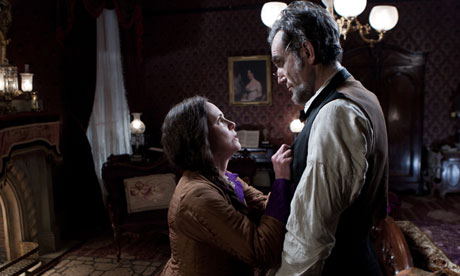

Doubtless there is meticulous attention to detail and the beautifully-framed set pieces would make an excellent stage for a play. The interior décor almost certainly suits the period (1865) perfectly, but it’s very stuffy and there are a lot of dark rooms, which makes it tiresome to view. Titles appear across the screen as each member of the confederacy or other important political figure is introduced, highlighting the documentary feel.

Lincoln attempts to do anything to win support for his 13th Amendment, which will abolish slavery and involuntary servitude, except as punishment for a crime, and is not above boardroom deals. Despite a tense voting scene, the action is severely limited for a film set in the midst of the bloodiest period of American history – more American men died in this conflict than in all other American wars combined.


We are also presented with a very simplistic view in which the Civil War was fought entirely over slavery between the Slave South and the Free North. While Lincoln preaches, “We begin with equality. That’s the origin isn’t it? That balance, that’s fairness, that’s justice” his detractors counter, “Congress must never declare equal those whom God created unequal”. There is hours of this stuff, as the debate drones tireless on. While we modern enlightened viewers clearly know which side is right, we cheer to Thaddeus Stevens’ (Tommy Lee Jones) interjection wishing to know when we can see an end to this “interminable gabble”.


As one of his black and white treatises on slavery, I prefer Spielberg’s Amistad. Watching Lincoln, the viewer may be forgiven for imagining they are back at school and being forced to sit through a fairly elementary history lesson. Lincoln himself confirms, “I could write shorter sermons but when I get started I'm too lazy to stop”.

Apparently the fear is that if slavery is abolished the men will have to be enfranchised. Whatever next; votes for women? They needn’t have worried – another 100 years had to pass before emancipation. Lincoln claims, “I’ve found that prophesying is one of life’s less profitable ventures,” which was perhaps just as well.

With the war over and the amendment passed, it remains to Lincoln to lead the country “with malice toward none; with charity for all... to bind up the nation’s wounds”. Of course, he will have far more personal wounds with his assassination (not shown on screen as the viewer is in another theatre when the fatal shot is fired), but he will belong to history.

To a score by John Williams, Lincoln strides into the dust to cast a shadow like a spectre over all American politics. References resound of George Washington, John Quincy Adams, James Monroe, and Thomas Jefferson throughout the film. It is self-evident that Abraham Lincoln takes his rightful place in this sparkling quintet. It is also obvious from the opening credits that DDL will earn an Oscar for his character portrayal. It is less clear whether the film is as assured.

Friday, 18 October 2013

Friday Five: Short Stories

The announcement of Alice Munro as the recipient of the 2013 Nobel Prize for literature has caused a minor flurry of interest as she is known pedominantly as a writer of short stories. Short stories are often considered the poor cousin in literary fiction, although many authors of full-length novels also excel at this discipline.

Meanwhile, the shortlist for the eighth annual BBC national short story award is comprised entirely of female authors. The chair of judges, Mariella Fostrup, suggests that the format is 'suited to the innovative brilliance of female writers'. This is clearly a contentious comment designed to create controversy. A such, it is not far removed from the patronising notion that women write short stories because they can only a snatch an hour here and there between rearing children and cleaning houses and their poor little brains can't cope with anything on too grand a scale.

When living in New Zealand, I read a lot of Kiwi short stories and I liked very few. The problem from my perspective was that they weren't actually stories with beginnings, middles and ends. One author stated she preferred to think of them as 'short fictions' as she felt the 'structured semantics of storytelling were tyrannous and restrictive'. In this case, you are not writing a story. At best, what you have is a poem; at worst, a creative writing exercise. Suffice to say there is much debate as to what defines a short story.

A good short story is a good short story, no matter who writes it. When I was a child I was incredibly impressed by Oscar Wilde's fairytales, Aesop's fables, Rudyard Kipling's Just So Stories and Enid Blyton's accounts of pixies and goblins. I read my way through stories of King Arthur and Robin Hood. I progresed to Greek mythology and the Bible.

My parents gave me a book of Saki's short stories to read as a young woman: I can't thank them enough. Edgar Allan Poe tortured my nights and expanded my mind. Charlotte Perkins Gilman and her tale of 'The Yellow Wallpaper' exposed me to an empathetic world I had never previously imagined. There are so many short stories that left lasting impressions, but I will attempt a truncated list.

5 Favourite Short Story Writers:
  1. Roald Dahl - going from his children's stories to his adult shorts was a revelation. I haven't touched royal jelly since.
  2. Alice Walker - her world is not my world, but she welcomes me in through her short stories.
  3. Stephen King - his stories are so well constructed and the format suits the horror genre.
  4. Edith Wharton - similar to the above, the glimpse of ghosts in her short stories are tantalisingly terrifying
  5. Jon McGregor - earlier this year I read This Isn't the Sort of Thing that Happens to Someone Like You: it was the best collection of short stories I have read in a long time.
One of Laura Beckman's illustrations for Roald Dahl's Royal Jelly

Thursday, 17 October 2013

Shining Example


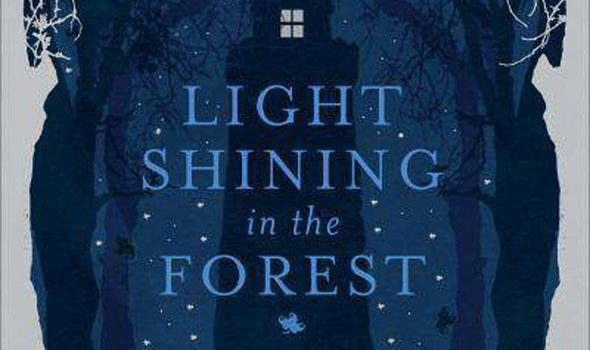
Light Shining in the Forest by Paul Torday
Weidenfeld & Nicolson, $29.99
Pp. 350

Every five minutes a child goes missing in the UK. This bald fact is reiterated throughout this novel, which deals with absent children, presumed runaways or victims of kidnapping. And yet it is not a police procedural.

Geordie is a logger working alone in the forest. His relationship with Mary is collapsing and his mind strays since the unexplained disappearance of their son, Theo. The overtones of the kindly woodcutter are strong and the presence of the trees becomes ominous like those in a pop-up storybook. “The trees are there because the trees are there.” If this is a fairytale it is more Brothers Grimm than Disney.

Another of the missing children, Becky, has an alcoholic mother and a distressed home life. A third, Karen, is comfortable and well-looked after. There doesn’t seem to be any pattern, but they all like to read. As in the best psychological thrillers, the familiar is rendered frightening, such as the mobile library van with its ice-cream chime luring children onto the street like a Pied Piper. But this is not a horror story.

Pompous politician, Norman Stokoe is newly appointed to the position of Children’s Czar for the North East. He isn’t sure what this entails but he sits behind a desk, patronises his secretary, Pippa, drinks a lot of coffee, and attends meetings. Although he doesn’t like children – “Children cost money. They take up time. They disrupt one’s routine” – he knows all the statistics about their welfare or lack thereof. “It is an industrial scale problem and it requires an industrial response. The UK leads the world – but whether in measuring the problem or solving it, it is harder to say.” There is a major discrepancy between the emotional and the objective, but this is not a sociological treatise.

An intrepid reporter, Willie Craig, stumbles across a potential story in the missing children and brings it to Norman’s attention. Willie finds life on the local paper in rural Nothumberland crushingly dull and is at loggerheads with his editor who believes that “a local newspaper should concentrate on community issues and leave the rest to the national tabloids.” There are elements of detection and deduction, yet the main focus is not on investigative journalism.

Paul Torday wrote the book-club favourite Salmon Fishing in the Yemen, made into a shiny film starring British box-office darlings Emily Blunt and Ewan McGregor, and criticised by some for being a little bit twee. Some of those capricious characteristics emerge in this novel. It is written entirely in the present tense with a refreshing lack of adverbs and attributions, and with undertones of humour implicit in the short, breathless sentences: “She listens. She is rapt, like a raptor.” But this is far from a quirky flight of whimsy.

In fact, it is hard to pin down exactly what this novel is, which is, obviously, the point. In this age of sound-bite culture, we like to pigeonhole and opine in definitive terms. Whereas previous ages looked to the supernatural to interpret things they couldn’t understand, we prefer scientific rationalisation while we worship celebrities. A crucifix hanging on a wall is deemed unusual. “It’s where most people Willie knows would have pinned up Newcastle Untied colours. In his own flat he’s got a shirt signed by Alan Shearer pinned to the wall as decoration. No crucifixes.”

And yet what possible logical explanation can there be for what we do to our children? “Look at the headlines in the papers most weeks: children are tortured as witches; they are tortured for recreational purposes; they are abandoned, abused, trafficked, exploited, or just lost.” Torday hints of something spiritual in the disappearance of the children, from the Angel of the North statue, which Norman spots on his drive up to Newcastle, “spreading its protective wings above the warehouses and factory units below”, to the shadows of the wind turbines, “like a cross over the road”, and the light shining in the forest, which startles Geordie as he lumbers there.

Although “Nobody wants to accept that the unreal can become real”, Theo displays stigmata – the physical representation of Christ’s wounds on the cross – which the authorities suspect are marks of abuse. When Torday invents a genuine Deus ex Machina, Pippa reflects, “there doesn’t seem to be much of a market for miracles these days”, but it is no more unbelievable than the horrific alternative of a person who plays God by taking and creating life.

Not all questions the novel poses are neatly answered, which can be frustrating if you like your stories to have tidy endings. The world may be “rather annoyed by something that it cannot easily explain”, but by not supplying pat explanations Torday’s latest novel remains mystical and tantalising. And due to a masterful control of tone, pace and suspense, in the hands of a sensitive director, it will make an excellent film.

Wednesday, 16 October 2013

Getting cocky


If you’ve ever wondered who
Would win in a fight
Between a sulphur-crested cockatoo
And a trio of Bratz dolls,
I could tell you.
On the roof
Are three mini macabre mannequins
With tatty clothes and tangled hair
Tossed there by the girls next door
Who find it hard to differentiate
Between torture and play;
Sugar and spice.


The cockatoo attacks;
It holds the dolls with a gripping claw,
Gouges their vacuous eyes,
And tears off their heads with
Its creatively curved beak.
Darwin’s design never envisaged
Such scenes of savagery.
The pompous image is punctured;
The tarnished attire is tattered;
The big-headed idols are vanquished.


A victory for the sulphur-crested suffragette
As she rips apart the ridiculous facade,
Exposing the ‘reclaim your inner slut’ mantra
As offensive, puerile hokum.
But the bird is a boy
And the violence feeds baser needs.
Some would say they asked for it,
Dressed like that.

Friday, 11 October 2013

Friday Five: Cheap as chicken

I like chicken as much as the next person. Or at least, I thought I did, until I moved to Australia, where it seems that the average person likes chicken a lot.

Australia has the second highest number of sheep in the world (after China) and yet lamb is quite expensive here. Australia is the seventh largest cattle rearing country in the world, but beef is still pretty pricey. Australia doesn't even make the top ten of national poultry producers, but chicken seems to be the choice meat of the country. This extends to the number of 'fast food chicken restaurants', of which there are many, without even resorting to the globally ubiquitous KFC.

5 Fast-Food Chicken Outlets in Australia:
  1. Nando's: originally South African, but it has been in Australia for the past 15 years.
  2. Red Rooster: first opened in Kelmscott, WA, this is now 'Australia's largest roast chicken operation'
  3. County Chicken: 'crisp and light with a taste just right', they also fry other stuff besides chicken, like fish.
  4. Henny Penny: mainly in NSW they describe themselves as 'quick service' rather than 'fast food' restaurants.
  5. Kingsley's Chicken: 'unbelievable value; awesome chips' apparently - they are a Canberra and Queenbeyan 'speciality'

Thursday, 10 October 2013

Australian Galleries 3


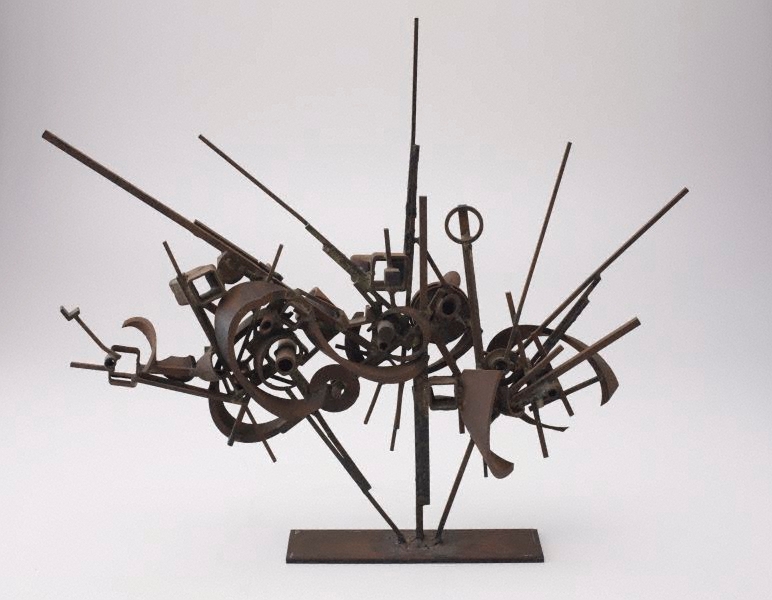
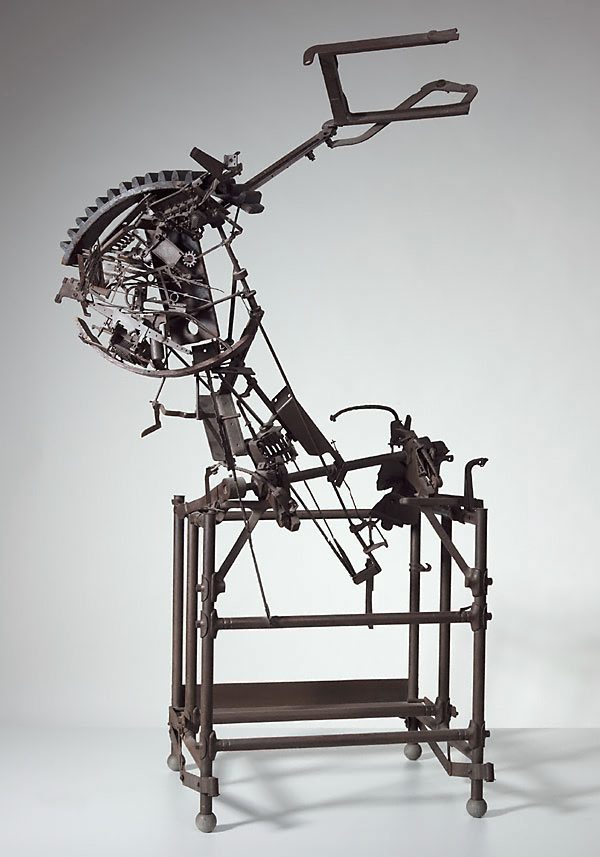
Metal Construction 123 - Robert Klippel
With a career spanning six decades, Robert Klippel was one of Australia's leading sculptors. His work investigates the realtionship between the organic and the mechanical; a duality that he saw as central to life and culture in the twentieth century. He took night-courses in arc-welding, silver soldering and panel-beating to acquire new skills.

In 1957 he moved to New York where he explored the unlimited 'vocabulary of shapes' available in junk metals. Using detritus - the chance fragments of modern disposable society - he created complex configurations with new life and meaning. By the late 1960s he had begun to shift his emphasis from using primarily machine parts to steel sections. Klippel aimed to synthesise sculpture and landscape and bring nature and technology together.

Metal Construction 202 (1966) - Robert Klippel
Angelina George paints the most amazing expansive canvases of her home land where she grew up and remembers when she used to walk about with her brothers and sisters or her mother. In the series of Dry Season paintings, she says she has worked from memories and imagination so it is 'not exactly what it looks like. You know. Traditional way and law.'

The sharp cliffs and rugged rocks hide billabongs and creeks where they find fish and birds. She says, 'we had to find our own tucker and we knew where to go hunting.' The spectacular landscape formations and shadows in these paintings are barren, bleak and beautiful with the sky forming only a tiny fraction of the canvas - the remainder is comprised of reds, oragnse, purples and distant greens. There is clearly life, if you know where to look.

Untitled (2008) - Angelina George
 When Ben Quilty first asked legendary painter Margaret Olley to sit for him, she said no. 'Her lack of ego is so appealing. Margaret didn't understand why anyone would want to see a portrait of her.' Fortunately, she relented and this amazing portrait in which paint sticks out in great blobs and swathes to create a fantastically piercing expression, won the Archibald Prize in 2011.

Margaret Olley (2011) - Ben Quilty
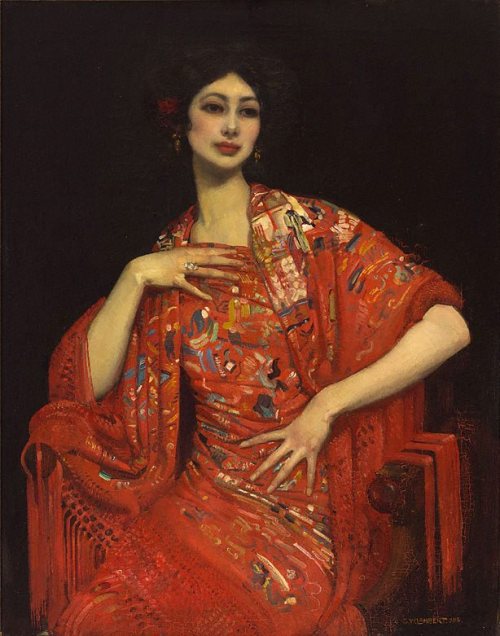
George Lambert's work is also a study in texture. In The Red Shawl, the material in its form and colour seem to be more important than the sitter. Another subject is caught in the act of removing her glove in Miss Helen Beauclerk and again, the detail paid to the fabric and the stitching of the material suggests the work of a fashion designer as much as a portrait painter.

The Red Shawl (1913) - George W. Lambert

Miss Helen Beauclerk (1914) - George W. Lambert
A third 'portrait' that caught my eye was Important People. Lambert suggested an allegory in his grouping of a flower-seller, a clerk and a boxer. He felt it should not only be the wealthy who get their portraits painted and that his work represented motherhood, the future generations, the fighting forces of the world and administrative qualities, without which the world (symbolised by the red cart wheel) would not turn smoothly.

Important People (1914-21) - George W Lambert
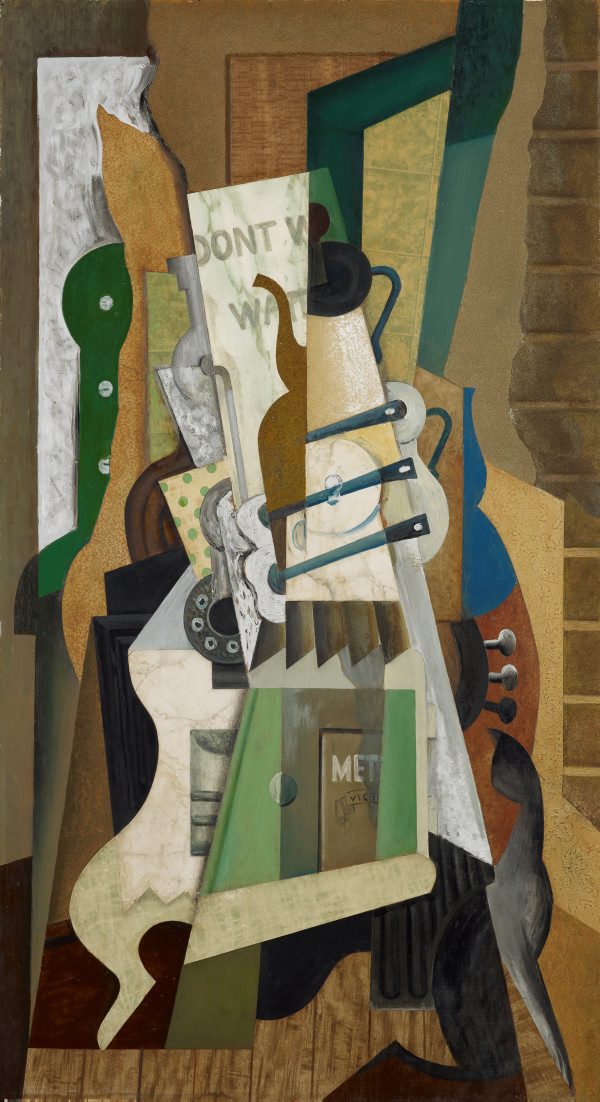
Eric Wilson studied abstract design and cubist philosophy on his travels to London and Paris. In Abstract- the kitchen stove he uses a domestic object to explore formal elements such as colour, shape, surfacing pattern and texture. The painting is structured around a triangular composition and demonstrates his attempt to create an 'orchestration of the formal elements into a symphonic whole'. The image also recalls domestic harmony in a musical instrument such as a lute or a cello.

Abstract- the kitchen stove (1943) - Eric Wilson
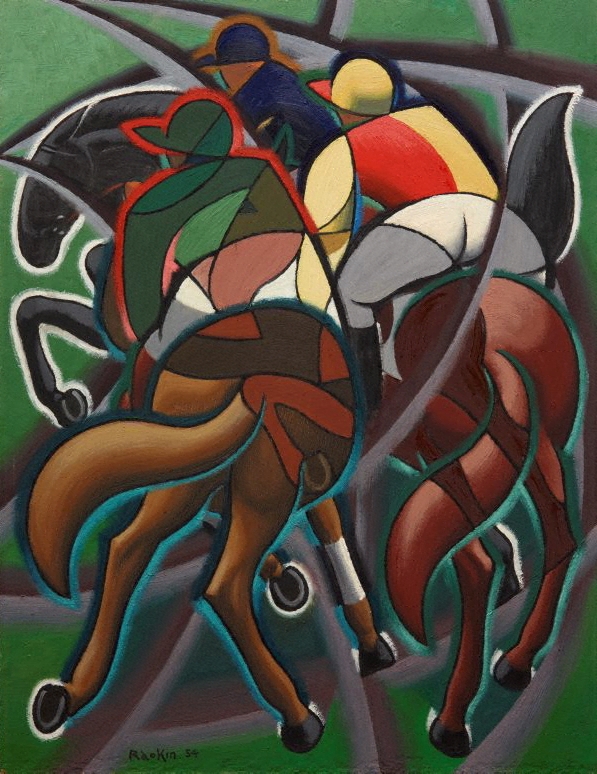
The cubist forms of the racehorse and riders in Weaver Hawkins' Going Round, create an almost stained-glass window effect. Hawkins was a founding member of the Contemporary Art Society and, in the early 1960s, a founding member of the Sydney printmakers' group.

Going round (1954) - Weaver Hawkins
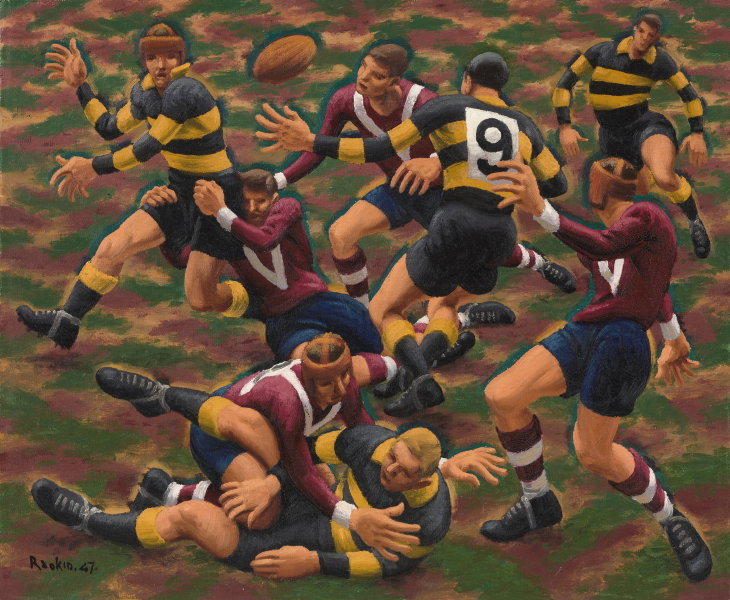
Hawkins' sporting works full of energy and movement assume another dimension when you realise that he was wounded in the Battle of the Somme and subsequently lost the use of his right hand and arm. He retrained himself to draw and paint using his left arm, which was never at full strength. From 1927 he began to use the alias 'Raokin' to avoid unwanted public and media perceptions about being an artist living with severe injuries after WWI. Almost as an antidote, the appreciation of the male form in all its rugged masculinity is on display in Dance of the Football Field, which depicts a rugby league match between Balmain and Manly.

Dance of the football field (1947) - Weaver Hawkins


Wednesday, 9 October 2013

Australian Galleries 2


Spring Frost by Elioth Gruner
According to visitor feedback, this is the ‘most-loved Australian landscape painting’ in the gallery. Elioth Gruner painted it in 1919 en plein air at Emu Plains. The cattle breath and morning shadows reaching out to the viewer, hark back to a rural nostalgia which was rapidly disappearing. The vigorous foreground brushwork and the sense of light and tone create a wistful world worth fighting for.

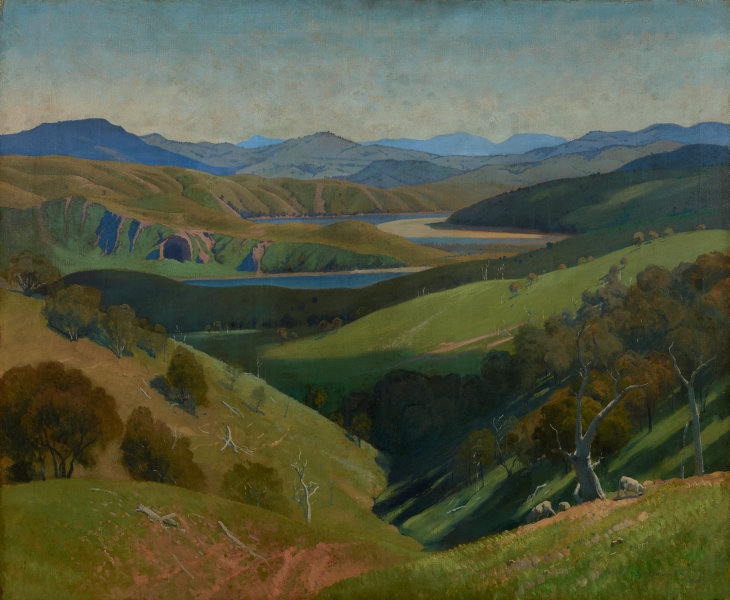
I also like his later work, which is more severe in form and outline. By emphasising the subtle harmonies of tone and colour, he creates a feeling of stability and permanence in contrast to his former exploratons into the evanescence of light. These organised pictures are more scientific and less emotional, but the landscape is familiar to me, with the sweep of hills to the valley river corridor, being the view from the back of our house.

On the Murrumbidgee (1929) - Elioth Gruner
I love Nora Heysen's work from her still lifes to her war paintings and her self-portraits. Nora Heysen’s self-portrait strongly articulates her identity and ambition as a young artist, independent of her famous artist-father Hans Heysen. Characteristic of her 1930s’ paintings, Self portrait is powerfully composed with precise, strongly defined forms and earthy colours recalling European masters of the early Renaissance. After undertaking study in Europe, Heysen established herself as a distinguished portrait and still-life painter. In 1938 she won the Archibald Prize, the first woman to have done so." - from the Art Gallery of New South Wales' website.

This particular portrait was painted in her father's studio (which we have visited), with the Vermeer prints on the walls. Nora wrote, "I greatly admired Vermeer’s works and wanted to paint like him – perhaps Vermeer and my father were my biggest influences in those days …"

Self Portrait (1932) - Nora Heysen
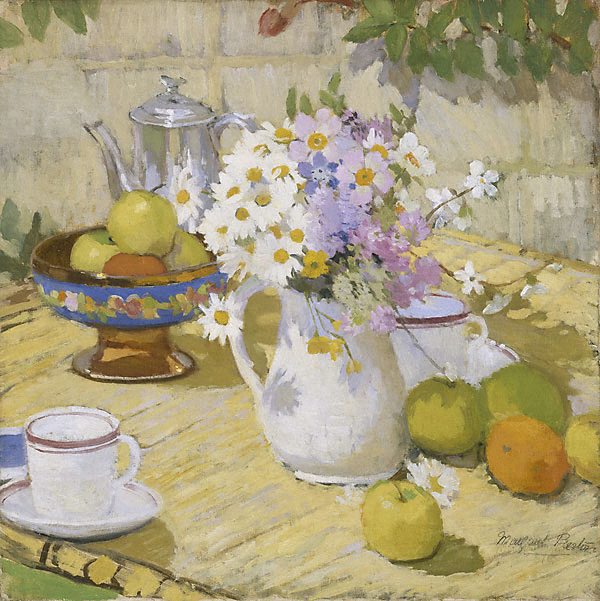
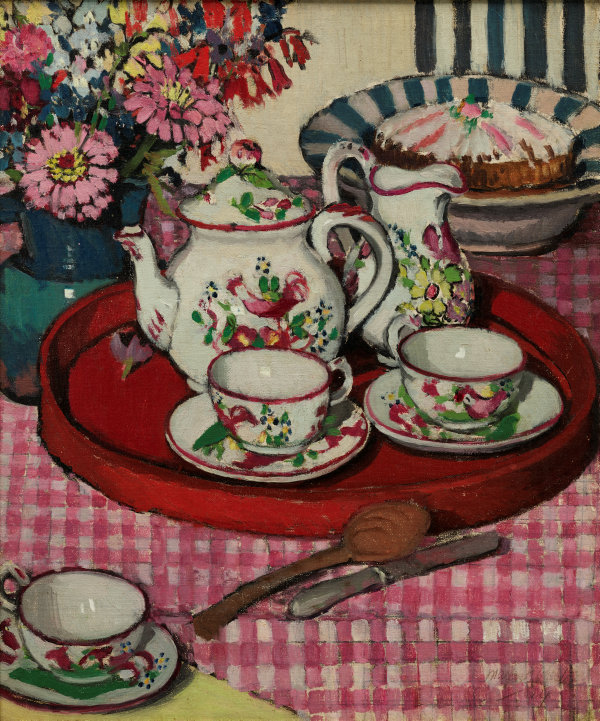
Margaret Preston is another favourite, and the development of her art and style is quite fascinating. Her still lifes are spectacular, including Summer and Still life with daisies and teapot, both painted in 1915. On 25 April 1915 Australian and New Zealand Army Corps landed on the Gallipoli Peninsula in Turkey, an action that came to signify Australia's emrging nationalism. At the time Preston (nee McPherson) was in England, whence she had moved from Paris after the outbreak of war. Despite the horror and trauma she encountered - she taught pottery and basket-weaving to shell-shocked soldiers - she continued to paint pleasant and cheerful still lifes.

Summer (1915) - Margaret Preston
In Still life wth teapot and daisies, the flat white sands of Bunmahon places the table firmly outside as its pink striped cloth manipulates the viewer's eye around and back to the central construction of bowls, flowers and teacups so diminishing an artificial perspective that would be created if the stripes travelled into depth.

"Her engaging play with reflections, a device she returned to throguhout her long painting career, shows another landscape mirrored in the teapot. A hammock of pink cradles a solitary figure in a long dress holding a parasol ad standing in a green field with a blue sky, so introducing a human element to the painting's design. The figure could be the viewer or a partaker returning to the afternoon tea."

Still life with daisies and teapot (1915) - Margaret Preston
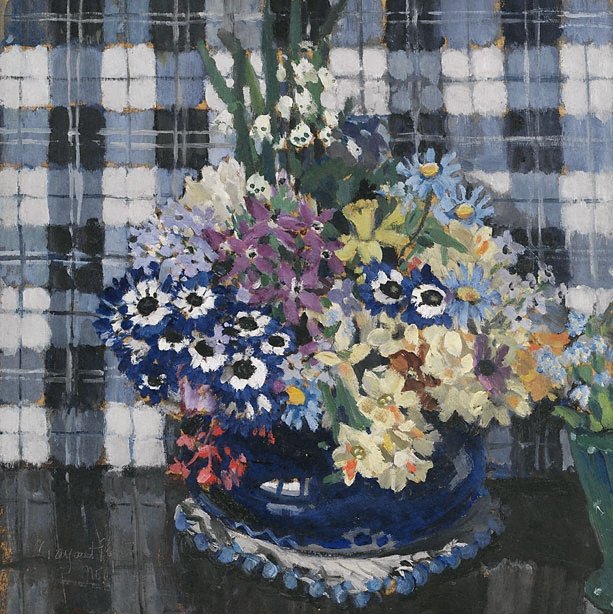
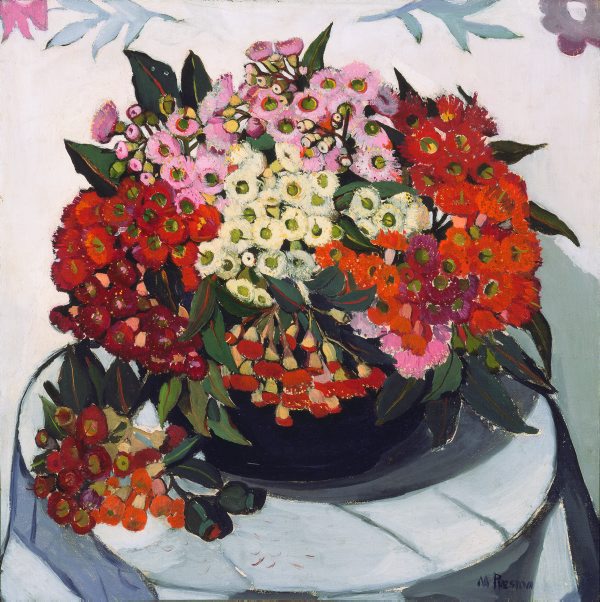
The difference between Flowers and Australian gum blossom shows the dvelopment and future direction of Preston's work. Although she still painted flowers, she chose to embrace local flora and a less formal approach with confidence.

Flowers (1922) - Margaret Preston

Australian gum blossom (1928) - Margaret Preston
In between, she also ventured into stylised groupings, such as in Thea Proctor's Tea Party. This painting belongs to the genre of still life, but it is also a kind of portrait. It is a symbolic rendering of the things that Thea Proctor stood for. Preston encapsulates her fellow artist's belief in the importance of surrounding one's self with objects of taste and beauty, and alludes to her enthusiasm for arranged flowers in domestic settings, something the two artists shared.

The Proctor's tea party (1924) - Margaret Preston
Meanwhile, Implement blue is one of Margaret Preston’s most innovative works, embodying the values of progressive, modern living. She felt that this was a mechanical age – highly civilised and unaesthetic. Impersonal inventions were introduced to make home-life easier, but she felt detached from domesticity.

The restricted palette and strict analysis of form in this painting reveal how she turns to the genre of still life to express her conceptual conflict. The domestic vessels have been renamed 'implements' and reduced to essential forms.

Implement Blue (1927) - Margaret Preston
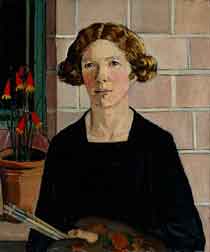
One of her most famous works is her 1930 Self Portrait, painted as a commission at the request of the Trustees of the Art Gallery of New South Wales. She later said, 'my self-porrait is completed, but I am a flower painter - I am not a flower." And yet, she has painted this image with the same attention to detail she brought to her still-lifes, incorporating the essentials of her art: her brush and palette and a pot of wildflowers.

Self Portrait (1930) - Margaret Preston
 Grace Cossington Smith’s The sock knitter has been acclaimed as the first post-impressionist painting to be exhibited in Australia. The extreme flattening of the picture plane and the use of bright, expressive, broken colour applied in broad brush-strokes to delineate form reflects the aesthetic concerns of European painters such as Cézanne, Matisse and van Gogh.

The subject of the painting is Madge, the artist’s sister, knitting socks for soldiers serving on the frontline in World War I. Distinctly modern in its outlook, The sock knitter counterpoints the usual narratives of masculine heroism in wartime by focusing instead on the quiet steady efforts of the woman at home.


The sock knitter (1915) - Grace Cossington-Smith
 In 1920 Cossington Smith was in the city when she noticed a crowd gathering. As she recalled: ‘I didn’t expect him to be there. I was in Martin Place and wondering why all the people were gathering, and someone said, “The Prince of Wales is going to drive by”. I was very excited and stood on the pavement and got an impression of it … then I think I made drawings of the buildings – a drawing rather – just to get it right. But I couldn’t while he was going by because it was only a few seconds, so I had to impress it on my mind’.

The Prince (1920) - Grace Cossington-Smith
I also love the painting of Reinforcements, troops marching for the use of the lines and colour which create an upright sense of movement - you can almost hear the boots hitting the ground in unison. The women in their hats waving handkerchiefs to the men and turning their backs on the brawling brat on the ground also speaks volumes to me. There are moments when individual wants are less important than communal needs.


Reinforcements, troops marching (1917) - Grace Cossington-Smith


Inspired by the art deco designs and vivid colours of the David Jones department store cafe in Sydney,  The Lacquer Room embodies the modern inter-war urban experience. The rich red and scattered patterns of the chairs are contrasted with the gleaming green of the lacquered tables, set against the brightness of the walls and polished floors. Grace Cossington Smith’s bold approach to colour exudes a sense of celebrating the new, similar to the contemporary consumer culture epitomised by the department store.

In an interview, she said, "It was quite a surprise, I didn't know it was there, but I went down to get cup of tea … and found this lovely restaurant … I was struck by its colour and general design the moment I saw it … Scarlet, green and white held me spellbound..."
 
The Lacquer Room (1935-36) - Grace Cossington-Smith
Ethel Carrick painted vivacious impressionist-influenced European landscapes, market scenes and flower pieces. After studying in London early in the 20th century, Carrick settled in Paris in 1905 where she became actively involved with women’s painting societies. She travelled extensively with her artist-husband, E Phillips Fox, in France, Italy, Northern Africa and Spain.
After Fox’s death in 1915, Carrick lived mostly abroad, travelling in Europe, painting in Majorca, Egypt, Morocco, Tunisia and India, and in the 1930s living in Kashmir. Her paintings commonly displayed an interest in figures, objects and her surrounding environment, rendered as patterns of colour and light.

Flower Market, Nice (1926) - Ethel Carrick