Friday, 14 February 2014

Friday Five: The food of love...

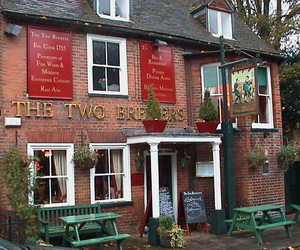
The Two Brewers, in happier times
I don't think I've ever been to a restaurant on Valentine's Day. I hate all the palaver of people trying to make you buy roses and playing violins anywhere in the vicinity. And I hate the general pressure to conform to capitalism that surrounds the date. But, for the purposes of this post, I did think about my favourite restaurants, most of them because they are connected with special memories...

Five Great Restaurants:
  1. Cesare's, King Street, Manchester - now apparently called something else; one of the first 'grown up Italian' restaurants I ever went to, around Christmas time while Him Outdoors and I were courting.
  2. Yang Sing, Princess Street, Manchester - I still dream about their crispy duck pancakes.
  3. Botswana Butchery, Marine Parade, Queenstown - fantastic setting, amazing food, excellent wine list and superb wallpaper!
  4. Le Sergent Recruteur, Rue St-Louis en l'île, Paris - When I lived in Paris, my dad came to visit (he was on a work trip) and I was able to suggest, 'a fabulous little place on the île St-Louis'. Pretentious, moi? It was very, very good, though.
  5. The Two Brewers, St Peter Street, Marlow - I used to drink here; it is my favourite pub in my home town. It became a gastropub after I left England, and I finally ate there in 2012 with my parents in the cellar restaurant, an authentic eighteenth century beer cellar. It burnt down in 2013, and was due to re-open sometime in 2014, although it is probably now flooded and I wish the team every success in getting it back up and running.

Thursday, 13 February 2014

Travelling on buses...

David Tennant (Doctor Who) and some chocolate on a bus - any tenuous link will do.
"Any man who rides a bus to work after the age of 30 can count himself a failure in life." - Margaret Thatcher
Despite what Her Ironess  thought, there are many reasons for choosing public transport. From ecological concerns to responsible drinking, you get all types on the bus. My favourite are the borderline nutters, who like to have conversations with total strangers, even if they are trying desperately to read a book. Here's one from today.

Her: I really like your top. It's such a beautiful colour [Liverpool red] but it doesn't go with your shoes. Such a shame. You should always match your shoes. 

Me: Oh.

Her: What are you reading?

Me: Gone with the Wind

Her: Oh, I loved that book. You must keep it forever.

Me: OK.

Her: Is it yours?

Me: Yes.

Her: Well, that's even better. I read it twice - once when I was younger and I thought I was Scarlett O'Hara, then when I was older and I realised I was more like Melanie, which is a shame because she's so dull. It would be nice to be a mixture of both... Melanie always reminded me of those assistant lecturers, so grey and boring. Do you know what I mean?

Me: Um...

Her: Of course you do, you live in Canberra. Did you go to university?

Me: Yes.

Her: I thought so. What did you do?

Me: English.

Her: Ah, is there anything else?

Me: Well...

Her: Do you read feminist literature?

Me: Some.

Her: Fay Weldon is wonderful, and Marilyn French - The Women's Room had a huge effect on me when I was younger. It changed my life. But that book (points), oh it's wonderful. And I love the ending, because life's like that sometimes, isn't it?

Me: Well I haven't got there yet.

Her: No, but you've seen the film?

Me: No.

Her: Well, it's not the same. They did a fairly good job, but then there was the Civil War, you see... It was 1860 something, wasn't it?

Me: Yes - 1865 it finished.

Her: Yes. She got hit by a car. Stepped out into the street and hit by a speeding car. She only wrote one book. Such a shame. 

Me: Um...

Her: You should never grow up. 

Me: Right

Her: I've just been to the National Library but I'm so cross because there are no guides to take you round the cartography exhibit. They're booked up to the end of the season. 

Me: Oh.

Her: Have you been to it?

Me: Yes - it was very good.

Her: Did you do the guided tour?

Me: No, I just walked around by myself.

Her: Hmm, It's not the same.

Me: Oh.

Her: I must sit down. Keep that book forever. And stay young.

Friday, 7 February 2014

Friday Five: Fewer than fifty shades of red


5 Skeins of wool in the tapestry I'm currently attempting:

  1. Poppy
  2. Maroon
  3. Raspberry
  4. Redcurrant
  5. Red
They look obvious here, but are not so easy to distinguish under dim lights in the evening. Just for the record, there's also a lot of blue.

Monday, 3 February 2014

Arthur Boyd: An Active Witness

Arthur Boyd: An Active Witness
The Museum of Australian Democracy at Old Parliament House
May - December, 2013

Arthur Boyd's art is generally considered political, although he never joined a political society or followed organised party politics. He was horrified by the effect of wartime conditions on society and the dark side of human behaviour. His style is inspired by Pieter Brueghel, Pablo Picasso, and Rembrandt van Rijn.

Cripple in smoke from factory chimney
The ink on paper drawing of Cripple in smoke from factory chimney (1942) displays the influence of Picasso's violent images with ugly features and sharp connotations of horror. This may suggest a portent of the Nazi death camps. He frequently focussed on people on crutches or in wheelchairs with dogs or other dumb animals as witnesses, metamorphosing human and animal figuresThe futility and violence of war was a recurring theme, as was savagery of nature and the beauty to be found in vulnerability.

South Melbourne

South Melbourne (1944) also features cripples, crutches and wheelchairs with dogs bearing witness, but this time the violence has escalated. The abandoned church in the background may represent structured society while the heads on sticks call to mind the angry mob in Lord of the Flies as they bear aloft a coffin for a skeleton. 
It is believed that this painting is a response to witnessing urban life during the war years, and the irrational behaviour from soldiers on South Melbourne Beach. Critics suggest there is a positive aspect, however, in the growth of life, which appears to be emerging from the feet in a poetic cyclical return.

The Kite

The primitive figures of The Kite (1943) seem to be enacting some sort of scapegoat sacrifice as the man who forms the kite itself looks down upon their sins, with extrapolated associations of greed, religiousness and bestiality. 
“I’d like to feel that through my work there is a possibility of making a contribution to a social progression or enlightenment. It would be nice if the creative effort or impulse was connected with a conscious contribution to society, a sort of duty of service.” 
The thirty pieces of silver
Boyd was concerned with humankind’s culpability for treatment of others and the natural world, and he connected his experiences with subjects from literature, folklore, classical mythology and religious stories. He worked in many media including ceramics, such as for the work, Thirty pieces of silver (1950).

Aboriginal groom


Boyd travelled to central Australia in 1951; like many Australians he had previously had very little contact with Aborigines, and he was shocked and dismayed at the living conditions of Aboriginal people in the Simpson Desert. He produced numerous small observational sketches, made as notes, during travel by car and truck in and around Alice Springs. Over time Boyd processed these experiences into a narrative which first manifest in the medium of ceramic tiles, such as Aboriginal groom (1957-58).
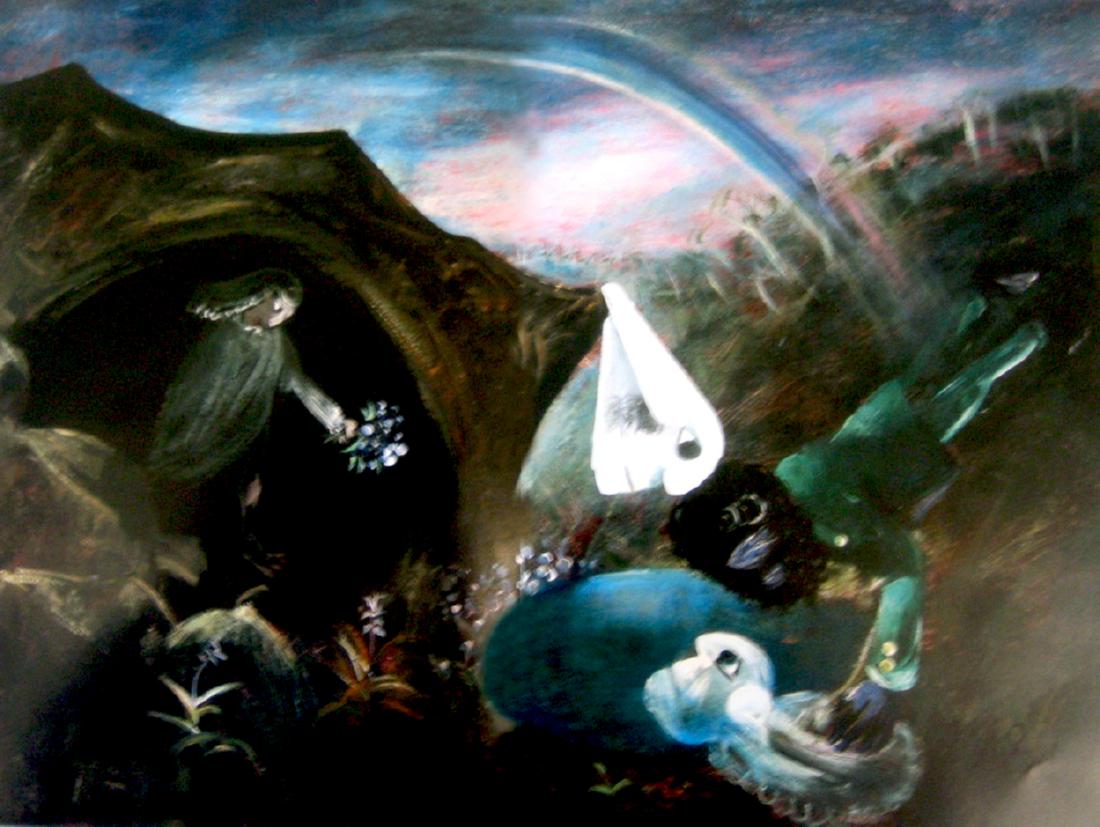
Bride in a Cave
Bride drinking from a pool

The groom and his bride were the protagonists in Boyd’s Bride series, which includes the significant paintings, Bride in a Cave (1958) and Bride drinking from a pool (1960), and convey his concern for the stigmatisation of those of mixed race.

Nebuchadnezzar being struck by lightning
Among other sources, Boyd raided the Bible for inspiration and found it in the tales of Nebuchadnezzar in the Book of Daniel “He was driven from men, and did eat grass as oxen and his body was wet with the dew of Heaven till his hairs were grown like eagles’ feathers and his nails like birds’ claws." - chapter IV. 

Nebuchadnezzar being struck by lightning (1968-69) is a powerful canvas of thick smears of paint – dark blues and greens with a shocking yellow explosive head (and bright red testicles like a dog).

Nebuchadnezzar in a fire
This series was inspired by seeing self-immolation anti-Vietnam protesters (on Hampstead Heath). In Nebuchadnezzar in a fire (1969) the large canvas is full of raging colours and a skeletal howl of agony.

Red Nebuchadnezzar fallen in a forest with a lion
Meanwhile, in Red Nebuchadnezzar fallen in a forest with a lion (1969), the figures are nebulous but you can almost hear the roar of the lion in the red and yellow swirls and streaks of paint.

Menelaus throwing down sword before Helen

In 1970, Boyd was commissioned to create a series of etchings from Lysistrata. The gallery has six etchings from the series of twenty on display. Boyd has set the tale of women withholding sex from their menfolk in an attempt to stop the bloody conflict in a timeless period. 

The white figures against a black background are like the reverse of a Greek vase, but the series was produced during the Vietnam War, so while Boyd comically illustrates Aristophanes’ witty tale, the underlying theme is the futility of war. The women take action, highlighting the price women pay in war is too high – losing husbands, lovers and sons.

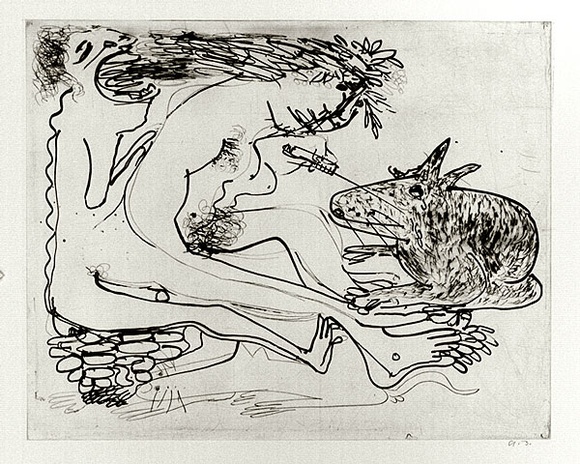
Nude with rabbit and syringe

In a vulnerable mental state and far from home, Boyd visited an animal research station in London where he saw vivisection and testing on animals. Whereas animals are often passive witnesses to human acts of atrocity in his work, the poor rabbit is the direct victim of the woman's savage needle in the etching Nude with rabbit and syringe (1968-9). Boyd suggests that the inhumanity towards animals is the result of man's monetary greed.
Large skate on a grey background
His concern for the environment is equally evident in Large skate on a grey background (1971) which is a departure in style if not content. The botanical depiction is real and lifelike, while the wounded flesh hints at cruelty and pain.

From 1974 Boyd began a new focus in his art, based on the Shoalhaven region around Bundanon, in New South Wales. He first visited Bundanon in 1971 whilst on a Creative Arts Fellowship at the Australian National University, Canberra, Boyd purchased his first property, Riversdale, on the Shoalhaven River near Bundanon in 1972, and the Bundanon property in 1979.


Jonah on the Shoalhaven
The painting of Jonah on the Shoalhaven (1976) combines elements of his artistic and environmental concerns. In the background a floating city with a mosque, and a mushroom cloud of destruction draw the eye, whereas in the foreground a figure rests against a withered tree on a white beach or perhaps salt flat, which provides very little shade with its falling leaves. The figure may be a man or a beast or a combination of both, tormented by a wound in his belly that appears to be full of gold coins. Boyd believed in the necessity for the individual to accept guilt.
"The only way to deal with [guilt] as an artist was to paint it out of my system. To expunge my own guilt by painting it and in a way face up to it. I mean guilt in a general sense, because although I do the painting, everyone else who then looks at it is in the same position as myself. I hopefully have helped them to face their guilt also"
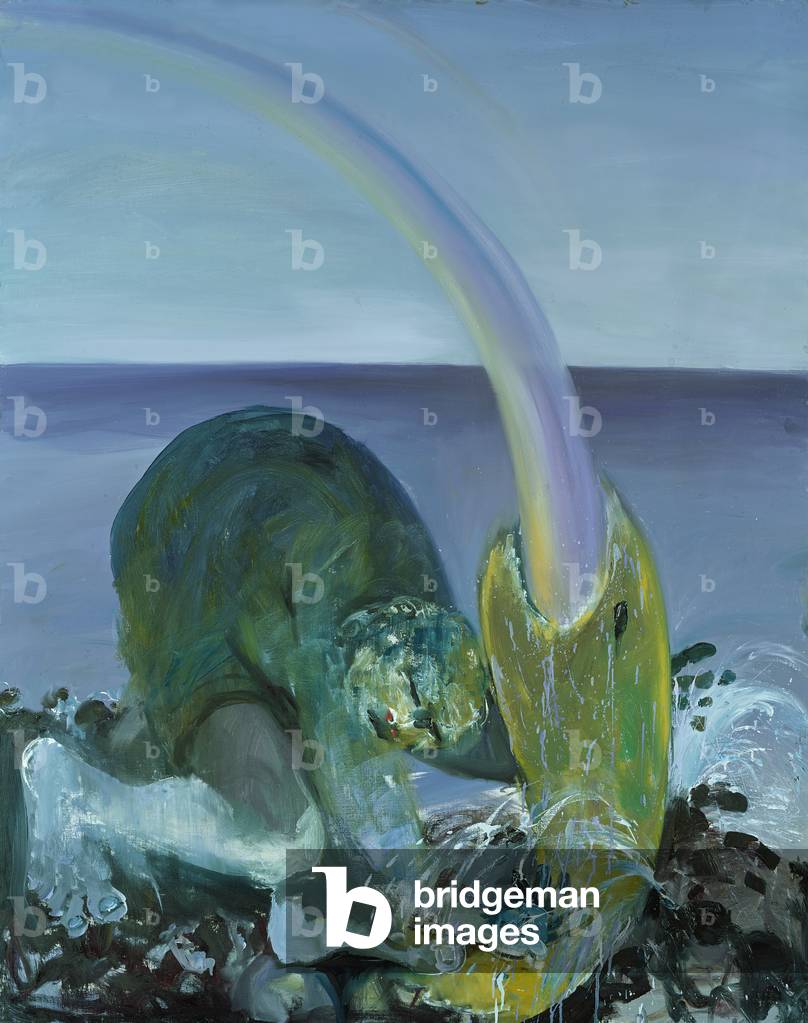
The Magic Fish

In his take on the Pushkin tale, The Magic Fish (1978) depicts a blue fish vomiting a rainbow while a woman kneels before it. She could be praying to it, or throttling it, depending on which point of the narrative is reached.

Picture on the wall, Shoalhaven

Meanwhile, Picture on the wall, Shoalhaven (1979-80) clearly indicates his environmental concerns and fear of nuclear fallout. Whilst disinterested in organised politics, Boyd at times joined political actions. He participated in exhibitions protesting against the Vietnam War and commemorating the bombing of Hiroshima, and signed appeals to the Mexican government for clemency for artist David Siqueiros.

Pre-Embarkation, Suffolk
Pre-Embarkation, Suffolk (1979) is a notable work. As well as incorporating his interest in the colonial past (as seen from the naked man tied to a tree, the blood on the forest floor and the black man with a broom), it is interesting stylistically. The palette of greens and cool colours reflects his ten years in Europe. While he was living in England, he received commissions to design sets for ballet and opera. This theatrical staging and the cooler environment have clearly made themselves felt on his canvas.

Hanging rocks with bathers and Mars
Humankind’s recklessness is foretold in the burning book observed by Mars in Hanging rocks with bathers and Mars (1985). Both humans and gods appear detached from their environment, guarding as well as actively despoiling a world understood as a resource. 

Art historians consider the landscape in this painting shows signs of regrowth after fire,or perhaps a hint of military graves. They find a resemblance between the form in the distance and a nuclear power plant located close to Boyd’s Suffolk studio in England and also a water tower located near Bundanon. Boyd was aware of the changing character of the Australian landscape across recorded history, prior to human impact.
Shoalhaven bathers
In the colour etching Shoalhaven bathers (1987) water-skiers, scuba divers, boat owners and other self-absorbed intruders are depicted as aquatic invaders, some approximating the red-hued guise of Mars. These protagonists are ignorant of the possible threat they hold for the river environs. In Boyd’s imagery Bundanon was not only a stage for local ideas of collective significance, but also a site worthy of raising awareness regarding impending ecological disaster.
Spare the face, gentlemen, please

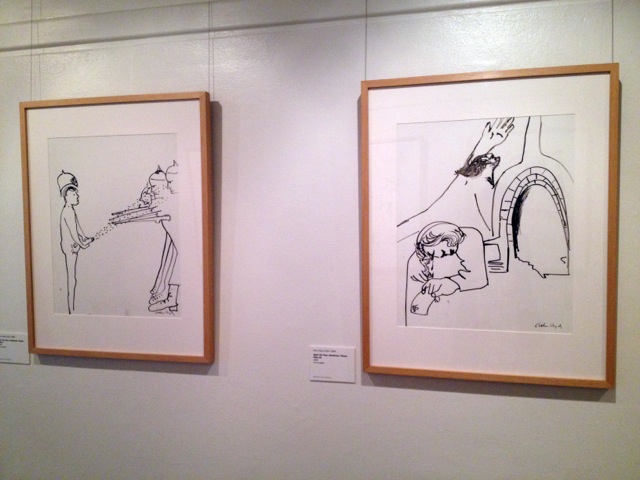
The exhibition concludes with some illustrations from Spare the face, gentlemen, please (1993), which illustrate the work of the same name by Tom Sanders, written in 1991. It is a collection of articles about his time in the army, living abroad, and his friendships, including reflections on the art world with all its meanness, deceit, pretensions and betrayals.

Boyd's raw and immediate artwork provides a shocking counterpoint to the written words, such as an illustration of a man shooting back at a firing squad with 'bullets' from his penis. 
“You cannot say enough bad words about war. For a long time I was obsessed by war, all those dark thoughts about the individual slaughter in the First World War, people with their legs hacked off and throats cut. The war got more mechanical and more scientific and more awful."
Much of Boyd's art focuses on the futility of war, yet, with similar atrocities occurring again and again, this exhibition could equally well ask the viewer to reflect upon the futility of art. 
Friday, 31 January 2014

Friday Five: Music to my ears

The last ice cream van at the edge of the world by Curly
The other weekend we went for a run in what turned out to be the heat of the midday sun. We weren't deliberately being Mad Dogs and Englishmen, but various events meant that was just the way it was. It was the middle of a heatwave (five days of temperatures over 37 degrees) and we ran out of water. It wasn't meant to take so long, but the last two kilometres took me 20 minutes. I was breaking out in a cold sweat and felt nauseous and dizzy. 

When we returned to the carpark I was guzzling the water we had in the car when I heard the tinkling of an ice-cream van. At first I thought I was hallucinating but no, the vehicle appeared playing a distorted version of Greensleeves and I was soon eating a cool, sweet treat that picked me back up and refreshed me after my endeavours. Never before have I been so happy to hear that ghastly tune, and it made me think there are certain musical interludes which have special connotations and for which I will always be grateful.

Yes, the photographer chopped our heads off, but see how we look like we know what we're doing!
5 Tunes I will never tire of hearing:

  1. The Gay Gordons - I'm not a fan of bagpipes unless they're played in Scotland and played well. This, however, was the first dance I ever danced with Him Outdoors as we met in Edinburgh and went to a ceilidh at Hogmonay, and so it was our wedding dance. I insisted that my sisters get everyone up dancing as soon as possible as we didn't want to be left out there like a pair of numpties and I figured that however drunk you are, you can dance to this, even if your waltzing is appalling.
  2. You'll Never Walk Alone - goosebumps for obvious reasons
  3. The British National Anthem - when they play that as they raise the union flag, my heart stirs. I know some people (i.e. Billy Connolly and all his disciples) think it's a dirge and would prefer the theme tune to The Archers, but I feel pride in my country when I hear it from military honours to medal ceremonies.
  4. The theme tune to The Archers - reminds me of my mum and the happier aspects of my childhood.
  5. Debaser by The Pixies - my best mate and I had a pact at university - whenever this came on in the club we would have to dance no matter what we were doing. I got so much whiplash from that song and I love it!

Friday, 24 January 2014

Friday Five: Best films of 2013


Being as the award ceremonies are all the beginning of the year and some of the films nominated aren't even released in this country yet, it's tricky to have seen them all and my own judgement by the time the gongs are given. Being as I often disagree anyway, this shouldn't have too much bearing on my list of favourite films. 

Also, for the purposes of this list, I'm not including the excellent National Theatre Live series, in which I get to see superb productions of plays beamed to a cinema from the stage. Perhaps I'll do that in another post, but for now it's worth noting that The Audience, written by Peter Morgan, directed by Stephen Daldry, and starring Helen Mirren as The Queen in private meetings with each of England’s prime ministers from Churchill to Cameron was a privilege to watch. Furthermore, the National Theatre Live production of Othello was absolutely outstanding: the best production of this play I have ever seen, and I've seen a fair few.

It's very hard to choose just five out of the score of films released last year that I've seen, but I have whittled it down to this list, in alphabetical order as it's impossible to pick a favourite.

5 Favourite 2013 Films:
  1. August: Osage County – A Brilliantly brutal depiction of a dysfunctional family further unravelling with disease and deception, trapped against a backdrop of endless horizons. Superb acting (especially from Meryl Streep and Julia Roberts) and brilliant dialogue (screenplay by Tracy Letts) make this adaptation of the stage play (also Tracy Letts) a frontrunner for Oscars.
  2. Behind the Candelabra – Yes, it really is as good as everyone says it is. Michael Douglas and Matt Damon are excellent. The flamboyance and excess are neatly captured with gentle ridicule but evident empathy, and confirm Liberace’s own conviction that ‘too much of a good thing is wonderful’.
  3. Blue Jasmine – Ten minutes in when I realised it was based around A Streetcar Named Desire, I knew exactly what was going to happen. The fact that it did, didn't make it any less compelling. Cate Blanchett is as wonderful as ever and this is the least annoying that I've ever seen Sally Hawkins. Woody Allen’s films are always better when he isn’t in them.
  4. Gravity – The first 3D film I've seen in the cinema since Jaws 3-D in 1983. It was done so well I was totally transporting (ducking as the flying space debris seemed to whizz out from the screen at me) and the weight of all the action was entirely carried by the two fantastic actors, Sandra Bullock and George Clooney. Director Alfonso Cuarón’s Oscar nomination is thoroughly well-deserved.
  5. The Spirit of ’45 – A fabulous documentary, written and directed by Ken Loach, about the spirit of unity which buoyed Britain during the war years and how we are crying out for that same socialism to create a vision of a fairer, united society today – inspiring and necessary.

Monday, 20 January 2014

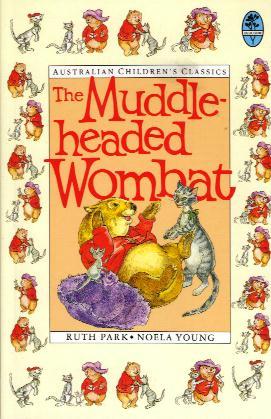
Muddle-Headed Storytime


The Muddle-Headed Wombat by Ruth Park with illustrations by Noela Young
Published by Angus & Robertson
Pp. 225

This Australian children’s classic is an utterly delightful tale of a wombat and his adventures with Mouse and Tabby, his second-best friend. The animals live in a little house at the edge of Big Bush which is “green and quiet and airy, and the right place for animals to live.” They go to school, visit the circus, have holidays by the sea and build a treehouse that collapses in a storm. Frequent squabbles punctuate their escapades, as they have many differences, but they always make up as they realise the value of friendship.

Wombat is muddle-headed because he is a Wombat. He mixes up words and can’t count past four – “He runs out of paws, that’s the trouble” – but he likes to be helpful although his favoured solution to a problem is to sit on things. He is thrilled to be going to school where “We’re going to learn things like four and eight make eleventy one and C O W spells cat, and things like that.” Similar to Pooh Bear he is not bright although he has inimitable logic, such as when he eats a packet of chalk but not the green because “it might taste like spinach and I don’t like spinach.” He is good at digging and seeing in the dark and is very loyal and loves his friends, which in turn makes him loveable.


Mouse is fastidious and house proud, always cleaning things, preparing meals (pancakes for Tabby; snails for Wombat; and mosquitoes for itself) and polishing its spectacles. Referred to throughout as ‘it’, Mouse is gender neutral, although this was written in 1962 and Mouse carries its long tail “over its arm as though it were the train on an evening dress” so is possibly meant to be female. Mouse is also sentimental and cares for things and people, particularly the grey tabby cat whom it adopts because “He was skinny and miserable and he had a peaky little face with big ears. He wore a bright red bow tie, but anyone could see it hadn’t been washed and ironed for weeks.”

Like many cats, Tabby is vain and thinks he is handsome, while he also claims to be frail and delicate, mainly to get out of hard work. He is very good at building things, however, such as a caravan and a treehouse and is also remarkably resilient, surviving being sucked into a carpet cleaner, dropped from a great height while performing as a puppet, and accidentally shaken into a stream, not to mention being sat on by Wombat who thinks “if he were sat on once or twice, and flattened out like a bookmark, it would do him the world of good.”

Noela Young’s charming illustrations add to the humour of the stories and caricature the animals highlighting their best and worst traits. They regard themselves as a family and they constantly attempt to adapt to living with each other while retaining their individuality. The tales are equally diverting and reassuring and were loved by both the adults and the children at holiday story-time.