Monday, 2 June 2014

Daylight Saving: Unrealised Potential


Daylight Saving
Tempo Theatre Inc
10-25 May 2014

Every autumn when the clocks go back (if you live in the half of Australia in which they do), you get a ‘free’ hour. What do you do with it? And if something happens in that magical in-between time, does it really happen? These are questions which are raised in Nick Enright’s Daylight Saving, or should be.

Felicity (Rina Ornorato) owns a successful restaurant but is unhappy in love as her husband, Tom (Bill Kolentsis), neglects her in favour of the young tennis-player, Jason Strutt (John Brennan), whom he manages. When Tom abandons Felicity on their wedding anniversary, she sets up a romantic assignation with Joshua (Jason Morton) an old flame, over for a brief visit from America. The planned candlelit dinner, however, is constantly interrupted by her busy-body mother, Bunty (Joan White), and their nosy neighbour, Stephanie (Nicky Lyn Hunter).

As the seeds of deception are sown and the resulting confusion is reaped, the action resembles a French farce, with conservative morality winning through. The pace is too slow as though the actors are favouring clear diction (and every word is clearly heard) to speedy delivery. This becomes a problem as the reason for the dissatisfaction in Felicity and Tom’s marriage is that they haven’t got time for one another, which isn’t portrayed in this somewhat staid version, directed by Michael Weston.

As well as lack of pace, there is also a sameness of tone, so the stakes of involvement don’t seem high enough. Felicity is potentially about to discard a marriage in favour of a fling, but this isn’t given the magnitude it deserves; there is no distinction between her annoyance at an uninvited dinner-guest, and her frustration that husband doesn’t love her. She does well, however, to try and maintain the cut and thrust between her prospective suitors – it takes three to tango in this instance, and unfortunately both Kolentsis and Morton are rather leaden-footed.

The play has wonderful minor characters, and Hunter and White revel in their roles. Hunter brings a neurotic lack of awareness to the insensitive Stephanie with swift movements to match her snap judgements. White, meanwhile, imbues Bunty with an equally oblivious calm and threatens to steal the scene with her assured authority. Brennan has the whiny teenager shtick down pat, but his stooped posture and slouching gait are ill-fitting with his supposed athletic prowess as Jason Strutt – the clue should be in the name.

Much mention is made in the text of the beautiful moon, romantic light and the Pittwater (Sydney North Shore) location, but very little of this is evident in the setting. The view of the patio and outdoor area is limited, and it would have helped to hear the sound of the waves to heighten the ambience. The staging is purely functional and misses an opportunity to be atmospheric. The moon and tides are said to affect hormones, and yet they are timeless and inevitable. The performance of this play is solid if not spectacular, and the dream-like potential of daylight saving remains unrealised.

Friday, 30 May 2014

Friday Five: Lip Colours


I don't really wear make-up. Occasionally I'll chuck some on, but most of the time I make do with tinted moisturiser. When we were younger, however, my friend (Our Gracious Hostess) and I used to read Seventeen magazine and look at all the pictures for hours. 

I was more interested in the music section while she liked the fashion. What she liked most of all was the names given to the cosmetics, and she thought that making up names for make-up would be her dream job. On Saturdays we went down to Boots the Chemist and she would look at the lipsticks and eye-shadows thinking up poetic descriptions for them, which were nearly always better than the ones they actually had. It was an exciting town.

Anyway, I realise that now I buy lipsticks for shows and apply different shades depending on my character on stage. You can invent a whole new character with these colouring tools, which is why it's called make up I guess.

5 Shades of Lipstick I Own:
  1. Cherubic
  2. Whirl
  3. Bella Donna Mauve
  4. Velvet Rose
  5. Plumage (this one's dark grey/purple)

Wednesday, 28 May 2014

Bullant Brewery

Several months ago, while driving back to Canberra from Melbourne, we found a fantastic little stopover. We had considered going home via Lakes Entrance until a kind lady at the Bairnsdale Tourism Information place told us that it would be heaving and horrible on that particular weekend, and suggested we make a start up the Great Alpine Road to Bruthen and stop for lunch at the Bullant Brewery. Those are the type of suggestions we are happy to heed, and so we did.


Bullant Brewery offers tasting paddles of any four beers, so between us we sampled the seven that they had on, plus a cider. The first four - pale ale; wheat beer; pilsner and kolsch - were all pretty similar in colour but distinctly different in taste. The folk at the brewery like to claim their beers are full-flavoured yet highly drinkable and their slogan is 'beer with bite'. 

The Mossiface Pale Ale (all their beers are named after locations on the Great Alpine Road) at 4.8% is an interesting blend of hop (American Cascade and Pride of Ringwood), malt (Pilsner and Munich) and yeast flavours. The result is a great balanced beer as each element adds up to more than the sum of its parts.
Him Outdoors with a Mossiface
The Bark Sheds Wheat Beer (5%) is a pretty good example of this style with the expected clove and banana aromas complementing the zesty tang of the hops to create a satisfying summer drink. The Tambo River Pilsner (5%) is a decent drop, although nothing special, you could happily knock back a couple at a party without feeling disappointed.

Kolsh is not usually my favourite style, and yet their Summer Kolsch (4.7%) was one of my beers of choice from their brewery with subtle fruit flavours, and Pearl and Hellertaur hops to provide a crisp finish. This is a seasonal brew so will only be available during summer, which is when you most want the dry, refreshing style.

Moving to the dark side, the Double Bridges IPA (5.8%) was also splendid, with an intense hop aroma to match the zesty hop flavour and the dry hop finish. Did I mention it was hoppy? I was not as impressed with the Pig and Whistle Brown Ale (4,7%), although I'm not generally a huge fan of this style anyway. It is deep copper in hue with a mere hint of hops against the mass of malt. The accompanying notes state it is a 'typical English style' and I'm sure they know what they're talking about, but I don't remember tasting beers like this back home. 

The Piano Bridge Stout (6.7%) is delightfully chewy and malty with all the liquorice, caramel, chocolatey goodness associated with this variety. The name is taken from an old bridge that crossed the creek 27km north of Bruthen. When a coach passed across it, the panels apparently bounced up and down like the keys on a piano, or like Him Outdoors did when he tasted this stout. The tasting platter was rounded out with Kelly Brothers Cider, of which I can't really say much except it tasted alright and is apparently gluten-free.

The food menu is extensive and we chose wisely, with beef fajitas for him, and a Moroccan chicken stack for me. The menu is seasonal and alters along with the beers, so it is constantly changing and I'm sure always worth sampling. 


The setting out on the deck was very pleasant, and it is covered so even though we experienced rare summer rain, we were comfortably sheltered. It was a very busy public holiday, but the service was still relaxed, we weren't made to feel rushed or like an inconvenience (despite turning up without a booking) and there was no surcharge. I would definitely recommend this as a place to visit, and they have live music sessions on Sundays in summer; there could be few better ways to spend a sunny summer Sunday afternoon. 

Monday, 26 May 2014

Plagued Performance


One Flea Spare
NUTS
ANU Arts Centre, May 14-17

If this play doesn’t win awards and accolades for the fabulous set (designed by Gowrie Varma and Ellie Greenwood), there is no justice in this world. The jumble of furniture and picture frames hanging from the ceiling and hammered to the walls screams chaos. This is a world where social, sexual, political and cultural mores are turned upside down and we are immediately plunged into this moral morass.

If, however, there is no justice; that would also be fitting, as inequality is one of the major themes the play examines. In 1665 when the plague stalks the streets of London, the wealthy couple William and Darcy Snelgrave (Andrew Eddey and Sarah Heywood) are quarantined in their house for four weeks. On the last day of their confinement, the house is broken into by Bunce (Lewis McDonald), a sailor, and Morse (Cheski Walker), a strange adolescent who turns out to be the serving girl of their neighbours. Once the guard, Kabe (George Mitton) detects their presence, the house is sealed up for another 28 days, forcing the unlikely foursome to live together in less than perfect harmony.

The isolation is stifling and the silences are admirably awkward as the unwelcome house-guests begin to learn about each other. The members of the confined quartet all give solid performances as they tease out information and back-stories from their characters. As in previous NUTS productions, the age of the available actors limits the possible range of expression, but the actors playing the fifty-something Snelgraves gave pretty fine performances considering. Darcy Snelgrave has been physically, sexually and emotionally repressed for over thirty years, and although Heywood plays this as more grumpy irritation than subdued longing, her thawing is persuasive as she rediscovers the pleasure of touch and intimacy.

Her husband is caught between trying to be the boss and wanting to explore the worlds that Bunce has seen. Eddey portrays this dichotomy with sincerity and his interrogation scenes are a masterpiece of cautious curiosity. McDonald, meanwhile, imbues Bunce with authority and awareness, whether instructing William and Darcy on physical intimacy or regaling the company with tales of wanderlust. He adds just the right hint of intimidation when he dresses in another man’s clothes and literally assumes the mantle of power.

As Morse, Cheski Walker luxuriates in a childlike limpidity and her movements around the stage are fluid and compelling. She might benefit from more variety of tone, however, as the depiction of fey spirit child becomes a little tiresome, and renders the screaming passion unconvincing. Similarly, Mitton could bring more menace to the role of Kabe. His jovial cheek adds a light comic touch, but a man who has been handed control over his past masters would surely take a more spiteful advantage of his new-found promotion.

There are some pacing issues in the play, which may be due to the co-direction of Gowrie Varma and Ellie Greenwood. Perhaps having two directors rather than one muddles the focus and prevents continuity. At times it feels as though everyone thought someone else was providing the vision and it all gets a little lost. At the interval, I heard several people wondering if it was actually the end, and only the fact that they hadn’t seen the actors bow persuaded them to return to the auditorium. Parts of the second half also flagged as though the actors were unsure how to combine the separate movements into a cohesive symphony.

Naomi Wallace took the title of her play from a John Donne poem in which a man exalts in the thought of a flea mingling the blood of a pair of lovers. Of course the flea’s ability to cross borders of sanguinity has darker consequences in terms of disease. In the enforced isolation the characters are simultaneously saved and damned by proximity and contact. The important moments all come through physical transfer: transmitting gin from one mouth to another; the caress of a body that has not been touched for 37 years; the placing of a finger into an open wound; the angel’s breath of a child or death; the strangely seductive handling of an orange; the thrilling fetish of toe-sucking.

This plague affects all – the rich and poor alike – and has no respect of place, persons nor time. Donne was a metaphysical poet; a term coined by Samuel Johnson to describe a loose bunch of poets concerned with conceits and speculation on themes such as politics and religion. The play’s treatment of class disparity is apt in this context and the poetic surface belies a blunt sub-text of growing concern over inequality as exemplified by recent riots and Occupy movements.

Of course, as every English school-child knows, the 1665 epidemic of the Bubonic Plague in London was swept away by the Great Fire of 1666. The notion of purity is strong on this stage; from the white outfits the characters wear, all the better to show up the blood and the dirt, to the constant washing of the floorboards with vinegar to prevent infection. The compulsory propinquity may lead not only to epidemic outbreaks of disease, but social revolution. Wallace seems to suggest that our contemporary plague is greed and individualism, and only through sharing and collectivism will we recover healthy community.

Friday, 23 May 2014

Friday Five: Proverbial birds


Following on from last week's Friday Five, I have been thinking about birds and how much they feature in our lives. We are fascinated by their habits - mainly their ability to fly, which is something we must envy, secretly or otherwise - and have developed many sayings to express events in avian terms.

5 Bird Proverbs:
  1. A bird in the hand is worth two in the bush
  2. Kill two birds with one stone
  3. One swallow does not a summer make
  4. The early bird catches the worm
  5. Don't count your chickens before they hatch

Friday, 16 May 2014

Friday Five: Feathered Fruit Felons


Nearly all the fruit from our garden has been devoured by the birds. I don't really mind as we have more than enough for our own use (I managed to save sufficient peaches for the wheat beer), and I like being visited by our feathered friends.

5 Birds that eat our fruit:
  1. Cockatoos eat the pine cones
  2. Rainbow lorikeets eat the plums
  3. Eastern rosellas eat the peaches
  4. King parrots eat the apples
  5. Wattlebirds eat the grapes


Friday, 9 May 2014

Friday Five: Bob Hoskins


Bob Hoskins, according to his Wikipedia entry (so it must be true), was an English actor known for playing cockneys and gangsters - sometimes both at the same time! His death last week, leads naturally to introspection about some of his great acting roles. 

All of the obituaries mention Who Framed Roger Rabbit, which was perhaps the film that made his name (voice, and gorgeously round face) globally recognisable. The combination of animation and live action in that film was remarkable and deserves acclaim. It also launched his career as a friendly uncle type and he went on to delight children's audiences with roles such as Badger in Wind in the Willows, Smee in Hook, and Geppetto in Pinocchio

At the time it was released in 1988, however, I was anti-Hollywood, cartoons and anything that stank of cheesy Americana, so it was never a favourite of mine. I appreciate that it was arty, ground-breaking and full of inside jokes, but I preferred (and still do) my films to be a little more subtle and thought-provoking.

5 Favourite Bob Hoskins Films (in chronological order):
  1. Felicia's Journey (1999) - Before he became a cuddly Cockney, Bob Hoskins could be a creepy chappie, and never more so than in this psychological thriller. His turn as the sinister middle-aged caterer with chilling secrets reminds us that he used to play gangsters in the likes of The Long Good Friday and that he was a fantastic embodiment of Shakespeare's ultimate villain, Iago.
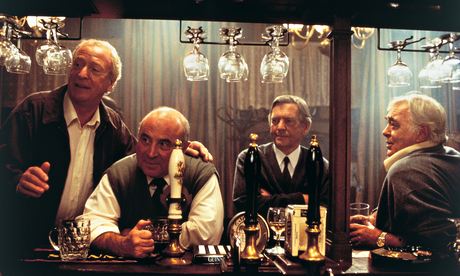
  2. Last Orders (2001) - one of those rare occasions where the film adaptation is as good as the (very good/ Booker Prize-winning) novel. It's all about the characters, as the group of drinking buddies and the son of the recently deceased Jack take his ashes to scatter them in the sea at Margate. Tom Courtenay, David Hemmings, and Ray Winstone join Bob in this last journey, and flashbacks include the brilliance of Michael Caine and Helen Mirren (as Jack and his wife). It's poignant, funny and beautiful.
  3. Vanity Fair (2004) - Bob Hoskins is frequently described as a character actor, and he does pop up in convincing cameos in everything from Dickens to Shakespeare. His turn as Sir Pitt Crawley in this frock romp is a generously understated example of why he is such a gift to directors and producers; making all the characters look even better.
  4. Mrs Henderson Presents (2005) - Playing the antithesis of his creepy old man role in Felicia's Journey, Hoskins provides the perfect foil to Dame Judi's rapier in this sweet, sentimental period piece full of warmth and wit in potentially seedy circumstances, as the Windmill Theatre introduced (sanctioned) nudity to the British stage.
  5. Made in Dagenham (2010) - I have a soft spot for this film because I saw it with a really good friend in a really good cinema. It's also about the struggle for equal wages for women, so of course I am going to appreciate the subject matter. It's full of working-class good will and solidarity, which makes you nostalgic for a time when people actually cared about each other, even though it probably never quite existed. Hoskins plays the union rep who is overwhelmed by the proximity of so many gobby women, but he remains the lovable cockney character we have come to recognise, posing the question, who will play these roles now? (Answer: Probably Ray Winston whose career seems to be following a similar path.)