Tuesday, 30 May 2023

Newspaper Analysis - The Weekend Australian Inquirer 27-28 May


When I returned to Australia after five weeks in Europe, I thought I would have a slow Sunday of reading the paper in the pub and catching up with local news and events. I forgot that the selection of Sunday papers in this country is strictly limited to a tabloid gutter-press and right-wing Murdoch-owned subsidies of an American mass-media cartel. 

So, I was stuck with The Weekend Australian from which I learned that the country is up in arms over The Voice referendum, which seeks to give Indigenous Australians representation in the constitution. Apparently it is divisive and unclear, although how they reach that conclusion is difficult to say as they also argue that the government has not released enough detail about something which will make the people 'bound in perpetuity'. 

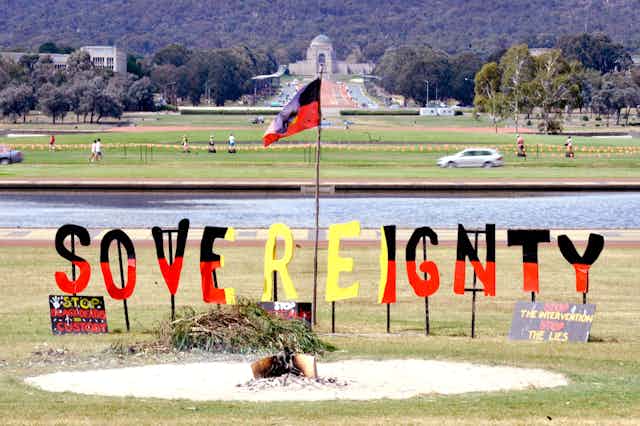
Many other articles criticise Stan Grant, who questioned the role of the monarchy in contemporary Australia during the coverage of King Charles III's coronation on the ABC network, the country's national broadcaster, principally funded by direct grants from the Australian Government and  administered by a government-appointed board. Opinion pieces opine that Stan Grant is out-of-step with public opinion and this six-and-a-half-hour broadcast was not the place to raise this issue. It doesn't help The Australian's cause that the multi-award-winning journalist Stan Grant is a proud Wiradjuri man. He has since quit television-hosting duties in response to online racist abuse over his coronation comments about historic Aboriginal dispossession. The Australian does not suggest when would have been a good time to make these comments. 

Without a hint of irony or awareness of hypocrisy, other articles claim that police tactics over COVID-19 were regressive as they shut down free speech based on questionable science. The Australian thinks there should be an inquiry into why people's Twitter comments were shut down. Speaking your mind in a time of great uncertainty in the midst of a pandemic with the potential of whipping up hysteria and pandemonium is clearly fine - as long as your view is individualist and supports capitalism. 

There is much frothing at the mouth about body dysmorphia, transgender popularity, and the discomfort of listening to women when they tell their stories. Brittany Higgins (a Liberal party junior staffer who alleged that she she was raped by a Minister in Parliament House) is a particular target for villification.

According to journalist Janet Albrechtsen, Brittany Higgins had a 'strategy' to go to the media first and the police second. She is the face of the #MeToo movement and, as a role model for other women, her 'tactics' 'may be mimicked by other women'. Albrechsten claims that, "Decisions by her and those around around her to air her allegation in the media have undermined key features of our criminal justice system." She continues, "The more times Higgins gave her version of events to the media, the more likely there may be inconsistencies in what she said happened."

Of course it helps The Australian to have a female reporter discrediting the words of an alleged rape victim. Albrechsten takes pot shots with sneering comments such as, "On more than a few occasions, the normal rules and sound judgements appear to have been discarded for Higgins." And she affirms this position with, "So many people in positions of power who were caught up in the hype of the Higgins media storm appeared to have made more decisions." Albrechsten appears to pander to the notion that size matters in the hunt for more column inches, and whereas I believe we should listen to women and take their accounts of abuse seriously, this article has me agreeing with one thing at least: #notallwomen
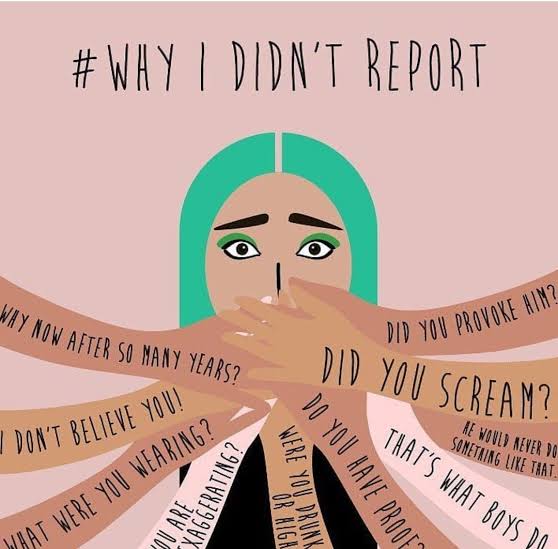

Richard Guilliatt weighs in on the debate (how is it even a debate?) by trashing as unreliable the memories of abuse victims after recovering repressed memories of trauma through a counselling technique called eye movement desentsitisation and reprocessing (EMDR) conducted by "so-called experts." He argues that, "sexual assault allegations were no taken as seriously as they should have been in the past but the public mood has shifted towards believing an allegation must be the truth." While neatly glossing over all that messy trauma, Guilliatt is upset that, "prosecutors in the current climate appear to see their role as supporting claimants rather than assessing cases on their viability." Heaven forfend any abuse victim might actually receive support as well as justice. 

More examples of the smug, patronising, sexist, ageist, scaremongering, homophobic, racist tone of the paper follow. But that's just my opinion. 

Dangers of AI risk smothering its benefits by Natasha Bita

I'm not saying it's alarmist but, "Like Siri on steroids, AI super-intelligence is rapidly disrupting the world of teaching and learning in ways that threaten to make reading and writing redundant." OK, so I am saying it's alarmist. The danger is, according to Bita, that "AI has caught most educators unprepared for its potential to turbo-charge teaching while giving lazy students an easy opportunity to cheat." She goes on to ask, "Will AI make students so lazy that they don't learn to think for themselves? What if AI re-writes history, spouts propaganda or 'hallucinates' by generating the wrong information?" What, like certain newspapers do now? 


She warns that "schools and universities will need to change assessment methods, relying less on take-home assignments and more on supervised exams, spoken tasks, and video assessments". It's almost as if educational institutions haven't been constantly adapting and changing their assessment methods every single year anyway. While one might think that drawing attention to the digital divide is a left-wing concern and an opportunity to talk about class and wealth inequality. "All state governments have blocked ChatGTP in state schools but many private schools are embracing its use, potentially giving their students an academic headstart." However, the example used of the school that is reaping the rewards of this unfair advantage is the Islamic Collage of Brisbane, because of course, why would you miss an opportunity for ramping up a touch of Islamophobia?

Left Dangling in a climate protest crackdown by David Penberthy

David Penberthy writes about the new laws in South Australia which impose greater financial accountability on protestors, or "those causing the mayhem", His language includes describing some of said protestors as, "retiree revolutionaries", "a small but crafty band of elderly 'rebels', as the XR activists call themselves", and "XR rebel Meme Thorne, a 69-year-old actor from the hippie haven of Willunga." 

Thorne abseiled down a bridge and "dangled above the traffic" in Adelaide as part of a protest against the Australian Petroleum Production and Exploration Association conference. While Penberthy makes no mention of the political motivation of this group, apart from the glib "in defence of Mother Earth", he expands upon the potential threat to the good citizens of Adelaide. "Her actions brought the city to a halt for an hour, even preventing some patients from making appointments at the Royal Adelaide Hospital".

The tone is exasperated and patronising, hiding a credible death threat behind an attempt at blokish banter. "Capturing the frustration of South Australians, Police Commissioner Grant Stevens spoke for many when he said dryly: 'The ropes are fully extended across the street so we can't, as much as we might like to, cut the rope and let them drop.'"

In response, Opposition Leader David Spiers, announced on talkback radio proposed amendments to the Summary Offences Act, increasing fines for such protests from $750 to $50,000 or three months' imprisonment. "It was a hitherto unseen moment of gut-instinct politics from the new SA Liberal leader and was lapped up by talkback listeners, many ringing in with messages of support from inside their stationary cars." Do we really want policy to be decided by knee-jerk reactions and people who lap things up like dogs and make phone-calls while driving?

Surprising life of the accidental president - review by Troy Bramston 

In an article about a new book, An Ordinary Man: The Surprising Life and Historic Presidency of Gerald R Ford by Richard Norton Smith (in which Smith describes Ford as being "charismatically challenged"), the reviewer, Troy Bramston adds this reflection:
"You can pass judgment on Ford or any other president by any standards you want, including contemporary standards. But it seems to me that you can only understand Ford or any other president or any other difficult decision, by immersing yourself in the context of the time."
Harpy Daniels wants YOU: US military goes for woke by Adam Creighton, Washington Correspondent

US Navy Yeoman 2nd Class Joshua Kelley appeared in persona as drag queen Harpy Daniels in a TikTok video encouraging young Americans to join the service. Creighton reports that, "Republican senators, former marines and much of the American public were shocked that the navy employed drag queens, let alone endorsed them to boost recruitment." Except, it doesn't. Kelley may be employed by the US Navy but, as the articles admits, this was not a sanctioned video. "The navy, which at first defended the promotional decision publicly, later denied Kelley was part of any formal program."

It transpires that the US military is struggling to meet its recruitment targets. "The US military, which has about 1.35 million active-duty personnel spread across the navy, air force, army, marine and space forces, requires more than 155,000 new recruits this year to replace departing personnel." Apparently this tough recruitment environment is comprised of "a perfect storm of low unemployment and steadily declining patriotism, fitness and interest among young Americans. Covid-19 made all this even worse."

Many young people are rejecting active military service because they don't see a need to ask what they can do for their country. "A prominent survey of Americans published in the Wall Street Journal in March revealed a huge drop in traditional values - patriotism, religion, family, community service - since 1998, especially among young people. Overall, only 38 per cent of respondents said patriotism mattered, down from 70 per cent."

In an outstandingly hypocritical swipe at the audacity of young folk to want decent compensation for their labour, the article goes on, "The only priority the Journal tested that has grown in importance in the past quarter-century is money, which was cited as very important by 43 per cent in the new survey, up from 31 per cent in 1998, the paper said, in what was a depressing read for anyone with traditional values." Well, curse those young people for needed money to survive in a consumerist world of high rent, fuel and commodities of someone else's making.

Could it be possible that environmental factors and toxic politics have leached the sense of service from young men?  Being told what to do without rhyme or reason is unappealing. This would indicate that the conservative role model is failing to attract young folk, and the 'values' of docile following of a capitalist construct is no longer something towards which they slavishly aspire. But sure, blame the drag queen. Perhaps Kelley should change their moniker to Red Herring.

Urban planning design transformed post-COVID by Bernard Salt

It's well written and well argued, and it definitely wants to give power to the individual and wrest it away from the 'nanny state'. Might that be because individuals can be persuaded to do what they are told, while collectives can stir up trouble for corporations? It starts out well, as Salt claims, "It makes sense that Australia, a nation largely founded on immigration [once again, the Indigenous contribution to nationhood is completely overlooked, but that's a whole different Stan of Grants], should evolve as a proving ground for town planning. Since European settlement we have created new cities and accommodated urban growth on a vast scale. And there is every reason to expect our cities to grow further in the years ahead." 

He can't resist a dig, however; "Modern homes typically have water tanks which (notionally) reduce demand for municipal water supplies. Solar panels and battery storage also shift responsibility for power generation and storage from the collective to households. It's all done to help the environment, of course, but it also has the advantage of freeing up funds that in a previous era would have been directed to creating public assets." This is a hugely selfish way of looking at things that supports the wealthy individual who can, and leaves those who can't afford such modifications out in the cold.

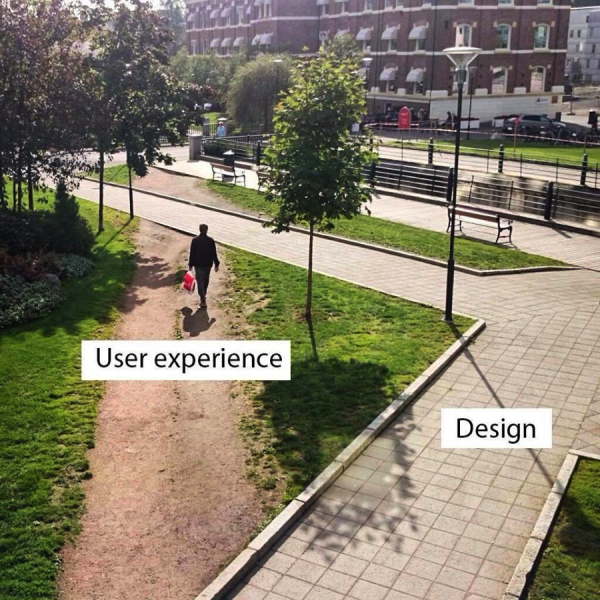
We can make people responsible for their own amenities and claim it is all in their best interests. "Knowledge workers living and working together in the dense inner city generate a frisson that creates entrepreneurial and/or economic activity. This idea supports the argument for density. But the pandemic unleashed powerful new forces that challenge the logic of how a city should operate. The reign of the knowledge worker is giving way to new roles such as carers, who live and work mostly in the suburbs. Plus there is a proportion of people who will work from home several days a week." Yes,this doesn't mean they don;t want city amenities or public transport, and it doesn't support any user-pays theory. If you can't pay; you can't use them. That doesn't mean you don't want to. 

"I think the narrative of city life is changing in the post-pandemic era. Our priorities have shifted towards security and the home, and our tolerance for commuting has lessened... It suggests a rising empowerment of moderately skilled workers based in the suburbs and regions, who, therefore, should have a greater say in how collective resources might be allocated." In other words, keep people in their homes, don't encourage them to become involved in community enterprises, and you won't have to build any facilities or infrastructure, unless people are prepared to pay for it themselves. Sorted. 
Friday, 26 May 2023

Friday Five: Films on a Plane, The Return Leg

  1. Aftersun: Daughter revisits camcorder memories of a teenage holiday with her young dad. Tender by Blur is on the soundtrack and sums up the film. ⭐️⭐️⭐️1/2
  2. Catherine Called Birdy: I've not seen many medieval comedies, but I'll bet this one is right up at the top of the list. Written and directed by Lena Dunham, based on a novel by Karen Cushman, and featuring Bella Ramsey (I've not seen her before but apparently she's known from Game of Thrones), Billie Piper, Andrew Scott, Joe Alwyn, Sophie Okonedo, Lesley Sharp, David Bradley, Russell Brand and Ralph Ineson (amongst many others), it is part touching coming-of-age tale; part deliberately anachronistic feminist take; complete and utter delight. ⭐️⭐️⭐️⭐️⭐️
  3. To LeslieMoney doesn’t buy you happiness but it does buy you alcohol and that leads to everything but. Andrea Riseborough gives a sensational Oscar-nominated performance as the woman who won the lottery and drank away her winnings; Marc Maron as Sweeney is her knight in shining overalls who withholds judgment long enough for her to try to forgive herself and make a plan for the future. ⭐️⭐️⭐️⭐️
  4. WolfwalkersGlorious animated fantasy adventure (An international co-productionled by Cartoon Saloon and Mélusine Productions) with folkloric, magical, supernatural, pagan and historical overtones about the destruction of the environment and the consequences for co-habitation with nature. Delightfully drawn with beauty and precision; perfectly voiced including the voices of Sean Bean, Simon McBurney, Honor Kneafsey, Maria Doyle Kennedy, and Tommy Tiernan. ⭐️⭐️⭐️⭐️1/2
  5. Women TalkingBut, as is so often the question, is anyone listening? Powerful subject; great cast; devastating dialogue well delivered. Would make a terrific play with the right direction. ⭐️⭐️⭐️⭐️1/2

Tuesday, 23 May 2023

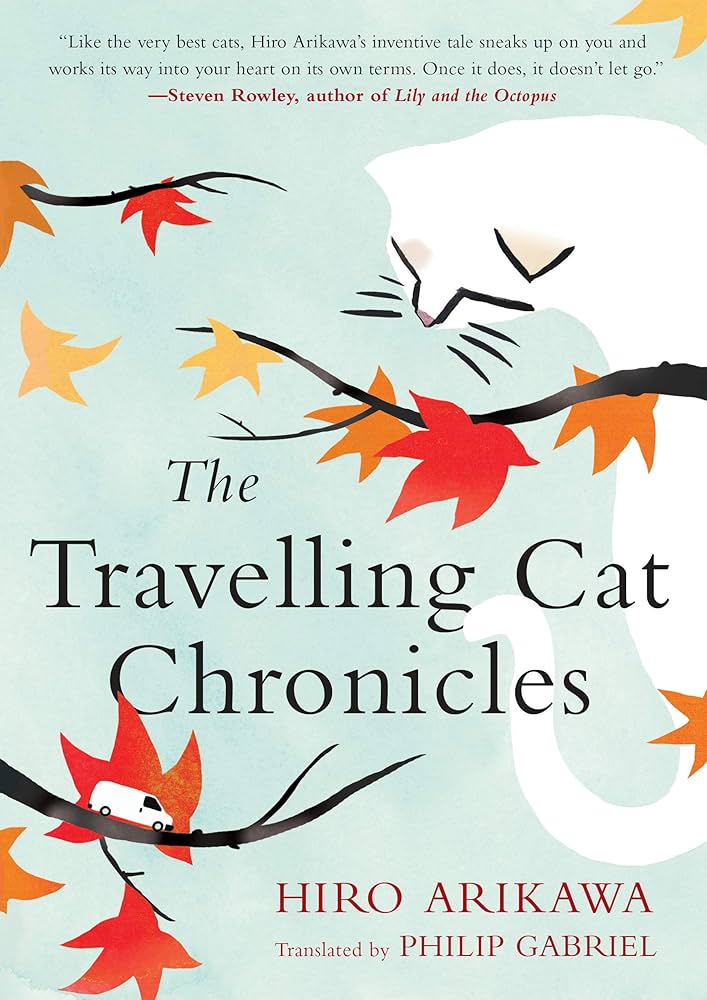
Deceptively simple or just a little bit naff? The Travelling Cat Chronicles


The Travelling Cat Chronicles by Hiro Arikawa
Thorndike Press
Pp. 327

Translated from the Japanese by Philip Gabriel, this novel (first published in 2015) had reviewers gushing that it was gentle, wise, witty, beguiling and full of simple but deceptive prose. I didn’t realise I was quite so cynical, but I have to wonder, is it deceptive or just simple and is it really profoundly charming or just a little bit naff?

The novel is mainly narrated by Nana, a cat named after the Japanese word for seven, which is considered to be lucky and the shape of the cat’s tail. Nana was a stray cat who was nursed by Satoru after being hit by a car. In return, Nana lives with Satoru and gives him affection. When Satoru knows he is dying, he wants to make sure Nana has a happy home so he sets off on a road trip to visit possible adoptive homes and friends.

These travels give Satoru an opportunity to spark memories and reconnect with old friends. He and Nana meet Yoshimine, the brusque and unsentimental farmer who thinks cats are just for catching rats, Sugi and Chikako, the warm-hearted couple who run a pet-friendly B&B, and Kosuke, the mournful husband whose cat-loving wife has just left him. In the pages concerning Kosuke, the point of view switches to the third person omniscient narrator who tells us about the boys’ friendship and how they bonded with a cat called Hachi (which means eight) when they were both in elementary school.

When we see Nana’s perspective he instructs us on cat behaviour, such as why they like cardboard boxes rather than special beds and toys. Nana doesn’t understand certain human idiosyncrasies including their fondness for the sea, and he also questions their need to concern themselves about burials and cemeteries. “When an animal’s life is over, it rests where it falls, and it often seems to me that humans are such worriers, to think of preparing a place for people to sleep when they are dead. If you have to consider what’s going to happen after you die, life becomes doubly troublesome.”

As well as teaching kittens to stand up for themselves and explaining feline ways, Nana also cares for his adopted human. He’s a proud cat, but he’s loyal, loving and perceptive. The Travelling Cat Chronicles is a novel about the bond between humans and their animals, but it also about the power of friendship from childhood to adults. Without the support of those he visits, Satoru would not have grown into the kind and gentle man he has become – the kind of man who would scour the country to find the perfect home for his cat.

Friday, 19 May 2023

Friday Five: Spanning the year of theatre

  1. Emilia - Essential Theatre, The Playhouse, Canberra Theatre Centre: When I read this play, I fell in love with it; it has feminism and Shakespeare intertwined with a glorious delight of language and heritage. It purports that the 17th-century poet Emilia Bassano is not only the 'dark lady' of the sonnets and his sometime lover, but the original writer of many of the works, whose words Shakespeare shamelessly stole to heighten the drama of his plays. Naturally, I was really excited to see this Australian touring version directed by Petra Caliva. Three women play Emilia at different stages of her life - one for her childhood and youth (Manali Datar); one for her young adulthood (Cessalee Stovall); and the third for her as an older woman (Lisa Maza). As each woman tells her story, the other two listen, react, encourage, cajole and reflect from the sidelines. The acting is of a high quality and the dialogue is delivered clearly and with passion. The characters are all played by women with the cowardly, grandiloquent and ultimately pathetic Shakespeare - played by Heidi Arena - getting the best lines and the biggest laughs. The set is minimal, comprising a revolving staircase which represents a multitude of scenes; the costuming brings the modern to the Jacobean (the brightly-colored Converse are a nice touch); and the choreography is eclectic with some snazzy contemporary moves. And yet, it just felt like there was something missing. Perhaps the haranguing and brow-beating tone left no room for nuance or relief so that the final speech, which should be incendiary - "The stakes we have been tied to will not survive if our flames burn bright. And if they try to burn you, may your fire be stronger than theirs so you can burn the whole fucking house down." - felt more like a damp squib, leaving the audience with nowhere to go and no way to react.
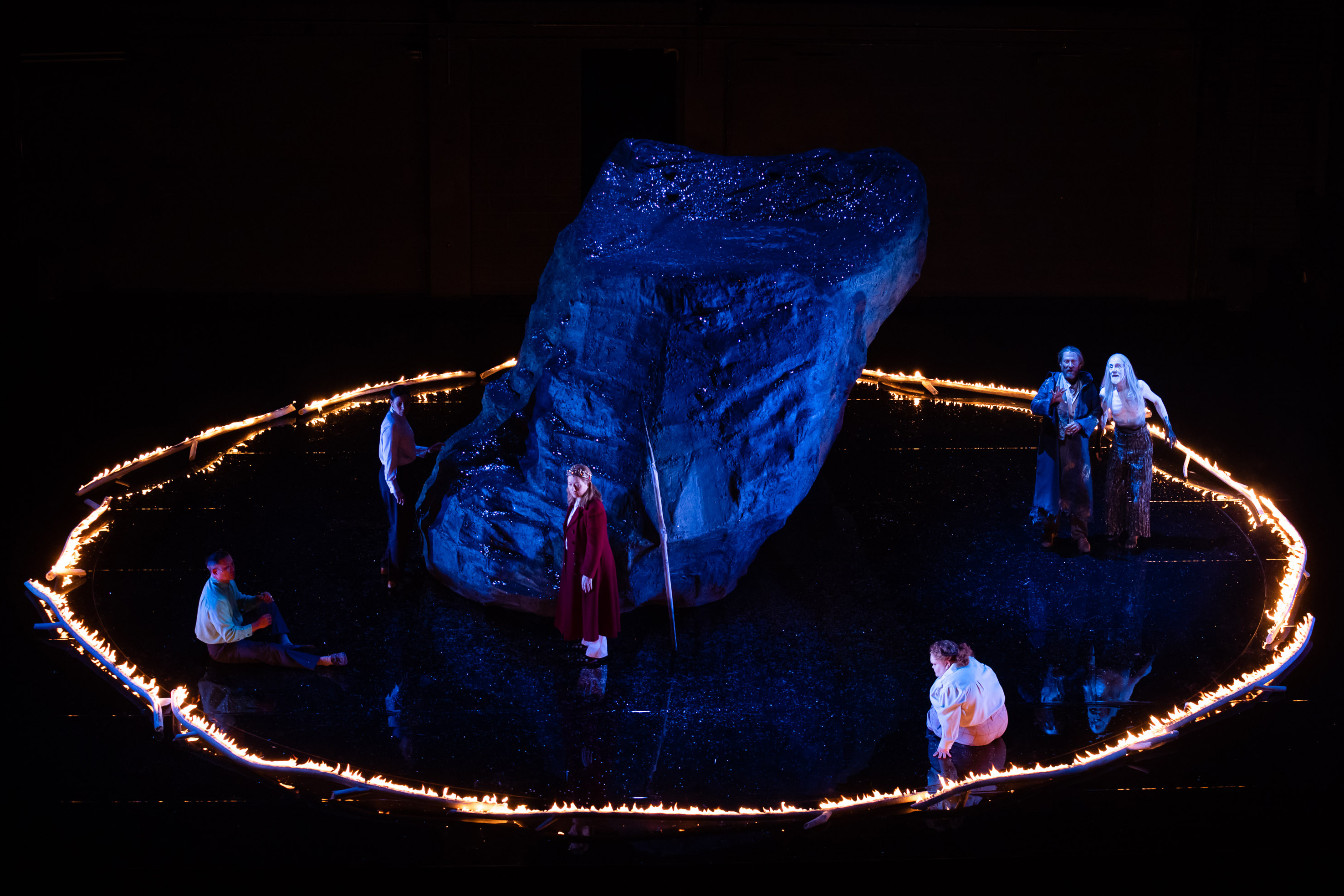
  2. The Tempest - Sydney Theatre Company, Roslyn Packer Theatre: I love the way certain directors interpret Shakespeare to suit their own ends - and why not? In this version of The Tempest (directed by Kip Williams), however, the attempt to force it to fit the 'they stole it from us' colonialist narrative, means Caliban has been made into the good guy by excising all references to his brutal rape of Miranda, Prospero's daughter. Rather than Prospero enslaving him due to fear of his bestial physicality, it becomes purely a white-man-subjugates-a-black-man narrative, and while the white man (Richard Roxburgh) and the black man (Guy Simon) in question are exquisite in their roles, and deliver the bard's blistering words with passionate sincerity, it removes much-needed nuance from the original drama. The set of a big central rock (Uluru anyone?) is inspired as it provides levels, hiding places and dramatic hierarchy, and the lighting effects are spectacular. The rest of the cast are all perfectly cast - Peter Carroll is a waspish and world-weary Ariel; Claude Scott-Mitchell as Miranda gets to speak some of Juliet and Jessica's lines (Shakespeare's other works have been plundered for their poetry), which she does with affecting flair; Susie Youssef is an unexpected boorish delight as Trinculo. Of course, some critics have taken issue with the gender-blind casting, but if they are concerned with straying from 'traditional' portrayals, I would have thought that would be the least of their worries.
  3. Cast of The Tempest by Sydney Theatre Company
  4. The Importance of Being Earnest - ACT Hub, ACT Hub: Determined to be different, Jarrad West's direction is more  cabaret than theatre, including bursts of song (Louiza Blomfield does a lot of heavy lifting as the chanteuse) and outstandingly vibrant costumes designed by Fiona Leach - Lainie Hart as a stylish Lady Braknell presents as a steam-punk-ringleader. Many of the lines have been cut (including the one about never travelling without one's diary so as to always have something sensational to read on the train) and characters' roles trimmed down; Miss Prism (Victoria Dixon in a seething passive-aggressive turn heightened by inebriation) really only serves to be hoodwinked by Cecily (Holly Ross in a wheedling doll-like performance) and for the famous misplaced handbag denouement. The setting is the Bunburry Club, and we are part of the action, with scenes taking place at tables often after audience members have been asked to move to make way for the performers. There is a lot of food and slapstick comedy involved in eating - Cecily and Gwendoline (Shae Kelly making a deliberate mockery of affectation) have a food fight over cake, and Steph Roberts delights in the gluttonous Algernon Moncrieff as she stuffs her face with muffins and refuses to take anything seriously. Joel Horwood has perhaps the hardest role of all as he plays the straight man, Jack Worthing, and with the delightfully gender-blind casting, this is no mean feat. Painting with such broad and colourful strokes, many of the British class nuances are missed but that doesn't seem to matter in this riotous production, which is more of a madcap comedy than a comedy of manners. 
  5. Amadeus - Sydney Opera House, Red Line Productions and The Metropolitan Orchestra, Concert Hall, Sydney Opera House: Let's face it, Michael Sheen is the draw-card here. Peter Shaffer's play is full of words and wit, interspersed with snatches of music and spectacle, and it requires a triumphant actor to bring the bombast and pathos in equal measure. As he looks back on the rumours concerning his part in the untimely death of Wolfgang Amadeus Mozart (Rahel Romain), Salieri (Sheen) interprets events with a satirical detachment and studied indifference, barely concealing his passionate envy and desperate ambition. It is a masterly performance, and his voice and presence command our attention. This is important, because there a few occasions in the second act where the script becomes burdensome and the audience begins to realise that three hours is an awful long run time. Director Craig Ilott revels in the flamboyance and offers plenty of distraction. The costumes are sumptuous (Anna Cordingley and Romance Was Born) with the rich fabrics, sensational colours and flamboyant designs appearing particularly striking on the austere set (designed by Michael Scott-Mitchell). The black steps and folding doors hint at a keyboard, a ladder and an amphitheatre reflecting the action back to us as if we are witnessing our own foibles and Faustian pacts played out before us. Nick Schlieper's lighting design - heavy on the back-lit scenes - creates intriguing shapes, silhouettes and shadows, although some bits of staging can only be fully appreciated if seated in the middle seats as the sight lines from the sides would cut off a lot of the visuals. Besides the brilliant pairing of Romain and Sheen, other stand-out performances come from Toby Schmitz as an endearingly foppish Emperor Joseph II, Belinda Giblin and Josh Quong Tart as the frenetic Venticelli who buzz about the stage transporting news and gossip, and the musicians of the Metropolitan Orchestra who supply Mozart's sublime music which, despite Salieri's best (and indeed, worst) efforts, we all know and love. 
  6. Grapes of Mirth - Contentious Character, Canberra:  Merrick Watts hosted an afternoon of comedy at a winery: the more we drink; the funnier they get. The acts were Frankie McNair (who gets funnier at every performance - proving that comedy is hard work), Peter Helliar (telling comfortable and amusing stories like a favourite uncle), Nath Valvo (very energetic and forthright), Dilruk Jayasinha (probably the best of the line-up), and Geraldine Hickey who was not in a good mood and was clearly thrown by the drunken heckling. Although it was baking hot and there was insufficient shade, it was a good, fun day out; not side-splittingly funny, but with plenty of entertaining stories.
Michael Sheen centre stage as Salieri in Amadeus

Wednesday, 17 May 2023

Debunking the Myths: Inferior


Inferior by Angela Saini
4th Estate
Pp. 237

Angela Saini contends that the so-called science which has labelled women as ‘the weaker sex’ is biased and influenced by politics, history, and social culture. Sick of people (men) telling her that women are inferior to men based on dubious scientific data, she wrote this book in an attempt, “not to lose control but to have at hand some hard facts and a history to explain them”. She challenges myths and provides explanations as to why some assumptions were made in the first place. Even though science is perceived to be neutral, women have historically been excluded from research, experiments, and theories. “Women are so grossly under-represented in modern science because, for most of history, they have been treated as intellectual inferiors and deliberately excluded from it.”

Darwin in his The Descent of Man believed that women were inferior because he couldn’t see any women doing the same intellectual things. “The evidence appeared to be all around him. Leading writers, artists and scientists were almost all men. He assumed that this inequality reflected a biological fact.” In evolutionary terms, drawing assumptions about women’s abilities from the way they happened to be treated by society at the moment is narrow-minded and dangerous.

Those ‘Men are from Mars; Women from Venus’ type ‘theories’ remain popular because anything that claims to explore sex differences is highly sought-after by media outlets looking for clickbait articles. People who counter that differences are not wholly due to genetics are often labelled sex difference deniers, in a way that would never be introduced in debates about race or colour; not since the 1950s, anyway. Sexual selection theories which were proven to be incorrect and unscientific, however, are making a popular comeback.

People are messy and come with preconceptions and prejudices. Saini argues that it is impossible not to politicise scientific data and that neuroscience has profound repercussions for how people see themselves. Humans are bound to pick up attitudes and adopt behaviours based on societal expectations rather than independent biological factors or sex chromosomes. We are also able to change and adapt as recent research into neuroplasticity confirms that the brain isn’t set in stone in childhood but is in fact mouldable throughout life.

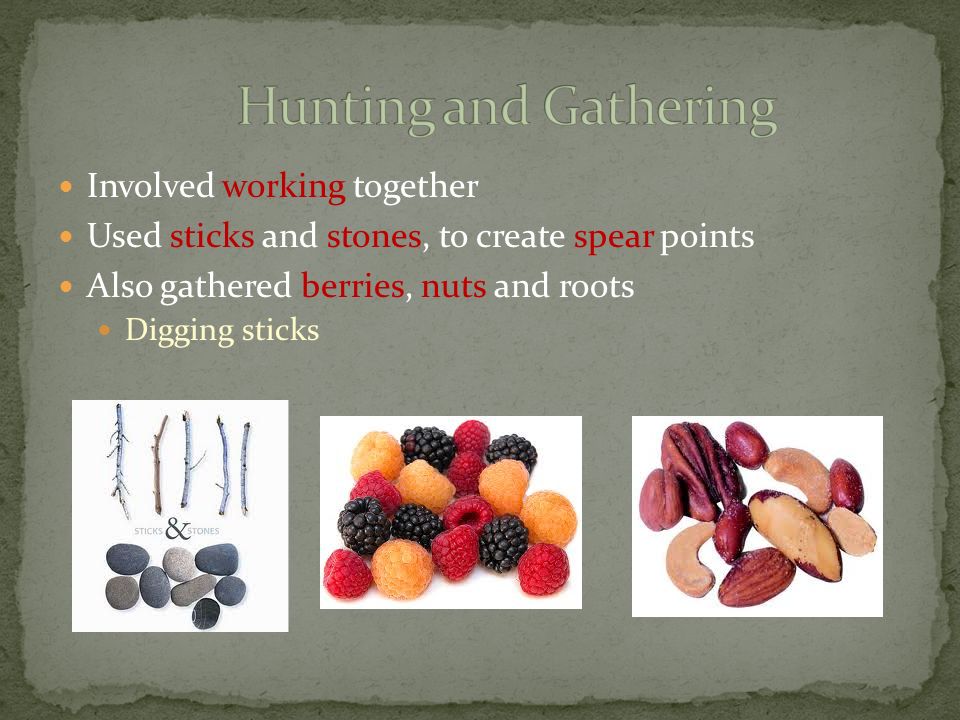
Saini also debunks several myths, such as the one that women are better at multi-tasking than men. The paper that was published on this subject, actually never reported this claim, but the cultural and gender stereotypes were stressed in the press release. A further belief is that in previous cultures men went hunting while women gathered, making the males dominant. Research by Bion Griffin and Agnes Estioko-Griffin into the Nanadukan Agta refutes this assumption, suggesting that males did some tasks and females did others. “By and large people did whatever they wanted to do. There was no sphere of work that was exclusively male or female – except perhaps the killing of other people.  Women would stay back when groups of men went out on raids of their enemies”.

Hunting was not the primary source of nutrition anyway, so the group that hunted did not have the most crucial task. While studying the !Kung hunter-gatherers in southern Africa in 1979, Richard Borshay Lee noted that women’s gathering provided as much as two-thirds of food in the group’s diet, so gathering was arguably a more important source of calories than hunting. It is also likely that the first tools were digging sticks and containers for the food, which, being made from wood, skin or fibre, would break down and disappear over time leaving no record, unlike the hard-wearing stone tools that archaeologists have assumed were used for hunting. “This is one reason that women’s invention, and consequently women themselves, have been neglected by evolutionary researchers.” Many of these myths began because they fitted the dominant – male – narrative that positioned women as inferior.

Humans are not automatically the same as other animals, and much of our behaviour is more likely due to societal pressure than biological expression. Women are not inferior, and the science that seeks to suggest this is the case is inevitably flawed. It is time for this to be recognised and stopped. Sarah Hrdy argues, “A feminist is just someone who advocates for equal opportunities for both sexes. In other words, it’s being democratic. And we’re all feminists, or you should be ashamed not to be.” This is the science we should all follow.

Friday, 12 May 2023

Friday Five: Ibiza Beaches

I was positively surprised by Ibiza. I thought it would be full of pissed up backpackers trashing the place, but it was utterly delightful. We were out of season and our hours were more 7am -10pm than 7pm - 10am, but we found some perfect beaches to while away the time, sip on a sangria, feel the sand beneath our toes and bob about in the Mediterranean Sea. Here are some of my favourites (yes, there are more than five: mi casa; mis reglas).

1. Babylon Beach

This was the closest spot to our accommodation and we walked down to see the sunrise a couple of times. Folks did yoga here to the gentle accompaniment of the lapping waves, and, although the bar was closed (don't worry - we found another one very close by!), it made for an idyllic setting. 


2. Marina Santa Eulalia
Just round the next inland is a beautiful cove full of yachts and hotels - the lights are very pretty on the water at night. 


3. Peurto de Ibiza
Not strictly a beach - more of a marina - at Old Ibiza Town. A perfect spot to sit and sip sangria while watching the boats coming in... and going out again. 


4. Playa Niu Blau
Great sandy beach with gradual drop-off into the sea for easy swimming. A cute little inlet at the far end of the beach was where boats were moored including one with a built-in slide. 


5. Playa Cala Pada
More good swimming and a restaurant right on the beach, where we shared an excellent seafood paella.


6. S'Argamassa Beach/ Cala Martina
There are eye-wateringly expensive resorts along this strip of beach where you can rent a day bed by the hour and sit by the pool ordering drinks and snacks all day long. We peered through the fence, then sat on the beach and swam in the sea for free before ordering a bottle of Albariño. There's an Ibiza to suit every budget.


7. Playa De Santa Eulalia
The main beach in town - the sand is raked every morning and the good folk of the town come to soak up the rays in the afternoon. The duathletes raced and rode up and down the promenade, and it offered spectacular opportunities for reflection in the evening. 

Wednesday, 10 May 2023

Word of the Week


Pilgarlic - defined by the OED as (arch) bald head; bald-headed man; poor creature; a man looked upon with humorous contempt or mock pity.

Often preceded by the epithet 'poor', the pil is (or was in the seventeenth century when the word was most common) pronounced the same way as peel, and so the image is clearly of a peeled garlic clove. Possibly this is due to the fact that a person who peels garlic would have hands that smell of it and so might be shunned or abandoned by others.

Another suggestion comes from Chaucer's Canterbury Tales. When the pilgrims arrived in Canterbury, the Pardoner gave a barmaid money to buy a good supper, but when he returned, he found another man enjoying her company and eating his food, making him sleep under the stairs. “And ye shall hear the tapster made the Pardoner pull/ Garlick all the long night till it was near end day.” In this context, it sounds somewhat obscene, if we imagine what part of the man's anatomy looked like peeled garlic.

Either way, it is a pretty solid insult and one it might be fun to slip into conversation and see whether you can get away with it.