Monday, 26 March 2018

First Public Appearance: Canberra Craft Beer and Cider Festival

Last weekend was the Canberra Craft Beer and Cider Festival. Wignall Brewery was making its first public appearance so I went along to help serve customers and document the event. We began by heading to the brewery and picking up the kegs to transport them to the festival. 


It was a beautiful clear morning as everyone was setting up their stalls and the organisers were laying out the tables and chairs and blowing up the balloons. After a quick coffee and a short but informative briefing - there are lots of volunteers who are willing to help - it was time to open the gates to the general public. 


There were 52 exhibitors with plenty of beer and cider to taste. The layout was along Batman Street and in the car-park of the Mercure Hotel. Stalls lined either side of the street with plenty of seating in the middle of the road. There were umbrellas and pine trees providing plenty of shade, and with suncream and water readily available, it was all set up to be a perfect beer-drinking environment.


I walked around early on to take photos of the people and their stalls before they got too busy, and I also sampled one or two beverages. Yes, I'm biased but I do love the Cole Porter from Wignall Brewery - it's deep and rich and chocolatey smooth. It did establish quite a reputation over the day and I heard many good things from customers.


We were next-door to Feral, who have long been a favourite of mine. I began the day with a Biggie Juice, which is so full tropical fruits and stone fruit and a pulpy hazy texture going on, that it totally tastes like a healthy breakfast beer. That's my story and I'm sticking to it.



Of course we were sharing the stand with the crew from Pact; they make great beer and they stand out not just for the quality of their brews, but also for their bold colours and striking marketing.


There was a small queue of dedicated drinkers waiting to be let in at 11am and the crowd slowly built up to lunch time, when the street and the stands got really busy.


I had a Passion of the Puss from Wayward early on in the proceedings - the passion fruit and yuzu Berliner Weisse is so fresh and tart and delicious - it's a real sorbet of an amuse bouche and the perfect palate-cleanser.


These lads from Cupitt Craft Brewers make a great smoked porter that has a good depth and a subtle charcoal flavour - very nice indeed.


I'm not usually a fan of 'session IPAs' but there is a time and place for all strengths of beer, and about 2pm at the Canberra Craft Beer and Cider Festival seemed about right to try a Piss-Weak Sauce (Session IPA). For once I appreciated a session IPA that has all the hop flavours without the alcohol strength. Nice.


I also got in a sneaky cider: George the Fox is smooth featuring well-balanced tastes of apple and oak. It's very easy-drinking and makes a refreshing change. 

Drinky Pete is horrified to find himself empty handed.
 As well as Pact and Wignall, Canberra were well represented by Bentspoke, Capital and Zierholz. The latter's porter has a smooth coffee/chocolate richness and that signature berry taste.


The bands added to the atmosphere by supplying a relaxed and entertaining vibe. There were also food options, including burgers, nachos and 'loaded' chips. The food was good but a little tucked away in a back corner; I would have liked it to have been more plentiful and prominent.


Our friends at Willie the Boatman pour some of the finest beers around. The Crazy Ivan has a good malty hop balance, and the Nectar of the Hops is described as 'perfect beer for our warmer months'. It was certainly a festival favourite today with the big and juicy; sweet and fruity hops (tropical fruit flavours; pineapple; mango; lychees) and low bitterness for a smashable session.

 
Crazy Ivan
Pact Beer Co and Wignall Brewery collaborated on a blend of the Mt Tennet Pale Ale and the Stable Genius IPA. It's quite soft and sessionable with a good hop level coming through while the bitterness has been tamed. An on-line competition resulted in it being called Mount Pale McStable Face, and if you're not impressed with the name, here's the person to blame. 


As the day wore on the crowds kept coming, so we kept serving them beer. Fortunately, other people did too.

 
The boys from Akasha
Club Brewing are an interesting outfit, describing themselves as a beer subscription service with a difference. They focus on small batch releases designed and brewed in collaboration with some of the best breweries in the world exclusively for their members. I tried their stout (brewed in collaboration with Baird Beer) and their hoppy black ale (brewed in collaboration with Beer Here), both of which were jolly decent. 

Collaborators!
It was a big day and at the end of it we were tired but happy, as they used to say in the Famous Five. In terms of getting out and about, talking to and meeting customers and chatting with other brewers about their beers and the general market, it must be considered a great success. Roll on the next one!


Tuesday, 20 March 2018

Hearts and Minds: QED

Ylaria Rogers as Catherine in Proof
Proof by David Auburn
Freefall Productions

The Q, 14 -17 March 2018

A mathematical proof is an argument in support of a statement based on exhaustive logic. It implies a clinical level of control, which David Auburn exploits in his 2000 Pulitzer Prize and Tony Award-winning play Proof. Catherine (Ylaria Rogers) is the daughter of mathematical genius and professor, Robert (Gerard Carroll), who has recently died after a long mental illness. During his increasing insanity she cared for him mentally and physically as she explains in intimately heartbreaking detail.

Her sister, Claire (Julia Christensen), who has escaped filial duty in New York as a currency trader, returns for the funeral and to sell the house. Her bags may be light but her baggage is not. Meanwhile, Robert’s former student, Hal (Derek Walker), stumbles across a proof in his mentor’s notebooks that he believes will change the future of mathematics.

On one level the play is simplicity itself, pared back to four characters and a single set. Despite the intellectual subject matter, there is no emphasis on chalk-covered blackboards or complicated-looking equations; we never see the experimental scribblings as they are contained in innocuous-seeming notebooks. The action all occurs outside the house, set on an oblique angle across the stage, featuring an array of well-tended pot plants in a sort of conservatory and windows covered with sheets through which lights shine erratically during scene changes.

Against this solid backdrop, however, we are in the world of non-linear narrative and imaginary numbers. Robert, whose death precedes the beginning of the play, makes several appearances and gives Catherine a bottle of birthday bubbles, which she drinks with him. Should we see this as an example of her mental fragility or the time-bending possibilities of quantum physics? She, herself believes she may be following her father’s footsteps both in the cerebral world of prime number theory and the irrational realm of madness.

Scratching the surface further uncovers layers of guilt, fear and anxiety, as is felt in all relationships, whether that be between father and daughter; siblings; tutor and pupil; or lovers. Carefully constructed façades crumble just as we are told the house in which Catherine and her father have lived until now is falling to pieces.

While a proof follows logical steps, it may also include natural language – in a mathematical context, this means a language developed and spoken by humans in an organic manner as opposed to a formal language, such as that used to program a computer. This is accepted to admit some level of ambiguity to the deductions, and this production excels in its ambiguity. Those who didn’t know the plot were shocked at the mid-point revelation, although admitting they should have seen it coming; a true testament to expert storytelling.

Tour director, Tyran Parke, and original director, Derek Walker, trust the actors to carry the narrative, and their belief is well placed as all four handle their character with subtlety and sensitivity. The frequent switches in pace and motivation are demonstrated through tone and expression as well as posture and movement. No one resorts to histrionics or excess; all are entirely believable. The role of Catherine is pivotal to the success or otherwise of this play and Ylaria Rogers imbues it with grace and nuance, highlighting every aspect from stubborn anger to enchanting naivety.

They also credit the audience with enough intelligence to reach their own conclusions about the ‘moral’ of the play rather than enforcing any particular agenda or riding any current hobbyhorse. The programme notes state that Freefall Productions wants to give audiences, ‘stories that they can identify with, theatre that touches our hearts and minds.’ With this superb and thoughtful gift of a production, they have done just that.

Alexander Brown as Hal and Ylaria Rogers as Catherine

Friday, 2 March 2018

Friday Five: Different (Re)viewpoints


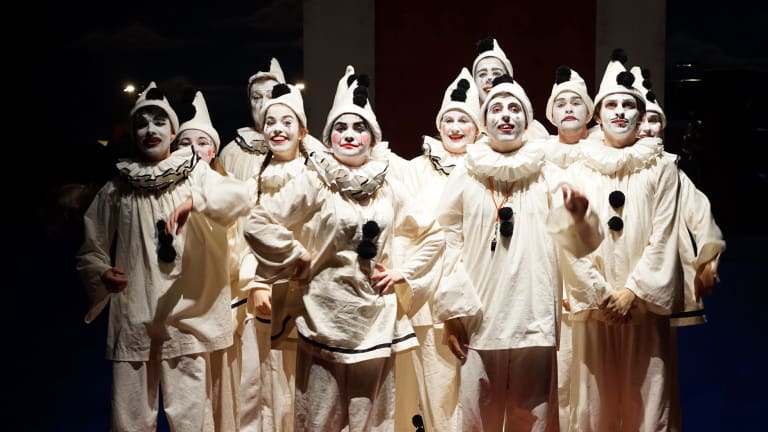
I am currently performing in the Canberra Repertory Production of Oh, What a Lovely War! I am not one of those people who don't read reviews (or claim not to) of the shows in which they are performing. I do read them but, as I have been a professional reviewer myself and have studied the art of reviewing under several different people, all of whom I respect (including Jeffrey Wainwright; Dave Olive; Laurence Coupe; Jeffrey Walsh; Kathryn Ryan; Peter Rose; Marion Halligan), I am aware that they are to be taken with a grain of salt. 

One of the first things I learned is that a review is only one person's opinion; not everyone will like what you do and that's just fine. A good reviewer should never divulge the plot or criticise without good reasoned argument; neither should they refer to themselves unless they believe the reader is more interested in them than the product they are reviewing, such as Jeremy Clarkson's car 'reviews' or Martin Scorsese's film choices.

The purpose of a review should be to give the potential consumer an idea of whether they will like the thing being reviewed or not, by placing it in context and mentioning the ways in which it is similar to or different from other comparable works. It should review the object that is there; not what the reviewer would have liked it to be. In that light, some of these are better than others - not because of what they say, but because of how they say it.


5 Reviews of Oh, What a Lovely War!
  1. Reviewed by Joe Woodward in The City News - "The production is a triumph for what theatre can achieve in a cultural and social connection with the political agendas of our time."
  2. Reviewed by Len Power for The Canberra Critics Circle - "This production is a puzzling disappointment...This was an important play in its day but with this uninvolving production it’s hard to see why."
  3. Reviewed by Peter Wilkins for The Canberra Times - "A precisely marshalled demonstration of outstanding ensemble work by the company, inspired by Baldock's directorial inventiveness, Ewan's excellent musical direction and Ylaria Rogers' lively and appropriate choreography."
  4. Reviewed by Cathy Bannister for Stage Whispers - "A fresh and vibrant interpretation... handled with alternating humour and foreboding, formality and relief."
  5. Reviewed by John Lombard for The Canberra Critics Circle - "While there were a lot of good physical ideas, they did not always tell the story effectively. Between thick accents and some poor articulation, it was hard to follow the extremely dense narrative."