Showing posts with label espionage. Show all posts

Tuesday, 25 October 2022

Le Carre's Last Stand: Agent Running in the Field


Agent Running in the Field by John Le Carré
Viking
Pp. 281

The last book that John Le Carré wrote is, perhaps unsurprisingly, a fast-paced action with a clear story and credible characters. Themes of espionage, defection and loyalty may have seemed passé, but nationalism and protectionism are once again current: the old enemy is back, reinvented as the new enemy and we may need to defend our nation and concepts of freedom and democracy all over again from plutocrats like Putin. The novel is crammed full of code names and secret spy business, played out against a backdrop of Brexit, Trump and greedy oligarchs in a contemporary environment.

Nat is a forty-seven-year-old veteran of Britain’s Secret Intelligence Service who plays badminton and lives a pleasant and seemingly settled life in London with his wife, Prue, who does pro bono legal work for worthy causes. He is somehow manoeuvred into playing badminton at his exclusive private club against a young upstart, Edward Shannon, who has ideas, and he is not afraid to expound them. With an older mentor’s indulgent attitude, Nat finds himself looking forward to these meetings, although the book is written in retrospect as he reflects upon them.

The premise is that Trump has helped to engineer Brexit so that Britain has to rely on Russia for financial and political assistance, which is obviously going to be grubby, and be beholden to the USA once again. Tellingly, Trump does Putin’s dirty work for him: “pisses on European unity, pisses on human rights, pisses on NATO. Assures us that Crimea and Ukraine belong to the Holy Russian Empire, the Middle East belongs to the Jews and the Saudis, and to hell with the world order.”

There may possibly be “an Anglo-American covert operation already in the planning stage with the dual aim of undermining the social democratic institutions of the European Union and dismantling our international trading tariffs.” This operation will also “disseminate fake news on a large scale in order to aggravate existing differences between member states of the Union.” One former spy is horrified to think that he risked his life to see the Great British Empire, liberal conscience and Christian values replaced by “a cartload of hypocritical horseshit”. In present circumstances, division and in-fighting will not be difficult to engineer.

The language of spies follows form: a newspaper in which hand determines whether it is safe to talk or not; letters written suggest the opposite of what is declared. There is, however, a refreshing respect for women, which is often absent from male hard-boiled thrillers. The novel is elevated by its use of witty and decisive one-liners to describe characters and actions. For example, one high-ranking official has a “cheery port-and-pheasant voice”, while another “doesn’t do confrontation, which is something we both know. His life is a sideways advance between things he can’t face.”

At 281 pages the novel is shorter than many of Le Carré’s previous heavyweight thrillers, but it is engrossing and entertaining, packed with set pieces, old tropes and new angles. We live in a world of surveillance and, while anyone may express almost anything on the surface, there are people watching our utterances and manipulating our movements, biding their time until we can become useful to support a pet project. Gripping stuff.

Tuesday, 5 April 2022

Espionage Isn't Always Exciting: The Spy Who Came in from the Co-Op


The Spy Who Came in from the Co-Op: Melita Norwood and the Ending of Cold War Espionage by David Burke
The Boydell Press
Pp. 175

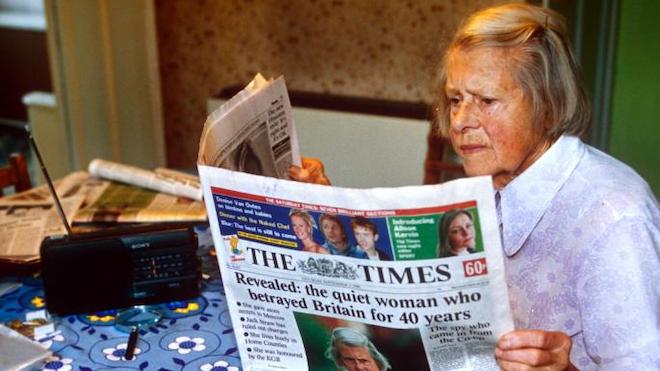
It should be quite difficult to make such an exciting story sound so dull, and yet David Burke manages it. While he is good at painting the big picture, he gets bogged down in tedious detail too often. Melita Norwood was the last of the atomic spies to be ‘run to ground’ in 1999, aged 87. She was deemed too old to prosecute and there were protocols which prevented her questioning, but the press had a field day, with headlines including the title of this book. Burke, however, mainly concentrates on the history of espionage during the cold war period, rather than her particular part in it, which seems like a missed opportunity.

Melita Norwood shared atomic secrets with Russia, which shortened the Soviet Union’s atomic bomb project by about five years. As secretary for G.L. Bailey, Director of the British Non-Ferrous Metals Research Association on the Tube Alloys project, she had access to classified information, which she chose to share with Russia because she believed in the Communist Party, but she also knew that if only one side had the power, then the situation could be lethal.

Ursula Kuczynski (Red Sonya) was Melita Norwood’s controller between 1941 and 1944, and the book that Ben Macintyre wrote about her, Agent Sonya: Lover, Mother, Soldier, Spy, was interesting enough to lead to this one. In some respects, their spying trajectory was similar. As Burke writes, her spying career had spanned two very different eras of Communism. “Here was a woman who had spent her childhood among an eclectic mixture of anarchists, suffragettes, Tolstoyans and the pioneers of British socialism, who had eagerly embraced the ideals of Lenin’s October Revolution. Their Utopianism remained with her throughout her life and blinded her to the worst excesses of Stalinism.” Also familiar to anyone who has read the above book are the descriptions of the ‘brush pass’ – the highly convoluted meetings between operatives carrying explicit items in a specified hand – and the cover reasons for the meetings, including vegetarian societies; football teams and philatelists.

There was clear evidence against Melita Norwood, but it was ignored “on a junior level” until she was outed. It was still going on when Stella Rimmington, Director General of MI5 had to answer questions about it in 1993. Many couldn’t believe that the timid housewife could have nefarious motives. The Norwoods moved to Bexleyheath in 1947, which was described as “the very epitome of post-war smugness in an age of austerity, boasting houses with fake Tudor beams, spacious parks and golf courses. It was middle country, middle class, middle management and middlebrow.” This was something the authorities wished to cover up as their focus was demanded elsewhere.

Burke writes that, “The British have a peculiar attitude towards spies ranging from fascination and approval to extreme horror.” He understands that when the story broke, the newspapers were keen to portray Melita Norwood “as a Mata Hari – the great grand-mother spy who had given the Soviets a blueprint of the atomic bomb that threatened the security of the West.” This may not have been strictly true, but the papers love a good story and are not averse to several large helpings of hyperbole. Burke acknowledges, “The fact that she prepared homemade chutney, drank tea from a Che Guevara mug, shopped at the Co-op for ideological reasons, supported CND, enjoyed gardening and did a delivery round for the Morning Star at the age of eighty-seven only added to the excitement.”

He posits himself as above all this scurrilous gossip-mongering and sticks to facts in a dull, dry manner, more’s the pity: this could have been a gripping yarn if he were less po-faced about it all. And, yes, Joan Stanley was the code-name for Melita Norwood and the subject of the film Red Joan, which is far more entertaining.