Friday, 11 July 2014

Friday Five: Le Tour en Angleterre


Philip Davies (MP for Shipley) has called for the CEO of Welcome to Yorkshire (Gary Verity) to be recognised in the next honours list. It's not that far-fetched; 2.5 million people watched Le Tour in Yorkshire, with the scenery and residents displayed to their best advantage. 

Despite some utter selfie-taking morons thinking they were more important than the race and causing crashes and potential harm to the athletes who have trained for years for the opportunity to participate, the British leg of arguably the world's greatest cycle race has been a resounding success.


5 Great Things about Le Tour in Britain:
  1. Yorkshire: dry stone walls; green rolling hills; acres of moors; spectacular villages... and coloured sheep
  2. The history: just as the helicopter flies above the beautiful chateaux of France; so we got brilliant aerial shots of castles, colleges, stately homes and abbeys - stunning
  3. The crowds - the number of people who turned up to shout and support and add colour and enthusiasm was fantastic to see. And the road closures and the publicity and the all-round welcoming spirit can only bode well for the future of cycling in the country.
  4. London - the capital looks great with cyclists streaming through it, past the sights of Big Ben, Tower Bridge, the Tower of London and so many more
  5. The Red Arrows flypast at the beginning, with Ian Stannard in the back seat.

Thursday, 10 July 2014

2014 World Cup: Today's Talking Point - The Pain of Penalties


Penalties are like democracy, which, in the words of Winston Churchill, 'is the worst form of government, except for all the others.' For the neutral, they provide thrilling entertainment, for the team that wins, they are wonderful; for the team that doesn't they are crushing. And either way, you have to live with the result.

But what is the alternative? Knock-out games need a result. You could make the teams play on and on and on, adding further periods of extra time by the half hour until there is a result. This gives the opposition time to reply and sets a fair expectation - as in those interminable tie-breaks in tennis. You could go for the 'golden goal' option (this used to be called 'sudden death' but the term was deemed to have 'negative connotations' and removed from use in 1993) as FIFA have sometimes done.

This was basically a 'next goal wins' scenario whereby if the match was drawn at the end of normal time, there were two extra halves of 15 minutes played each way and if a goal was scored in this time then the game was won instantly. If not, the match then proceeded to penalties. Detractors complained that this led teams to play defensively (as if this were a bad thing) focusing on not conceding a goal rather than scoring one. 

Then there was the 'silver goal' introduced in 2002, whereby if a team scored in extra time, that half was concluded and the game was not stopped automatically, but if the goal had come in the first half, then the second half wasn't played. Furthermore, it was up to each tournament to decide which rules they were going to implement. Confusing? Yes, well that might well be why FIFA resorted to penalties.


Some say penalties are a lottery. Not really. If you are going into a tournament that may be decided on penalties (and a fifth of all World Cup knock-out matches since 1974 have been decided on penalties), then you practice taking them, and the side that performs best at penalties wins. This is proven by empirical evidence. 

England have been involved in three penalty shoot-outs at the World Cup; they have lost all of them. After their shoot-out defeat (by Argentina) in 1998, manager Glenn Hoddle admitted that his squad had not practiced taking penalties. Prior to the 2014 World Cup, England had lost more penalty shoot-outs than any other nation. Incidentally the teams that have won most penalty shoot-outs in the World Cup are Argentina and Germany. Bring on the final.

Wednesday, 9 July 2014

World Cup 2014: Today's Talking Point - The Case for the Defence


What else could we possibly talk about other than that defeat? Hosts Brazil, who haven't lost a home game since 1975, let in seven goals; five in nineteen minutes in the first half. The final score of 7-1 to Germany could have been greater. And every non-partisan supporter cheered for football.

The Brazilian team has been appalling in this World Cup. Their football has let them down; they have relied too much on Neymar and have left gaping holes in defence, as Germany exploited to their delight and Brazil's bemusement.

Brazil aren't the only ones; the defending at this World Cup hasn't exactly been spectacular. All the focus in the early stages was on Neymar, Suarez, Ronaldo, Messi, van Persie, Robben, and even Rooney, but no one bothered about what was going on (or not) at the back. The games in the group stages were largely goal-fests, which may have entertained the masses, but it didn't bode well for the future of football. It was clear that the teams that were going to succeed in this World Cup would be any one which paid equal attention to both ends of the pitch: bringing a fresh interpretation to the cliche, 'a game of two halves'.


But it was more than that. The tricks, flicks and flairs of traditional Brazilian football were infrequent in this tournament. Crowds have been turned off as the boys from Brazil have hacked, fouled, shoved, barged and kicked their way through to the semi-final. The fact that they have appeared to win more than their fair share of referee's calls has also looked ugly. It has been far from aesthetically pleasing, and football fans are unimpressed. And so there are very few regrets as the Germans go marching on. So long, samba; the party's over.


Friday, 4 July 2014

Friday Five: Signals for Help


I read recently of a bloke who said that if anyone ever saw him drinking a can of Miller Lite, they should know that he had been kidnapped and it was a desperate signal for help. Why else would anyone ever drink that stuff?

This reminded me of a devilishly clever plot in one of the Famous Five novels where George is kidnapped and forced to write a letter to her friends to persuade them that they shouldn't worry about her. She signs the letter 'Georgina', so they instantly deduce that all is far from well, and they spring into action to rescue her - I can't remember the rest of it but secret passages and fabulous picnics were bound to have been involved. 

Which made me wonder how, in such a situation, I would frantically try to draw attention to my predicament without alerting my kidnappers. If you see my exhibiting any of these behaviours, it is a secret signal and I expect you seek assistance immediately.

5 ways you will know I am signalling for help:
  1. I have got a tattoo
  2. I say of a football match, 'it's only a game'
  3. I interchange adjectives and adverbs with willful disregard for the complexities of the English language
  4. I express an affection for country music or prog rock
  5. I am wearing Ugg boots or visible underwear in public

Wednesday, 2 July 2014

World Cup 2014: Today's Talking Point - Heroes and Villains


Football is theatre. It combines high drama with low comedy and deep tragedy. Hours of training and rehearsal culminate in a performance before spectators. A variety of characters peoples the stage, including hard-working straight men and heroes.

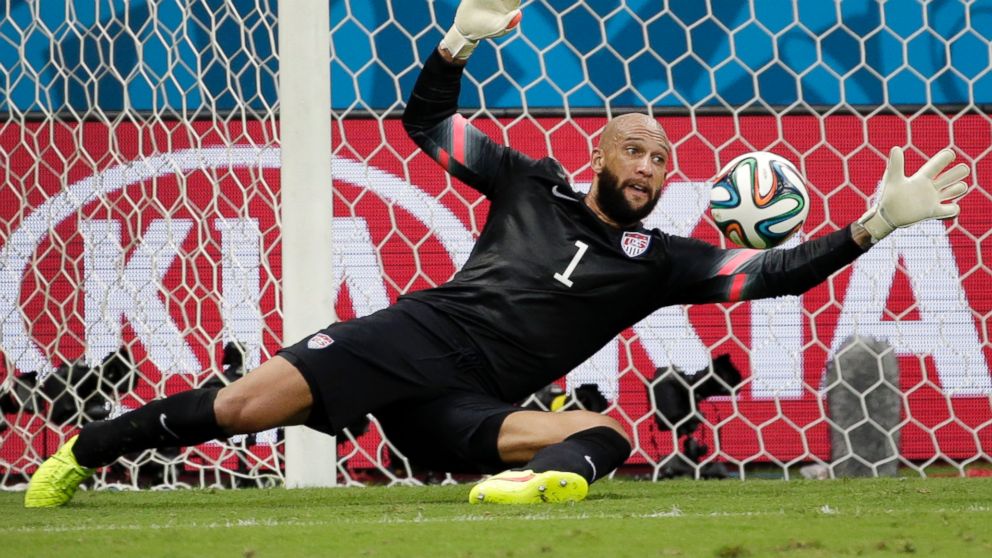
Two of these heroes were in action this morning. Tim Howard played an amazing game for the U.S.A. against Belgium. Confident and reliable at the back, he anchored an at-times shaky defence and made more saves than in any World Cup match since record-keeping began. Reports tend to be all about goals scored and of course these are important, but goals saved are equally so. Despite being on the loosing side, Howard should be proud of his hand in his team's impressive performance.


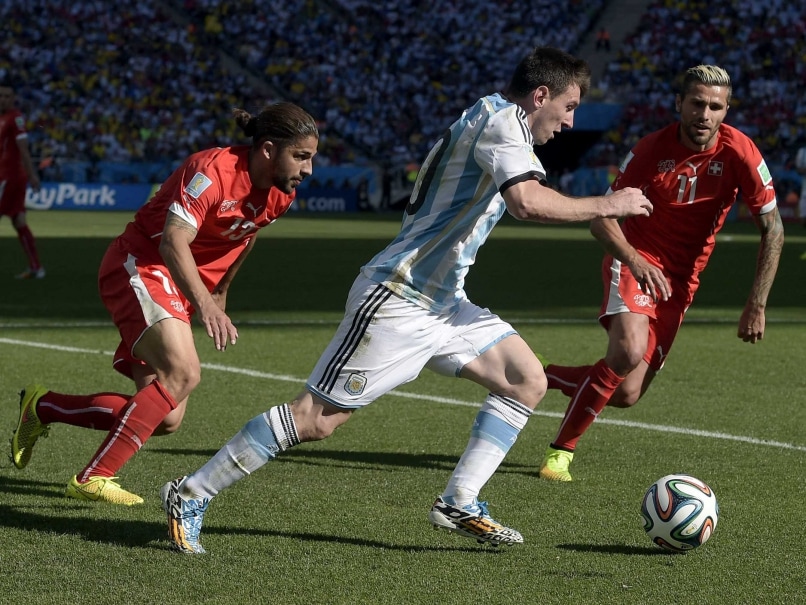
Lionel Messi is another of football's leading men. I heard a commentator say, 'If Argentina didn't have Messi, they'd just be an average side. But they have got Messi.' The Swiss tactics were clearly to mark him out of the game; whenever he got the ball he was surrounded by red shirts, and yet he still managed to skip a way through. The theory is that Argentina have a Plan A (get it to Messi) and a Plan B (get it to Messi). If both of these fail, they resort to the last measure (keep trying to get it to Messi). 


Football also crosses the threshold into pantomime, and every pantomime needs a villain. Many people award this role to Arjen Robben of The Netherlands. They claim he dives to fool the referee into awarding him penalties. This may be true. It is also true that he was fouled repeatedly in the game against Mexico; at least twice in the penalty area. 

If you are kicked, hacked and tripped, and the opposition are getting away with it, you have to draw the referee's attention to it somehow. Your side's chances to progress, your football, and your fitness are all at risk here. Maybe he overdoes it, but not without reason - and maybe that one wasn't the penalty that should have been awarded, but it made up for the two previous ones that weren't given.


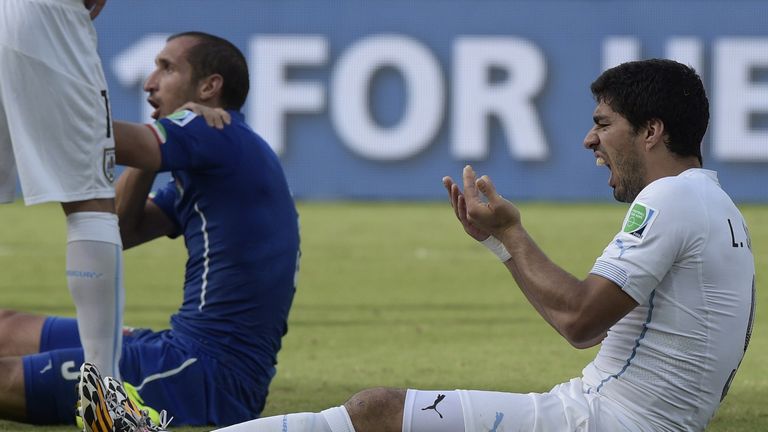
Much harder to defend is Luis Suarez. Biting people is indefensible. I said it last year in April, and I say it again. There is no excuse. I know there are arguments as to his phenomenal footballing brilliance and his dubious mental state. I appreciate that some think the four month ban from all footballing activity (including training with Liverpool) is too harsh and penalises a club that had nothing to do with the incident. This is not the place to discuss this. This is the place to quote Joyce Grenfell:

"I think it serves you right if he bit you, and don't bite him back. Because he's smaller than you are. Are you bleeding? Then don't make such a fuss." I think it's fair to point out that in this instance 'he' is a hamster called Harold Wilson. And that Joyce Grenfell also admonished another little girl, "We never bite our friends."


As for someone who is possibly both, you can't go past Cristiano Ronaldo. After the infamous World Cup winking incident of 2006, he was pretty much loathed by everyone who wasn't a Man Utd supporter. In fact, 'I hate Ronaldo' was, according to Google, the most popular Man Utd-related web search of 2007. 

In 2008, Man Utd faced Chelsea in the the Champions League Final. It was 1-1 at full time and went to penalties. Ronaldo was the only Man Utd player who missed his penalty, but his team went on to win the title. Did he celebrate with his team-mates? No. He lay down in the centre circle and cried like the spoiled brat that he is because he thinks he is more important than his team, whether that team be Man Utd or Portugal. I still think he is a petulant, whining, arrogant, selfish, vain, indulgent, tantrum-throwing, self-obsessed, pouting prima donna, but...

Ronaldo has no tattoos. This is a massive plus in my book. But the reason is even better. Apparently he gives blood a couple of times a year, and European Law states that you can't donate blood if you have had a tattoo in the past four months. And that ridiculous haircut of his? I read on the internet that it was to match the scar of a young fan who had brain surgery. And then I read on the internet that it wasn't. Whichever, it has made me soften towards him just a little, which is good, because a character who is all bad does not make for compelling theatre.


Tuesday, 1 July 2014

World Cup 2014: Today's Talking Point - The Heat!


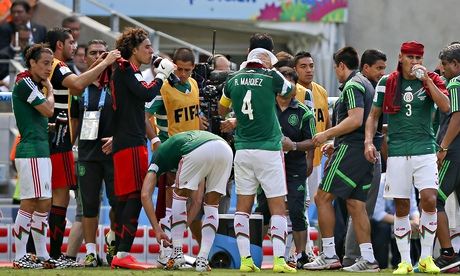
It's hot in Manaus. And Fortaleza. And many (but not all) other Brazilian cities where World Cup games are being played. It's humid too, with 80% humidity recorded at the Italy v England game, creating extremely unpleasant conditions. Especially if you're not used to them. 

Of course, these footballers are professional athletes and most of the European teams have an entourage of fitness experts to help them to acclimatise. Apparently the Italian squad prepared by running on treadmills in the sauna, and the English 'wore extra layers', which admittedly isn't particularly high-tech and something my Dad used to recommend when we ran out of heating.

It's no surprise then, that the teams who have had their group stage matches in the hotter and more humid locations have suffered unduly high incidents of heat-related ailments from heat exhaustion to cramp and dehydration, all of which take time from which to recover. Predictions were that the European teams who played here would particularly struggle, and this proved to be the case. Italian midfielder Claudio Marchisio claimed he had been hallucinating during his team's clash with England in Manaus.

It was also outrageously hot at USA 94, when FIFA banned water breaks despite the temperatures soaring to 46 degrees Celsius. John Aldridge had a famous meltdown on the touch-line as players were refused refreshments during the game between Mexico and Ireland. Since then the rules have changed, and FIFA now allows water breaks 'if health professionals deem conditions to be dangerous'.


These breaks are not mandatory, but a Brazilian judge has ruled that the referee must give a water break if any game is played in a temperature above 32 degrees Celsius in the Wet Bulb Globe Temperature index, which takes conditions such as wind speed (or chill), cloud cover, humidity, and UV radiation into account.

To switch sports for a moment, nearly every year there is controversy at the Australian Open as tennis players in Melbourne struggle with blistering heat. In 1998 an Extreme Heat Policy was introduced, with measures such as the ability to close roofs, longer breaks between games and sets, and the possible suspension of matches. In 2007 on-court temperatures reached 50 degrees, and this year not only the players were affected; a ball boy fainted and more than a thousand spectators were treated for heat exhaustion.

So why is this controversial you ask? Because some people say they should just get on with it. Their argument goes that these people are paid (and paid phenomenally well) to entertain us. The conditions are the same for everyone, so no-one has an advantage. 


My refutation is partly that the audience or spectators are denied the peak performance of these athletes, because no-one can achieve physical excellence in such heat. Also, basic humanity should stop you from wanting to torture people by forcing them into oven-like situations. They are sports-folk, not gladiators. Surely we don't want to watch them harm themselves? That's not sport; it's sadism.

Thankfully common sense has prevailed, with the introduction of three-minute cooling breaks used for the first time in the game between Mexico and The Netherlands. And officials have clearly realised that it is absolutely ridiculous to host games in places where it is too hot for comfort. Oh, wait... did someone say Qatar?


Monday, 30 June 2014

World Cup 2014: Today's Talking Point - Changing of the Guard?


The beautiful game is often referred to as the world game; it is played in and by more countries than any other sport. For all of it's global appeal, however, it has historically been dominated by teams from Europe and South America. Since the first World Cup in 1930, the winners have come from Europe ten times and South America nine times. (There were no World Cups in 1942 or 1946 due to WWII.)

Now it seems the old guard may be giving way. As in 2010, only six European teams made it through to the knock-out stages. Obviously I was disappointed (but not surprised) by England's premature exit, although one could argue they were in good company with Spain, Portugal and Italy all booking early flights home. By contrast, Central American and African nations are performing well and adding extra excitement to the tournament. 

And what about the U.S.A.? No one really expects them to progress much further; even if they beat Belgium (which is not outside the realms of possibility), they will probably be facing Argentina, which may be too high a hurdle to overcome. But how exciting to see them get this far. Their TV viewing figures suggest their football team is the most-watched national side the country has ever produced. This is great news for football (America and Australia are the only two countries in the world that don't call it football) and encouraging for the good of the American public.

It is also amusing to note the vitriol of certain neo-Conservative American columnists trying their best to deride football as dull, unskillful or noncompetitive. I'm not actually sure what they are watching. I would post a link, but I don't want to give them any more publicity. Suffice to say these are people who think being called a socialist is an insult.