Friday, 15 November 2013

Friday Five: Legends of King Arthur


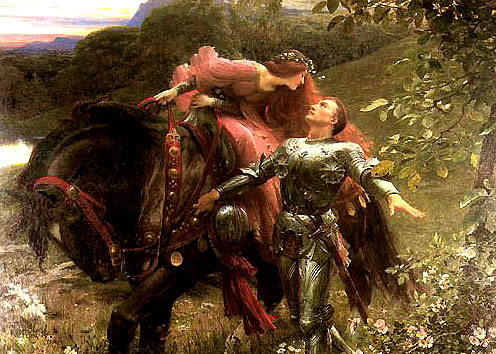
La Belle Dame Sans Merci by Frank Dicksee
I recently read The Quest for King Arthur by David Day. I love books about the legends of King Arthur and all the mysticism that surrounds him and his knights. I'm not so interested in the 'real' King Arthur and the historical accuracy but more in the way the legends have been appropriated and adapted to suit various causes at different times - in fact I wrote my university dissertation on that very theme. Every now and then I read another novel with the loose basis of the legends, and over the years I have built up a little collection of favourites.
Image by Alan Lee
5 Favourite King Arthur Books:
  1. King Arthur and the Knights of the Round Table by Roger Lancelyn Green - I loved his account which I read as a child, and this was probably the version that first set me on the Arthurian Way. He is also to thank for my interest in Robin Hood and Greek and Norse mythology.
  2. The Once and Future King by T.H. White - including The Sword and the Stone, this tetralogy had a profound influence on me (and Disney, as it turned out). I loved the writing and the illustrations by Alan Lee.
  3. Le Morte D'Arthur by Sir Thomas Malory - one of the strongest bases of the stories as we know them and a firm foundation of my dissertation.
  4. The Merlin Trilogy by Mary Stewart - comprised of The Crystal Cave, The Hollow Hills and The Last Enchantment, this is an interesting view of events placing all of the power in the hands of the magician in the times after the Romans had just left Britain.
  5. A Connecticut Yankee in King Arthur's Court by Mark Twain - I liked the time travel and courtly elements and the trope of hindsight and engineering making the time traveller the smartest person in the room, but it proved to me that Americans don't understand tradition and so mock it instead.

Wednesday, 13 November 2013

Henry 4: Mess with the master at your peril


Henry 4
Bell Shakespeare
Canberra Theatre Centre, The Playhouse, 27 Feb - 9 Mar 2013

The point of Shakespeare’s history plays is that they are written about specific people at precise times and for explicit reasons – the clue is in the name really. So, while I appreciate Bell Shakespeare’s decision to condense Henry IV Parts One and Two into a three hour version, I fear they have lost a lot more than they have gained by this treatment.

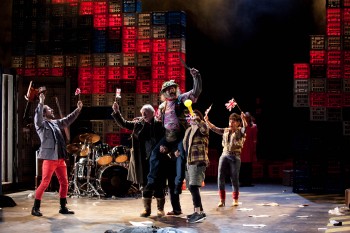
The set of milk crates in a Union Jack formation, while effective visually and contextually – it is broken apart to allow characters to enter and depart – is an instant anachronism, as the first union flag of England and Scotland was not created until 200 years after Henry IV’s death. Instantly the entire power struggles, righteous rebellions and questionable route to claiming kingship is rendered irrelevant. Later lines, such as the usually gut-wrenching, “How I came by the crown, God forgive me. Plain and right must my possession be”, and “Lord knows what crooked way I have earned this crown”, are robbed of all potency.

At the interval, many of the young adults in the audience (I went to a matinee plagued with school groups) were asking each other what it was all about and did anyone know what was happening? Well might they ask, because most of the battle tactics, political and historical aspects are mercilessly cut leaving a hollow mess.

Harry Hotspur (Jason Klarwein), rather than being a worthy and brave opponent over whose dead body Prince Hal (Felix Jozeps) intones, “Fare thee well, great heart”, becomes a subject of ridicule. He is portrayed in commando gear; a macho action man, well-built and crass, whom Hal mimics and affords no respect. Hotspur’s impatience is translated as childish petulance and his banishment of his wife from his bed implied to be from homosexual motives and steroid use.


Although Henry IV (David Whitney) uses Jerusalem as a battle hymn, the fight with knives, chains and lead piping has no dignity. The attempt to link the Percy Rebellion or Northern Rising with the Cronulla Riots is cheap and illogical. Similarly Falstaff’s (John Bell) edited discourse on honour loses all impact because there is nothing glorious with which to contrast his cowardly actions. The lack of regal motivation is woefully absent and the speeches are bereft of any beauty and nobility.

So, what does remain? Director (and adaptor) John Bell seems to want to focus on the coming of age of Prince Hal from playboy Prince to shining ruler. There are two problems here. Firstly, the taverns of Cheapside and the company of Falstaff, Mistress Quickly (Wendy Strehlow) et al are meant to be attractive. There is nothing enticing about the pole-dancing joints and dingy bubble-wrap covered sofas and bus seats in which the young prince carouses. The tavern scenes are drenched in booze and debauchery and are tawdry and dull rather than appealing.


The rubber gloves and plunger favoured by Mistress Quickly are indicative of the proverbial bargepole with which one wouldn’t want to touch Sir John Falstaff – embodied here as a disgusting and greasy old rocker shambling about in an ill-fitting waistcoat. If he is meant to offer an alternative father figure of fun for Prince Hal, it is an extremely unattractive one.

The other problem is that is hard to believe in Prince Hal’s kingly qualities. In this performance he was played by an understudy and perhaps the original casting (of Matthew Moore) was much stronger. Felix Jozeps was cast as Boy (amongst other roles) and this would have suited him far better. He acts like the irritating adolescent in the Zits cartoon strip – all lanky limbs, floppy hair, ill-bred mannerisms and self-entitlement. When Henry IV berates his son, the king is far more dynamic than either character had been in the previous foreshadowing scene between Hal and Falstaff. With his feet on the sofa and slouching posture Hal is awkward in front of his father, and King Henry IV literally walks rings around him.


King Henry IV is harsh, bold and unfriendly, surrounded by men in suits who think his son is a waster – and they’re right. Prince Hal may want his father’s love and respect, but he doesn’t go out of his way to earn it. In his army costume and beret he looks like a Thunderbird puppet, and his hugging and hogging of the crown during his father’s death scene is pathetic rather than potent.

Hal’s eventual denouncement of Falstaff seems petty and vindictive rather than necessary for the health and future of the nation. We are not chilled as we should be when Falstaff claims, “The laws of England are at my commandment” because we haven’t been led to believe that the stakes are particularly high. Neither is there anything revealed in the portrayal of Prince Hal to indicate that he will “imitate the sun” and “show more goodly, and attract more eyes/ Than that which hath no foil to set it off.” It is impossible that this sullen teenager will become one of England’s greatest ever monarchs.

The production contains some excellent acting – namely Sean O’Shea who has crisp delivery as Shallow, and Yalin Ozucelik who brings a much-needed amicability to the loyal companion character of Poins. The frenetic band, incorporated into the action with the drummer seated on stage also enhances the pace of the action, but the direction is inconsistence with a muddle of metaphors.


The integrity of the ambushed fight scene is weakened by the introduction of German tourists for cheap laughs. Shallow and Silence are supposedly watching football (or soccer, as Australians insist on calling it, although the flags are totally wrong) adding unnecessary business to detract from their speech as though they are worried that the plot alone cannot hold the audience’s attention. The overall effect is as though the company don’t trust the words, even adding modern speech to the policemen and making lame reference to slices of lime in necks of corona bottles for the line, “There’s lime in this sack”.

Messing with the rhythms and beauty of Shakespeare’s language is practically criminal. Primary school viewers may enjoy the match the pictures to the words approach, but Bell Shakespeare are guilty of throwing the baby out with the bathwater.

Monday, 11 November 2013

My Newest Favourite Thing: No Junk Mail


I bought this little sticker for two dollars and since affixing it to the letter box I no longer have to shovel screeds of badly printed paper advertising stuff I don't need and can't afford from there straight to the recycle bin. I feel like I saved a forest already. That is all.

Friday, 8 November 2013

Friday Five: What I'm Watching

While I wait for the new seasons of Doctor Who and Downton Abbey to arrive in Australia, I have been amusing myself with other television series. Upper Middle Bogan was excellent but has now finished. I will also mention Mock the Week, although I'm not sure it counts as a series, and Dancing with the Stars as the only reality TV show I watch. I even voted for the first time ever the other day - Libby Tricket, in case you're wondering.

I watched one episode of Masters of Sex, which was really good, but it's on a bit late for me. Similarly Sleepy Hollow which was fine until the programmers changed the time slot. I like to not watch flickering screens for an hour before bedtime. I started watching Marvel's Agents of S.H.I.E.L.D. but after two episodes the badly-drawn female characters annoyed me too much to contimue watching. I also enjoyed the two episodes that I caught of First Crossings, in which historic pioneering journeys are recreated by Kevin Biggar and Jamie Fitzgerald.


5 TV Shows I'm Watching:
  1. Whitechapel - with Him Outdoors or during the daytime when it's light - I'm not sure why I find this scarier than any other crime drama, but I do.
  2. The Blacklist - the woman is annoying, but the series features James Spader - enough said.
  3. Miss Fisher's Murder Mysteries - season two and we're back for more frock horror: such fun!
  4. David Attenborough's Africa - yes I know it's a repeat and I've seen it before, but it's Sir David; it's the BBC; it's Africa - what's not to love?
  5. Big School - mocking the genre of school sitcom soap like Grange Hill for never-grew-ups, it's awfully compelling.

Friday, 1 November 2013

Friday Five: Killer Vegetables


Because yesterday was Halloween and lots of people were doubtless carving Jack o'lanterns, it  made me reflective on the nature of pumpkins. I love pumpkin - in spicy coconut type soups, in rich tomato stews or roasted with the parsnips and potatoes to accompany a joint. I've never been a huge fan of pumpkin pie but that's part of my dislike of mixing savoury and sweet. There are some wonderful pumpkin ales that I look forward to seeing on the market in autumn, but that's a post for another time. (Autumn, perhaps.)

But I hate chopping it. I even consider buying it pre-chopped from the supermarket, although I never acually have because that seems to me be the height of laziness, along with pre-grated cheese or pre-peeled oranges - they sell those in Marks and Spencer. Well, I am vindicated, because it turns out that pumpkins are top of the dangerous vegetable list  yes, there is one. According to the Royal Society for the Prevention of Accidents (RoSPA) tens of thousands of people every year are admitted to hospital with injuies inflicted from trying to chop pumpkin, and root vegetables are responsible for two-thirds of kitchen injuries.

Advice to avoid such injuries includes the ostensible paradox of having sharp knives, and choosing a vegetable peeler for the task where appropriate. Chopping your vegetables too fast is also hazardous admonishes the survey of more than two thousand customers carried out by an on-line takeaway service (slightly biased motives, anyone?). Two fifths of the participans confessed they had injured themselves by trying to imitate the methods of the TV chefs.

5 Most Dangerous Vegetables:
  1. Pumpkin - I agree with RoSPA - tasty but dangerous (a bit like Christopher Eccleston)
  2. Onion - I don't suppose it helps that they make me cry so I have to close my eyes while cutting them up
  3. Beetroot - they stain everything, and if you forget that you've eaten it, the next time you go to the toilet will be terrifying
  4. Artichokes - the social embarrassment of not knowing what to do with it can be crippling
  5. Leeks - one was thrown at Ashley Cole in a Wales v England match in 2011 (what an original insult) and Fluellen beats Pistol up with one and then forces him to eat it in Henry V. Depending on how badly this is taught in schools, it can poison children against Shakespeare for life. 

Thursday, 31 October 2013

Licky-likey?


A sketch of her cat, Cort, by Sarah Morrissey
Today I learned another totally useless but mildly interesting fact - why yes, I do collect them. Apparently 45% of people lick the lid of their yoghurt pot. 10% of people in the survey said they didn't eat yoghurt. This leaves a whopping 45% of people who don't lick the lid. Who are these people? And why?

I can only assume that they are of the 'younger generation' who don't buy their own groceries and are therefore quite content to waste someone else's money on uneaten dairy product. I also assume that their parents have not lived through an era of rationing so they have never received the lecture on the sin of food waste. Nor have they ever had the one about starving children in Africa. Or they simply have no shame.

Of course, I'm talking individual yoghurts here, not the big family-sized one, as that would be unhealthy and a bit odd. The only reason I can see for not licking the lid is because they used to be made of tin foil and if you tore that and then licked it you could cut your tongue. Hands up who's done that? Just me, then. Well, most of them now are that plastic sort of substance and it's very difficult to cause yourself a mischief with that.

I'm not sure that I know a single person who belongs to the non-lid-licking 45%. Even my cat licks the lid, and the empty pot for that matter, and he gets his little face stuck in there which is quite funny but he won't thank me for sharing that with you. So, if you are one of these mystery container top abstainers, could you please explain your reasoning? I'd really like to know.

Friday, 25 October 2013

Friday Five: Staying inside the lines


Tonight is opening night of In Loco Parentis, written by Helen Machalias and directed by Andrew Holmes. It is a tough and confronting play that explores 'unwelcome sexual encounters, inconvenient truths, and brutal university policies'. I play Dr Bryce, the Head of College who may or may not be complicit in the appalling incidents occuring on campus. If you are in the area, come and see it - I'd love to discuss it with you afterwards!

5 lines from In Loco Parentis:
  1. "First and foremost, welfare starts at home, and that means looking after each other, especially the vulnerable members of our community." - Katy McIntyre
  2. "Chicks are like grass, they need to be cut down to size regularly or it gets out of hand." - College Boy
  3. "For future reference, Mitchell, beginning a sentence with 'I'm not being sexist, but...' is a guaranteed way to get a woman off-side." - Dr Jillian Bryce
  4. "You used to love it here, and then you took a gender studies unit last semester and became some angry, magnanimous bitch." - Mitchell Cameron
  5. "I assume he's your garden variety college footy head?" - Jana Abernach