Monday, 20 July 2020

Gently Hurling: After She Left


After She Left by Penelope Hanley
Impact Press
Pp. 337

This novel focusses on three generations of women and in particular the mother/ daughter relationship, but the characterisation is shadowy and they all blend into one. Penelope Hanley obviously has things that she wants to say about Irish immigrants, illegitimacy, art, Sydney, politics, and the Women’s Liberation Movement but the forced plot and the unnatural dialogue does her story a great disservice. The granddaughter, Keira, is trying to do a photo essay project on her grandmother (Deirdre Wild)’s art, but her mother, Maureen, resists saying much about her, creating a sense of mystery. It transpires she had an illegitimate child after an affair with a married man; this is not a scandal today and the consequences of it then aren’t covered well enough for it to merit the supposed shock.

There are ways of blending historical detail seamlessly into a novel, which Penelope Hanley ignores. She uses newspaper articles to fill in details, or clunky discussions about conscription and the Vietnam War; Whitlam’s speeches are transcribed. Neither does the author follow the advice given to every aspiring author of ‘show; don’t tell’. The description of Deirdre’s peripatetic lifestyle reads like a route map, and rather than trying to weave the effect of the artworks into the narrative, Hanley chooses to describe Deidre’s art in a mock newspaper review; a three-page long account of the paintings and the artistic style supposedly from the Sydney Morning Herald.
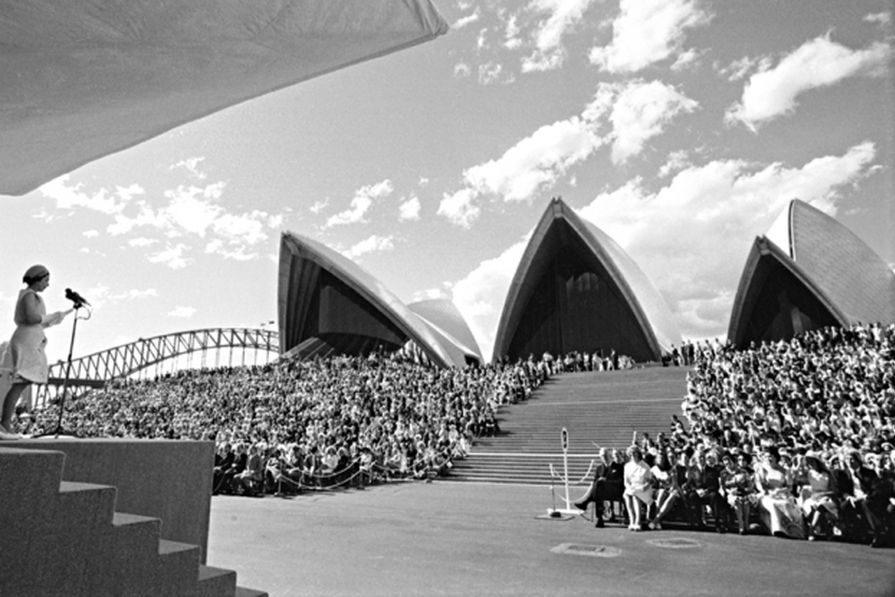
Queen Elizabeth II officially opening the Opera House on 20th October 1973
Characters discuss sexism in art, and the architecture and politics of the Opera House in a way which is simply unrealistic. Keira won’t go to the opening, because the author wants to shoehorn in her opposition to the monarchy. The frequent discussions about gender roles and how women do all of the “domestic stuff” even when they have a paid job too, are clearly important, but are presented as daughters and mothers lecturing each other with full speeches. It plays to the gallery so strongly I feel as though I’ve been hit over the head with a pop-up placard. Earnest debates about apathy and change read more like a social history textbook, and the writing is turgid as no noun is left with an adjective; no verb without an adverb. “When she let herself in, Lady, in a quick dash of woolly curls and wagging tail, hurled herself gently at Keira, barking ecstatically, her paws on Keira’s thighs.” – can a dash be anything but quick? Can one hurl gently?

Depth is implied through what the characters are reading, perhaps hoping their knowledge and ideas might be inferred; all books are mentioned from Iris Murdoch and Erica Jong to Germaine Greer and Simone de Beauvoir. Apparently constant mention of characters’ outfits is also a substitute for giving them any personality. This could have been an interesting tale but it is submerged in layers of overblown prose, excessive detail, stilted dialogue and indistinguishable characters.

Friday, 17 July 2020

COVID 19 Friday Five: More ISO TV

The A Word, season one

Following a previous post, I am still watching far more television that I normally would. But, hey, I think we've all agreed that nothing is 'normal' anymore.
 
5 More COVID-Friendly TV Series:
  1. The A Word (BBC First) - With a punk, post-punk, new wave and indie classic soundtrack of the best music evs (download it from Spotify: it's six hours long) and the stunning backdrop of Lake District fells (often with Christopher Eccleston running over them), this drama looks and sounds exceptional. The titular A word is autism as a family comes to the realisation that their son has it, how they incorporate it into their daily lives, and how the wider community accepts it. It's a rather air-brushed version of reality (no one is mean or petty) but the dialogue (Peter Bowker) and character dynamics are superb. There are currently three seasons (2016; 2017; 2020) and I'm bereft now that I have watched them all.
  2. The Capture (ABC iview) - In a society where we rely on surveillance to protect us, it is terrifying to think that it may be easily manipulated. This tense British crime drama written by Ben Chanan and starring Holliday Granger and Callum Turner is gripping, intelligent and startlingly contemporary. With a tagline of 'Seeing is Deceiving', it is the homage to Orwell's Big Brother that we've been waiting for. 
  3. Dublin Murders (SBS On Demand) - A crime drama that follows in the footsteps of Broadchurch or Shetland with a mardy moodiness, intriguing writing, and enough flashbacks and plot twists to keep things interesting. Sarah Phelps has adapted Tana French's best-selling novels to a binge-worthy small screen format. However, none of the characters are at all sympathetic, and when one actor/character pretends to be someone else, viewers with prosopagnosia may lose the plot. 
  4. The New Pope (SBS On Demand) - If you thought The Young Pope was bonkers (and you'd be right), wait until you see The New Pope. With the incumbent lying in a coma (providing several cameo opportunities for Jude Law), it is up to the cardinals to choose a new leader. After a few false starts they settle on John Malkovich who plays his part with delicious inscrutability. The serious side explores the dichotomy between those who think the Catholic Church represents compassion, and those who fear it has been irrevocably corrupted by sexual and financial scandals. Meanwhile, the throbbing soundtrack and camp, raunchy undertones entertain with twenty-first century sentiment. 
  5. Sanditon (BBC First) - Andrew Davies has adapted Jane Austen's unfinished novel (her material covers half of the first episode) into a period drama which will delight Janeites and Regency fans alike. There is a typical predictable romance between an insipid female and a dull and pompous male, but all the subplots and actors are excellent. We have the injustice of female marital imprisonment, an employer's legal and moral responsibilities to their employees, a matter of race and preconception, and a rotten pineapple. All of these are framed by charming set pieces such as a picnic among the bluebells, a rowing regatta on the river or a cricket match on the beach. And Anne Reid takes over from Dame Maggie Smith as the indomitable dowager.

Wednesday, 15 July 2020

Upsetting the Apple Cart: The Orchardist's Daughter


The Orchardist's Daughter by Karen Viggers
Allen & Unwin
Pp. 389

I’m starting to think that every Australian novel has to revel in bleakness and misery. This one is set in Tasmania pitting loggers against environmentalists and featuring large dollops of abuse and small-town bigotry. There are three main narratives in the novel: Leon leaves his home (and his abusive father) on Bruny Island to work as a park ranger; Mikki is locked in to the takeaway shop where she works (for no wages) by her brother; and Max, a young boy who lives next door to Leon, is bullied by his father and his best friend’s big brother. All of them experience both physical and mental pain and cruelty.

Leon knows that he will be opposed by the loggers who work in the community. He tries to stay away from the politics, and make friends with the locals through playing Australian Rules football, but although he is one of the best players on the team, he is not accepted and receives hostile treatment on the training field.

The toxic masculinity extends to relationships off the field as well, and it is common knowledge that the star-player, Mooney, beats his wife, Liz. Leon is aware that the treatment he receives on the AFL field “wasn’t out of the ordinary. The guy was a prick.” But no one does anything about it, because they don’t want to upset the apple cart (pun intended). There is a cycle to this abuse, as sons learn behaviours from their fathers, and Leon is worried he may be trapped within it.

There are glimmers of hope and restorative signs within the novel. The book is divided into sections – Seeds; Germination; Growth; Understorey – and metaphors of sustainable logging, and of healing and regenerating through fire are clear. Another symbol of mistreatment is explored through animals. The boy who bullies Max and forces him into shoplifting, tells him he wants to feed his puppies to his German shepherd. Max loves the puppies although his father has drowned previous litters and threatens to do the same with these: cruelty to animals and children is well-known as the apprenticeship of a psychopath. Mikki is evidently on the side of the righteous as she fears for the eagles and the Tasmanian devils with their facial tumours. She and Leon attempt to save the devils, as the author explains that ninety percent of them have already been wiped out, and intimates that society needs to preserve the endangered; the weak and the defenceless. Mikki is herself vulnerable but she longs for a chance to explore and experience life.

Mikki gets a crash-course on awakening and self-recognition through literature. Geraldine, who works at the visitor centre, lends her novels and they discuss the characters: “Then you realise parts of their lives are just like yours. Different setting and time, but the problems are the same. You just have to be clever enough to see it.”

If literature is a way to encounter people and places to which we might not otherwise have access, then The Orchardist’s Daughter lets us into the world of small-town Tasmania where there is hurt and anger, but also happiness and friendship. The novel suggests that if the community nurtures the fragile seedlings, they will blossom and bear fruit. Everything needs space and time to grow, and we can choose which aspects of our nature we feed and nourish.

Friday, 10 July 2020

Friday Five: Sydney Breweries

I found these old pictures from way back in 2016 when we had a weekend of sporting, cultural and outdoor activities in Sydney going to football matches, art galleries and coastal walks. Naturally, we also went to cafes, restaurants, pubs and microbreweries. Here are five of the latter.

5 Sydney Microbreweries
  1. Paddy's Brewery, Homebush - we walked for hours to get to this strange little place on Parramatta Road, down back streets and under railway bridges. The brewery has apparently been going since 2001 and it is tucked away in an inauspicious-looking hotel. The beer was fine, although I'm not sure it was worth searching out, and I suspect that the craft brewing scene has moved on since this enterprise began. 
  2. Him Outdoors with his judgy face on

  3. Sydney Brewery, Sydney - We actually went to the Cidery Bar & Kitchen, which is an odd little place in the middle of the Rydges World Square in the Sydney CBD, looking out over a shopping centre. It was a hot day and the Sydney Cider was perfectly crisp and refreshing - it's brewed on site and has a great name.
  4. Sydney Cider

  5. Young Henrys, Newtown - This is more like what I expect from the craft brewing scene - a busy little hub down a back street surrounded by industrial buildings and young folk with black t-shirts and hipster beards. There was a small selection of well-brewed ales on offer with lots of hops and freshness. 
  6. Shiny new bling at Young Henry's
  7. Willie the Boatman, Marrickville - an absolute favourite for service and variety. The owners and brewers are so friendly and all they want to do is share their wares. There's not a lot of space to sit, so it's best to stand at the bar to talk to the staff, try out all the beers, and consider taking a few home for later. If you can grab a stool when one becomes available, the tasting paddles are a fine way to work through a few different styles. 
  8. Batch Brewing, Marrickville - There are so many options to try here that it's hard to move on anywhere else. The brewers at Batch are always experimenting and you sit right among the tanks to taste the beers which range from sours and sessions to browns and stouts. The tasting notes are complied with attention to detail, to answer any questions, and there really is something for everyone! The place has a friendly and social vibe, and a food cart is parked up outside to cater for the peckish. More beer!
That's a happy face

Monday, 6 July 2020

Cosy Cotswolds Crime: A Season for Murder


A Season for Murder by Ann Granger
Headline
Pp. 310

This novel is subtitled A Mitchell and Markby Village Whodunnit, implying there are more. A quick Google search reveals there are fifteen and this is the second. I would happily read them, as I found this to be what is somewhat dismissively termed, a ‘cosy murder’ novel, but it is perfect for reading on a rainy weekend, and as comforting as a bowl of chicken soup. It is set in a world of village life, country lanes, cosy pubs, and the Boxing Day Hunt where do-gooders attempt to help with varying degrees of success, and men are cruel to women. It was published in 1991 before mobile phones and internet searches – crime was different then; a plot point relies upon bin men collecting the rubbish bags personally. The moors are spooky, the lanes can be too quiet, and myths and superstitions abound along with ancient and pagan rituals. It’s all wonderfully atmospheric.

As usual, a young, attractive independent woman (Harriet) is the murder victim, but there is blame apportioned to her and her behaviour: she had many gentleman callers; she was a harpy and a whore; she had no one special to look after her; “But I wouldn’t have done it if she hadn’t driven me to it… It was entirely her own fault, her doing, not mine… She was the cause, she started it all.” Men can’t be trusted apparently, and they certainly can’t be friends with women. Harriet, and women in general, suffer from this dichotomy.

The novel follows typical crime tropes and we are aware that due process must be followed; in law as in literature. “I’m not a barrister, Markby thought, nor judge nor jury. But he was the first step on the path to those persons and he had to get this right! If he didn’t, some clever lawyer would get the boy off on a technicality.” Another of these tropes is that there must be chemistry and tension between the male and female detectives, and so, of course, there is. Meredith is a happily single woman, yet still feels she has to prove herself to others and stake her place in the world, especially at Christmas; a very lonely time.

At thirty-five, Meredith has always “looked after herself”, and now she considers, “It was too late to change and tie herself to someone else. But she knew that was untrue. Of course it could be done. People married or entered into permanent relationships later in life and thrived on them. But it would turn her world upside down.” The perspective often changes from Meredith to Marky as the novel follows the thoughts of one and then the other. At one point they are singing carols (badly) in church, and the focus switches like a harmony in song. This is nicely done, and the style of writing complements the delightful Cotswold setting to make this an enjoyable addition to the genre.

Friday, 3 July 2020

Friday Five: Cross-Stitch on a Theme

Sometimes everything gets 'a bit much' and, in these times, I have found that working designs from Really Cross Stitch: For when You Just Want To Stab Something a Lot helps. Of course, I am not advocating violence, but I am hoping for progress, and there is a theme in my latest five patterns about who or what I would like to change. As previously, all the words are from Rayna Fahey, and all the complete lack of ironing is my own.

"Politicians and toddlers have a lot in common. They are both prone to tantrums and act unreasonably, especially when they don't get their own way. Every now and then - just like a toddler - you have to give them a good talking-to!"
"Contending for the misogynist comment of the millennium, a presidential candidate's suggestion that he was at liberty to grab female genitalia due to his privilege was dismissed as 'locker room talk'. Whilst this overheard vulgarity wasn't enough to kill an election campaign, it certainly put feminists on a war footing well before Trump took office.

This pattern attests to the fact that kitty has claws. The only pricks we will tolerate come from our cross stitch needle."
"Now it's really not nice to attack someone you don't like politically based on their appearance. But this time the temptation was too strong.

"For someone who is world-record-breakingly quick to insult someone, Trump's skin does appear to be diaphanously thin when it comes to people discussing the size of his hands. But in the scale of things, this is the guy that reinstated the Global Gag Rule and wants to ban the world's 1.6 billion Muslim people from America. So there's plenty of actual policy to organise around while you're doing this cross stitch."
"Cunts are deep, warm, and delightful; indeed the place from which the majority of us astoundingly enter this fragile world. Yet no single word creates as much division and carries as much power as this little number.

"One thing activists are super-good at is dissecting the meaning of language, until letters break down into pixels. Give us another decade and everyone will know that vagina is 16th century slang for a place to keep your sword. Ouch."
"Language can be used to persuade, amuse, insult, and mobilise action. Few formats can accomplish these goals as ably or succinctly as the protest sign.

"Of course, sometimes the words just won't come. Or there are too many of them to fit on one sign. Or you're just so tired of being angry and upset that you just want to go UGH; which is fine. 'Just, Ugh' conveys all the despair, rage and hopelessness in just seven easy letters, and of course, can be used for virtually any occasion as it works for anything. Plus, it's nice and easy to stitch."

Wednesday, 1 July 2020

My Newest Favourite Thing: Cook Park

One weekend in Orange, about a year ago, I had a day to myself, so I went to an art gallery and a museum, as you do, and then I went to the local park to read my book and smell the flowers. I thought it was a beautiful park and it was bursting with the sights of early autumn. Australia is beautiful, but the eucalpyts can sometimes be a little monochrome, so I revelled in the bright hues and varied colours.

The 4.5 hectare parkland is named after Captain James Cook and was originally laid out in a traditional Victorian design in 1873, with straight paths and rows of trees. Much of the original design is still in place, and the trees include elms, oaks, lindens, poplars, redwoods, cypress and ash.


There are bats or flying foxes in the trees, and apparently they aren't popular with everybody. 

The 1908 Bandstand
The cast iron James Dalton fountain was donated in 1981 by a prominent Orange townsman (as in, a townsman from Orange; not Donald Trump) and wealthy merchant. It features three storks, a fern frond decoration and four boys with urns standing on a plinth embossed with acanthus.

The James Dalton Fountain


There's an 'ornamental lake' (duck pond) complete with tortoises, and picnic tables and play areas.


I've always liked a glass house, probably because they remind me of when my mum used to take me to Kew Gardens to look at the tropical plants. The Blowes Conservatory in Cook Park features lots of bright and beautiful begonias. Signs tell me they are highly regarded and award winning. I think they're pretty.

The Blowes Conservatory

The Bastick Cottage is named after father and son who served the park as curators and lived in the Victorian-style heritage building until 1970. It is now used as a craft shop where visitors can buy handcrafted goods including pottery, knitting, woodwork and homemade jams. 

Bastick Cottage


Times change, obviously, and it is unlikely that anyone would be fined five pounds for riding or driving a motor cycle or a bicycle in this park today. Since I visited about a year ago, there is probably a petition to have it renamed, as the reverence for things considered colonial has come up for heated debate. As it stood, however, the name on the gateposts was proudly picked out in fresh paint. Who knows how long this relic will remain.