Friday, 31 May 2013

Friday Five: Chat Shows

I like chat shows. This is a good thing, because they seem to be making a come-back. When I come home from rehearsal or a show, my mind is still whirling and I need to unwind but don't want anything too heavy. Sometimes I have a drink and listen to music. If he's still awake I talk nonsense with Him Outdoors. Sometimes I watch chat shows and listen to snippets from other people's lives.

You are invited to share on a chat show: you learn what they want you to learn - it's not like it's phone-tapping - but there are also involuntary physical gestures that can lead you to form an opinion about the person on the sofa. The format I prefer is when the guests are seated together so they interact with each other. Michael Parkinson once said that this was the way to get the best show. He could just sit back and enjoy it as the party unfolded. That's what feels comfortable to watch too. I also like the variety feel with musical and comedic acts interspersed with the chat.

5 Favourite TV Chat Shows:
  1. Parkinson - Michael Parkinson: simply the best
  2. The Graham Norton Show - has an interesting variety of guets and Graham Norton knows how to make them come across well (no filth intended)
  3. Rove Live - before he went to LA; Rove McManus was the Australian standard
  4. The Kumars at no. 42 - The studied awkwardness and faux-family dynamic with guests who played along with the joke; it just worked
  5. Wogan - Terry Wogan may have suffered from over-exposure (he was everywhere in the 80s) but his chat show was actually pretty good.

Friday, 24 May 2013

Friday Five: Looking Back

The most-hyped film of 2013 is due for Australian release next weekend. In the lead-up to Baz Luhrmann’s bombastic take on The Great Gatsby, there has been a general scramble to show appreciation of the jazz age. This includes many folk opining how much they would have liked to have lived in the 1920s, when glamour was de rigueur and showgirls were awash with champagne.

I’ve never really got this ‘born into the wrong era’ thing. For one thing, if you were lucky enough to be a Bright Young Thing in the 1920s, you had a great depression, another World War and the chilling spectre of fascism looming on the horizon. As for fashion, those dresses (not to mention those dances) aren’t at all becoming for larger-chested women. And women (aged 21 and above) did not achieve the right to vote until 1928 in the UK. (The Representation of the People Act of 1918 only enfranchised women over 30 who met minimum property requirements).

Herein lies much of the problem. When people look back longingly at bygone eras and imagine themselves in such times, they are thinking of the rich, the male and the white. Admittedly there is still a long way to go (and many of today’s young women are actually retarding the cause by assuming it is no longer an issue) but there has never been a better time to be a woman than right now in the Western democratic world.

I have the right to vote; to work; to be educated; to be healthy; to live how I want and love whom I want. So when people ask in what decade you would most like to live, I have to say now. Many people seem to like to wallow in nostalgia, and I have recently come across many examples of this, but I will not play that past is better game.

5 Examples of Moribund Nostalgia:
  1. The Hollow by Agatha Christie – I recently performed in this play which includes many lines about memory and going back to our roots. “The past is sometimes a very good place to live.”
  2. Midnight in Paris – fellow cast members had a discussion about this film, which illustrates in a surprisingly gentle way how even those who live in the so-called halcyon days don’t see them as such as yearn for something else.
  3. The Past and Other Lies by Maggie Joel – a book I was reading at the time of the run, which follows three sets of sisters in London from WWI until ‘now’ and includes this quote:
    “You were meant to get nostalgic for the past once you reached a certain age, but it hadn’t happened. And why would it? The past wasn’t somewhere any right-thinking person would wish to dwell. It contained far too much that you were sad had gone forever, and so much more that was just plain unpleasant. And it got no less unpleasant just because the years had passed. You just felt the pain of it less, that was all.”
  4. An article I read in The Word magazine by Rob Fitzpatrick about our attitude to young people’s music, in which he writes,
    “Don’t waste your life trying to steal back the past. But just as importantly, don’t try and trash the future either – because it’s not ours to trash. The people it belongs to don’t care what we think anyway.”
  5. “The past is a foreign country – they do things differently there” – the opening line from L.P Hartley’s The Go-Between, and a great quote.

Tuesday, 21 May 2013

Get Carta: Magna Carta Place


The Magna Carta monument in Canberra was unveiled in 2001. It celebrates both the Centenary of Federation and Australia's special relationship with Great Britain. The funds for the project were raised by the Magna Carta Committee, a part of the Australia-Britain Society. It is heartening to see the countries supporting and respecting each other in relation to such an important issue as government and democracy.

The materials used apparently convey a sense of timelessness - bronze, bluestone, granite and ironbark. The design by architect Alastair Falconer was inspired by history, myth and geology. It consists of a three-tiered pavilion with a hill at the back referencing ancient burial mounds. It is designed as though the hill is slashed open and the pavilion is revealed at the heart.


The mound is shored up with a wall along which runs a time line through a series of murals (by Silvia Velez and Chris Meadham) tracing the events that led to the emergence of the Magna Carta in England and its relevance to Australian law and civil rights.

The time line then spirals through the centre of the monument with tenets of the Magna Carta imprinted on it, such as Justice; Equality; Freedom; Rule of Law and Trial by Jury - all noble sentiments and fundamental to the British (and, hence, Australian) justice and legal system.

A time capsule is buried in the middle to be opened in 2101. Meanwhile, back in the present (and past), the pavilion is crowned with a golden ring incised with the Latin wording of Chapter 29 of the Magna Carta (one of the four remaining copies of the 1297 issue of the Magna Carta is displayed at Parliament House). The English translation is found on a rubbing plaque in the pavilion:


"No Freeman shall be taken or imprisoned, or disseised of his Freehold, or Liberties or free Customs, or be outlawed, or exiled, or any other wise destroyed; nor will We not pass upon him, nor condemnation, but by lawful judgement of his Peers, or by the Law of the Land. We will sell to no man, we will not deny or defer to any man either Justice or Right"


These legal terms are stirring and impressive, and make me feel proud to be a British (and New Zealand) citizen.

Friday, 17 May 2013

Friday Five: Theatre Superstitons


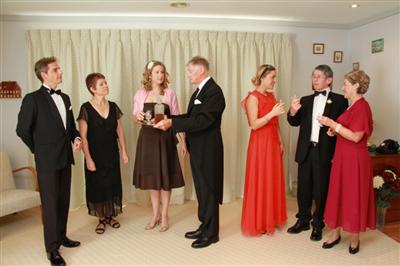
Tonight is opening night of Tempo Theatre’s production of Agatha Christie’s The Hollow in which I am performing. I would like to wish all the cast and crew the very best. Yes, good luck and all that.

Now, there are a lot of superstitions in the theatre. People will tell you that thespians are almost as superstitious as sailors. I don’t know any sailors, so I couldn’t possibly comment. I do know a lot of theatre types. Some of them (heaven forfend) are somewhat pretentious – ’tis the nature of the beast – but few of them are superstitious.
 
Some of the more well-known superstitions stem from historical reasons, but they have no relevance today. Like business jargon, they are merely used to form a club, to fake importance and exclude others. If your art is worth doing, it will stand alone without the need for nonsense and special terminology. I hereby declare theatre superstitions as bunkum.
 
5 Nonsensical theatre superstitions:
  1. Good luck – It is considered bad luck to wish someone good luck before performance. Apparently there are evil fairies who listen in and pervert the positive vibes – conspiracy theories, anyone? So people wish each other ill-luck to confuse these easily befuddled fairies. Many English-speaking thespians exhort each other to ‘break a leg’ and Australians announce ‘chookas’. This apparently originates from the fact that actors are poor and chicken is expensive so if the house was full and the actors were paid according to box-office takings, they could afford chicken for dinner. ‘Chooks it is’ was shortened to ‘chookas’ and it’s off to KFC for all. Classy folk, those Aussies.
  2. Macbeth – Some folk claim that if you mention Macbeth (or quote lines from the play) in a theatre or you will have to leave the theatre, turn around three times, spit, and knock on the door to be invited back in. Apparently the play is cursed, and several explanations are offered. One; because it contains a lot of sword-fighting and people are likely to get hurt, two; the witches were cross that their secrets were revealed, three; some idiots believe the Globe was burned down during a performance of Macbeth. (It was actually Henry VIII – live cannons on stage will do that for you). For this reason, theatre folk tend to refer to it as ‘the Scottish play’. To that I say, ‘bollocks’. Or, in the immortal words of the fabulous Stephen Fry, “Macbeth, which we actors call [pause for dramatic effect] Macbeth.’
  3. Whistling – this one does actually have a reasonable origin. It is considered bad form to whistle in a theatre, because riggers used to use a code of whistles to change set, scenery, lighting and other stage effects. Since the invention of communication devices, however, this is hardly relevant.
  4. Bad dress rehearsal – people claim that a bad dress rehearsal means a subsequent sterling opening night. What tosh. A bad dress rehearsal means the cast and crew are under-prepared and it is something directors are forced into saying to boost the spirits of their woeful company.
  5. Ghosts – every theatre worth its salt has a resident ghost. It’s a great scapegoat for things going missing or not being where you swear you set them. Theatres are usually closed for at least one night a week, to allow the ghosts to have their own performance. Never mind that the actors need a rest. Or that the off-night is usually a Monday when paying audiences don’t tend to go out after a hectic and expensive weekend.

Count Down Quotes to 'The Hollow' 15: Opening Night

"Things are not what they seem, and all the rest of it." - Inspector Colqhoun, C.I. D.

Thursday, 16 May 2013

Count Down Quotes to 'The Hollow' 14

"You just close your eyes and press the trigger and the bullet goes somewhere." - Henrietta Angkatell

Wednesday, 15 May 2013

Count Down Quotes to 'The Hollow' 13

"Shan't get any more money, shall I, when I'm trained? Doesn't seem worth being trained then, does it?" - Doris