Thursday, 18 February 2010

Winter Olmpics

I love the Summer Olympics: the teams; the flags; the national anthems; the countries: the medal ceremonies; the athletics; the hype; the drugs… It’s really quite a spectacle. When we were kids we had our own version around the local green. We played sprinting, middle distance running (which was like sprinting but slower), long distance running (which was walking and lying about the number of laps you’d done), long jump, high jump, skipping and hopping. We also had goal shooting, because the only boy who ever actually wanted to be a goal-keeper lived on our street.

And then there are the Winter Olympics, full of games that people from cold places play. These are just mad! They play ‘team sports’ like ice hockey, which is legalised violence; rugby league with sticks. My aunt and uncle who lived in Canada moved their entire home several thousands of miles because their son showed more than a passing interest in the sport.

There’s also curling, where a group of people wearing tea cosies on their heads slide stones down the ice while some demented rink-proud lunatic sweeps it vigorously with a broom. Odd, to say the least. When they’re not tidying it up, they’re skating round it with thighs the size of their torsos squeezed into lycra suits. One memorable year, everyone leaned a little too far into the corner and they all fell over. Leapfrogging them all – no mean feat in ice skates – was some rank outsider who’d previously been lapped. Steve Bradbury skated to victory in a performance akin to Dobbin the Pantomime Horse winning the Melbourne Cup. (He's from Australia - they don't call it the Lucky Country for nothing.)


Staying on the ice, these Olympic heroes and heroines have devised all sorts of peculiar things to do on it. They slide down chutes of it at break-neck speed either feet or head first individually on tea trays or in teams in bath tubs. These events are called luge and bobsleigh and, ominously enough, skeleton.

One the most intriguing events, is the ice dancing. Somewhat like skating with the stars, except that these people are actually good. Most people claim it is the winter equivalent of synchronised swimming and that no one watches it. Is that so? In Britain, Ravel’s Bolero is known as ‘The Torville and Dean Music’, and that was even after Bo Derek took her clothes off to it, which I would imagine takes some topping!

The South Park characters have a prior skating celebrity as a mentor, and two female American competitors had a rather ugly and public spat involving a sledgehammer and a film contract, although admittedly it went straight to video release. Competitors spin and glide their way around the ice in ridiculous flimsy sequinned costumes and the audience waits with baited breath until some poor little Russian falls on her bum and gets a crap score from the judges. She gets the public vote though because she still manages to smile bravely through her atrocious make-up.

When they’re not doing foolish things on ice, they’re doing them on snow. Ski-jumping for example. Why would you slide down an enormous ramp of snow with no poles and fly through the air hoping to land in a pile of cold wet stuff? And where are the practice jumps? The training ramps? Britain had a bloke who sort of fell rather than jumped off the end. He was called, obviously ironically, Eddie the Eagle. Eddie the Emu more like. He became a national idol.

My favourite event is the biathlon in which participants X-Country ski until their limbs turn to jelly and then they shoot things. Perhaps not the most obvious combination unless you are a member of the Norwegian army, or James Bond. These competitors are so exhausted that they fall over the finish line in a heap of heaving sweating lycra. An enticing visual image perhaps, but would you trust them with a gun?

I would like to suggest that we no longer neglect the fine display of the winter Olympics and that we host our own, back yard version. I accept that ice-rinks that form are unlikely to be more than muddy puddles, and skiing down the slide in the children’s playground may be frowned upon. So I recommend we stick to more mundane and familiar pursuits.

Wrapping up warm would be first on my list. The winner would be the person who managed to wear the most layers of clothing and still move. This would cause a spin-off in merchandising and thermal underwear would become quite fashionable. Although the Michelin Man would become a role model (or is that a roll model?), the competitor, if so desirous, could still sport sequinned attire or something diaphanous in chiffon.


Walking down icy steps is another potential event. There are all manner of possible categories; speed, style, vocal expression… A panel of judges could grant points for interpretation which are subjective enough for Canada to get away with never awarding the USA top marks. There could be a tandem event, a pursuit, or even a relay of contestants grasping at handrails and slithering their way down to a small bundle at the bottom of a flight of steps.

Ingenious ways of starting a car, de-icing the windscreen with a credit card, putting on snow chains and lighting a fire would all be possibilities. Drinking mulled wine would be a clear favourite, with hot chocolate supping for those in training. Of course, I welcome your suggestions for this auspicious event and invite you to send them all to:

The Back Yard Winter Olympics
Cold Comfort Farm
Waiwerahat
New Zealand

Wednesday, 17 February 2010

Death of an Innocent

Today I killed an innocent spider. I feel guilty because I like spiders; they eat flies and I don’t like flies. This is naturally wrong and selfish of me to slaughter species depending on my personal likes and dislikes, but that’s just the way I am.

But I have been seduced by the media hysteria about white-tailed spiders and their venomous bites. So when I saw this thing with its white spots I was alarmed and I sprayed it with the ‘Raid Multipurpose Fastkill’. It was a sprightly little blighter and I had to chase it around the kitchen waving my aerosol can screaming, ‘Die, die, die!’

Eventually it rolled over and curled each of its eight legs (the front four of which are red) around its delicate body to protect itself, but I was ruthless with my pesticide. I was so non-green, I was practically Agent Orange!

I then looked up images of spiders on the internet to justify my actions. A while later I was crawling with guilt (and psychosomatic itches) as I realised that ‘my’ spider looked nothing like the ones on the pages before me.

So in memorandum – here is a photo of the wee beastie I cruelly cut down in the prime of its life. Note the lack of resemblance to the much-maligned white-tail (listed on an Australian catalogue of spiders as 'low risk'). For shame.

Monday, 15 February 2010

Nine: Screen Test

To begin, let me say I quite liked Nine, although my friend the Bad Fairy didn’t. She is a fan of musicals, both theatrical and cinematic, and this has been from screen to stage and back again.

What I didn’t know at the time, but do now, was that the original 1982 Broadway production of Nine was nominated for 12 Tony Awards and won five, including Best Musical. The writer (Maury Yeston) sought the permission of his inspiration – Frederico Fellini – to interpret (the original Fellini film based on the number of films Guido had directed to date) for stage – and has now given director Rob Marshall his blessing to make this film.

Knowing all that, I began to wonder whether if you already know the story/have read the book, you are less likely to enjoy the film. Incidentally, I saw Disgrace this weekend and although it faithfully followed the book, I wondered why anyone had bothered to make the film, unless it is just another chance to prove that John Malkovich is indeed, odd. Him Outdoors says it simply brings the story/concept/dilemma to a new audience through a different media. I do so hate it when he’s rational. (And right.)

But back to Nine. It is a male fantasy about the terminally self-obsessed writer/director Guido Contini, surrounded by glamorous women. The women have names, but these don’t matter as they are merely constructs to massage Guido’s ego and only exist in their relation to him. He is trying to write and direct the film Italia, which proves to be too big a job. Perhaps it is impossible to condense the spirit of a country into one film. A nice touch sees the lead actress, played by Nicole Kidman, adorning a billboard to promote the forthcoming film which never eventuates – in a less-than-subtle reference to the teeth-achingly dreadful Australia. I’m not surprised he has writer’s block with a plastic Madonna for a mother and a simpering ninny for a muse.

There are many elements of the film version of Chicago (which Rob Marshall also directed) such as mixing up black and white with colour shots, and interspersing a full set with a theatrical construct. Him Outdoors liked the cars and the intimation of La Dolce Vita.

I was disappointed by the lack of Italian scenery (although a few backdrops of the Coliseum and the Amalfi Coast were thrown in) and felt the script was weak considering it was penned by Michael Tolkin (who wrote the screenplay for The Player – one of my favourite films) and the late, great Anthony Minghella.

A lot of the numbers sounded as though they could have come from any other musical and only a couple stood out. This might be the fault of the ‘singers’ rather than the songs. Bad Fairy questions why they don’t get someone who can actually sing and use their voice instead; it’s not as though it’s ‘live’ so it is actually dubbed anyway. They did it to a cute kid in Berlin, while the ugly kid sang off-stage; that’s show business, folks! She reckons it lets down the integrity of the film when all the other production values are so slick. Fair point, albeit quite controversial.

And so to the cast...

The director: Daniel Day-Lewis – approaching fifty with a mid-life crisis looming (although I doubt he’ll live to 100 with his lifestyle), he assumes a role in which I would have expected to see Rupert Everett as a wonderfully burnt-out genius; he could have come straight from an Oscar Wilde play. His singing is Rex Harrison-esque and the interview scene where he fronts up to reporters with nothing yet ‘in the can’ is transplanted straight from Chicago.

The wife: Marion Cotillard – one of two people in the film who can sing. The song where she makes a dignified exit from the restaurant, insulted that the mistress has turned up (My Husband Makes Movies) is an understated delight. The one where she parodies a striptease, giving all the material trappings to the man who has already taken her soul (Take It All) was re-written for the film (originally it was a trio for her, the muse and the mistress) to showcase her wide acting and vocal range.

The mistress: Penelope Cruz – sexy but vulnerable; a good role for her, although the supposedly erotic scene (A Call From the Vatican) is like something out of one of the less ‘tasteful’ porno mags. She is used and discarded, although our sympathy is tempered when we see her husband whom she is betraying. Her brief is to be childlike and kittenish (all pouts and fluttering eyelashes) and attempt an overdose in melodramatic fashion.

The mother: Sophia Loren – she used to be beautiful when she could move her face. Now she looks like a blow-up doll and it’s hard to act when you can’t form an expression. Their scene of Italian son’s obsession with his mama and the lullaby Guarda La Luna is mawkish in the extreme. Apparently it is her spirit to whom he is appealing as she is actually dead, which would explain the death mask and the wooden acting.

The muse: Nicole Kidman – ditto. When she removes the wig and says, ‘This is me’ I wanted her to put it back on immediately. She looks like something from Mars Attacks! and with similarly out-of-this-world acting, as in completely alien. Rumour has it that Catherine Zeta-Jones was originally cast in the role but pulled out when Rob Marshall refused to expand the role for the film. She made a wise decision, although he did not. If this character were more motivational (not to mention the fact that she could actually sing and dance) it would have been easier to understand her allure over Guido and his need for her. As it is the song, Unusual Way, is weak and insipid; more tepid than Trevi.

The mentor: Judi Dench – a perennial favourite. I saw her in Merry Wives; the Musical and she has a beautiful catch in her throat which, although she is far from a ‘great singer’ makes everything she sings sound emotional. Her song, Folies Bergères (Razzle Dazzle by any other name) wasn’t great, although it was an excuse to swan around with a feather boa and who wouldn’t want that? Her relationship to Guido is similar to M’s affectionate tolerance for Bond’s roguish ways, but the costumes are better. She has a wonderful speech about the role of a director and how little they actually do in pulling together a film.

The prostitute: Fergie – the other one who can sing. Her song, Be Italian, is the one song I remember and can still hum weeks after seeing the film. I loved the staging of it, with handfuls of sand being raked through fingers and flung across the set to create powerful visual effects. I spent the rest of the film wondering how I could incorporate that into a play and who would do all the sweeping up afterwards.

The fashion journalist: Kate Hudson – still the bubbly beautiful girl reprising her role in Almost Famous. Her song (Cinema Italiano) was written specifically for the movie (and it is unashamedly a movie, rather than a film) and sounds exactly like Buenos Aires from Evita – this could have been another opportunity to showcase the glamour of Italy and yet it is set on a catwalk and in a bar.

Saturday, 13 February 2010

Supermarket creep


I hate supermarkets; they sap my soul.

There is so much stuff – so many varieties of things we don’t need in packages that we will just take home and throw away. We are faced with a plethora of options but no real choice. How many cereals can one person handle? I find myself standing in front of them staring at the multiple versions of maize and my eyes glaze over.

It starts with the vegetables. There are simply too many and they are all evenly spaced and displayed in colourful regimented mounds that seem plastic in their uniformity. And it’s so cold that I lose the circulation in my hands, while my mind loses the will to live.

The music is vile, and the forced jollity of the announcements telling me what’s on special in aisle four makes me want to cry at the thought that the real world is out there somewhere, but it’s not in here. What’s in here is bored-out-of-their mind women pushing trolleys and pandering to their brattish offspring.

It’s one of the domestic chores I like least, right up there with cleaning the toilet. And yet, I love a farmer’s market.

Here there is something seductive about the produce on offer. Even the names are alluring; the pale and fragrant lemon cheese; the still-warm vine-ripened tomatoes; the personally-pressed virgin oil; earthy new potatoes; regal purple aubergines; spiky but soft artichoke hearts. Some people believe that any list can be poetry if the right words are used, but that’s another matter.

I’m currently reading the brilliant Eating for England by Nigel Slater. He writes of the farmer’s market; “I shop there because I want to meet the people who grow what I eat, to experience the joy of seasonal shopping, to be as close as I can to where my food originates without actually getting my hands in the soil. And I suspect that, as I trundle up the hill with my recycled bag of cheap corn on the cob still in its fresh green husks and a swaying bunch of three-foot-high sunflowers, it probably allows me to feel just a wee bit smug about those shoppers with their supermarket packet of identically sized, overpriced, cellophane-wrapped green beans from Mozambique.”
When I was a student, I used to go to different shops to collect my groceries. There was a herbalist, a greengrocer, a fishmonger, a delicatessen (I couldn’t afford anything from there), a butcher, a baker and yes, even a candlestick maker (and I was going through that late teen/early twenties obsession with smelly incense and cinnamon and spiced pumpkin candles).
Things were cheaper, and I could talk to the people who sold them. Sure, it took all day to collect my bits and pieces wrapped in waxed paper but that was okay, because I had all day – I was inevitably procrastinating about writing an essay on eighteenth century English drama.

Now it’s far more convenient to drive to one soulless sterile building with blinding bright lights and no heart. (To be fair, when Big Fresh in Christchurch introduced singing vegetables to the greengrocery section it was truly terrifying).

And yet, some people like it. As I returned a trolley to its berth (is that what they call them? They should) a bloke smiled happily, “I love the supermarket; it’s full of hot women. I’m going to come here every day.” And there you have it; it may not be a bustling bazaar or a social souk, but it can be considered a meat market.

Wednesday, 10 February 2010

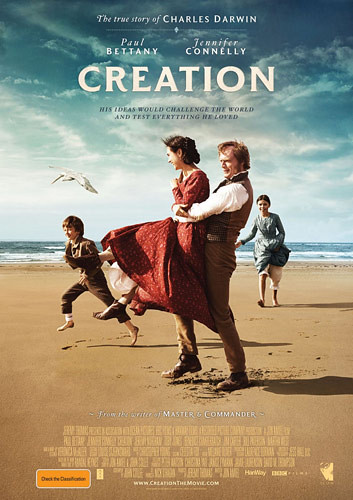
Creation

There was a time when no one believed in the Theory of Evolution. Then there was Darwin and On the Origin of Species and everyone did. Now some people refute evidence that the world wasn’t created in seven days. According to Creation, 150 years ago a nine-year-old child was made to kneel in rock salt for defending the existence of dinosaurs. She was Annie, the favourite, and short-lived, child of Charles Darwin.

Creation tells the story of a man’s personal and familial battle – to confirm what he has proven; he must turn his back on all his wife believes. Paul Bettany embodies Darwin’s inner struggle beautifully with nuances of insanity as he wrestles with the big issues. Science is at war with religion and, as the obnoxiously vituperative Huxley (a splendid Toby Jones) tells him, “You have killed God”.

He does not slash through the framework of society glibly and in fact prevaricates for a couple of decades before finishing his earth-shattering work. He knows that, “Society is bound together with religious beliefs – it’s an improbable form of barque, but it floats.” As he fidgets through grace before meals and leaves a church in a middle of a sermon by his friend Reverend Innes (a firm but gentle Jeremy Northam), we see the gradual eroding of his religion in a tale told through flashbacks and fast forwards. “The loss of faith is a slow process like the raising of continents over thousands of years.”

He questions the rational of a vindictive divinity. Thousands die that only a few may live – what sort of a plan is that? Innes can only answer, “It is not my duty to speculate on the will of God.” Just as there are no atheists in the trenches, Darwin postpones publishing because, although he has proved the triumph of science, he is still afraid to risk his mortal soul. When his daughter’s life hangs in the balance (it is to be supposed that she died from scarlet fever), he is prepared to bargain with God; if you let my child live...

This all sounds rather weighty and cerebral, yet Bettany’s Darwin is warm and vivacious. Whether playing with Jenny the orang-utan, explaining to his daughter in explicit detail how light can make a picture as she fusses in the photographer’s studio, or waiting nervously for his religious wife to finish reading his book and pronounce her verdict, he is eminently human albeit not particularly Victorian.

If there is a heaven and hell, he may be separated from his wife for eternity. And he loves his wife as he loves his children. Jennifer Connelly plays Emma Darwin with unassuming grace and strength. Their chemistry is clear through looks and gestures that belie the oft-portrayed repressed emotions of the era. She says of her husband, “He’s like a barnacle and if you prise him from his rock you’ll kill him.” It appears that she is this rock.

It transpires that Darwin and his wife are first cousins and both of them feel guilt over their daughter, Annie’s death. He worries that they never should have married and that their blood is too close. He thought they were breeding the perfect child but now fears that they endowed her with the weakness that killed her. Amid the current debate about designer babies, it is opportune of him to muse, “Nature selects for survival; humans for appearance.”

There is rather an obvious scene in a pub where two pigeon fanciers explain to him that they are breeding their birds to enhance their attributes, although there are inevitable casualties en route. Is he guilty of treating living things as experiments – even his children? In one of his hallucinations, the dead embryos captured in specimen-jars come horrifically alive in his study. In a fit of fevered rage he releases all the doves from their cote, disgusted by his genetic engineering. His imagination becomes increasingly obsessed with Annie (Martha West) who continues to dominate his thoughts after her death.

Great cinematography abounds from the opening credits (cells; sperm; fish; birds; butterflies; wildebeest) to the sped-up cycle of life and the seasonal changes depicting passage of time. The English countryside is stunning with its woodland mammals and rock pool inhabitants. Nature is instructive and it is also a battlefield. In a scene straight out of a BBC documentary, a fox catches a rabbit much to the dismay of the youngest Darwin girl. The moral is left to Annie to explain, “The fox has to eat the rabbit or its babies will die – that’s the balance of things.”

And above all, this is a story. Darwin regales his children with tales of adventure – how many kids can rely on their father’s personal exploits of climbing the Andes, being on a ship struck by St Elmo’s fire, earthquakes and giant sloths? The backdrop is an achingly beautiful string quartet or the passionate piano playing of Emma. The beautiful descriptions come from a voice over of diaries and letters weaving a rich tapestry of light and dark threads.

Nothing is black and white. Can you maintain a belief in an abstract theory when it threatens you personally? How far can you have a difference of opinion and still be friends? How much should you leave to your children and what do you owe them? The film contends that we are in a constant state of flux – we have been and are being evolved – and that this is not the end. The future (stem-cell research; cloning; religious fundamentalism and the latest God delusion) is as yet unwritten.

It is fitting that the film is based on the book, Annie’s Box by Randal Keynes, a great-great-grandson of Darwin himself. As Charles and Emma separate and reunite, their harmony and entropy echoes the opening credits. Side-by-side and hand-and-hand they appear two-by-two in a manner that will satisfy followers of Genesis and genetics alike.

Wednesday, 3 February 2010

Books read in September


The following are short reviews of the books that I read in September 2009. The marks I have given them in the brackets are out of five.

The Post-Birthday World – Lionel Shriver (3.9)
This might well be subtitled a novel of sex and grammar. It concerns middle-class middle-aged navel gazers, debating whether or not to have an affair, yet it is strangely compelling.

The Sliding Doors concept means the book is written with artifice and mathematical precision, almost like a ‘boy book’ but with a female subject matter, reminiscent of Carol Shield’s Happenstance. The first chapter is the same – Irina and Ramsey go out to dinner on his birthday and she is tempted to kiss him despite the fact that she is in a stable relationship with Lawrence. In the words of the author, ‘Thereafter the narrative splits into two parallel universes: the one in which she gave into temptation, and the one in which she remained faithful to her partner and demurred.’

The eternal love triangle is not exactly a revolutionary theme for a novel, but it is observed with such intense scrutiny that many nuggets are familiar, although some of the dialogue is unrealistic.

The two men offer the choice of companionship versus eroticism, and Irina discovers that not all excitement is good and that security is hugely undervalued. Obviously Ramsey and Lawrence are opposite sides of the same coin. “If you put the two of them together – Lawrence’s discipline, intellect, and self-control, Ramsey’s eroticism, spontaneity, and abandon – you’d have the perfect man.” The reader is practically invited to get involved – which man would you choose? In Irina’s situation, what would you do?

The artifice of the novel occasionally intrudes, and Shriver deliberately draws attention to it. In this novel of linguistics and semantics, every word has significance and connotation. Every utterance is analysed for meaning or pretention and the imagined children’s stories that Irina illustrates are both fascinating and relevant.

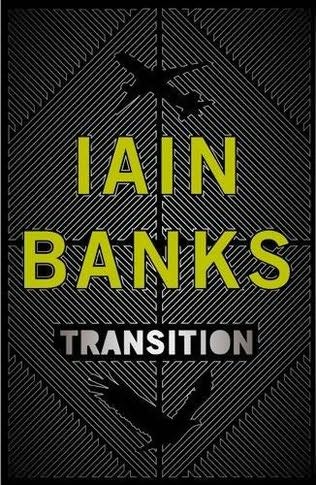
Transition – Iain Banks (4.2)
This novel is supposedly the mid-way point between Iain Banks and Iain M Banks, so you get the best of both worlds; nitty-gritty realism and fanciful sci-fi imaginings. From the opening sentence – “Apparently I am what is known as an Unreliable Narrator” – you are immediately plunged into chaos and confusion.

The narrator is a transitionary, someone who can flit between worlds where they can interfere and affect outcomes. Some of the tasks of the Transitionary are to do good; to intervene by introducing people to each other, leaving a book lying around for them to discover, stopping them from entering a building that is about to collapse. But these are not the roles the Transitionary relishes and which keep him awake at night.

Some people are able to tandem, which is to take another person with them when they transition. Most transition with the help of a special chemical in tablet form, called septus, although the Transitionary does it by sneezing, like Nadia Popov in Rent-a-Ghost. An organisation controls the transitions and the quantities of septus, but what happens if people can flit or transition without it? Also, some people are able to pervert the natural order by assuming new bodies and simply refusing to age or die. As with all of Iain (M) Banks’ novels there is an element of paranoia and the fear of powerful corporations, and he advocates disorder and natural arbitrariness.

With or without the M, Ian Banks is instantly recognisable and any novel of his will provide a good read. You know what to expect up to a point. His genius is that he can take similar ingredients each time – sex, torture (this gets a bit preachy and there is an obvious swipe at the Bush administration and Guantanamo Bay), drugs, whisky and of course, Scotland – and create an entirely new concoction.

Desdemona, If Only You Had Spoken! – Christine Brückner, (translated by Eleanor Bron) (4)
This collection of eleven monologues was written by Christine Brückner and translated by Eleanor Bron who adapted them for the stage. Brückner wrote imagined monologues of women who were famous but had never had a chance to be heard. The subjects range from the Virgin Mary to Clytaemnestra or Desdemona. Some of the characters are fictional heroines, others are real characters, like Gudrun Ensslin (part of the Baader-Meinhof group) or Katharina von Bora, who was married to Martin Luther, founder of the Protestant movement.

Each speech is introduced with a concise and informative explanation of the character and their relation to history. In these monologues, many of the women rail against their invisibility, demanding to be considered in their own right, rather than as a wife, mother or unpaid housekeeper. Brückner has given these women a voice; all of which are varied, but all of which are real.

Eleanor Bron seized upon the opportunity to translate these pieces and perform them. She confesses she was helped by the fact that, “Monologues, once the province of after-supper recitation and revue, had recently started to find favour once again. This revival owed a lot to Alan Bennett’s television series ‘Talking Heads’, which resuscitated the form by demonstrating its richness and variety.”

All of the women have things to say, which range from relationships and motherhood to politics and war. All of these women are angry, which makes their emergence from the page to the stage very dramatic. All of these women are powerful. All of them deserve to be heard. And Christine Brückner and Eleanor Bron should be commended for bringing them to our attention. Now we just need to sit up and listen.

Lucky Man – Michael J Fox (3.8)
When Michael J. Fox ‘came out’ to the media that he had Parkinson’s disease (or P.D. as he terms it) in 1998, the disease came to international attention. He is quick to point out that it affects people differently and their reaction to the drugs they take will vary. He can only relate his story and he does with candour and honesty that is touching and informative.

Dealing with the disease forced him to alter his way of life, deal with his drinking and address his issues with his family and fame. In order to explain what changes he made, he relates details from his career and his lifestyle, some of which he is ashamed.

He describes the world of fame as a hall of mirrors – an unreal world in which you get given free stuff all the time and the police let you off speeding tickets in residential areas. The freedom that came with this fame proved to be his undoing as he constantly pushed the boundaries only to find that there weren’t any and if he wanted some, he would have to put them in place himself.

And then he woke up one morning with a hangover and a twitching little finger that wouldn’t go away. For a long time he denied the symptoms and attempted to carry on life as normal, but eventually he saw an analyst, gave up alcohol and forced himself to confront his illness. “I experience the full panoply of classic Parkinsonian symptoms: rigidity, shuffling, tremors, lack of balance, diminished small motor control, and the insidious cluster of symptoms that makes communication – written as well as spoken – difficult and sometimes impossible.”

He takes medication to quell these symptoms but he can’t stay on it all the time so he experiences a sort of Jekyll and Hyde melodrama depending on whether he is on or off his medication. He arranged his life so that he could act or be seen in public when the drugs were in effect ensuring no-one knew he was sick. When the acting and hiding of symptoms got too exhausting, he finally decided to publicly admit his illness. But he didn’t want pity from his audience; he wanted to be able to do something positive.

He found that breakthrough research is being done into Parkinson’s that cannot be funded – the Bush administration’s stand against stem-cell research is far from helpful, if not downright criminal – but according to a professor of neurological sciences, “of the big three degenerative neurological diseases – Parkinson’s, Alzheimer’s, and ALS (Lou Gehrig’s) – we think P.D. will be the first domino to fall.”

MJF didn’t just want to be a poster boy for P.D. so he set up his own organisation to help researchers find a cure within find a cure within the decade. “Our optimism on this score was matched only by our impatience.” We can only hope that his impetus helps bring a cure for this debilitating disease. And sooner rather than later.

Monday, 1 February 2010

Burnley banner

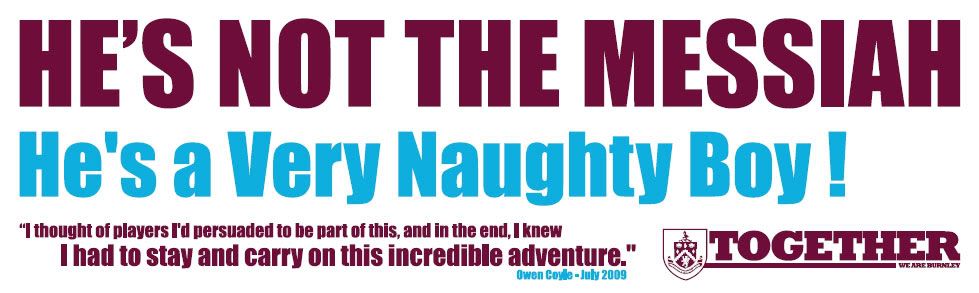
Burnley used to believe that Owen Coyle was God. He raised them from the second division to play in the premiership alongside the footballing superstars. Now he has abandoned them and gone to Bolton. True, he used to play for Bolton and his heart is more likely to be there, but it's a bit of a kick in the teeth from the man who banged on about loyalty.

Burnley fans are
understandably bitter, but they know money talks. After all, they were among the first clubs who introduced player's wages to the league in 1885. They've been paying for it ever since.

Him Outdoors says he's 'very disappointed' but he's ready to shrug it off and get on with it, but not without cheering on
this banner, dsiplayed at the recent fixture between Bolton and Burnley. The one below isn't quite as witty, but it fits on the page.