Friday, 30 November 2012

Friday Five: Cricket

When I was a child, I couldn't see the point of cricket. Perhaps, even worse than that I resented it for the fact that it took up my parents' time; time which could have been far more profitably spent lavished on me.

My mother would have the television on with the sound off while every radio in the house was tuned to the commentary and if a six was hit or a wicket fell, she would hurry to the front room to watch the replay in pictures. My father enjoyed live cricket from Australia - usually atop a ladder in the middle of the night as he worked his way endlessly around the house painting the windows while wearing a headtorch.

I first started to realise its true value in the days before all-day Sunday drinking. Him Outdoors would take me to the local cricket club where we could lounge on a grassy bank all afternoon and decadently drink cider. This was the start of my conversion. It continued through local league, county cricket and international tests, culminating in the 2005 Ashes Series.

The roles were reversed as I watched live cricket from England through the wee hours of the New Zealand night biting my fingernails to the quick while watching some of the finest cricketers perform outstanding feats with bat and ball. And we won, which helped. I was hooked.

I am not a nerdy stat geek by any means. I remember moments and personalities rather than numbers and records. Of course there are now several variants on the game - the ODIs and the 20/20s - but it's still the tests that really excite me, and it's still the ones between England and Australia that I will willingly waste a whole week watching.


5 Things I Love About Cricket:
  1. It's an entirely legitimate waste of time. Tell someone you spent five days lying on a sofa and they will think you are an invalid or a sloth; tell someone you spent five days watching cricket and they will at worst think you are obsessive. I get it now, mum and dad; all is forgiven.
  2. Tradition - from the village green to the pitch at Lords, there is something comforting and familiar about all that history and all that sport being played to specific rules. I still don't understand at least half of said rules, but somehow this doesn't seem to hamper my enjoyment one jot!
  3. The commentary - those guys (and sadly, as yet, there are no women in the commentary box) know what they're talking about, and most of them say it very entertainingly. Even more amusing are the times when they get distracted by someone's haircut or a nice piece of fruit cake.
  4. The ebb and flow - when I was young and ignorant I used to be very frustrated by the fact that no one could definitively answer the question, 'who's winning?'. Now that I'm older (although I make no claim to be less ignorant) I love the fluidity of the game, revelling in the way the upper hand is often perceived rather than qualified. I don't even mind when it all ends in a draw.
  5. The sound - from the gentle applause that greets the crack of leather on willow, to the raucous chants of the Barmy Army and the strains of Jerusalem on the trumpet, it couldn't be anything but cricket.

Wednesday, 28 November 2012

Word of the week

Crapulent - yes, it's a real word! I know it sounds like something that Tilly from Miranda might say, but actually, according to the Concise Oxford Dictionary, it means 'given to or suffering from effects of, resulting from, intemperance'. It is derived from the Latin crapulentus meaning 'very drunk' or possibly the Greek kraipale, meaning 'drunken headache'.

So, to use in a sentence: 'Unsurprisingly after drinking two bottles of red wine and a couple of whiskies last night, I am feeling somewhat crapulent this morning.'

Tuesday, 27 November 2012

Chinese Village Theatre

Back in New Zealand, Arrowtown was celebrating its 150th anniversary of the discovery of gold. I had written some pieces of theatre which were performed as part of the celebrations, so I went over to see them in action.

My commission from Julie Hughes of the Arrowtown 150 Committee was to provide several vignettes of about five minutes each to be performed in the Chinese Village in Arrowtown. The idea was that actors would pop out of huts or be staged in open areas in groups of 1-3 to bring the people and the experiences of the Chinese miners to life. Originally I was also going to direct these, but as I moved to Australia, this was no longer possible. I recommended Tiffany Menzies to direct them, as I knew she would grasp the concept and do an excellent job.

Part of the brief was to make the pieces positive and not dwell on the negative aspects of the Chinese gold-miners' experiences. This was quite a tall order, as most of the information documents the abuse and discrimination they suffered. As this was largely because of the differences in their culture that many other miners (mainly from European backgrounds) had not previously encountered, I tried to explain some of that.

I also wanted to avoid the ghastly scenario of having non-Chinese actors portray Chinese miners as this would be insensitive and just plain wrong, especially as the Chinese Consulate General Madam Tan was attending. Accordingly I wrote some pieces for non-Chinese and female actors as well, as I knew there might be difficulties in finding sufficient Chinese actors to play the parts. I incorporated elements of humour, fact, fiction and many aspects of the local life that I gathered from extensive reasearch, while injecting as much colour as possible. The pieces are all under copyright and cannot be performed without my permission.

The Welsh Wordsmith was there, reading the Arrow Observer on the toilet - in situ, as it were. The stone outhouse is all that's left of Ah Wak's store in the Chinese Village. The store itself, which was made of wood, burned to the ground in 1905. This lavatory is one of only four Chinese Sites on the Historic Places Trust's Register for Otago. He was improvising so this was nothing to do with me. It was, in fact, all his own work.


These images are of Kay performing Fruit and Veg. This piece was inspired by anecdotal memories of Ah Lum: "He wore long flowing robes, and walked into Arrowtown on Saturday morning followed by several 'coolies' carrying baskets of ginger and other vegetables slung on carry/ bamboo poles to sell to the European folk." The vegeatables he grew, apparently, were cabbage, peas, potatoes, corn, gooseberries and strawberries.

The piece is about the difference in attitude towards health and medicine - using fruit and vegetables for their natural holistic properties. Also there is a connection between the physical aspect of the vegetable and its purported healing properties - for example, the cabbage looks and feels like a brain and supposedly sharpens the brain, calms the mind, and removes irritability. This is a tenet of Chinese medicine which was totally unfamiliar at the time.


Weighing In  was performed by Paul Halsted and David Oakley. It's written for two none-so-bright gold-miners in a sort of Pete & Dud/ Alas Smith & Jones style, as I suspected there would be a shortage of Chinese actors. It incorporates oral tales from the archive of the Lakes District Museum about searching for gold and trying to supplement income.
Paul Halsted performing in Weighing In
David Oakley performing in Weighing In
Zee performed the role of Ah Lum in Village Store. I wrote this piece as a fairly cheesy verse of rhyming couplets, describing a number of food and other items mentioned in anecdotal accounts of his store, including "Chinese teas, rice, pickled lemons, ginger, opium, gambling pieces, medicines, smoking accessories". Among the relics of tent dwellers, archeologists discovered sardine and jam tins, gin and brandy bottles, which are woven into the poem.

This was a fabulous spectacle, and much credit must go to Tiffany, all the actors, and the Arrowtown 150 Committee. Congratulations all!


Friday, 23 November 2012

Friday Five: I Don't Believe It!

Generally I try to be positive with the Friday Five. And it's not that I'm being negative exactly, but this is a short list of things that well-meaning people say that I would rather they wouldn't.
  1. 'It'll be different when they're your own' - no it won't, because I'm not having any, for any one of the 16,893 reasons that I've previously mentioned.
  2. 'Smile, it might never happen' - it probably already has; hence the reason for the glum expression. This is actually an extremely insensitive thing to say.
  3. 'You can achieve anything if you put your mind to it' - although I appreciate the sentiment behind this one, it's simply not true. Some achievements require money, circumstance, luck, natural talent and a number of other things that just may not line up. To promise a child (or even an adult) they can have anything through sheer will is cruel and misleading.
  4. 'It won't happen again' - you don't know that. You might try not to do it again, but there are no guarantees.
  5. 'It's more scared of you than you are of it' - I doubt that; it hasn't got boots but if it did, I'm pretty sure it wouldn't be quaking in them.

Wednesday, 21 November 2012

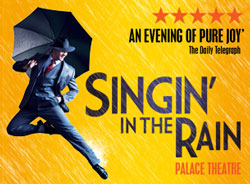
Singin' in the Rain : A Smashing, Splashing Treat!

Singin’ in the Rain
The Palace Theatre, London
August, 2012

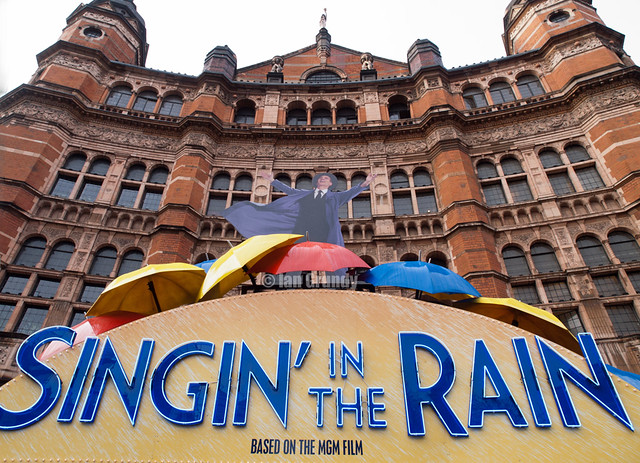
The Palace Theatre on Shaftesbury Avenue is festooned with gaily-coloured giant umbrellas to advertise its current show, Singin’ in the Rain. I got chatting to the elderly couple sitting next to me, whom it transpires come from Maidenhead. They both used to live and work in London and come to shows every week. Now they are retired and ‘only’ make it up once a month. When they heard that I’d never seen the show and didn’t know the story, they were delighted for me and, at the end, expressed joy that I should first have experienced it in ‘such an excellent version’. What lovely people!


The musical itself is joyful and exuberant, with a charming story – yes, it has one! In Hollywood in 1927 a moving picture studio is having a successful string of hits starring Don Lockwood (performed by the understudy Francis Haugen) and Lina Lamont (Katherine Kingsley). Apart from the fact that Lina is a little confused between fiction and reality, and thinks that Don is really in love with her, all is going well for Don and his best buddy Cosmo Brown (Daniel Crossley) – the best buddy role is actually very intriguing.

And then, on October 6, 1927, The Jazz Singer premiered, and the future of cinema was irrevocably altered. People wanted talking pictures. Unfortunately Lina Lamont has a ‘speaking voice that sounds like a wounded trumpet swan, and her singing voice is even worse’. No one knows what to do, despite Cosmo’s brilliant Make ’Em Laugh (ironically poor advice as the talkies ruined the careers of silent film comedians such as Harold Lloyd and Buster Keaton), while the producer RF Simpson (Michael Brandon) and his assistant Roscoe Dexter (Peter Forbes) have to placate their increasingly irascible star.


Meanwhile, high on his own success, Don bumps into a girl on the street, Kathy Selden (Scarlett Strallen), who tells him that movies aren’t everything and he’s not as great as all that. Naturally he is smitten and sings almost a musical parody; You Stepped Out of a Dream. To celebrate their latest film success, a group of chorus girls leap out of a cake and perform a fabulous number; All I Do. Don recognises Kathy, whom he has been trying to track down since their earlier encounter, and attempts to intercept her during the routine.


Eventually he gets her a job at the studio on the chorus line (after a hilarious turn with the diction coach – David Lucas – and Cosmo; Moses Supposes), but she has to be hidden from Lina on set, due to a slight altercation at the party caused mainly by Kathy’s good looks and natural talent. Problems persist (not least due to Lina’s jealousy), but the couple – as they have become – are happy. With Cosmo ever-present, they form a perfect team (Good Morning is almost impossibly good-hearted) and their happiness is infectious. Not even the rain can dampen Don’s spirits, and you know what comes next...

The eponymous song is a triumph of singing, dancing and staging. One of the lighting rigs is fitted with water jets and the shallow depression in the centre of the stage fills up with water, forming a giant puddle in which Don kicks and splashes about like an over-excitable blackbird. I was pre-warned as I had seen this segment on The Royal Variety Show, and the man in the ticket office warned me not to sit in the front four rows. Those who did got a thorough soaking. It was half time, though, so they could all dry out in the interval.

It is agreed that Kathy will dub Lina’s scenes which leads to a clever piece of film/theatre work in which Kathy sings a duet with Don – Would You? – through a sort of ventriloquist arrangement. Lina discovers the deception and is wounded. Although she sings What’s Wrong With Me? for comic effect, there is a serious side to her anguish.

As the programme notes (a touch archly), ‘It is no coincidence that the character in Singin’ in the Rain who struggles with the transition to sound is a woman. There were far more actresses whose careers suffered than there were actors. It seems that even back then, audiences were more forgiving of the imperfections of male movie stars than their female counterparts.’

This is musical theatre, however, and complexity and sympathy are eschewed in favour of sweetness and pluck. Lina threatens Kathy who agrees to perform ad her back-up for one last time in a Wizard of Oz-esque man-behind-the-curtain scene. Don and Cosmo ensure there is a happy ending, but not before Kathy flees into the audience in distress. She stood a few steps away from me in the aisle and I saw ‘real tears’.

It’s a show about dancing (The Broadway Melody by Don and Company in which he sings about how he ‘gotta dance’ is an up-tempo highlight of the second act) and the finale is a smashing, splashing treat. When Don, Kathy and Cosmo emerge in bright yellow sou’westers, the audience roars with pleasure. Some parents send their children up to the front so that they can experience the puddle stomping up close and personal.


The entire cast joins in twirling umbrellas and kicking sprays of water from the stage, casting rainbows of glee as the droplets shimmer in the lights. I’m not the only one who, after two and half hours of unashamedly feel-good entertainment, leaves the theatre with a smile on my face.


Tuesday, 20 November 2012

Improbable Fiction, 'Unofficial Soundtrack'

Whenever I 'do' a play (act, direct, crew), I compile a soundtrack for it. This excludes musicals, obviously, which have kindly provided their own. 

Music is very closely linked to memory in my mind, so I find the 'soundtrack' a useful device and aide memoire. It picks up on certain lines or characters, and focuses my mind as I drive to rehearsals. It also manages to keep me awake as I drive home late and exhausted after rehearsals. I've not got to bed before midnight for over a week and we open on Friday so I need it.

For people unfamiliar with Alan Ayckbourn's Improbable Fiction, this playlist may seem a little odd. For those who do know the play, it may seem even more so. But these are the tracks that come to mind when I'm working on the play. "They're in order, but... well, you'll see..."
  1. Paperback Writer - The Beatles
  2. I Close My Eyes and Count to Ten - Dusty Springfield
  3. City Hobgoblins - The Fall
  4. Build Me Up Buttercup - The Foundations
  5. Writer's Block - Just Jack
  6. The Social Network Song (Oh Oh - Uh - Oh Oh) - Valentina Monetta
  7. I Write the Songs - Tom Jones
  8. Everyday I Write the Book - Elvis Costello
  9. Java Jive - The Ink Spots
  10. Oxford Comma - Vampire Weekend
  11. Invisible - Alison Moyet
  12. Thunder in the Mountains - Toyah
  13. Something Canged - Pulp
  14. Just an Illusion - Imagination
  15. Once in a Lifetime - Talking Heads
  16. We Are Detective - The Thompson Twins
  17. Hot Soup - Da Vinci's Notebook
  18. I've Committed Murder - Macy Gray
  19. Where's Your Head At? - Basement Jaxx
  20. Wasted Life - Stiff Little Fingers
  21. Spaceman - Babylon Zoo

Friday, 16 November 2012

Friday Five: Nicest Man in Britain

Last week I watched a couple of documentaries, one presented by David Attenborough and one by Michael Palin - both were excellent; both informing and entertaining. I know Michael Palin has frequently been described as 'the nicest man in Britain' but I think it must be a pretty close run thing between him and David.


I began to wonder what makes someone 'nice'. The Concise Oxford Dictionary has it that one must be 'pleasant in manner; good-natured; kind'. I remembered a conversation with my Dad once about 'kindness' as a quality in fiction. He contended that in real life one never admired someone's kind quality as one did in literature. I begged to differ, and I still do. I've never held with that theory that nice guys finish last.

Perhaps when we were young and foolish, we preferred the wild and reckless to the polite and generous, but try watching Casablanca now and I'll bet you've changed your mind about what you would do at the end if you were Ilsa Lund.

For my own stipulations, the nicest man in Britain must not only be nice, a man, and British (which discounts Rolf Harris, who might otherwise have been a contender), but also to have achieved some sort of fame in their chosen field (random friends and relations don't count).

5 Nicest Men in Britain:
  1. Michael Palin (CBE)
  2. Sir David Attenborough
  3. Sir Steve Redgrave
  4. Hugh Laurie (OBE)
  5. Jamie Oliver (MBE)
Other challengers for the compassionate crown include: Griff Rhys Jones; Trevor McDonald (OBE); Harold Dennis 'Dickie' Bird (OBE); Edward Michael 'Bear' Grylls; David Beckham (OBE); Martin Bell (OBE); Colin Jackson (CBE). Of course, that's just my opinion. What's yours?