Tuesday, 15 February 2022

Simply Exhausting: Olive Kitteridge

Olive Kitteridge by Elizabeth Strout
Scribner
Pp. 270

Writer David Nicholls has described this Pulitzer-prize-winning book (in a quote printed on the cover) as “An extraordinarily rich and detailed portrait of both a marriage and a community.” And he’s right. Similar to Lake Woebegone Days or Fried Green Tomatoes at the Whistlestop Café, it is the story of the village – the inhabitants; the relationships; the gossip and the surprises – told in a gentle, meandering style. But it is also nostalgic and elegiac in tone (reminiscent of Eleanor Oliphant is Completely Fine with focus on crucial social networks being actual rather than just virtual, particularly in our post-lock-down world) while melancholy and loneliness are achingly prominent.

Olive is a retired schoolteacher, married to Henry, who used to be a pharmacist, and with a strained relationship with her son who didn’t turn out to fit into the mould she had made for him. Opinions range among the community, and people view them differently. Olive is probably a Highly Sensitive Person, based on her reaction to stimulus. She understands the needs and motivations of others although when it comes to her own actions, she is not always so self-aware.

Set in the town of Crosby, Maine, the landscape plays a Hardyesque part in the characters’ feelings and experiences. Autumnal colours are encouraging: “It was early September and the maples were red at their tops; a few bright red leaves had fallen onto the dirt road, perfect things, star-shaped.” Winter hues are not: “The leaves were half-gone now. The Norway maples still hung on to their yellow, but most of the orangey-red of the sugar maples had found their way to the ground, leaving behind the stark branches that seemed to hang like stuck-out arms and tiny fingers, skeletal and bleak.”

The novel comprises thirteen short stories that are interrelated but discontinuous in terms of narrative, although the community is everything to itself. Throughout the community, the school and the church remain as focal points, which could be considered both good and bad in a current climate. One character reads in the newspaper, “They were making a film about the towers going down. It seemed to him he should have some opinion about this, but he didn’t know what to think. When had he stopped having opinions on things?” Among the stories, told in the third person free-indirect style (where the language takes on the aspect of the character), there is a funeral reception for adulterous husband, a hostage-taking in a hospital, an anorexic girl spurned by her boyfriend, and an alcoholic lounge pianist reeling from a toxic relationship. The inhabitants of another house only go out at night to preserve their privacy after a family tragedy.

Parochial and insular, the novel is not about global events or political or social issues, but personal battles with nostalgia and loneliness. One of the characters connects music with memories of the past and realises, “She had never liked music. It seemed to bring back all the shadows and aches of a lifetime.” Olive struggles with an introverted/ extroverted personality familiar to many. “She didn’t like to be alone. Even more, she didn’t like being with people.”

If there is a message – and I’m not sure that there is – it is to cherish the moment and be ‘present’ but not in a pumped-up-business-speak way. “Life was a gift – one of those things about getting older was knowing that so many moments weren’t just moments, they were gifts.” Olive knows that “loneliness can kill people” and she divides her life into what she thinks of a ‘big bursts’ and ‘little bursts’, considering that one needs a balance of the two.

Not all of the characters are likeable – not even Olive, who connects them all – but they all have hopes and dreams, at least in the beginning. There are hints of hopefulness towards the end of the novel, but it is overwhelmingly a little bleak and defeatist. As Olive sums it up, “Dying. Not dying. Either way, it tires you out.”

Friday, 4 February 2022

Friday Five: Films on a Plane

  1. Delicious - Well, it looks beautiful - shot to make the mouth water (cinematography by Jean-Marie Dreujou). Sacked by his master, the Duke of Chamfort (Benjamin Lavernhe), for showing too much initiative as a chef, Manceron (Grégory Gadebois), gets his own back by setting up France's first restaurant on the eve of the fall of the Bastille and proving that not all service is servitude. He is assisted by Louise (Isabelle Carré) who turns up with a desire to be his apprentice. There is obviously more to her motivation than that, and it transpires that freedom to cook your own recipes is a revolutionary act. The dastardly duke believes that food is only for the rich as they have the exclusive ability to appreciate it. Ideas of setting out individual tables with tablecloths, writing up a menu, using fresh produce and not drowning it in heavy sauce were new; revenge as a dish best served cold was not.
  2. The Green Knight - Green is the colour; denoting growth, renewal, mould and decay - it is cyclical and endless, like this legend. It's arty but beautiful with the perfect counterpoint of bleakness, and Dev Patel as Gawain is charming enough to carry the tale. One for the mythologists.
  3. Jungle Cruise - I watched it on a plane, and it was good, mindless fun. The plot is negligible and the acting is all admirably sound with Emily and Dwayne being highly reliable as the  wholesome adventurous duo. Jack Whitehall, Jesse Plemons and Paul Giamatti are totally predictable as the camp brother, Teutonic baddie and avaricious business-owner respectively. If you want to watch a movie (and it is a movie rather than a film) based on a theme park ride; you pay your money and you get exactly what you order. 

  4. Last Night in Soho - The multi-genre format of this film is what makes it so intriguing. It's part thriller; part horror; part social commentary; part fantasy/ sci-fi and part period drama. A young woman, Eloise (Thomasin McKenzie) leaves her safe rural home to study fashion design in London because the lights are much brighter there. We learn that her grandmother worries about her mental health (her mother took her own life) and fears she might be out of her depth. With her fertile imagination, Eloise conjures up a world of SoHo in the swinging sixties where she believes all is glamorous, as epitomised by the characters of Sandy (Anna Taylor-Joy) and Jack (Matt Smith). As this fantasy world becomes more real, however, she discovers the seedy underside of the city where everyone is being exploited and love is never free. The ending may be a touch outré, but the film is definitely watchable and gripping, portraying the capital as a palimpsest of buried secrets.
  5. My Son - It feels as though this was filmed during lock-down, with minimal sets, locations and cast. James McAvoy and Claire Foy are an estranged couple who have to communicate when their son goes missing form a holiday camp in Scotland (the scenery is spectacular). We soon suspect he has been kidnapped, but why, by whom and, most importantly, is he still alive? These two are great actors but the plot is really weak and sketchy. Apparently this is a remake of a 2017 French thriller, Mon Garçon, and the director (Christian Carion) both times requested that his lead actor perform without a script. James McAvoy is brilliant but he is an actor, and they tend to deliver lines. Without any, this by necessity falls down into a fairly pedestrian narrative, which seems a shame and a shocking waste of opportunity.
  6. Spencer - Was the point of this film to reinforce the perception that Diana was a selfish, manipulative self-indulgent attention seeker? If so; job well done. With little consideration for anyone but herself (including her children), she sets out to make the traditional Christmas all about her by flouting the family like a spoilt child who suddenly realises she is not getting her own way at every opportunity. This would not be interesting if the family were not royal and she were not the vomit-inducing (yes, she does a lot of that) 'queen of hearts'. Kristen Stewart gives a credible performance as a portrait of a victim, but the whining is deafening and the sympathy short. Plaudits to the costumiers and the design team - the rest is overwrought hokum. Americans will love it.

Wednesday, 26 January 2022

Colouring in between the lines: Stanley and Elsie


Stanley and Elsie by Nicola Upson
Duckworth
Pp. 364

Never read about your heroes. Sir Stanley Spencer may have been a brilliant and talented painter who created works of magnificence, but it seems he was a very selfish and unpleasant individual. His life, like his artwork, was unconventional and would have been described at the time as Bohemian. At the time of the novel he is married to Hilda (Carline) and they have two children, but he has an affair with a woman with whom he thinks he shares a background, Patricia Preece. Patricia is in a relationship with Dorothy Hepworth, which continues throughout her affair with Spencer. He divorces Hilda and marries Patricia, who continues to live with Dorothy, and Stanley returns to Hilda whom he cares for through cancer until her death. These are facts and, therefore, not spoilers.

Dorothy Hepworth, Patricia Preece, Stanley Spencer and Jas Wood at the wedding of Preece and Spencer (1937)

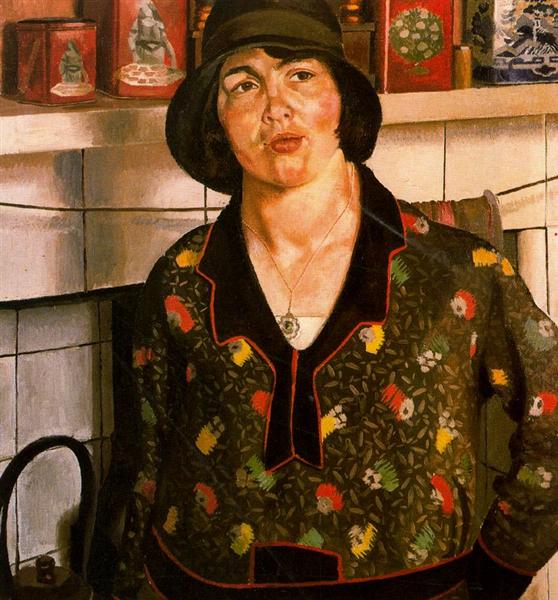
The novel is narrated by Elsie, who was the housekeeper and, at times, confidant to both Stanley and Hilda, and she learns about and talks to the man in a manner that suggests her position is obscure. She wonders how deeply to involve herself in the lives of these people, about whom her parents have warned her, because artists are all a bit odd. She claims to not want to cause difficulties, and yet she is keen to be a part of the relationship. When Stanley paints her and calls the painting Country Girl, she is offended that he sees her as a simple village girl, but he counters the painting is of “the girl I’ve watched so closely, the girl whose neck I love, whose mouth, whose legs, whose whole demeanour – not because I love them, but because I love her. I called the painting Country Girl because it celebrates everything you and I have in common.” This is definitely not fact but overt fiction. Supposedly the novel is more about Elsie than his wives, Hilda and Patricia, but although Elsie narrates, we don’t learn much about her. Maybe she just isn’t a very interesting character.

Country Girl by Stanley Spencer (1929)

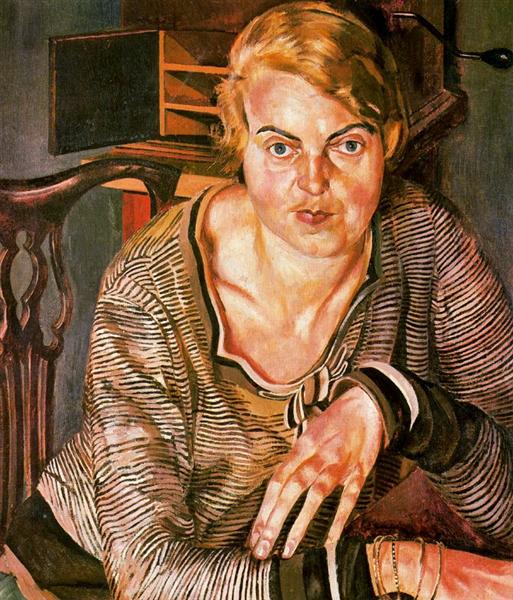
Stanley makes all the women in his life desperately unhappy, but Patricia seems to want him for his networks and his introductions to galleries. She is very glamorous, but not as good a painter as Dorothy, whose works she passes off as her own (with Dorothy’s consent). After the breakdown of Stanley and Hilda’s marriage, Patricia wonders whether to marry him or not, knowing she will be damned either way. “I’d rather be a money-grabbing bitch than a penniless whore.” Dorothy warns her, “People will take Stanley’s side. He has a talent for rousing sympathy, and the man is never at fault when there’s a woman to blame.”

Portrait of Patricia Preece (1933) by Stanley Spencer

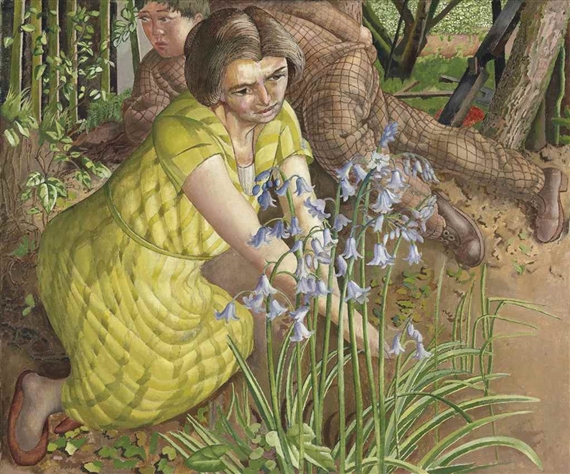
Hilda loves the garden and growing things; it is holistic and she is skilled at it, although Spencer dismisses it. On one occasion she brings in some snowdrops from the garden and when Patricia visits with some exotic blooms she has bought, he dumps the snowdrops out of the vase to replace them with the showy blooms, in an obviously symbolic gesture. Metaphors are stretched a bit thin to cover Stanley’s attitude to relationships and other people, as Hilda tells him, “Life’s one big picture as far as you’re concerned. You put yourself at the centre of it and paint the rest of us around you, hoping we’ll stay where you want us to. But real people are different. Real people live and breathe and change, and not only at the stroke of a brush.”

Hilda with Bluebells (1955) by Stanley Spencer

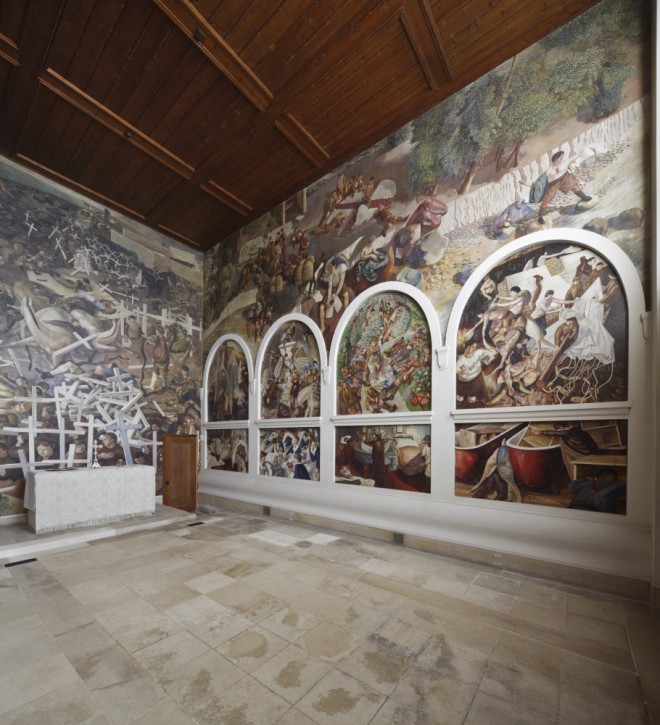
Spencer was skilled at organising multi-figure compositions such as in his large paintings for the Sandham Memorial Chapel, dedicated to the fallen of the First World War. He himself suffered from PTSD after the war, and tried to highlight and celebrate the mundanity of the army, including figures of men washing uniforms, cleaning tackle, studying maps, eating breakfast or making tea in his images. Spencer also has a complicated relationship with religion and, besides painting the artwork for the chapel, he paints Jesus into many of his pictures, often doing simple tasks as one of a group, not as the principle figure in the image, but as one of the crowd. He keeps a copy of St Augustine’s Confessions by his side while at work as inspiration. “There’s a passage about serving God through ordinary things. ‘Ever busy, yet ever at rest. Gathering yet never needing, bearing, filling, guarding, creating, nourishing, perfecting, seeking though thou hast no lack.’ As soon as I read that, I knew why I was there. It was all a service to God, even if I wasn’t fighting.”

Paintings at Sandham Memorial Chapel

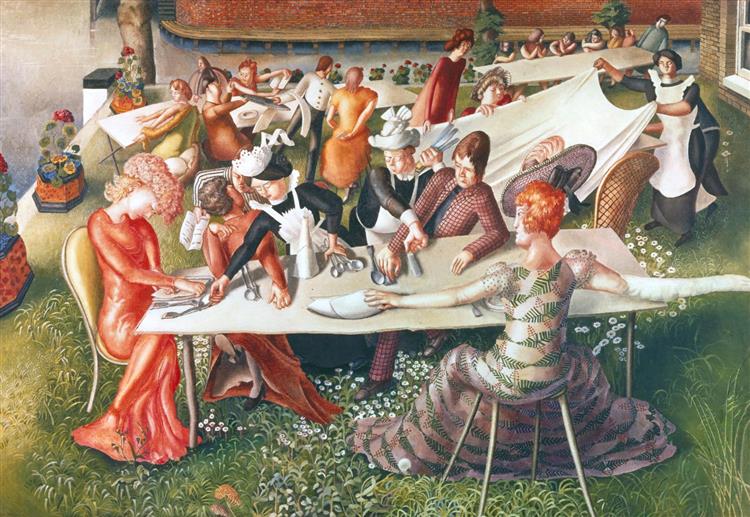
Through his art, Spencer is intrinsically linked to Cookham, the village on the River Thames where he was born and spent many years of his life. He referred to Cookham as ‘a village in heaven’ and in his biblical scenes, fellow-villagers are shown as their Gospel counterparts, expressing both his unconventional faith and the compassion that he felt for his fellow residents. I know the area well, and I can picture the streets Nicola Upson writes about in the novel, and the train journey into London, which Elsie takes when visiting Patricia in the city.

Christ Preaching at Cookham Regatta: Dinner on the Hotel Lawn (1957) by Stanley Spencer
This is a fascinatingly messy life and the people are brusque and cruel – some might say brutally honest. There is no romance in these relationships, just as there may not be in Spencer’s paintings, but does feel a little as though Nicola Upson has given Elsie a greater role than she deserves, while trying to diminish the artist.

Friday, 21 January 2022

Friday Five: Keep on Puzzling

And now we bring you the latest from the puzzling files, beginning with a picture of the church at Port Arthur lent to us by The Luminosity. The trees were the hardest bit. And there was a piece missing, which we only found later after we had boxed it back up.


 Next we have this rather beautiful colour wheel made from sharpened pencils...


...and a cat, lent to me by Design Diva (the puzzle; not Melantho).


Third on the list is this depiction of Jane Austen's world, lent to me by The Purple Lady. I don't love Austen as I do Shakespeare, so this wasn't quite as much fun as the previous one I did from this company, but it was still quirky enough to be enjoyable. 


I did really enjoy piecing together this image of London landmarks, which I did with my Dad while I was visiting my parents at home.


And finally (for now), I completed this picture entitled Frosty Friends at my sister's house while Scary Sis went out to work. Clearly it's been a tough holiday.

Tuesday, 4 January 2022

Cold as Marble: A Likeness in Stone


A Likeness in Stone by J.Wallis Martin
New English Library
Pp. 361

In the powerful opening scene of the novel, two divers exploring an old flooded house at the bottom of a reservoir find a decomposed body in a wardrobe. We soon discover it is that of Helena Warner, an undergraduate reading English at Somerville College, Oxford, who went missing twenty years ago. At the time, Thames Valley Chief Inspector Bill Driver, was convinced that she had been killed by her lover, Ian Gilmore, but with no body, the case was never solved. Now it is re-opened by the new policeman on the job, Detective Superintendent Rigby, who works with Driver to try to bring Gilmore to justice. It may be set in the same cosy world as Morse and Midsommer Murders (and it was made into a miniseries starring Andrew Lincoln and Ruth Jones) but it is far more grim than that, because, “horror wasn’t choosy. It manifested in the most unlikely of places, and in various guises.”

Of course, this is a mystery, so nothing is as it initially appears, and submerged secrets rise to the surface, as the timeline shifts back and forth. Helena was part of a group of friends who don’t actually like each other very much and still have affiliations and implications many years later. These three university associates are all implicated in a very dark world which includes sadism and psychopaths.

Rigby and Driver must work together to solve the case despite their different methods. Driver looks down upon Rigby whom he dismisses as, “Well-dressed, intelligent-looking; no doubt the product of one of these new-fangled schemes that sends graduates shooting up a ladder Driver had to climb rung by painful rung, year after frustrating year.”

Women are victims; objects to be possessed and preserved in youth before they age and supposedly lose their beauty. Other examples of casual sexism and lazy stereotypes are scattered throughout the novel. Artists are troubled and odd; mental health facilities are a comfortable alternative to a hard life; computers are new (it was published in 1997) and, apparently, the police one is female, “What’s more, this little sweetie was a redhead. One false move and she could go off on one, no trouble.”

This gripping and clinical, fast-paced police procedural has been likened to the work of Ruth Rendell or Minette Walters. It is certainly dark and moody with a chilling aspect. “Real evil, unlike the romanticised fantasy of evil, was merely gloomy, monotonous and boring… The majority of murders were committed not with malice, but with indifference, by people who lived in the type of environment that deadened the soul.” It is eerie, creepy, and a thoroughly captivating thriller.

Friday, 31 December 2021

Friday Five: Favourite Films of 2021

Normally, this post would cover my five favourite films of the year. But, as I think we can all agree, there is no such thing as 'normal' in 2021, so I'm having ten, even though it's a Friday Five. The films just have to have been released this year in Australia (where I live). So here they are, in alphabetical order:

  1. De Gaulle: Has a strong vibe of Darkest Hour for French people, and Tim Hudson plays a wonderful Winston Churchill.
  2. The Deep House: A couple exploring a haunted house with dark secrets is a familiar genre. He is controlling to the point of exploiting her fear and vulnerability for his own amusement. She craves his affection; he craves ‘likes’ on his social media pages (and we know that controversy generates more attention). Putting this claustrophobic setting and relationship underwater is inspired. The house is at the bottom of a lake and the couple dive deep into all sorts of metaphors and horror tropes as they run out of air, escape routes and plot credibility. The narrative holes and limited acting ability are mitigated by the underwater photography and the perspective-shifting concept. If you like budget horror that explores psychoses, then this is disturbingly good.
  3. Don’t Look Up: It's an American satire: neither of those things are noted for their subtlety, indeed exaggeration is one of the defining features of the genre - 'satire: artistic form, chiefly literary and dramatic, in which human or individual vices, follies, abuses, or shortcomings are held up to censure by means of ridicule, derision, burlesque, irony, parody, caricature, or other methods, sometimes with an intent to inspire social reform'  - so I’m not sure why people are criticising it for that reason. In this story, a comet is hurtling towards earth and will wipe us out, but the conspiracy theorists think, 'That's what they want you to believe, sheeple'. Of course it's obvious, but like the man says, it's based on truly possible events. Oh, and it's got a star-studded cast playing up stereotypes to the max. 
  4. Lapsis: Director, writer and editor, Noah Hutton, gives us an epic work about the exploitation of gig-economy workers and the evils of capitalism through a low-budget but high-concept sci-fi action thriller. Perhaps if we joined together and helped one another rather than constantly competing for individual success, we would all gain, rather than just the big bosses profiting from our labour. Oh, wait, that's socialism - it will never catch on; at least not in America.
  5. News of the World: Travelling the country and reading snippets from the newspapers to illiterate communities sounds like my ideal job. The ever-reliable Tom Hanks is the ideal person to do it. Oh, and he also takes it upon himself to return an 'abducted' child (Helena Zengel) to her aunt and uncle on the other side of Texas. Paul Greengrass directs a solid Western which is almost a love letter to the genre, with all the usual tropes viewed from a different angle. The contemporary politics are a touch too obvious as there is a lot of colonial guilt for which to atone, but it's a generally uplifting film which attempts to sow some seeds of hope for the future.
  6. Nobody: Incredibly violent and full of stylised toxic masculinity, but Bob Odenkirk is an extremely likable actor and his character is kind to a kitten in the first scene, so I've given him (and consequently the film) an extra star.

  7. Nomadland: Frances McDormand plays Fern, a woman who is 'not homeless but houseless' as she travels the United States looking for work as if in a modern version of The Grapes of Wrath. She is seen cleaning toilets in truck stops, boxing up goods in the soulless Amazon warehouse, or sorting beets in Hardy-esque scenes, but there are also wide sweeping vistas of the incredible scenery of this beautiful country. There is only a finite space for self-made millionaires, capitalist growth and rampant individualism - the rest of us have to share the planet, and the conversations held at a closed dinosaur park are laden with metaphor.
  8. The Power of the Dog: Excellent slow-burner with intense and toxic relationships against a stunning backdrop of Central Otago (standing in for Montana). Jane Campion knows how to bring out subtle nuances, which don’t stand out like dog’s balls, but reward the audience’s attention. It would be nice if women were given a little more agency (because Kisten Dunst deserves an equally dynamic role as Benedict Cumberbatch, Kodi Smit-McPhee and Jesse Plemons) but then I guess at least that’s probably true to life.
  9. Promising Young Woman: Carey Mulligan is amazing and the treatment of this horrendous material is well-handled by director, Emerald Fennell. At times it has a graphic novel/ raunchy thriller vibe, because, like, how else are you going to get the entitled would-be rapist frat-boys to watch it, right? These are the boys that whine, ‘Why do you have to ruin everything?’ when a woman dares to stop their 'fun' with an accusation of abuse. Yes, we’re f*#^ing angry!
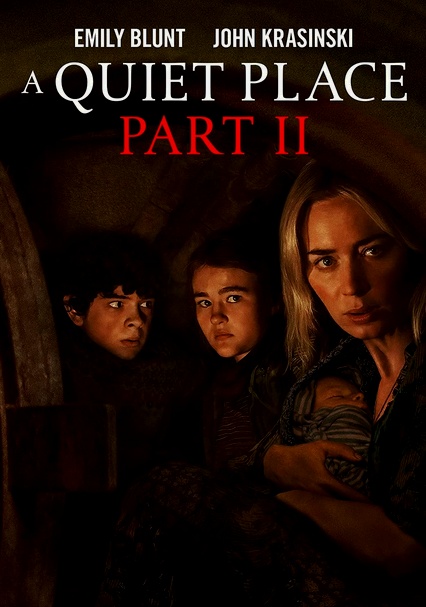
  10. A Quiet Place Part II: In which the younger generation step up, Cillian Murphy learns some essential sign language, and the sound editing deserves all the awards.

Tuesday, 28 December 2021

As the Worlds Turn: The Gospel of Loki


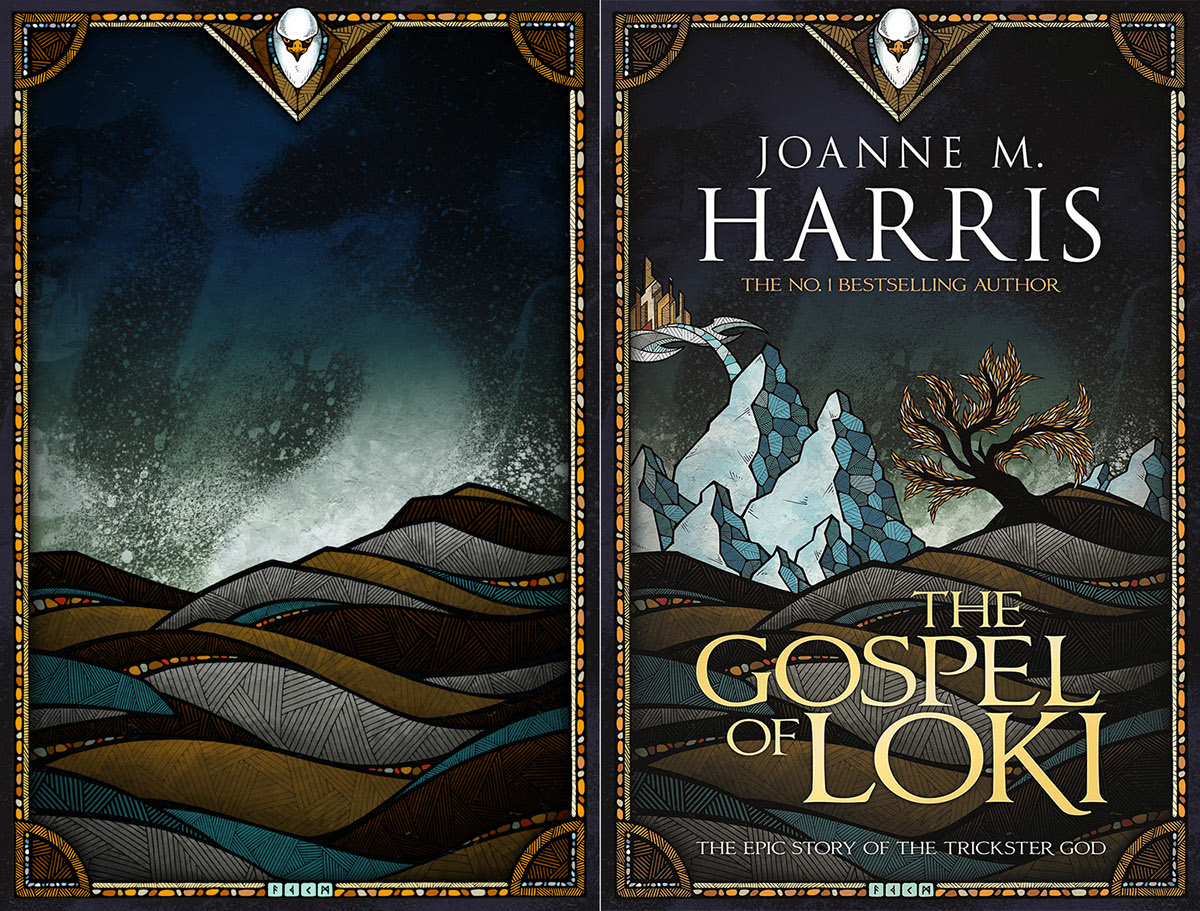
The Gospel of Loki by Joanne M. Harris
Gollancz
Pp. 302

Subtitled The Epic Story of the Trickster God, this is the story of Ragnarok from the perspective of Loki. Loki is often blamed for his tricks and his part in the downfall of Asgard, but he laments that he was tricked too and that the Worlds of Order and Chaos will perpetually battle each other. “The Worlds never really end – just the folk who have made it their own. And Order and Chaos never end, but the balance of power is in constant flux.” He is known as a storyteller and one who bends the truth, but he suggests this is no different from anyone else, and he understands that truth is not the same as history. He explains that religion and history come into being, “not through battles and conquests, but through poems and keenings and songs, passed through generations and written down by scholars and scribes.”

The tone of his narrative is gossipy and engaging, with wry asides and perceptive commentary. Loki is arrogant and confident; he loves causing chaos and tricking people into believing what he wants them to. He is seduced from the world of Chaos by Odin who brings him to the world of Order and sets him up as his son, but he is never accepted by the other gods and feels his difference. He also understands, however, that he can never return to his former way of life, as Sturt, god of the world of Chaos, will never take him back. As a result of this, he is brutally aware that he will have to take care of himself. His chapters are in the form of lessons with subtitles, such as “Never trust a ruminant”; “Never trust a wise man”; “Never trust a relative”; until he comes to the conclusion, “Basically, never trust anyone”.

While he likes some aspects of this world, not everything meets with his approval, and he is particularly dismissive of sentiment and love. “Love is boring. People in love are even more so… As far as I could understand, love made you weak and boring.” Loki doesn’t understand the concept of punishment either, which he criticises with a wry aside at modern culture. “Punishment is futile, of course. It doesn’t stop crime, or undo the past, or make the culprit sorry. In fact, all it does is waste time and cause unnecessary suffering. Perhaps that’s why it’s the basis of so many world religions.”

Loki’s account takes a modern world view: one in which we have to protect our world or risk losing it. But he is quick to point out the difference between the civilization and the earth, which will survive with or without us. “The Worlds have ended before, many times, and been remade. Nothing lasts. History spins its yarn, breaks threads, spins again, like a child’s top, going back to the beginning.” It is not the planet we seek to save, but ourselves, and he understands that we may have left it too late: change is inevitable. This is a frightening commentary on the hate-filled, virtue-signalling, self-preservation, capitalist society in which we live.

The implication is that the Worlds move between Chaos and Order with different gods in charge, depending on who writes the stories. “And that’s how, five hundred years later or so, a new religion with its new god came to supplant us; not through war, but through books and stories and words.” And, as if this was his plan all along, Loki emerges as the new central god. This is clever. And there is a sequel (The Testament of Loki). Of course there is; it’s fantasy.