Friday, 17 January 2014

Friday Five: Getting High

  
Pink bubbles at Madame Brussels
One of the many things I like about Melbourne is her buildings. Old sandstone edifices erected in the wake of the gold rush are given new life with steel and glass designs while maintaining their classic integrity. The skyline reflected in the river; the Shrine of Remembrance hailing from the end of the avenue; the bustling and strangely elegant Flinders Street Station opposite the unashamedly flamboyant Federation Square with its focus on tourism, events and hospitality; and the sprinkling of churches and town halls on the tram thoroughfares all add up to a vibrant, eclectic and appealing cityscape.

And those Melburnians aren't afraid to take their buildings to new heights. While I was there recently, I discovered a 'thing' for rooftop bars. I know they're nothing new, but around the city pubs and bars have decided to maximise space (and sunshine) by putting patrons on the roof. And because some of these buildings are relatively high compared with their neighbours, if you're lucky you will get both views and fresh air.

5 Melbourne Rooftop Bars:
  1. The Rooftop - Seven floors up (the lift wasn't working when we visited) it serves fine views along with champagne, cider and cheeseburgers. From December to March it also operates as a cinema complete with stripy deckchairs. 
  2. Madame Brussels - Inspired by a German brother-keeper, the theme is pink and white stripes with sparkling rosé, cocktails, punch, cheese plates, fondues and an innuendo-laden menu.
  3. Palmz at the Carlton - Kitsch and cheerful with faux flamingos and other exotic beasts, and plenty of palm trees as a backdrop to your piña colada. Fortunately, the bar also stocks a range of good beers, so you don't have to drink the eponymous brew.
  4. Campari House - Wood-fired pizzas and an extensive wine list make this tucked-away corner down a land and up the stairs a wonderful find. The distant lights of the city hum and shine as you relax with plastic turf beneath your feet.
  5. Aer Bar, European Bier Cafe - Well-stocked with Belgian and German favourites, this bar could be pricey but we stumbled (literally) across half-price European beer night and so had Leffes, Hoegaardens and Erdingers with a cool breeze after a hot day - a 'misting system' keeps temperatures down during the daylight hours.

Friday, 10 January 2014

Friday Five: Cricket grounds

Spider-cam at the W.A.C.A.
Don't worry, I won't mention the cricket. I won't even whisper the word 'Ashes', which is all that is left of England's dreaming. I will, however, mention some grounds where I have seen the game played (by one team at least). I enjoy watching cricket, as I have said before, and I have see it in some fine locations. I am omitting the Westpac(Trust) Stadium in Wellington because it is not a particularly good ground. I did once watch England play an ODI there against New Zealand and it was my turn to go the bar when England were halfway through the batting order on a run chase. I returned with the required four pints to be told, 'drink up; we're all out'.

5 Great Cricket Grounds:
  1. Worswick Memorial Ground, Rawtenstall - I've seen Rawtenstall play here (with Michael Bevan as their professional) and I've also seen Roger Harper when he played against them with Bacup in the Lancashire League; cracking stuff!
  2. The Basin Reserve, Wellington - from England to my nephew's under-eight team, I've seen a variety of entertainment here this big-hearted little cricket ground.
  3. The Events Centre, Queenstown - with grass bank seating and some of the finest views in the country (the Remarkles form the backdrop to many a dropped catch) the cricket has to be pretty spectacular to gain the spectators' attention. It usually isn't.
  4. The W.A.C.A. Ground, Perth - it was hot and I saw some records including Captain Cook's first ever golden duck and the highest number of runs scored in an over in what is possibly the last Ashes test ever at this venue.
  5. The MCG, Melbourne - one of the greatest sporting arenas in the world.
The Melbourne Cricket Ground

Friday, 3 January 2014

Friday Five: Breweries


On our recent trip to Western Australia and Victoria, we experienced breweries as well as beaches. In consultation with Him Outdoors I have listed a top five below.

5 Favourite Recently-Visited Breweries:
  1. Feral - the Hop Hog is delicious, the Rust, Fantapants and BFG are very tasty indeed, and the Boris Imperial Russian Stout is 'almost the perfect pint' according to Him Outdoors. If you find the perfect pint you may have to stop searching, which accounts the inclusion of the word 'almost'. The staff were very friendly and informative, and as it was swelteringly hot and we'd come a long way, they gave us free Feral baseball caps. We shall wear them with pride.

  2. Bootleg - describing itself as 'an oasis of beer in a desert of wine', this brewery features a wonderful setting; great beer and knowledgeable friendly staff (and we were staying next-door so it was out 'local' for a few days). Between the Raging Bull, the Speakeasy IPA, Tom'a Amber and the Sou West Wheat, there was something for everyone!
  3. Eagle Bay - some mighty fine brews, including a feijoa collaboration with the Yeastie Boys and an excellent Vienna Lager and Pale Ale. They are also a winery and a restaurant, but we didn't allow ourselves to be distracted.
  4. The tasting paddle at Eagle Bay
  5. Cowaramup - All the beers across the board were impressive with the porter being a stand-out for me. And the service was excellent.
  6. Bullant - superb setting and accommodating staff; although it was very busy when we visited on New Year's Day we were still made to feel welcome. All the 'beers with bite' are named after local places along the Great Alpine Road, with the Mossiface pale ale being my favourite. They also do superb food as evidenced by this photo of my Moroccan chicken stack. 

Friday, 27 December 2013

Friday Five: Holiday Beaches

City Beach in the morning
Nothing says holiday to me like sun, sea and sand - beaches are blissful; being able to walk/ run on squeaky sand listening to the birds calling and the waves crashing is simply a delight. Our recent visit to family in Perth led to a fair sample of local beaches. Here are my favourite:

5 Great Western Australia Beaches:
  1. City Beach - my brother lives here and can walk down every morning. Lucky or what? Niece Niamh also reckons it's a good spot to practice gymnastics.


  2. Aidan's birthday beach - I don't know its real name but this beach in Margaret River has got good waves for body-boarding and sand dunes for fitness training, is gentle enough to take out a kayak, and has ample beach space for playing cricket.


  3. Surfers' Point - also in Margaret River. I wouldn't surf here, as our hosts kindly indicate the spot where a surfer was taken by a shark, but I'm told it has 'gnarly breaks' -apparently that's a good thing.


  4. Gnarabup - a gently sloping beach provides a prime spot for swimming and sandcastle-building.


  5. Yallingup Beach - it means the place of love and is the home of surfing in WA.

Monday, 23 December 2013

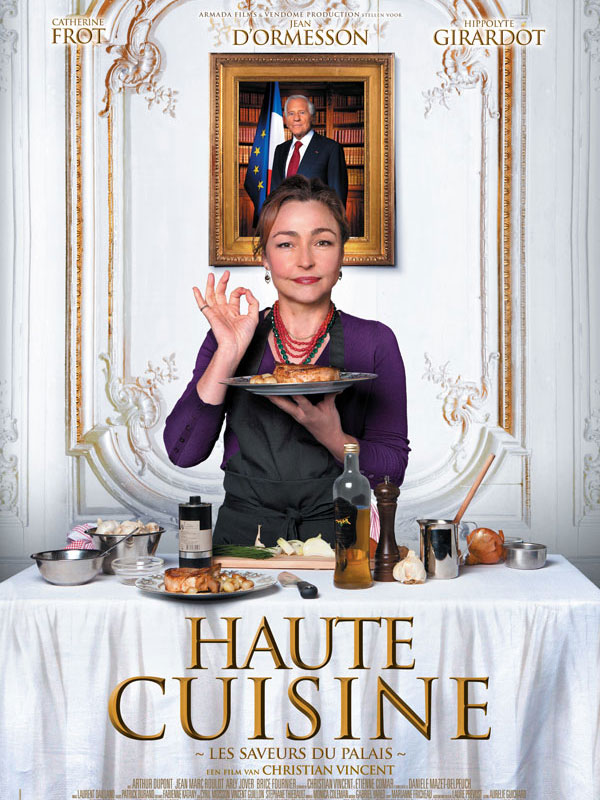
Haute Cuisine (Les Saveurs du Palais) - Supremely Satisfying


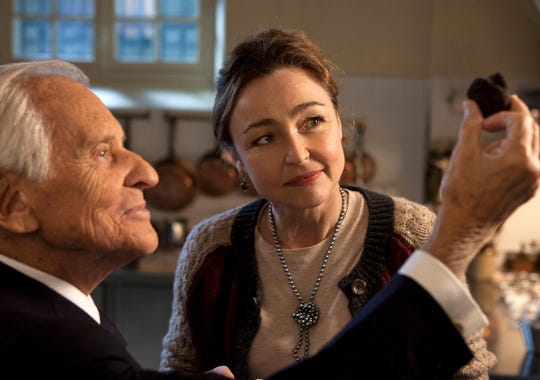
Director Christian Vincent offers a delightful film which is as light and fluffy; insubstantial and impressive, as a perfectly executed soufflé. Hortense Labourie (Catherine Frot) is content to be a chef in Périgord with a farm, a menagerie and an elderly uncle to look after, until she is summoned to Paris as the private chef to the President of France (Jean D’Ormesson). The ministers are so arrogant it would serve them right if she simply refused, but then we would have no film, so she accepts and enters this beautiful, formal world, and the gourmet extravaganza begins.

She is given a tour of the Palais de l'Élysée, including the spotless kitchens with all the latest equipment. She moves among gleaming copper pans, printed menus and steamed tablecloths, and is given masses of directions and tips on protocol, but no mention of food. The men in the staff kitchen are no help to her as they resent her position in the private kitchen – they are macho and rude and call her Du Barry (after the mistress of Louis XV) – so if she wants to learn what the president likes, she has to deduce it by trial and error. She studies what is left over on his plate to try and understand his preferences.


Initially Hortense cooks decadent meals such as Savoy cabbage, Scottish salmon, Loire carrots – “I like things to come from somewhere” – but when she is finally awarded an audience with the president he says he likes classic, rustic food and begs her to “cook like my grandmother did; give me the best of France.” He asks for simple and authentic dishes without decorations – “I want to taste things” – and she gives him clams, cream of asparagus soup, fruit and pistachio tart, and Beef Wellington (which is called boeuf en croûte in France).

She has a sous-chef, Nicolas Bauvois (Arthur Dupont) with whom she develops a cute relationship – she insists that he call her by her name, rather than ‘chef’. Catherine Frot’s Hortense is a beautiful middle-aged woman with a ready smile and a twinkling sense of humour, rather than a Hollywood bimbette who would get the role if this were an American film. Although the chemistry in the kitchen is charming and appealing, it is refreshingly free from sexuality. Nicolas shares her love for food and its creation and gives her a sounding board to express her culinary methods and opinions – “I talk through a recipe – I can’t help it.”


The narrative is based on the true story of Daniele Mazet-Delpeuch who became the first female chef to a French president, Francoise Mitterand. In this film it is suggested that the president can talk for hours about food, and maybe it would have been better for him to do so instead of heading into politics. He and Hortense discuss old recipe books and the passion that went into writing them; they bemoan that no one writes like that anymore. Hortense believes that food should reveal individual character and is disappointed by a dish that is well-made but lacking in personality: “anyone could have made it.”

Insistent that she can source better food than that used in the main kitchens, she sets out to buy her own provisions and we are treated to scenes of specialist produce shops selling exclusively cheese, poultry or fish. She and Nicolas experiment and have fun in the kitchen with food and menus, exploring recipes and combinations. Hortense teases him that a pastry chef must measure precise quantities while cooks use instinctive dashes. We may not be able to taste it but the colours, textures and detail of the dishes are gloriously filmed supplying a generous portion of gastro-porn.


Her downfall comes partly at the hands of the main kitchen chef who is upset when he thinks she has muscled in on his territory. She is in charge of appetizers, mains and cheese; he takes care of dessert, and he questions the categorization of cream cheese which he insists she removes from the dishes served at a family dinner. For a country whose revolution is proverbially based on the distinction between bread and pastry – “Let them eat cake” – this seems apt. When she is called to account for the fact that her meals are three times as expensive as those from the main kitchen she counters, “I work with people who share a passion for excellence – it comes at a cost” and she has justification in her claim, “A cook is not an accountant; a cook is an artist”. 

As well as the financial aspects and personal rivalries, Hortense must face the fact that as he ages, the President is forbidden rich food by his health advisors. There will be no more cheese, sauces, or rich or fat foods, and she sulks to Nicolas, “I hope you like working with fruit”. She must now run everything past his guards, which image is turned on its head when she has them running across the courtyard to ensure that dishes are delivered at the correct temperature. Her argument when she is told that she can still cook anything for President’s guests, but just not for the President himself, is that she wasn’t brought in to cook for ambassadors. Ultimately she cannot overlook her passion for the food for the sake of her position.


The film is framed by her experience on a French Antarctic base as a cook for the scientists and surveyors there. She runs by the beach and over the bleak countryside in an environment that couldn’t be further from the opulence of Parisian palaces. On her last day she tells the team that she has bought a truffle farm in New Zealand, combining her loves of the miracle and perfection of truffles with the beauty of virgin territory. Whether in decadent chateaux or primitive extremities, food is more than just physical sustenance. True fans of gastronomy will find much in this film to nourish the soul.

Friday, 20 December 2013

Friday Five: Nativity Plays


One of our Christmas traditions (well, we've done it twice, which makes it a tradition, surely) is to watch Love Actually on Christmas Eve. I'm looking forward to it again this year. Generally we are all boozed and emotional so we shed tears and sniffle through the 'You've also made a fool out of me and you've made the life I lead foolish too' bit, while laughing at the dancing around No 10 in socks bit.

I'm always bamboozled by the fact there is an octopus and a lobster in the nativity play, but fair enough I suppose. We never had anything as random in our nativity plays, but I went to a fairly conservative C of E school. Do schools even still perform nativity plays in England or is that considered too separatist?

5 Characters I have played at school nativities:
  1. A tree - it was a cedar tree, which is associated with healing, cleansing and protection. One of the Psalms (92, if you're interested) mentions that 'the righteous shall grow like a cedar in Lebanon'. The cedar tree is named from the Sanskrit word, 'devdar' meaning 'timber of the gods'. Junipers are also a form of cedar, and they give us gin, for which we are truly grateful. No doubt my six-year-old self interpreted all this through arboreal embodiment, thus negating the need to ever go to drama school.
  2. A shepherd - I got to carry Lamby onto stage, and on our heads we wore tea-towels, which we held in place with rubber quoits from the gym. PC-ness wasn't a thing in mid-70s Buckinghamshire.
  3. An angel - I wore a white sheet. You could tell I was an angel and not a ghost because it didn't cover my head and I was covered in tinsel.
  4. The Angel Gabriel - apparently this was a promotion, but I wanted to be Mary so I sulked, and when I was meant to say, 'Fear not' to the shepherds, I yelled 'Fear Me!' 'I am Mighty and Dreadful!' instead.
  5. The Narrator - l got to say all the words, which made me happy and kept me from terrorising any shepherds. 

Tuesday, 17 December 2013

Remember Me: Forgotten pictures

Remember Me: The Lost Diggers of Vignacourt
National War Memorial
November 2012 - July 2013

Apparently a picture is worth a thousand words, and actions speak louder than them, but the small, sentimental exhibit at the National War Memorial references words, pictures and deeds.

For much of the First World War Vignacourt was just behind the front lines; a staging point, casualty clearing station and recreation area for troops of all nationalities moving up to and then back from the battlefields on the Somme. Passing military traffic came from the British, American, Chinese, Indian, Scottish, Nepalese and French as well as Australian diggers.

An enterprising French couple, Louis and Antoinette Thuillier, established a business taking portrait photos. They took the photos in their stables and turned them into postcards so the soldiers could send them home, and maintain a fragile link with family and loved ones back home in Australia.
“Enough of war, we are now resting in a peaceful little village and it is lovely to lay in the sweet grass under the apple trees and forget the trials of war and think of home sweet home. Bill, Ern and myself had our photos taken today and I will send you one when I get them.” – Horace Arnold Parton, 5th Battalion, 1916
The negatives of these photos were discovered years later in the attic of a dilapidated farmhouse by a relative of the photographers, who generously donated many of them to the Australian War Memorial. There were over 4,000 pictorial records of soldiers on leave, tired and battle weary but having fun with their mates. AWM World War I expert, Peter Burness, says that two-thirds of these men would go on to be killed or wounded. “The losses were appalling. In all likelihood these images are the last photographs taken of many of these young men before they died.”


“By Jove! Australians! Those clean-shaven, sun-tanned, dust-covered men, who had come out of the hell of the Dardanelles and the burning drought of the Egyptian sands, looked wonderfully fresh in France. Youth, keen as steel, with a flash in the eyes, with an utter carelessness of any peril ahead, came riding down the street.” – Peter Gibbs, British War Correspondent, 1916
Members of a television news programme reprinted these pictures in a dark room, using traditional techniques on fibre-based paper. They saw the soldiers emerge from the darkness, and cleaned and silvered the images with selenium toning to create the silver gelatine photographs. This exhibition features 74 of these prints and 800 digital negatives, fleshed out with written diaries and letters as part of the museum’s collection. Many excerpts are from letters written to sisters, mums or sweethearts, asking for photo-mementos and news from home. It’s noticeable and slightly sad that there are so few letters written to dads.


Although the photographers did not record the names of these men, several researches have attempted to identify them through their uniforms. Other clues to their identity can be found in their epaulettes, colour patches, badges, rank insignia on uniforms, medal bars, ribbons and wound stripes worn on uniforms, and any kit or equipment they may be carrying. In many cases the battalion is known, as men for a battalion posed together, even though they knew their battalion would be disbanded.

British censorship on the Western Front meant that few such informal photographs exist outside the official record. Australia did not have its own official war photographer until 1917 and soldiers were not able (as they ewer in the Gallipoli campaign in the Dardanelles) to sneak their personal cameras into the war zone. The Thuillier collection fills a hole in the historical record. It covers many of the significant aspects of Australian involvement on the Western Front, from military life to the friendships and bonds formed between the soldiers and civilians.
“The brightest memory of the lot is that I have known real men. Men with the cover off. Men with their wonderful nobility of character, of mateship, revealed. It’s a glorious memory to have. To have known men as men... My mates! Memories of men! Memories of mates!” – Edward P. Francis Lynch, 45th Battalion, commenting after the war

Some men were members of the newly formed (1916) cyclist battalion who traded horses for bikes and pose proudly with their metal steeds. Perhaps there might be special sympathy for them from the riders of the Paris-Roubaix or Tour of Flanders as they clatter over the greasy cobbles? There are pictures of bands playing instruments and some delightful images of people shyly celebrating the armistice.

A few of the photos have snowfall as a backdrop – between 3rd and 13th January 1917 heavy snowfalls hit the region. The Commander of British unit in Vignacourt issued an order to his men: “No snowballs are to be thrown at the drivers of passing vehicles.” That they could consider such amusements is evidence that they are really still just lads. It makes it all the more poignant to consider, “It is a poor land rich with crosses. A troubled land where brave men rest forever.”


“Many things perforce remain unrecorded. The friendships, strong and clean as new steel, forged in the desert sand or the Somme mud that will savour life for us to the very end.” – Albert William Keown, 5th Battalion, commenting after the war