- Parent - a parent is a person. A parent (hopefully) loves, nurtures, raises, cares for, looks after, educates, protects, cherishes, tends, nurses, encourages, reprimands and inspires their child. Any one of those words provides meaning and clarification. Interestingly (well, I think so anyway) - 'mother' and 'father' can act as both nouns and verbs. The verb 'mother' apparently means to bring up a child with care and affection. It can also mean to look after someone kindly and protectively, sometimes excessively so. The verb 'father' means to become the father of a child be making a woman pregnant. There seems to be an incompatibility between those words.
- Medal/ Podium - if someone trains or works hard and has talent and aptitude, he or she may compete in events and win/ obtain/ achieve/ secure a medal. The medal in question could be gold, silver or bronze, in which case the contestant may win/ obtain/ achieve/ secure a place on the podium in first, second or third place. The person does not 'medal' or 'podium', whatever the commentators and newsreaders may say.
- Top Score/ Red Card - another commentating misdemeanour found in many sports is the usage of 'top score' as a verb, when someone has actually scored the most points. This offence is usually committed in basketball, which is American, so what would you expect? It is worse when one hears it from cricket commentators who should know better. When a player is shown a red card in football, we used to hear that they had been sent off; nowadays they are more likely to be said to have been red carded, which used to be something that happened to wool.
- Friend/ Unfriend - I admit this is an interesting one as it has come about as a reaction to a specific technological development. When one sends a friend request on Facebook and is accepted, one is said to have been friended. "I'll friend you on Facebook," say young people when they are seeking cyber social interaction. After a while someone makes a snap judgement which offends the sensibilities of someone else and rather than having a rational discussion which could possibly inform and educate both parties, one 'unfriends' the other by blocking their future banal posts. Friendship is no longer a relationship to be nurtured and grown through good times and bad; it has become something which happens at the touch of a button.
- Action - Employing the worst of business-speak, some people say they are going to 'action an item', when they mean they are going to do a thing. I presume this is because an agenda will have items that result in action points as people take on tasks. Once again, there are many words that could be used to inform others of the intention to execute/ carry out/ accomplish/ implement/ enact/ engineer/ administer/ put into practice/ perform or simply 'do'. It seems that business types don't like to use a simple word where a trendy or convoluted one will do. They think it makes them sound more important and intelligent. They should know that the exact opposite is true.
Friday, 30 June 2017
Friday Five: Nouns that are not verbs
And the logical continuation of last week's post...
5 Nouns that are not verbs:
Labels:
Friday Five,
grammar,
language,
nouns,
verbs,
vocabulary
Monday, 26 June 2017
Frozen: Let It Go
Ice by Louis Nowra
(Allen & Unwin) Pp. 322
Early Sydney comes alive through
the impressions of the young men as they first arrive. It is a character in
itself, defying description and confounding assumptions; full of possibilities as
people flee the Old World and try to reinvent themselves in a land of
opportunities. Malcolm is always chasing the
latest business venture: he brings refrigerated meat from Australia to London,
electricity to Melbourne and order to the Tokyo electric tram system. He is
attracted to what he calls Australia’s “dirty prism of classless democratic
optimism” which allowed him to succeed in business.
Malcolm is clearly a man’s man, dismissing
women as inferior and the representation of women within the novel is astoundingly
weak. Malcolm’s mother remarries and excludes him from her life, and his second
wife, Mary, is unkindly portrayed as some sort of harpy, despite the fact that
his treatment of her is appalling. He mourns his first wife, Ann, building her
a mausoleum – a weird subterranean world of bottled embryos – and Mary
disappears into the background to lead a separate life.
The telling of Malcolm’s story is
full of things that biographers could not have known but must have imagined; as
the tale proceeds the narrator becomes increasingly unreliable. Ann dies, which
is convenient, because live women are so messy, and Malcolm is distraught, but
is the narrator talking about himself or about Malcolm? “Until he’d married her
he had been unloved and she had awoken love in him, as surely as if it were a
delicious, sweet emerging from melting ice. She had given him a purpose, a
sense that he was human and loving, but a callous God had snatched her away
from him, scooped his insides out and rendered him hollow.”
The references to being frozen in
form and time are both literal and metaphoric as the lines between subject and
biographer blur. The frigid purity of ice is contrasted with the warm sensuality
of the body. Malcolm makes a wax effigy of Ann and keeps it in his catacombs
where he builds a room for her and visits her for necrophiliac purposes. “It
was as if she was frozen, like the perfectly preserved American sailor
excavated from the iceberg.” The similarities with the drug – “the drug that
ruined your life and mine” – are not accidental.
Malcolm’s
time is one of great change and discovery and he himself is a man of science and technology. The scientific developments
of the age – X-rays; atoms; telephones; electricity – become confused with
spiritualism and mesmerism because “The boundaries between the possible and
impossible were quickly narrowing at an astonishing pace.” Mary believes that, “Scientists belong in the
darkness of their laboratories, not in the bright light of society.” Darkness
and secrecy, however, lead to obsession and madness, which will always be revealed
when exposed to the light.
Labels:
biography,
book,
book review,
coma,
death,
grief,
Ice,
iceberg,
Louis Nowra,
obsession,
review,
science,
Sydney,
unreliable narrator
Friday, 16 June 2017
Friday Five: Verbs that are not nouns
![]() |
| You are invited |
I know that language changes and develops and is not set in stone. I studied linguistics and etymology and I agree that language is a metaphorical rich tapestry. I love the smorgasbord of our polyglot vocabulary based on an olio of portmanteau words and phrases. I do, however, desperately dislike the way many otherwise intelligent people use words out of their correct context when there are plenty of available words they could use instead if they weren't so lazy or slavishly devoted to the current fashion of worshiping youthful inexperience and ignorance.
I realise that as long as one can make sense of what is being said, then the aim of communication has been achieved, and that this is perfectly acceptable for someone who does not speak English as their primary language, or is a child. My point is simply: if you are fortunate enough to know how to speak properly, you should do it. Some basic abuses of the English language that will always make me judge the perpetrators are the attempt to use nouns as verbs (more of which later) and vice versa.
5 Verbs that are not nouns:
- Invite - One invites someone to attend an event; if one is lucky, one receives an invitation to attend. I really don't understand why this is difficult to comprehend.
- Intercept - Sporting commentators are not exactly esteemed as oracles of oratory, but they are generally responsible for this breach of grammar. When a player latches onto a pass meant for another player in football, rugby, hockey or netball, it is an interception, not 'an intercept'.
- Build/ Rebuild - I blame Reality TV for many things as it happens, but one is the proliferation of using words out of context because the perfectly adequate word that already exists is somehow simply not cool enough. For example, when renovating or reconstructing a house, presenters and 'contestants' often refer to 'the build' or 'the rebuild' as they pull down walls and rip up floorboards.
- Eat - I really hate this one. When people ask where they can go to get 'some eats', it takes a huge amount of restraint to refrain form telling them exactly where they can go with their 'fake language'. Do they mean meal? Do they mean food? It's almost as bad (but not quite) as adults referring to a delicious treat as 'tasty noms'. This puerile expression comes from Sesame Street's Cookie Monster. Yes, the character was cute and everything - when you were a child. Even on a programme which featured brightly coloured puppets trying to cope with the simple mechanics of life, he wasn't exactly the brightest crayon in the box. So why would any adult wish to imitate the sound he made when stuffing his face? It's not cute or endearing; it's pathetic and irritating. Stop it.
- Disconnect - Whenever anyone says something along the lines of 'there is a disconnect between parties', I assume they went to business school but didn't manage to graduate, and I automatically discount their opinion. Yes, I know they may have something interesting and worthwhile to say, but as there is a disconnection/ discrepancy/ divergence/ division/ dichotomy/ detachment/ breach between their thoughts and their words, I can't be bothered to listen.
Labels:
Friday Five,
grammar,
language,
nouns,
verbs,
vocabulary
Tuesday, 13 June 2017
La La Land: a note to follow So-So Land
![]() |
| The Bland Girls |
After ten tedious minutes of her story, we return to the traffic jam (we really are getting nowhere fast) and take it up from the point of view of the hornblower (Ryan). He talks to his sister in a scene in his flat which is meant to indicate how poor he is because there is a stain on the wall and he's got no furniture. They swap lines like 'Unpaid bills are not romantic' and 'I want to be on the ropes. I'm letting life hit me until it gets tired and then I'm going to hit back', but don't worry about getting to know the sister because once she has set up the exposition, she disappears never to be seen again.
Ryan Gosling gets fired from his job as a pianist in a restaurant for blatantly disobeying his boss's directions to only play the set-list. He is so upset that he rudely barges past Emma Stone who was coming to tell him how much she had enjoyed his playing. Time passes (we know because the titles helpfully tell us that we have moved through the seasons) and Emma Stone indulges in more bad auditions and pool parties - poor love.
![]() |
| Play something we know! |
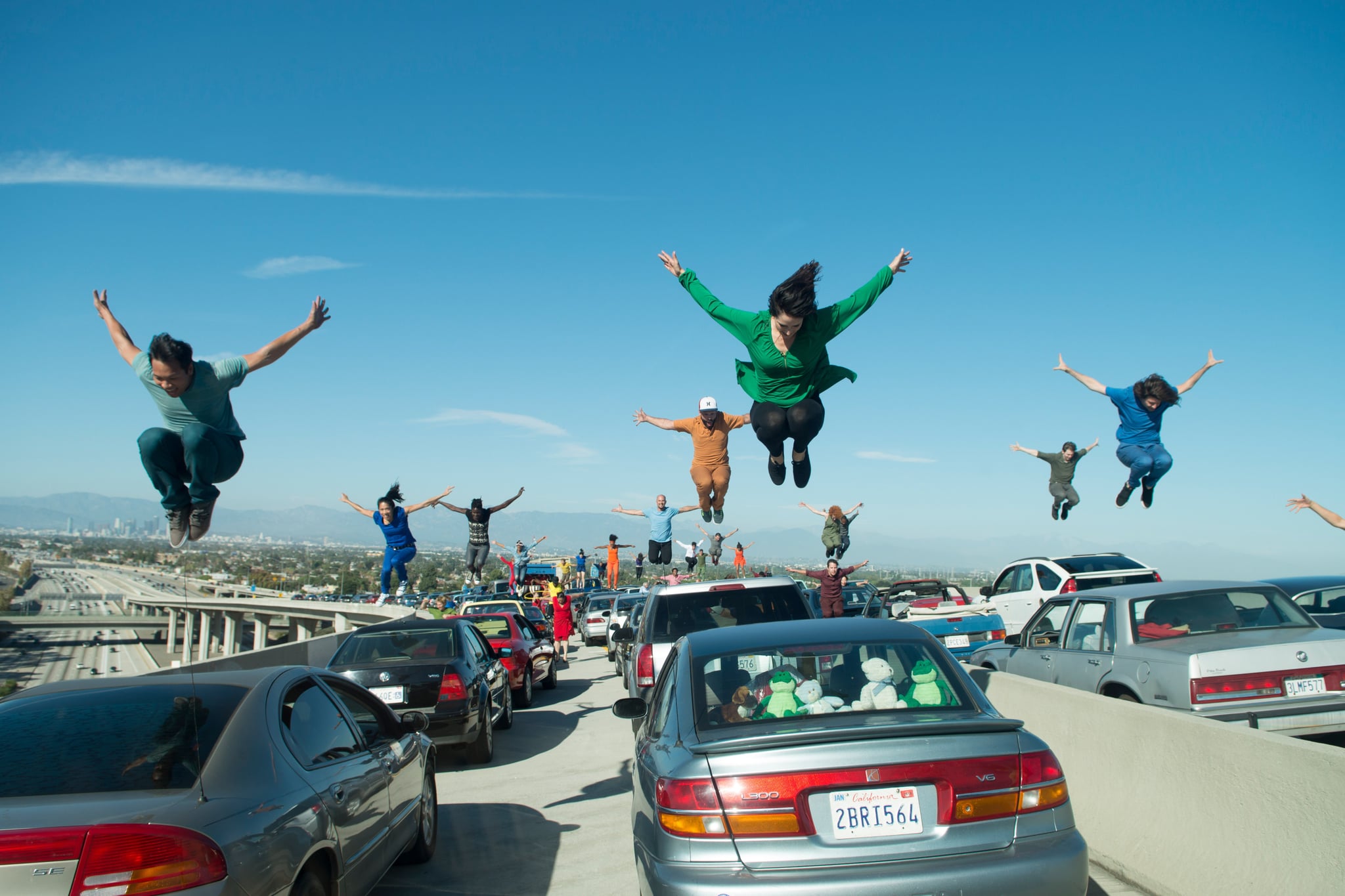
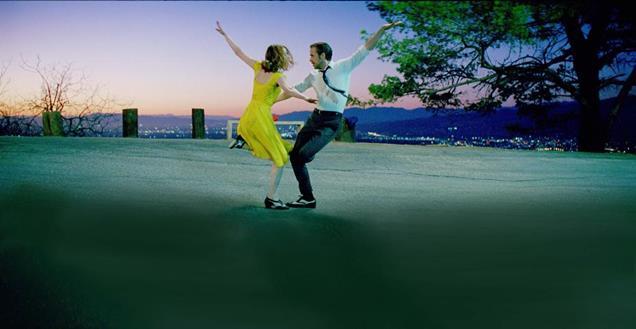
She meets Ryan again at a party where he is playing keyboards in an 80's tribute band. To get her own back for his previous rudeness, she requests the band play 'I Ran', which he later tells her is an insult to a serious musician (36 is definitely too old to be having adolescent pretensions). He should be so lucky; it's the best piece of music in the whole film. As they walk back to their cars they have a 'moment', which provides the opportunity for the typical teen I-Hate-You-But-I-Love-You routine. Cue for a song about a Waste of a Lovely Night, which has some decent lyrics and choreography, like something out of a Doris Day film, but only if you couldn't care less about Doris, and she couldn't sing or dance.
Although she wants to be an actor she has never seen Rebel Without a Cause, which shocking oversight can only be explained by her utter self-absorption. Ryan, who is slightly more aware that there may be other players in the entertainment field, says he'll take her to the pictures 'for research' and then walks along a pier into a beautiful sunset, singing a merry song and nicking an old bloke's hat.
| Where did you get that hat? |
Next day Emma gets a callback which is supposedly brutal (but actually realistic) and looks forward to going out with Ryan until her boyfriend turns up and takes her out to a meal about which she had forgotten - both the meal and the boyfriend it seems. You needn't get attached to him either because, after hearing some piano music that reminds her of Ryan, Emma ditches the dinner and the boyfriend, and runs to the cinema. She selfishly stands in front of the projected image at the front of the screen (thus blocking the view of all the other patrons - but since when did she care about anyone else?). Just as Emma and Ryan are about to snog in the cinema, the projector burns through the screen and she still never gets to see how to make a decent film.
| Serious code violation |
Instead, the couple continue their date at Griffith Observatory where the fight scene from Rebel Without a Cause was filmed (see how multi-layered this thing is?). Apparently it is a gravity-free zone and they are soon floating around among the stars like a cross between E.T. and Mary Poppins, and they finally get to kiss. This is clearly inspirational as Emma Stone then writes a play (as you do) and her model chums pop up for one more scene to be told that it is a one-woman play and they are soon to be left on the cutting-room floor.
| ET meets Mary Poppins |
![]() |
| Look at me, everybody! |
Some bloke in a tight yellow polo-neck offers Ryan a job but he says he'll Never Work With Him. In the next scene Ryan Works With Polo-Neck Bloke and takes the gig (partly because Emma has pointed out that he might actually earn some money). The band they play for lays dub and techno over trad jazz - which is apparently what the young people want, because no one is interested in old jazz anymore and all the innovators are dead. Emma goes to see the band, but they are popular, which disappoints her and she looks like someone has strangled a puppy because success is so vulgar. He goes on tour with this band and is highly successful and makes lots of money but is Away A Lot and doesn't call every day.
Ryan comes home for a surprise visit and cooks a giant chicken or a fatted calf or some enormous hunk o' meat. He tells her he is going to stay in the band for a few more years and keep touring and making money. They fight because this may be The Dream but it is not His Dream and he has sold his soul to the Electrical Keyboard Devil. Then Ryan sets the kitchen on fire and the smoke alarm takes over the high-pitched whining, and Emma runs away (her penchant for escaping mid-meal is clearly the latest in Hollywood dieting chic).
Emma books a theatre to perform her play, which only about half a dozen people attend, which isn't surprising as Ryan has told her to 'write something as interesting as you are.' The performance clashed with a photo shoot for his band so Ryan didn't make it, which is a deal breaker and she goes home to Middle of Nowhere Land to give up on her dreams. But, a casting director was at her play and really liked it and phones Ryan to ask Emma to audition for a thing in Paris. He goes to find her (by parking in suburban streets and blaring his horn) and passes on the message - she has a needy, whiny 'I'm not good enough' moment, but he is all supportive and they drive back to Hollywood to Make It Happen.
| Self referential audition 'song' about how hard it is to be an actor |
At the audition she is asked to tell a story and, displaying a gross ineptitude at following directions, she sings a song instead - perhaps the film has suddenly remembered it is meant to be a musical? Of course she gets the part because this is all unbelievable nonsense. Fast forward five years and she is a big star, married to Someone Else, and buying her coffee from the cafe where she used to work.
Emma and Someone Else go out to dinner and stumble into a basement bar which would you Adam and Eve it, of all the jazz joints, in all the towns, of all the world... Ryan is also living his dream and their eyes meet and there is a dance number montage of how life could have been if they had stayed together. If only the whole film had been like this without the tedious bits in the middle, it would have been quite good. But it wasn't. And it isn't. The End.
Labels:
Emma Stone,
film,
Hollywood,
La La Land,
musical,
review,
Ryan Gosling
Friday, 2 June 2017
Friday Five: Five (More) Theatre Outings
I have been on more theatrical excursions of late, so here is a brief summary of some of the shows I have seen:
![]() |
| Dracula by shake & stir theatre co |
- Hamlet at The Phoenix - advertised as 'A staged reading of an edited Hamlet by William Shakespeare', this is Cameron Thomas and a group of his mates reading sections of an extremely abridged Hamlet in a pub. As one would expect, there are drinks between acts, which means things get a little loose towards the end, but as the audience do too and pretty much everyone dies anyway (you can't possibly call that a spoiler!), it seems to fit the theme. Some of the actors are much better than others (inasmuch as some of them can actually act), and some sound like they are reading it for the first time - which, they might well be, as rumour has it that someone pulled out on the day of the performance. Live music from Cameron Ewens on keyboard throughout keeps things moving along nicely, and the actors swap characters along with their hats, which provides some humorous moments. There isn't a lot of depth or complexity (Fortinbras and the notion of restoration of order to Denmark is entirely absent) but it is fun and fast and not at all furious.
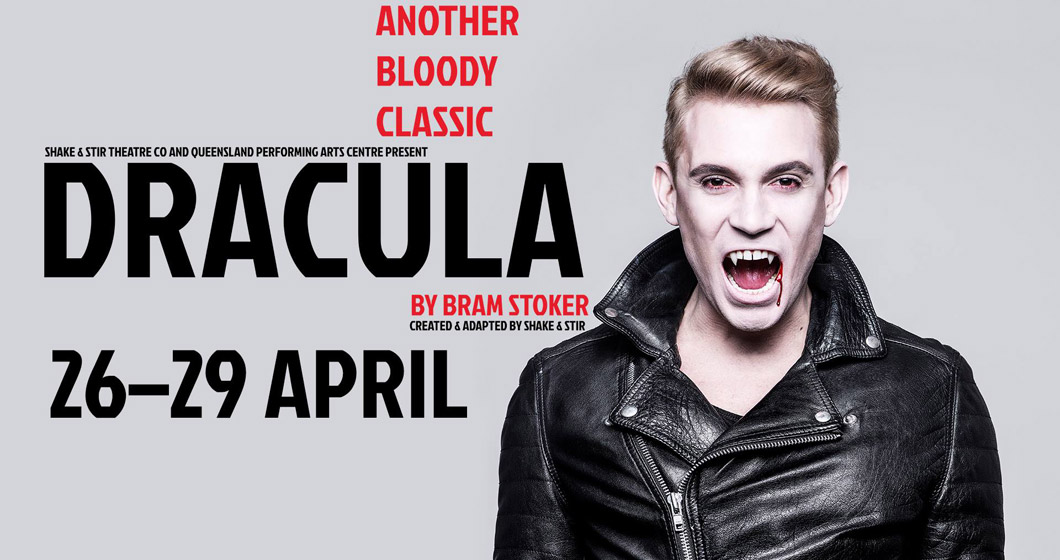
- Dracula produced by shake & stir theatre co. at The Playhouse, Canberra Theatre Centre - Shake and Stir once again bring sumptuous production values to the stage. The design and technical elements are faultless with a multipurpose revolving set and truly atmospheric sound and lighting. The adaptation honours the original book, eschewing some of the more schlocky aspects of later incarnations. While the darkness is ever-present, however, the fear and tension is absent, which may be because Old Creepy Dracula (Nick Skubij) seemed to morph into The Terminator, and I kept expecting him to say, "I'll be back."
- The Iliad Out Loud & Abridged at The Street - Three people (William Zappa; Nick Byrne; Chrissie Shaw) read an adapted version (by William Zappa) of Homer's Iliad over the space of nine hours (that's three hours a night). They don't interact with each other or the audience, and harangue us with details of ships and battles, misogynistic Gods and rampant masculinity, while percussionist Gary France hits things in the background. They all have beautiful voices and bring out the poetry of the repetitious language, which was always meant to be spoken aloud rather than read in isolation. There is a strong appeal to school groups and university scholars, of which there are probably many in Canberra, who want to feel worthy. This is theatre for radio; best listened to while doing chores about the house.
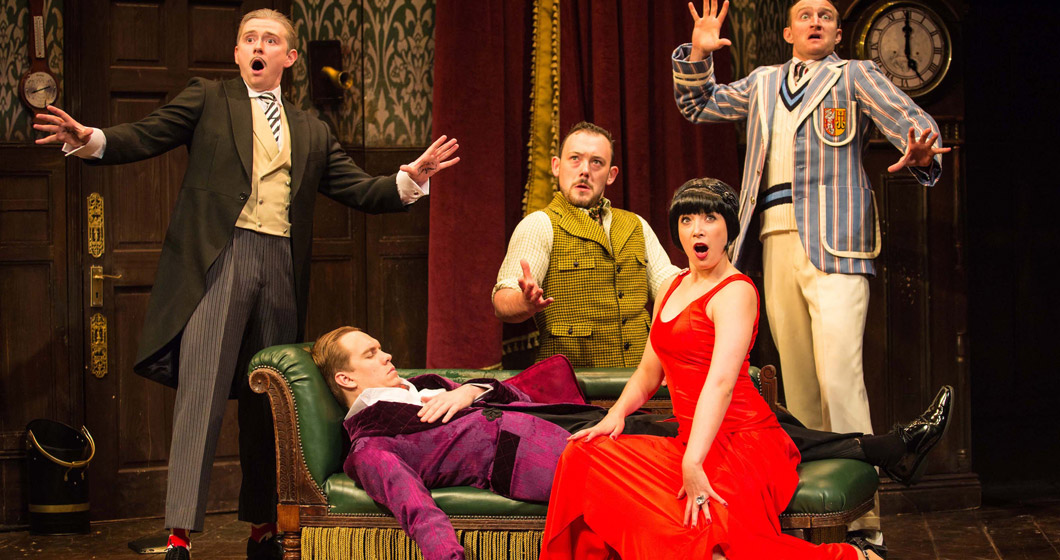
- The Play That Goes Wrong produced by Lunchbox Theatrical Productions Pty Ltd at The Canberra Theatre Centre - The fast-paced, critically well-timed production provides a really enjoyable night out. There are laughs a-plenty in the first act, which feels like comedy; fewer in the second, which feels like farce. Strangely enough, I've never enjoyed watching women trying to upstage each other while fighting in their underwear (it's just not funny, although many men seem to think so), but the stage crew logistics were superb, and the risk-assessment necessary is mind-blowing. The acting is all highly-stylised and unsubtle (co-writer Henry Lewis credits The Art of Coarse Acting, Monty Python and Laurel and Hardy, so that's hardly a surprise) and the story (of who murdered whom and why) becomes increasingly irrelevant as theatre tropes come flying from all directions, along with the props and set itself.
- A View from the Bridge produced by Canberra Repertory Society at Theatre 3 - Director Chris Baldock gives Arthur Miller's classic the 'bigger-than-Ben-Hur' treatment with a set that upstages itself, built from pallets and netting to represent the wharves where Eddie works. It is superbly lit and dominates the action (too much in places, where more intimacy would be welcome) but is awkward at times with actors struggling up and down gangplanks and crashing through flimsy wood in an alarming manner. The young leads are excellent and the relationships between the immigrant Italian bothers Rodolpho (Alexander Chubb) and Marco (Chris Zuber) are compelling and affecting. As Catherine, Karina Hudson is delightfully fresh and conflicted as she struggles to understand her uncle and aunt, and their attitudes to her burgeoning maturity. Less impressive is the central relationship between Eddie (Knox Peden) and Beatrice (Karen Vickery), which is too combative and lacks any hint of the warmth and affection Beatrice claims to miss. Nuances of text and movement are swamped by over-gesticulations, shouting and the chorus of (largely ineffective) actors who remain on stage throughout, patronising the audience's intelligence by miming the action. The production is bold, brave and bombastic, but bigger isn't always better.
![]() |
| The Play That Goes Wrong by Lunchbox Theatrical Productions |
Tuesday, 16 May 2017
I need a hero
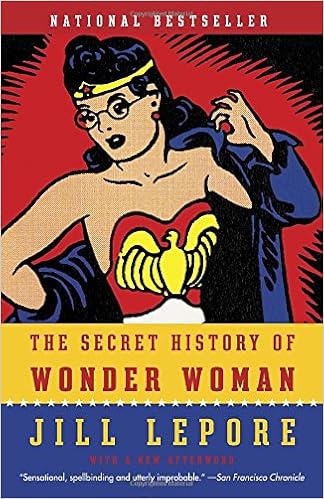
The Secret History of Wonder Woman by Jill Lepore
(Scribe)
Pp.297
Wonder Woman is an important feminist
icon, and this book explores her creation by William Moulton Marston and her
subsequent effect on modern culture. Marston used scraps of his own experiences
to shape the character he wrote about in comics. While at Harvard he
experimented with machines that might tell truth from lies, conducting experiments
wherein he hooked people up to a machine which tested their blood pressure
while answering questions. In this respect he invented the lie detector, which
has a remarkable resemblance to Wonder Woman’s lasso of truth.
His personal life was also to
colour his invention of the Wonder Woman character. He married Sadie Elizabeth
Holloway, a strong feminist, and they had two children together. Meanwhile,
Marston also conducted a relationship with Olive Byrne, who lived with Marston
and Holloway in a ménage a trois and bore him two children. Their living
arrangements were unconventional, but they seemed to work for them all.
Marston believed in the power of
love, and he was desperate for a platform from which to spread his views. “Women
have twice the emotional development, the ability for love, that man has. And
as they develop as much ability for worldly success as they have already the
ability for love, they will clearly come to rule business and the Nation and
the world.”
Marston claimed that his basic idea was for women to be “fighting
male dominance, cruelty, savagery and war-making with love control backed by
force.” This dominance was represented by chains, which proved one of Marston’s
major hurdles, as there were complaints that the excessive bondage in Wonder Woman led to inappropriate
behaviour and attracted the ‘wrong sort of audience’.
The comics were most definitely
aimed at children. “By 1939, almost every kid in the United States was reading
comic books. A form of writing that hadn’t existed just a few years earlier
seemed to have taken over the country.” If there is one thing lacking in this book
it is the author’s inability to explain the phenomenon whereby comics began to
appeal to adults. Marston himself wanted them to be taken seriously by more
than just children, and he desperately wanted academic acclaim.
Wonder Woman was also accused of racism,
with the villains being German, Japanese or Mexican, speaking in dialect and
with hook-noses. But what all villains in Wonder Woman share is their
opposition to woman’s equality. Wonder Woman fights Nazis and boys bullying
girls at school; she makes sure that milk is safe to drink for American
children; she battles the unscrupulous textile industry to install equal and
fair wages for women workers; she tackles jealous and controlling husbands who
chain their wives to the sink and will not let them go to work or even leave
the house. Gloria Steinem reflects, “Looking back now at these Wonder Woman
stories from the 40s, I am amazed by the strength of the feminist message.”
The first issue of Wonder Woman contained a four-page
centrefold feature called ‘Wonder Women of History’ to “celebrate the lives of
heroic women and explain the importance of women’s history”. The scripts featured
“scientists, writers, politicians, social workers, doctors, nurses, athletes
and adventurers”. Sadly, attitudes which were progressive in the 1920 became
quite reactionary in the 1950s. The Wonder Woman of History pull-out was
replaced with a series about weddings called ‘Marriage a la Mode’.
Like everything else, Wonder
Woman changed in the 1950s to reflect the prevalent attitudes. Although Wonder
Woman was created by Marston, drawn by Harry G Peter, edited by Sheldon Mayer, and
published by Charlie Gaines, she was owned by Sensation and latterly DC
Comics. Gardner Fox also wrote Wonder Woman stories, and he had a very
different perspective on a Woman’s Place. Thus, while in 1942 Wonder Woman
joined ‘The Justice Society of America’ (by popular vote from readers of Sensation Comics) and was the only
female in the society, she was relegated to making tea and taking minutes under
Fox.
Wonder Woman’s character was
revised in the American TV show of the 1970s, but she had lost much of her socio-political
heft. As the women’s movement floundered
in the late 1970s and 1980s, and splintered into factions from which it still
suffers, Wonder Woman suffered right along with it. She was a woman of her
time, and maybe the time is right for a revival.
Monday, 8 May 2017
Advent Beers 2016 - Merry Christmas, indeed!
Once something has been done a couple of years in a row, that makes it a tradition, right? Well, in that case, Him Outdoors and I worked on our 'traditional' Christmas gift to each other - our advent beer calendar. He buys the evens and I buy the odd ones, as it were, and then we wrap them in festive tissue paper and stick gift cards in the guise of number on them. We share each one and take notes on its merit or otherwise. As follows:
![]() |
| In the beginning... |
1. Sail and Anchor IPA (5.5%) – Rich
and malty American IPA – enhancing the strong hop bitterness 4/5
2. Prickly Moses
Bluberry Hefeweizen (4.6%) –Blueberries are front and centre in
this fruit beer with a touch of wheat beer’s trademark banana bubblegum on the
finish 4.5/5
3. Bitburger (4.8%) – Crisp, dry German Pilsner – not my favourite style but a good
example 3.5/5
4. Robe Town Sour Fest (4%) – Love the sour
leathery notes of this one 4.5/5
5. Hook Norton 12 Days
of Christmas (5.5%) – Dark brown spiced English strong ale
with burnt caramel notes and nutty overtones 4.25/5
7. Gavroche (8.5%) – Fruity with toffee caramel malt; very pleasant version of a Biere de
Garde. Like a saison with a strong malt profile 4.25/5
8. Schlenkerla Eiche Dopplebock (8%) – Smokin’! 4.25/5
9. Durham White Stout (7.2%) – A really tasty
strong beer recreated from the days when ‘stout’ meant strong rather than dark
– delicious spicy hop aromas and flavours 4/5
10. Samuel Smith India
Ale (5%) – Earthy nutty hops
work so well in this fantastic English-style IPA with a touch of caramel coming
through the malt – superbly subtle 4.5/5
12. Innis & Gunn
Original (6.6%) – Rich, warm and golden wooded goodness 4.25/5
13. Liberty Brewing Co
Uprising (5.7%) – Decent beer – pretty hoppy for a pale ale – have we just shifted the
hop posts? 3.75/5
14. Temple Rye Hard (6.3%) – A little bit of a
tang but not too much – also slightly grainy as I’ve come to expect from rye,
but still very passable. Yippee Kye Ay Mofos 3.25/5
16. Pikes Sparkling Ale (5.2%) – Malty and orangey
– quite tasty actually 3.25/5
17. Renaissance The
Woodsman Belgian Milk Stout (6.6%) – creamy milk texture with coffee bitterness.
Intense, full flavour. I’m not really getting the Belgian yeast though. 3.75/5
18. Ballast Point
Grapefruit Sculpin (7%) – Delicious grapefruit characteristics; sharp
and zesty with a mellow malt profile to give substance, depth and balance 4.5/5
19. Nøgne Ø/Bridge Road
India Saison (7.5%) – A bit too bitter, which detracts from the
fruity zest of the saison – the yeast doesn’t feel well integrated 2.75/5
20. Birra Del Borgo ReAle (6.4%) – Tasty and
malty with distinct earthy bitter hops 4/5
21. Sierra Nevada Narwhal (10.2%) – Smooth, rich, slight roast bitterness and strong alcohol
warmth 4.5/5
22. Chimay White (8%) – Golden caramel goodness – full mouthfeel with nicely balanced
flavours. Those Belgians certainly know how to make triples! 4.5/5
23. 8 Wired Rendition (7.5%) – Barnyard,
leathery, damp straw funk. Fantastically clean and a little bit tart but not
sour. Barrel-aging brilliance. 4.75/5
24. Brewdog Hoppy
Christmas (7.2%) – American IPA – orangey citrus hop with grassy, grainy taste –
not altogether pleasant 3.25/5

Subscribe to:
Posts (Atom)