Thursday, 10 September 2020

Get Orf My Land: The Shepherd's Life


The Shepherd's Life: A Tale of the Lake District by James Rebanks

Penguin

Pp. 287

Sheep are big business. Last month (August 2020) in Lanark, Scotland, a sheep called Double Diamond sold for a world-record sum of £367,500. James Rebanks knows that sheep are important. As a shepherd, he understands that farming and shepherding are crucial to the economy and the livelihood of many. He explains that this is hard work but that he loves it and enjoys the connection that he gets from the land. What he doesn’t seem to understand is how privileged he is and how many of the people he scorns would love to have been given his opportunities.

The Shepherd’s Life is not particularly well-written but Rebanks received an advance from an agent before he had written it. Although he appears to despise people who don’t do his work, they seem to be interested in him. He writes a sort of auto-biography, which also contains a lot of information about farming and a lot of assumptions about what non-farmers think of him and his industry. Many of his blunt and antiquated attitudes are irritating and arrogant, such as his inherent sexism and antipathy towards intellectuals, but the sections on sheep-farming itself are interesting and the most engaging.

As a child he followed his grandfather around the place knowing that he would inherit the farm because he is male. He has sisters, but it was “different for girls…their role is to leave and do something else to earn respect.” This knowledge of his purpose in life means that he feels ownership of the land. “We owned the earth. We’d been here forever. And we always would be. We would get battered from time to time, but we would endure and win.”

For him and his family, “our sense of belonging is all about participation. We belong because we are part of the work of this place.” And what if we can’t inherit a farm? Will we never ‘belong’? He dislikes Alfred Wainwright, Chris Bonnington and William Wordsworth because they’re ‘not from round here’ and so have no right to talk about ‘his’ land; he thinks climbers, poets, walkers and daydreamers are pointless, and that tourists are “minor irritants, like ants – they got in the way and they had strange ideas, but a little bit of bad weather and they’d be gone again to get on with stuff that mattered.”

The book itself is poorly written, grammatically clunky and very repetitive; a lot of sections start out telling us what someone is doing in the present tense, as he tries to set a basic scene: “My father is wielding a white-handled meat saw…” “My mother is sitting on a wooden chair in our barn…” “We are working in the sheep pens.” The use of generic pronouns is also problematic, for example, he writes of his grandfather, “He had a rough whiskery face when you kissed him goodnight.” This begs the questions, when did I kiss him, and what was his face like when I didn’t? He acknowledges, “We are, I guess, all of us, built out of stories” and yet, he doesn’t narrate his own very well.

He became inspired by books when he picked up a copy of A Shepherd’s Life by W.H. Hudson (the story of a shepherd called Caleb Bawcombe) and says he admires “the brilliant plain storytelling, no messing about”. It is predictable when he talks of reading; it is of male authors – Camus, Salinger, A.J.P. Taylor, Orwell – and that his biggest inspiration is the hyper-masculine Hemingway. After criticising the poets, he tries to write his own, and I certainly hope he’s a better sheep farmer.


He is at his best when writing about the sheep, the dogs, and the cyclical nature of farming. When told without prejudice, these snippets are interesting and engaging, including the shepherding chores of lambing, making hay, shearing (“It is a carefully choreographed thing in which the sheep is turned, shuffled and rolled in clever purposeful ways”), dipping, and training sheepdogs.

He divides the book into four seasons, as everything they do is connected to the weather and the natural cycle. In many respects, shepherding and farming have not changed in centuries. “You could bring a Viking man to stand on our fell with me and he would understand what we were doing and the basic pattern of our farming year. The timing of each task varies depending on the different valleys and farms. Things are driven by the seasons and necessity, not by our will.”

If you remove the tractors and the machinery, the farming practices are ancient, and it upsets him that these traditions, skills and knowledge are being lost or dismissed. He commends the ‘old ways’ and wants future generations to see the reality of farming and agriculture. His book is almost a call to arms to protect the natural mechanics and importance of farming.

James Rebanks is a tough person to like – he has some interesting things to say about sheep and the farming of them in the Lakeland fells, but he tells them in a didactic and hectoring tone. If he could climb down from his privileged perch, his message about sustainable farming might be easier to hear.

Friday, 4 September 2020

Friday Five: Inverse Positivity

One of my favourite words is discombobulated. The sound of the perfect match of vowels and consonants goes some way to making up for the slightly weird effect of the feeling. It led me to wonder if there is such a thing as combobulated, and I was interested to learn that there isn't. Similarly, one can be overwhelmed or underwhelmed, but never simply whelmed (although the word 'whelmen' is a Middle English term meaning to turn over.) In an article from 1953 entitled The Mystery of the Vanished Positive, J.H. Parker wrote about this phenomenon known as unpaired words or absent antonyms.

One of the ways in which these words are created is through 'back-formation' in which a new word is created by removing affixes. For example, the noun 'resurrection' was borrowed from Latin and then the verb 'resurrect' made its way into the language hundreds of years later by removing the '-ion' suffix. Many English words are formed this way but because they may sound odd, they are often used to humorous effect. 

'Far from being quite gruntled'

Novelist, humourist and all-round wit, P.G. Wodehouse, made good use of this when he writes in The Code of The Woosters, "I could see that, if not actually disgruntled, he was far from being quite gruntled." In Scrubs, Turk tells another character, "I don't disdain you! It's quite the opposite - I dain you!"

One of my favourites is the word 'ruthless'. One expects there to be a corresponding 'ruth-full', but it appears not. I like it particularly because one of the characters in Arthur Ransome's Swallows and Amazons, Ruth Blackett, captain of the Amazon, changes her name to Nancy because she wants to be a pirate and her Uncle Jim tells her that pirates are ruthless. 

Swallows and Amazons in which pirates are ruthless

5 Unpaired Words:

  1. Disgusting - from Latin gustare, meaning to taste; the antonym, desgouster, appeared in Old French, but there is no English reverse equivalent. Although wind can be 'gusting', that comes from a different root altogether, gustr, being the Old Norse word for 'cold blast of wind' (circa 1580)
  2. Gormless - Once again Old Norse used the word gaumr meaning care or heed. In dialect English, the word gome is found to mean notice or understanding (circa 1200). In the 18th Century there is evidence of the use of gaumless or gawmless to mean wanting sense/ stupid. One cannot generally be gorm-full
  3. Feckless - Clearly meaning lacking in feck, but what is feck? It is a Scots/ Northern English corruption of the Middle English word effect, so feckless is synonymous with effective. Unfortunately the use of 'feckful' as a substitute for effective is no longer common
  4. Inept - Similarly, we rarely describe someone as being ept, due to a linguistic quirk. The word inept comes from the Latin root in + aptus (not + able/fit). Whereas English kept both inapt and inept, the language decided to only retain apt and ditch ept. Shame.
  5. Nonchalant - Sadly, there is no word 'chalant' in English. The word 'nonchalant' derives from the Old French word nonchaloir meaning to disregard (non + chaloir = not + to concern) Therefore the opposite of nonchalant is concerned or interested, not chalant.

The English language is beautiful and rich and multicultural. I love it, and I love writing and playing games with it. This is a poem by the aforementioned J.H. Parker being comically feckful with absent antonyms.

A Very Descript Man

I am such a dolent man,
I eptly work each day;
My acts are all becilic,
I've just ane things to say.

My nerves are strung, my hair is kempt,
I'm gusting and I'm span:
I look with dain on everyone
And am a pudent man.

I travel cognito and make
A delible impression:
I overcome a slight chalance,
With gruntled self-possession.

My dignation would be great
If I should digent be:
I trust my vagance will bring
An astrous life for me.

Friday, 28 August 2020

Friday Five: More Podcasts

Back in May I wrote a blog post about the podcasts to which I was listening in COVID-19 times. Well, it's still going on, and I'm still listening. I just keep adding them to the list, and they roll around and keep me entertained alongside my regular favourites. Here are five more recently-listened-to podcasts.

5 Recent Podcasts:

  1. The Guilty Feminist (Patreon) - Deborah Frances-White hosts this podcast which ranges from stand-up comedy to interviews about hard-hitting topics such as domestic abuse and genital mutilation; recent episodes have covered Justice, Satire, Rebellion, Shame, Education and Credibility. Every episode kicks off with a round of  'I'm a Feminist, but...' as hosts and guests confess to 'shameful' double standards which we can all recognise. While mixing up the tone, the message remains firmly to fight for gender equality, and this is also the podcast that introduced me to the wonderful protest folk music of Grace Petrie. 
  2. The Anfield Wrap (TAW Player) - Yes, it's all about Liverpool F.C. and yes, it has over 28 million downloads worldwide. Neil Atkinson hosts a group of blokes (and it is nearly always blokes, unfortunately) who sit around discussing the highs (of which there are many lately) and lows of the club. There are a number of levels to which one can subscribe, but the free content is sufficient for me, covering transfers, signings, matches (both before and after), player interviews and a plethora of awards. Bonus 'cup of tea' episodes address current issues and how they affect the club from supporting foodbanks to LGBTQI rights and kicking racism out of football. 
  3. The lads of The Anfield Wrap with the manager of the Anfield team
  4. No Filter (Mamamia) - If interviews with interesting folk are your thing, then this Australian podcast hosted by Mia Freedman might be for you. With a fresh approach and a candid attitude she chats to well-known celebrities (Julia Gillard and Osher Gunsberg) and 'ordinary people' with incredible stories, such as a mother of a trans child or the bloke whose wedding sparked a COVID outbreak. 
  5. Have You Heard George's Podcast (BBC Sounds) - George Mpanga (aka George the Poet) delivers a highly individual take on societal issues through a mixture of music, poetry and storytelling. The first series, which came out in 2018, won four gold awards at the British Podcast Awards, plus two silvers and the podcast of the year.  His subjects included blaxploitation films, Reaganomics and why drug dealing and murder can seem the only options for black youth, whether in the 1970s and 80s US or contemporary UK.
  6. Newscast (BBC News) - I started listening to this when it was Brexitcast, then it became Newscast, then Coronaviruscast, and now I think we're back to Newscast. It might be tricky to keep up with the title but the premise is the same - intelligent, topical political and social issues introduced by Adam Fleming, and discussed 'with the BBC's best journalists and other people who know what they're talking about'. It's basically how I check in with what's going on back in Blighty; it's interesting informative and measured with lots of heft and a touch of levity.

Tuesday, 25 August 2020

Victorian Thriller of Modern Manners: A Particular Eye for Villainy

A Particular Eye for Villainy by Ann Granger

Set in Victorian London, this novel (the fourth in a series of seven so far, but perfectly readable as a stand-alone novel) concerns a husband and wife ‘team’ who are not exactly working together. Narrated in alternate voices, the story follows Elizabeth Martin Ross and her husband, Inspector Benjamin Ross as they attempt to solve the mysterious murder of a man on their street, Thomas Tapley. No one knows anything about Mr Tapley, where he comes from, what he does, or where he goes during the day. He was taken in by a respectable landlady (Mrs Jameson, a neighbour of the Ross’s) and accepted because he “was possessed of a certain charm and innocence of manner. For all his down-at-heel appearance, the street soon decided he was ‘an eccentric’ and approved his presence.”

Naturally, discoveries are soon made, such as the fact that he has a brother, Jonathan Tapley, who is a barrister, a daughter, Flora, who is soon to be married, and a secret from his past. The novel is also peopled with earthy characters such as cab drivers, prize fighters, street urchins and policemen. Superintendent Dunn exclaims to Inspector Ross, “Only think of the players in this drama! Beautiful and pure young woman – I suppose Flora Tapley to be both – on the brink of marriage. Son of a peer. Eminent barrister. Mysterious Frenchwoman of dubious background seen with the victim on the beach at a Continental watering hole. Good grief, Ross, this business has all the ingredients of a shilling shocker!” And all this is before Superintendent Dunn even knows about the private detective disguised as a clown.

Ann Granger makes the most of her setting, with the time and location being of paramount importance. As it is before telephones and cars, characters are constantly sending telegrams and catching a cab to deliver news or collect people. The novel ranges from Southampton to Harrogate via London and France, infused with a suspicion of foreigners and seaside towns, which “tend to have a racy reputation.” Deauville and Trouville are apparently known “as the sort of place fellows take their mistresses.” There are, of course, grim and criminal elements: there is an altercation at a graveyard and a chase across rooftops like something out of Oliver Twist and the accounts of the less salubrious parts of the city are imitations of Dickensian descriptions.

As with another Ann Granger novel I have read, there is a focus on the process of the law. In many aspects detection is a puzzle, and Inspector Ross searches for clues, but the author points out that people’s lives can depend upon this game and that they need compassion and humanity. If the law is a game, policemen and lawyers don’t always play on the same side, and they often compete. Inspector Ross battles with Jonathan Tapley and clearly does not like him: “I could not let him win. I would not let him win. We were like a pair of duellists, facing one another in a misty dawn, pistols drawn and having one shot each.

Part of this antagonism is motivated by class: Inspector Ross’s parents were coal miners; he was brought up ‘on charity’ and sent to school by the largesse of his benefactor. Because it is written by a woman, the consideration of female treatment is prominent. At times it provides wry humour, but there is also social commentary; women have limited options as they ‘belong’ to their men folk. Ann Granger may have grafted some more modern ideas on the sensibilities of the characters, but the anachronisms are forgivable in the nature of humour and irony.

Wednesday, 19 August 2020

My Newest Favourite Thing: The E-Type Jag


"The most beautiful car ever made" - Enzo Ferrari

"I want that car and I want it now!" - Frank Sinatra

"Every car that came before and every one that has happened since is irrelevant." - James Elliott, Classic & Sports Car

When I was fifteen, I visited my dad at his work place. He was doing very important things at the forefront of computing. He had a to-do pad on his desk and, while he was out of his office making coffee (or, more likely, finding someone to make it for us), I wrote on it 'Buy Daughter an E-Type Jag'. He said nothing about it and I presumed he hadn't seen it, or just tossed it in the bin, but he came home from work the next week with a Matchbox Jaguar E-Type, which remains one of my most treasured possessions.
Matchbox E-Type Jags

When I got married, I added one to the wedding present list, and I received a beautiful model of a silver Series 3 coupe. It was exquisite, right down to the gleaming spokes of the wheels. Clearly, we were getting closer. Him Outdoors arranged one as our wedding car, and we had one booked, but the week before, the owner phoned us to tell us that it had failed its MOT and couldn't be on the road. He offered us an Austin Healey as a replacement. As if. Him Outdoors had had one job. (As it turned out, we got a launch which ferried us up and down The Thames while we had a bottle of champagne and crossed the county border in style, so all was marvellous.)


The Jaguar E-Type is a British sports car that was manufactured by Jaguar Cars Ltd between 1961 and 1975. Launched at the Geneva show in March 1961, it was designed by former aeronautics engineer, Malcolm Sayer, who had previously worked for the Bristol Aeroplane Company during World War II. It was fast: 150 mph top speed and 0-60 mph in under seven seconds, and it had a range of features that made it exceptional. 
  • Unitary construction: a method of fabricating vehicles where the body, floor pan and chasis are built on one unit, resulting in high performance torsional rigidity
  • All-steel monocoque, which offers high fuel efficiency due to low weight: the whole structure is an outer shell (monocoque meaning 'single shell' in French) which provides better space efficiency and crash protection
  • Disc brakes: the E-Type had them on all wheels, at a time when few mass-produced cars did
  • Rack and pinion steering 
  • Front and rear suspension: double wishbones at the front, wishbones and twin coil/ damper units at the rear

Okay, so maybe I looked most of that up (although I did know it was fast for the time), because if I'm honest, I'm not all that interested in the specific features. What thrills me is the looks. This is simply the most spectacular thing on wheels. I'm far from alone in thinking so. In March 2008, the Jaguar E-Type ranked first in the Daily Telegraph list on the world's 100 most beautiful cars of all time. That may be the only time I agree with that paper. 


The New York City Museum of Modern Art has six cars in its permanent design collection, and the Jaguar E-Type is one of them. The others are a Cicistalia 202GT, Jeep, Smartcar, Volkswagen Beetle and F1 Racing Car (Ferrari 641), which may have historical and cultural significance, but they haven't got equivalent style. In 2018 James Elliott wrote in Classic & Sports Car, "The Jaguar E-type is the most commonly desired car in the world. Period. Even car-haters swoon in its presence and, if you ever want to be taken seriously as a classic car dealer, you must have one on your forecourt."


It's hard to argue with that design and those vital statistics: length of 14ft, 8in; counterbalanced by width of 5ft, 5in. It looks as though it was designed by a human to appeal to our artistic and aesthetic instincts, rather than by a computer to appeal to power-to-weight ratios and wind-tunnel performance. It was both. There were 72,500 of all types built and, according to Elliott, "the E-type is the barometer of the entire classic car market and has been since day one."


Finally keeping a promise and completing his job (seventeen years on; who says we have to keep nagging - things will be accomplished eventually), for my birthday last year, Him Outdoors hired one for the day. It was amazing, and a little bit terrifying. I was overwhelmed by my dreams coming true, and by the slightly erratic nature of the beast. 

By modern standards of power steering, the directional motion is tough. The bonnet is so long that you sometimes have to nudge out of a side-road before you can actually see what's coming. There are no wing mirrors and the view from the rear mirror is limited.The engine wants to let rip - this really is a powerful cat - and it can be strenuous to control that surge. She has modern tyres that grip the road (apparently not as thrilling to racing drivers who enjoy the thrill of high-speed cornering on tiptoe), but if you're not going quickly enough around a corner, she will wander a fraction to try and hint who's boss. She can smell fear. 


Bearing all that in mind, I took a couple of turns around the carpark, and was content to let Him Outdoors do the lion's share of the driving. I took the photos (we were in Cambridgeshire; a land of thatched houses, village greens and picturesque pubs) and watched the people watching us. We had been told that people would make way for us and let us into traffic. They did. We had been told that people would smile and wave as everyone loves an E-Type Jag (only the Jensen Interceptor receives a fraction of the interest according to the bloke who rented it to us). They did. 

We had been told that people would want to stop and talk to us about the car. They did. We had stopped at the roadside because I wanted to take picture of the car against the ploughed fields and the sunset. A chap pulled up alongside us and asked if we needed any help. He said that he used to own an E-Type and, seeing one stopped at the side of the road brought back memories of his multiple breakdowns. We had a chat and he could barely take his eyes off her. I don't blame him.


In an article for GQ entitled, The A-Z of the Jaguar E-Type: a 1960s icon that's never out of style, Marc McLaren wrote that the E-Type was "as integral a part of the Swinging Sixties as Mary Quant miniskirts and Mod suits". It's also timeless. In 2017 an E-Type Zero was used as a wedding car by Prince Harry and the new Duchess of Sussex - what've they got that we haven't...? It's an electric version of a 1968 Series 1.5 Jaguar E-Type Roadster. Buyers could either provide their own donor vehicle for conversion or let Jaguar Classic source a donor car to be rebuilt - the BYO price was quoted as GBP60,000.

It would be a shame to lose that engine, but it's more environmentally conscious, although development was halted in November 2019, and no further explanation appears to be forthcoming. Meanwhile, she sounds sensational; that cat-like purr is content for now, but it contains a suggestion of power, just waiting to be unleashed. I am utterly smitten. 

"If it's not an E-type Jag; it's just a car." - Me

Friday, 14 August 2020

Friday Five: Still Cross Stitch

I've had a lot of time in the evenings for this cross-stitch malarkey. I enjoy it and it helps me to feel productive while I'm at home watching television because we haven't been able to leave the house for a while. Social media means the word still comes to me, and a lot of it makes me angry, so this helps deal with some of those feelings too. The designs and words are from Rayna Fahey's Really Cross Stitch: For when You Just Want To Stab Something a Lot. The poor execution and random colour changes are due to a certain level of disorganisation on my part for which she cannot be held accountable.

Rebel rousing: Stick it to the man
"Are you pretty rebellious? This pattern is rebellious and pretty.

"Were you one of those kids whose teacher used to complain because you asked too many questions? Excellent. My favourite kind of human. Never, ever stop questioning.

"Do you know what I ask myself when faced with a big political challenge? What would Pippi Longstocking do? Well, the world's favourite feisty nine-year-old would probably throw a few politicians up a tree, while turning cartwheels and mocking gender roles."
Nanacore: With age comes wisdom
"#1 slogan of the nanacore.
"Once upon a time, a long, long, long time ago, and then a bit before that, women took to the streets to march for the right to have control over their bodies.

"My body, my choice, has always seemed a pretty basic concept to grasp. For some gobsmackingly unbelievable reason, there are still men in this world who believe they're better placed to make these decisions. Who are these people? Don't they have something better to do with their lives? It would be nice if some bro gangs would pull them to one side and remind them that women aren't property anymore."
Act your rage: We've got this all stitched up
"The best thing about this pattern is its versatility. No matter what the issue of the day is, you'll be ready! 
"Before photography, a protest sign was made to inform passers-by of the reason and logic of your protest. They were often lengthy and rather verbose. The advent of photojournalism and then television meant signs got shorter and snappier. Now we have social media the humble placard has evolved into a locus of wit.

"Sometimes, however, the rage is too intense for puns. In that case, this pattern is perfect."
If I must *sigh*
"Throwing your hands in the air in despair rarely gets you anywhere. Try shaking your fist instead.

"As my grandmother used to say, 'It is what it is'. You've just got to get on with it. It's just like weeding a garden. You pick a weed out but it's already self-seeded so you need to weed again but also plant some wildflowers in its place. And you say, 'Shit man, I already took care of that,' but the roots are already in there and it's gonna take a few goes. Sometimes loads of goes.

"So get together your small committed group of determined people and change the world already!"
Results are in: Not being dead is pretty ace
"You know politics has gone completely ridiculous when scientists have to take to the streets in the name of well, facts.

While I was writing this book my kids all went down with influenza. Thanks to antibiotics, they're still alive! Then there was that time I got cancer, and then got rid of it. Still alive! Thanks Science! Science is great for lots of things aside from helping us stay alive, make beer and shoot rockets into space. Science is also great for letting us know if we're killing our planet and what we should do about it. Which it's currently doing. Let's listen to the experts, huh?"

Tuesday, 11 August 2020

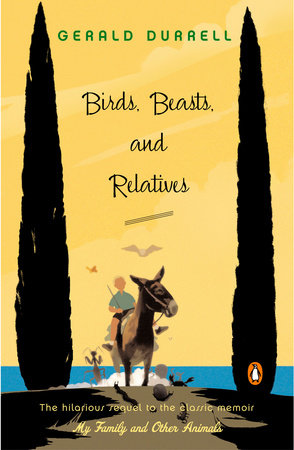
Childhood entitlement: Birds, Beasts and Relatives


Birds, Beasts, and Relatives by Gerald Durrell
Penguin
Pp. 245

This is the second instalment of Gerald Durrell’s Corfu Trilogy in which he continues with stories from the first book because the family say he has missed out all the best bits. As it is the same time period as the previous work, we don’t really need re-introductions, although it is interesting to see what the family members thought of their portrayal.

Gerry introduces several extra characters to us, mentioning Larry’s many friends who come to visit, including Max and Donald, and Sven who plays the accordion. We are also introduced to Countess Mavrodaki, “the recluse par excellence”., and we learn about his tutors, such as George, and his final (for this book) tutor, Kralefsky, a keen aviculturist (a person who keeps and rears birds) and a storytelling fantasist. He also provides greater depth to characters we have already met, and he describes his meeting with Theodore Stephanides, to whom the book is dedicated ‘in gratitude for laughter and learning”.

Gerry still collects animals for his menagerie: an owl called Ulysses; three dogs; and “there were rows and rows of jam jars, some containing specimens in methylated spirits, others containing microscopic life. And then there were six aquariums that housed a variety of newts, frogs, snakes and toads. Piles of glass-topped boxes contained my collections of butterflies, beetles and dragon-flies.” I remember things that I learned from reading these books as a child, such as the fact that snails are hermaphrodites.

Gerry has a child’s viewpoint and assumes that people and things exist for his entertainment. He experiences bucolic activities such as harvesting olives, but also is witness to live birth, and his reaction is less palatable. The description is anatomical but also unpleasantly dispassionate, perhaps because the human is foreign. “I was so used to the shrill indignation of peasants over the most trivial circumstances that I did not really, consciously, associate Katerina’s falsetto screams with pain. It was obvious that she was in some pain. Her face was white, crumpled, and old-looking, but I automatically subtracted ninety percent of the screaming as exaggeration.”

Furthermore, his description of the gypsies is somewhat uncomfortable in a modern setting. “I had always wanted to get on intimate terms with the gypsies, but they were a shy and hostile people… and although they would allow me to visit their camps, they were never forthcoming, in the way that the peasants were in telling me about their private lives and their aspirations.”

When Mother receives unwanted attention, and even a proposal of marriage, from a ‘disgusting old brute’, Captain Creech, she is naturally horrified and a little bit afraid. The children all laugh and ridicule, and she counters, “When there’s a real crisis, you children are of absolutely no use whatsoever.” Yes, this is an amusing anecdote, but she is a single woman in a foreign country in the 1930s with no respectable family to protect her.

Gerry writes of people as though they were specimens to be studied as his animals, birds and insects; because they are foreign (or female), they are other and this dispassionate approach is a little off-putting. These are still great stories of their time, but a deeper look reveals some more unsavoury aspects, which can be excused from a child’s account, but not really as an adult reader.