Tuesday, 14 December 2021

Bloody Long Walk

For anyone who has been following my other blog, you will know that I was planning to walk The Bloody Long Walk with some friends, Purple Lady and Design Diva. Well, we did it, and here are the photos to prove it. We started at the beginning, which is a very good place to start, but a horrific ear worm. See how we are all smiling at the top of Red Hill, before we get blisters and exhaustion. 


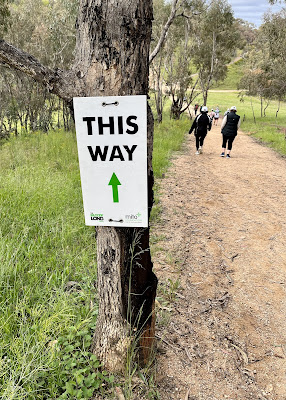
We were given caps and water bottles at the start line, which was a little annoying as we had been dropped off and I had not planned to carry anything - now I had to wear/ carry these items until our first meeting with our support crew. This is really a minor quibble. I appreciated the clear markers and signs that indicated we were on the right route. Although we have reccied it before, it was nice not to have to keep referring to a map and just follow the signs. 

We had arranged for a support crew to meet us with encouragement and sustenance at regular intervals. The crew comprised Him Outdoors, The Luminosity and TT. At our first stop at Lennox Gardens, about 8km in, they provided us with cheers, energy drinks, water and TT's superb sausage rolls. 


The walk potters round and about through the embassies and posh suburbs, calling past the Southern Cross Yacht Club, where we had phoned ahead for our coffee order from the support crew, much to the envy of other walkers (that's the goal, right?).

I did note that some teams were walking with loud music playing through speakers - I found this pretty annoying, and it didn't help that they were generally playing stuff I don't like. I understand that you might need music to motivate yourself, but that's what headphones are for - not everyone shares your penchant for noise pollution and it's pretty inconsiderate. That is not a point for the organisers, as there is nothing they can do about the selfishness of others, but it's a fairly large quibble. I would go so far as to say I was feeling peeved.

One team, on the other hand, had a stack of questions with which they were quizzing each other as they read them out from cards. As we passed them we heard them ask, 'How many toes have most cats got?' I love the way that question is phrased (to make allowances for three-legged felines and furry freaks, I guess), and we learned the answer is 18. I knew they had four on the back paws but had forgotten about the extra tree-climbing toe at the front. Educational exercise - what a great thing!


Halfway through the official Bloody Long Walk, we paused at the Yarralumla Nursery for further support from the crew. This station included frittata from The Luminosity and fruit cake made by Patience Itself. Design Diva assures us that, contrary to appearances, the cake was awesome. "I was part way through chewing in this picture and trying to smile at the same time and it came out as me looking unimpressed."


There is some pain here, mainly in the foot department; Purple Lady will be the first to admit that this is more of a grimace than a grin. At this point we were half way around Black Mountain Peninsula - the 25km sign says, "Hey, at least it's not a marathon". My, how we laughed! (Joke explained later.) As to why we are crouching in the photo, I've got absolutely no idea. Delirium perhaps?


The next 10km were tough. Purple Lady was in agony, almost tears, and was loosing her will to continue. She swore she would finish (actually, she just swore) and at one point asked us to just talk any old nonsense to her to take her mind off the pain in her feet. For the final 5km around the central basin of Lake Burley Griffin, we played a game whereby we picked a category and ran through the alphabet, taking a letter each. At one point we chose 'dog varieties' and we started out well: Alsatian; Beagle; Corgi; Dachshund etc. Things were flagging towards the tail end of the alphabet however (do you see what I did there?), as we got to Terrier; Ugly Dog; Very Ugly Dog; Weimaraner; Xtremely Ugly Dog; Yorkie; Ze Ozzer Dogz. Well, we were very tired...

But we finished the walk, and here is the proof - The Luminosity celebrating wildly with us as we crossed the line. 


As mentioned before, Him Outdoors pointed out that if I continued for another 7.2km at the end of this Bloody Long Walk, I would have walked a marathon. I felt I had come this far, so why not? Design Diva agreed, so we walked through the finish line, went to the toilet, and carried on our merry little way. Purple Lady could not walk another step, so we arranged to meet her at the conclusion of our unofficial 42.195km at Capital Brewing. 

Him Outdoors parked there and came back to meet us, jollying us along for the final stretch - as our own jollity was stretched a little fine by this point. We had to do a lap of the carpark to make up our distance, but reader, we made it. I know we look exhausted; we were. There are easier ways of getting a pint, but the beer at the end was very satisfying. 


It was a long day, but very rewarding. To 'cap' it off, I soaked in the bath and had a glass of bubbles. Cheers to my walking chums and the superb support crew. Here's to us all. We achieved a thing. 

Tuesday, 7 December 2021

Rookie Errors: Knots and Crosses


Knots and Crosses by Ian Rankin
Orion
Pp. 226

In a new introduction, Ian Rankin explains that he didn’t know Detective Sergeant John Rebus was to become such a huge fictional figure going on to star in more than a dozen novels. He notes his rookie errors in giving Rebus a complex back story and knowledge about things he might not have known (art and literature), combined with lack of understanding of things that he should, such as police procedure.

There is more than an element of Colin Dexter’s Inspector Morse about Rebus as Rankin is keen to show off his education with mixed metaphors and a classical background. “The skies were as dark as a Wagnerian opera, dark as a murderer’s thoughts.” He has faith, but does not hold with organised religion and he reads his Bible for comfort. “Ah, but it was not a nice world this, not a nice world at all. It was an Old Testament land that he found himself in, a land of barbarity and retribution.”

Rebus is patronising towards ideological students; needing to disassociate himself from others’ language; to prove himself better than that (he reads Dostoevsky’s Crime and Punishment, don’t you know), he positions himself above the students who come into ‘his’ city. “Edinburgh was all appearances, which made the crime less easy to spot, but no less evident. Edinburgh was a schizophrenic city, the place of Jekyll & Hyde sure enough, the city of Deacon Brodie, of fur coat and no knickers (as they said in the west).”

Much is made of the city’s underside, hidden from the tourists and the students, but known to the likes of him. Rankin has created this world and he is proud of its darkness. As it becomes clear there is a criminal delighting in killing girls and taunting Rebus, many are shaken that this occurs in the Scottish capital. “But here, in Edinburgh! It’s unthinkable. Mass murderers belonged to the smoky back streets of the South and the Midlands, not to Scotland’s picture-postcard city.”

Rebus has a secret past – of course he does; he was a Para and trained for the SAS with a special Crack Assignments group.  He has buried his SAS experience in his subconscious, but it is clearly important to the case he finds himself investigating. Indeed, there are so many references and near flash-backs that the reader knows this trauma has something to do with the crime, even if he doesn’t. When he decides to delve into his subconscious, it is no surprise that the mind is a deep and curious place, with many layers, just like Edinburgh itself.

As well as being firmly fixed in place, Rankin sets his novel in a particular time, where pubs served different measures, and computers and digitisation are new. Rebus’s colleague tells him that the time is coming when all files will be on computers and work-horses like him will be obsolete. “It’s progress, John. Where would be without it? We’d still be out there with our pipes and our guess-work and our magnifying glasses.”

Unfortunately, another thing that anchors this novel in its time is the casual sexism and portrayal of women. Gill Templar is suspected of being a “ball-crusher” because she has opinions and stands up for herself, although she has appallingly unnatural dialogue. When she inevitably has sex with Rebus she is described less as a woman than as a doll. “She smelt good, like a baby on a fireside towel. He admired the shapes of her twisted body as they awoke to the thin, watery sunlight. She had a good body all right. No real stretch-marks. Her legs unscarred. Her hair just tousled enough to be inviting.” At least she fares better than another woman he picks up, who is written more like a cow in a herd than a human individual with thoughts and feelings.

And then there is his (unsurprisingly) ex-wife, whose body he describes as “pressed, pushed and prodded into a shape attainable only with the aid of some super-strong girdle. She was not, he was relieved to find, wearing as well as their occasional phone conversations would have had him believe.” Currently there are 23 John Rebus novels. Apparently Ian Rankin is now writing the character as a real policeman rather than a graduate’s ideal. We can only hope he has sorted out that adolescent misogynistic streak as well.

Friday, 22 October 2021

Friday Five: Halloween Cross-Stitch

It does feel very odd to me that the seasons are back to front here and certain festivals occur at the 'wrong' time of the year. Halloween falls between Harvest Festival and Guy Fawkes Night. It occurs as the nights begin to draw in and there are more shadows and misty corners in which things can lurk and our fears and anxieties can grow if left unattended. To me it is tied to the Gaelic festival of Samhain, which marks the end of the harvest season and the beginning of winter or the 'darker-half' of the year. 

As with many things the ancient pagan, mythical, religious roots have largely been consumed by consumerism and capitalism. I dislike that intensely. I do, however, like the idea of making the connections with the liminal world more comforting and less frightening. To this end, I have enjoyed stitching these designs. 

5 Halloween Cross Stich Designs:

Wednesday, 20 October 2021

Macho Noir: Paint It Black

Paint It Black by Mark Timlin
Victor Gollancz
Pp. 256

Nick Sharman has been around for a while apparently; this is the eleventh novel in a series of nineteen and counting, starting in 1988 (this one was first published in 1995). He is the narrator of these novels about himself, a South London ex-policeman now private detective, in a world where women exist only to be rescued or revenged, and full of the sort of hard man dialogue and soulless quips that would even embarrass Guy Ritchie. But author, Mark Timlin, is very popular – one doesn’t publish nearly twenty books in a series without being – and reviewers consider him to provide an “answer to the hardboiled noir of 1940’s America, uprooted lock, stock, and barrel to the dingy back streets of 1980’s south London”. I suppose I didn’t realise anyone was asking the question.

Nick Sharman gets a call from his ex-wife Laura in Glasgow to tell him that their daughter, Paula, has gone missing. He and his wife, Dawn, track her down to a field in Banbury where she is with a bunch of travellers, having accompanied her friend, Paula. Paula is a ‘bad influence’ and they have taken drugs, but she has a heart of gold; yes the clichés are that obvious. At this point, he could simply take the girls back home, “The case of the private detective’s daughter webbed up in the rave scene has come to a satisfactory conclusion.” Of course he chooses instead to track down the dealers and blow up a shipment of their drugs. They take their revenge by killing Dawn and their unborn child. He then retaliates in a plan that goes horribly wrong but involves a lot of killing, guns and explosives.

Ah yes, the guns. Timlin loves sex, violence, cars and travel routes. He describes ammunition as though it were a fashion accessory. He does love his detail – desperate to prove his tough-guy credentials like something out of a bad Ross Kemp documentary. He enjoys deadpan wisecracks; when he arrives at a secret location and is told, “We’re here”, he replies, “Everybody’s got be somewhere” as if that means something deep. 

When he gets onto his obsession with cars and directions, however, he sounds more like a boring salesman at an unspeakably tedious conference team-building dinner. “We got back into the Mondeo and took off down the secondary road in what I guessed to be a southerly direction for a few miles until we came to a village called Frating Green, where the A133 bisected the B1029, and we swapped cars again. I found a Volkswagen Golf GTI neatly parked on a grass verge, whose doors opened to my hoister’s key.”

And then there’s the bit where, despite the fact he has a teenage daughter whom he apparently adores, he still has sex with her friend, Paula, after she has specifically told him she is fifteen. “I had my arms full of a tiny, slippery little female who wanted a fuck. So I gave her one. Right or wrong, that’s what I did. And I enjoyed it, and so did she.” That is statutory rape; there is no question about this – it’s wrong.

There is clearly a market for this macho storytelling. It is a market that doesn’t get irony, and probably thinks that giving women their rights is as bad as giving them credible characterisation in a novel. This novel was published 25 years ago; that (fortunately) feels like a lifetime.

Saturday, 16 October 2021

Friday Five COVID-19: More ISO TV


We're coming out of lockdown today - hurrah! While we will be cautiously allowed out to pubs, cafes and restaurants; theatres and cinemas are not operating at capacity so there will be more TV watched for visual input. Meanwhile, these programs have been on my recent watched list. 

  1. Atlantic Crossing (SBS On Demand) - A Norwegian/ American drama miniseries addresses the issue of trying to get Allied support for Norway against the Nazis, who had invaded their country in WWII. Allied intervention was not assured, as the forces were busy on multiple fronts, so while the King of Norway and the Crown Prince Olav were in England, trying to drum up European support, Crown Princess Martha took her children to the U.S.A., where she becomes the guest of President Franklin D. Roosevelt. because this is a drama, the script implies there may be more than friendship between these characters. Production values are sleek, design and costumes are exquisite, and the acting varies from subtle and inscrutable to histrionic. Soapy romance elements aside, the politics is fascinating to view from a different historical perspective.  
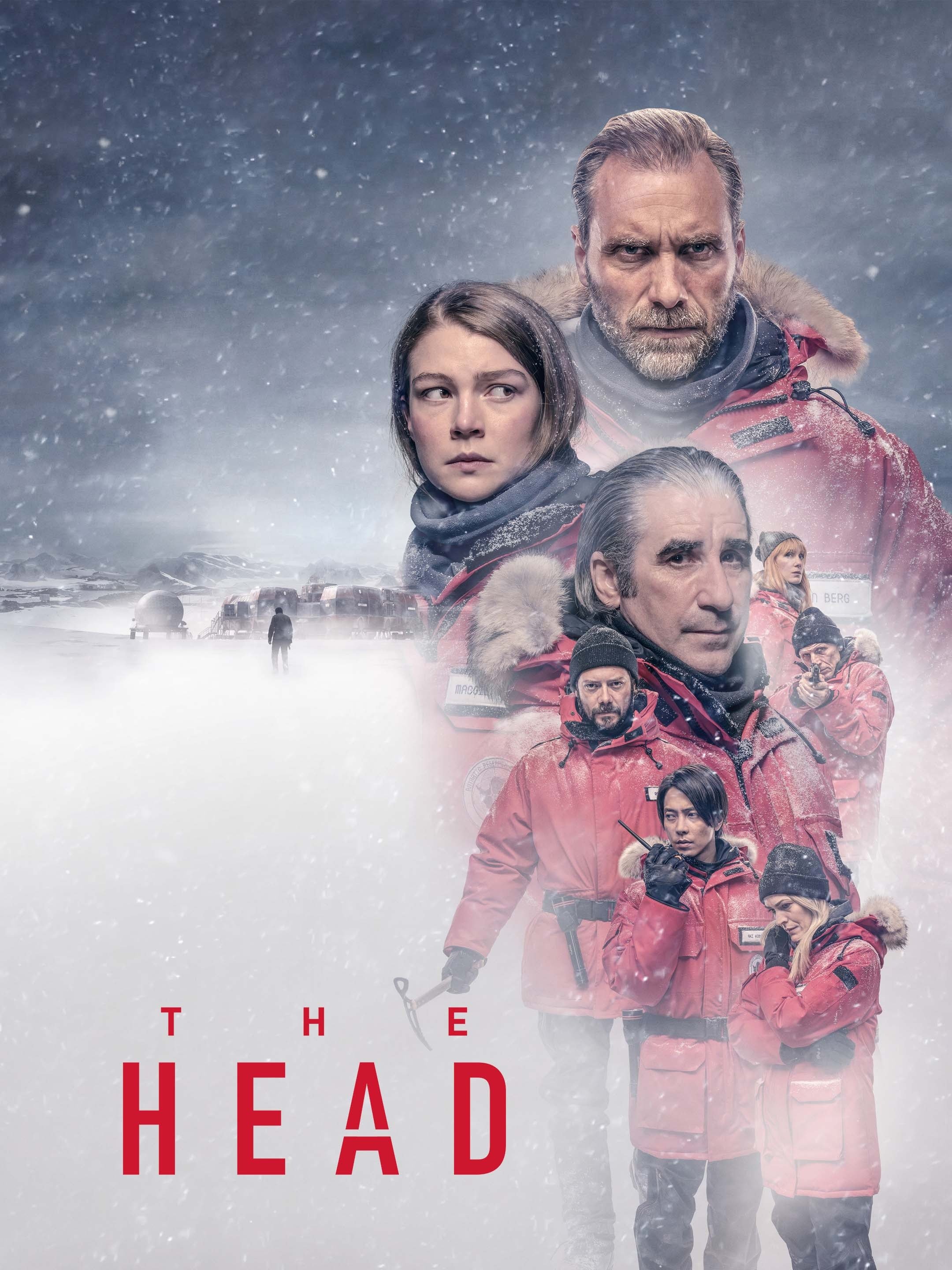
  2. The Head (SBS On Demand) - This Spanish-made, English-language psychological thriller ticks all my boxes; set in a snowy, cold location (The South Pole), a group is left in isolation as the Winterers remain at Polaris VI Antarctic Research Station to continue their research to assist in the fight against climate change. Immediately cracks begin to appear. Fast forward to six months later when the summer team return to find all the Winterers are dead or missing and there is a killer on the loose. Flashbacks indicate that everyone was shifty with a metaphorical axe to grind or a point to prove. It is logical, but I didn't work it out until the very end. It's like Agatha Christie on ice.

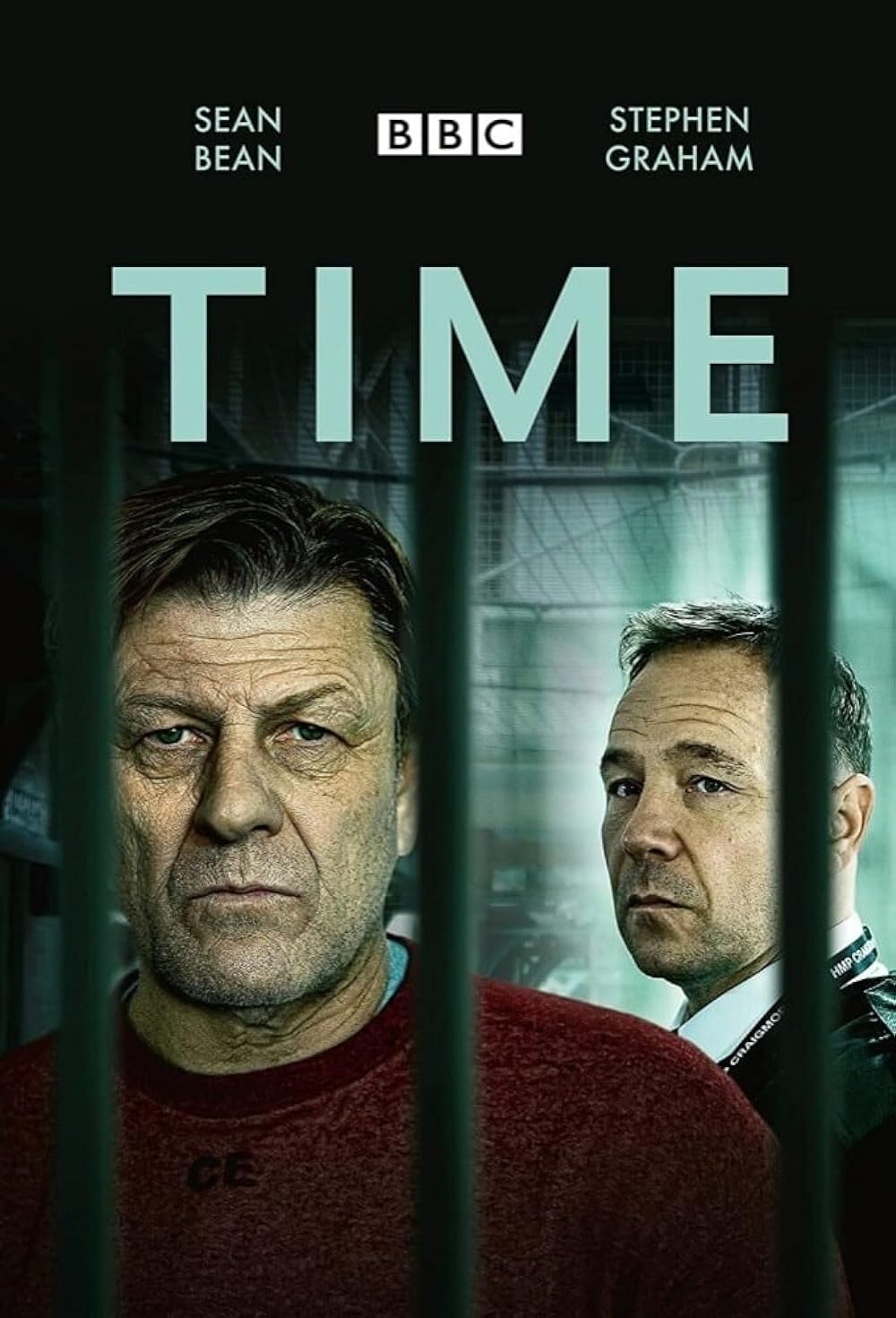
  3. Time (BBC First) - All praise the new three-part drama miniseries by Jimmy McGovern set in a prison, starring Stephen Graham, Sean Bean, Sue Johnston and Siobhan Finnernan. It's exactly as cheery as one would expect, but the acting and the writing is almost criminally good.
  4. Wentworth, Season 5 (ABC iview) - I'm a long way behind with this series - Season  5 finished in 2017, and Season 8 is halfway through (with filming interrupted due to COVID). It chucks in every prison cliché - don't go in the showers; get on gardening detail if you can; beware the butch lesbian; the kitchen deals drugs; most of the screws are bent, but it is one of few mainstream TV dramas that passes the Bechdel Test.

  5. War of the Worlds, Seasons 1 & 2 (SBS On Demand) - There are a lot of versions of this story. According to this one (produced by Fox Networks Group and StudioCanal-backed Urban Myth Films), if you send Nick Cave songs out into the cosmos, you might get invaded by aliens from the future. "I don't believe in an interventionist God" has never seemed so apt. The bleak and deserted landscapes are reminiscent of 28 Days Later or The Day of the Triffids, but Gabriel Byrne lends it a touch of gravitas, and the blend of English and French gives it a certain je ne sais quoi. 

Tuesday, 12 October 2021

How Beauteous Mankind Is!: Circe


Circe by Madeline Miller
Bloomsbury
Pp. 333

The retelling of classical stories and myths from the female perspective is currently all the rage (The Penelopiad by Margaret Atwood; The Silence of the Girls by Pat Barker; A Thousand Ships by Natalie Haynes) and Madeline Miller is part of this welcome revolution. Here she tells the story of Circe, a semi-goddess often described as a witch, best known for her role in Homer’s Odyssey, where she detained Odysseus and his men, turning some of them into swine. Miller relates this tale in the first person, providing a back-story and reasons for Circe’s behaviour, like the unravelling of a fairy-tale.

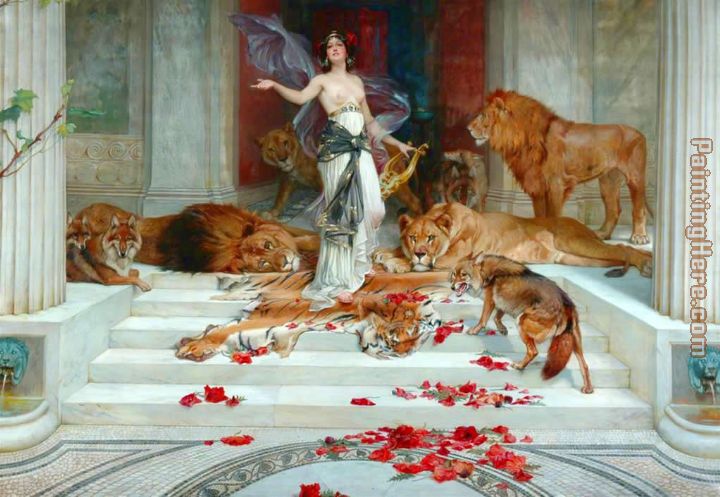
Circe (1911) by Beatrice Offor

Circe is the daughter of Helios, Titan god of the sun and, from childhood, she is ridiculed for not shining brightly enough in his eyes. Her name means Hawk because of “my yellow eyes, and the strange, thin sound of my crying”. The gods think her voice is weedy and screechy, but it transpires it is simply like that of a mortal. She is fascinated by humans and shares an affinity for them with Prometheus, who shaped man out of mud. As a child, Circe asks Prometheus what a mortal was like and he tells her, “There is no single answer. They are each different. The only thing they share is death.” She questions how they bear the burden of this knowledge and he replies, “As best they can”.

Bored with the smooth symmetry of the gods, Circe loves the diversity of humans. She is fascinated by mortals, and her words are like those of Miranda in Shakespeare’s Tempest or reminiscent of Doctor Who, who admires mortals but is not one. She has no god-like powers, although she does have knowledge of herbs and potions; medicine to be used for healing and harm, the Greek word for which is pharmakis, ‘a preparer of drugs, a poisoner, a sorcerer’, from which we derive the word pharmacy, and which wisdom led her to be called ‘witch’.

The Wine of Circe (1900) by Edward Burne Jones

Just as she studies the mortals, she also philosophises about the gods. She knows that they are cruel and curious, and that they rule by fear through a hierarchical chain that recalls various political parties and governments.

The gods also “love their monsters” because it gives them something to threaten mortals with, and something for heroes to challenge. They look down upon mortals and heroes, and enjoy toying with them – the Trojan War and its consequences are all a result of their petty squabbles – and they like to see what the mortals will do next when put into impossible situations. “Gods love novelty… They are curious as cats.” These gods are equally childlike and cruel, with a unique morality. “They do not care if you are good. They barely care if you are wicked. The only thing that makes them listen is power… They take what they want and in return they give you only your own shackles.” They also punish those who help mortals; they want the mortals to be afraid because they give better offerings.

Circe (1889) by Wright Barker 

The most important thing to these gods is their reputation. They are similar to the Knights of King Arthur, who vied for quests to prove their honour, but these gods want only fame – they don’t care how they come by it. Most mortals also want fame above anything: when Odysseus travels to the underworld to consult Tiresias, the blind seer, Achilles tells him it is better to live a quiet life than die a hero’s death. He disagrees. When Telemachus turns down Athena’s offer of adventure, she is bewildered. “There will be no songs made of you. No stories. Do you understand? You will live a life of obscurity. You will be without a name in history. You will be no one.”

Miller uses the style of Homeric language and epithets about Helios, “My father’s chariot slipped into the sea and began to douse itself in the waves” but she also has an individual style as she reinterprets classic myth from a modern angle and damns the ostensible glory of the gods.

After displeasing her father, Circe is exiled to an island, Aiaia, which she cannot leave, but she can receive visitors (including Hermes, Jason and Medea, Daedalus, and, of course, Odysseus). She becomes a magnet for reckless and randy sailors (these are the ones she turns to swine as they try to rape her) and her island a place for disgruntled fathers to send their disobedient daughters, like some mythical convent. She casts her feminist viewpoint on her treatment. “Brides, nymphs were called, but that is not really how the world saw us. We were an endless feast laid out upon a table, beautiful and renewing. And so very bad at getting away.”

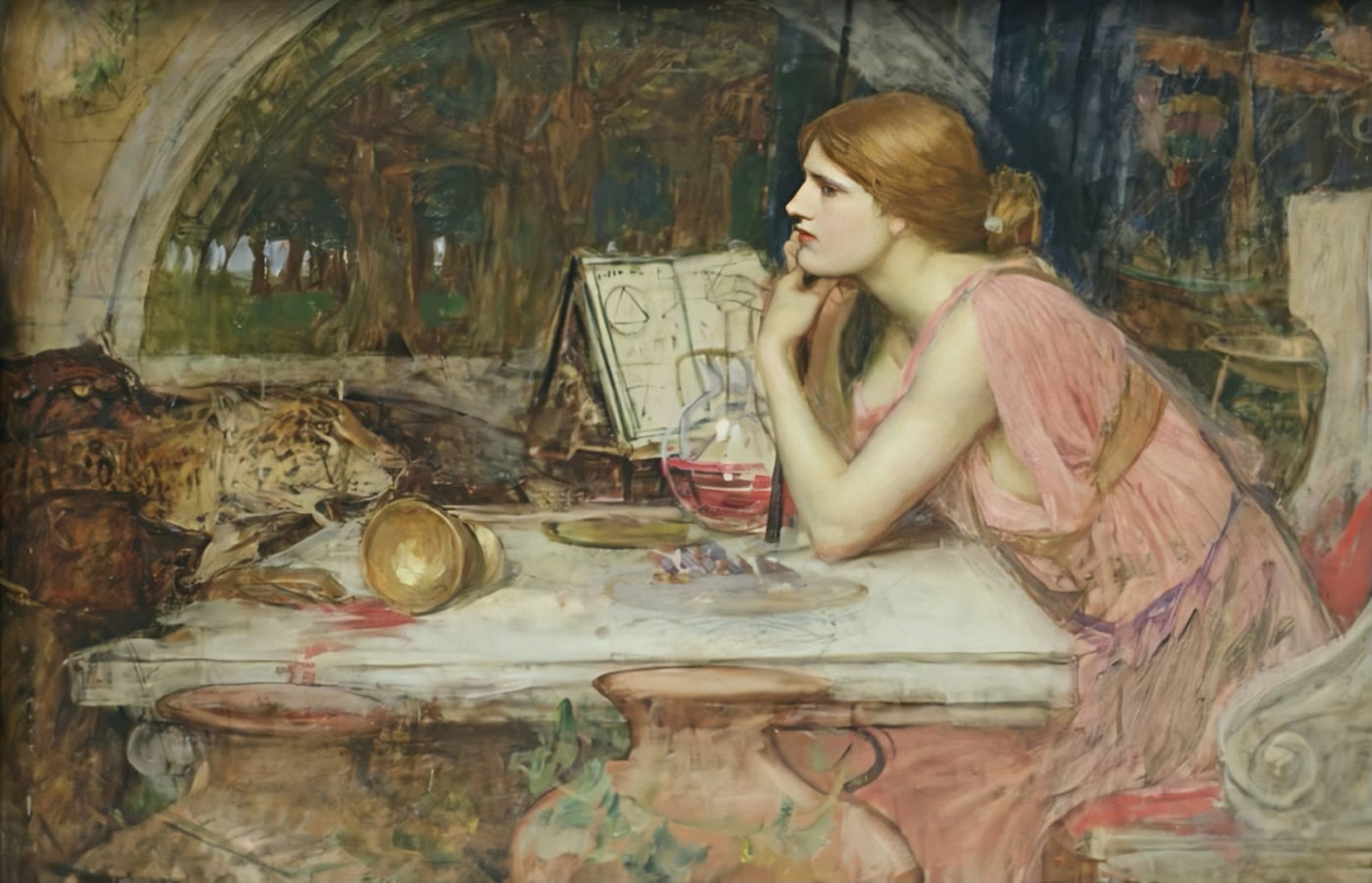
The Sorceress (1911) by John William Waterhouse 

Circe’s story is one that has only previously been told through the eyes of others and the tangential effects she has on their narrative. Miller presents us with another side to wily Odysseus, “The spiral shell. Always another curve out of sight.” She also shows us a fresh perspective on Penelope when Odysseus’ wife and son visit Circe on Aiaia, and the use of the word ‘weaving’ to describe spells and craft unites the women through something other than the lover and mother trope.

Circe is immortal, and she sees many changes, but she does not wish to see destruction. During her early experiments, Circe discovers the limits of her powers. “However potent the mixture, however well woven the spell, the toad kept trying to fly, and the mouse to sting. Transformation touched only bodies, not minds.” To her mind the greatest transformation is life into death. The idea that there is an undying spirit is comforting; it is the same as a story which can be endlessly retold. And this is a version I would be more than happy to hear again.

Circe and Her Swine (1896) by Briton Riviere

Friday, 8 October 2021

Friday Five: Street Libraries

One of the things I have enjoyed about lockdown is the walking I have done around the suburbs. With limited time allowed for exercise and a limited radius in which to do it, I have been varying my routes close to home. These wanderings have taken me past many delightful street libraries, which inadvertently showcase their suburb. Yes, there are different shapes and sizes, and they contain different books aimed at different readers, but one thing they all have in common is a desire to share with their community, and I think that is rather wonderful.

Five Street Libraries:

  1.