Showing posts with label Hiro Arikawa. Show all posts

Tuesday, 23 May 2023

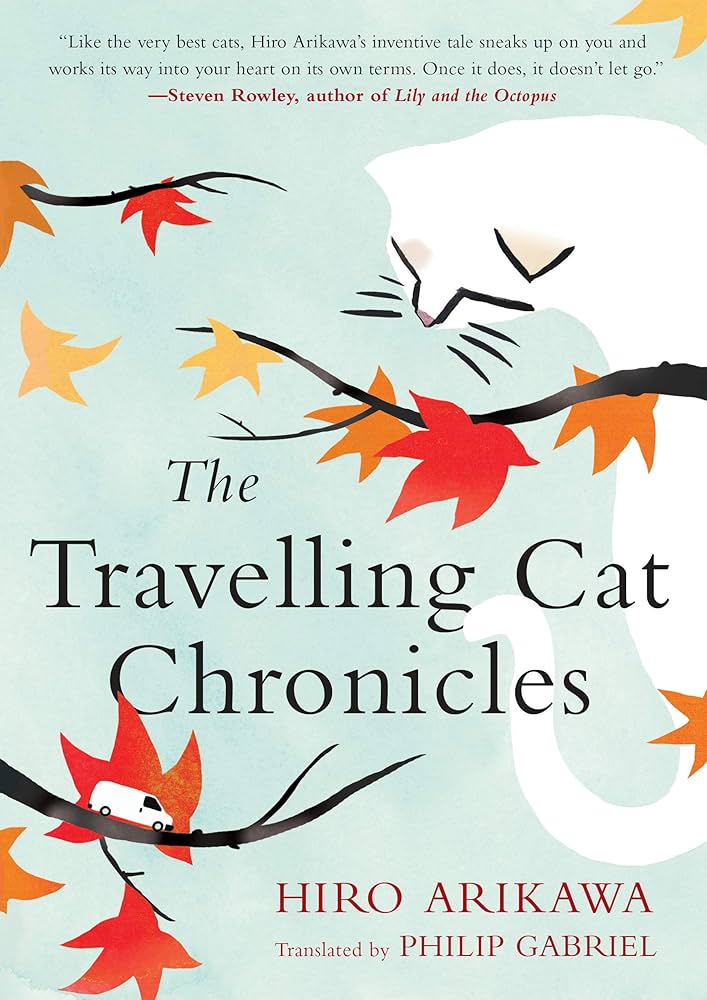
Deceptively simple or just a little bit naff? The Travelling Cat Chronicles


The Travelling Cat Chronicles by Hiro Arikawa
Thorndike Press
Pp. 327

Translated from the Japanese by Philip Gabriel, this novel (first published in 2015) had reviewers gushing that it was gentle, wise, witty, beguiling and full of simple but deceptive prose. I didn’t realise I was quite so cynical, but I have to wonder, is it deceptive or just simple and is it really profoundly charming or just a little bit naff?

The novel is mainly narrated by Nana, a cat named after the Japanese word for seven, which is considered to be lucky and the shape of the cat’s tail. Nana was a stray cat who was nursed by Satoru after being hit by a car. In return, Nana lives with Satoru and gives him affection. When Satoru knows he is dying, he wants to make sure Nana has a happy home so he sets off on a road trip to visit possible adoptive homes and friends.

These travels give Satoru an opportunity to spark memories and reconnect with old friends. He and Nana meet Yoshimine, the brusque and unsentimental farmer who thinks cats are just for catching rats, Sugi and Chikako, the warm-hearted couple who run a pet-friendly B&B, and Kosuke, the mournful husband whose cat-loving wife has just left him. In the pages concerning Kosuke, the point of view switches to the third person omniscient narrator who tells us about the boys’ friendship and how they bonded with a cat called Hachi (which means eight) when they were both in elementary school.

When we see Nana’s perspective he instructs us on cat behaviour, such as why they like cardboard boxes rather than special beds and toys. Nana doesn’t understand certain human idiosyncrasies including their fondness for the sea, and he also questions their need to concern themselves about burials and cemeteries. “When an animal’s life is over, it rests where it falls, and it often seems to me that humans are such worriers, to think of preparing a place for people to sleep when they are dead. If you have to consider what’s going to happen after you die, life becomes doubly troublesome.”

As well as teaching kittens to stand up for themselves and explaining feline ways, Nana also cares for his adopted human. He’s a proud cat, but he’s loyal, loving and perceptive. The Travelling Cat Chronicles is a novel about the bond between humans and their animals, but it also about the power of friendship from childhood to adults. Without the support of those he visits, Satoru would not have grown into the kind and gentle man he has become – the kind of man who would scour the country to find the perfect home for his cat.

Friday, 3 March 2023

Friday Five: Books Read in February

  1. The Seven Moons of Maali Almeida by Sethan Karunatilaka: This month's family book club selection (the choice of both me and my cousin) is more than just a pretty cover. Reminiscent of George Saunders’ 2017 Booker Prize winner Lincoln in the Bardo, the 2022 Booker Prize winner also deals with the liminal space (called the In Between) in which unsettled spirits, ghosts and ghouls roam dazed and confused. They are given seven moons to come to terms with their death and to enter into The Light, or roam this limbo land forever. Maali Almeida is dead (instantly recalling Dickens' opening lines of A Christmas Carol - 'Marley was dead: to begin with. There is no doubt whatever, about that') and has a week to find out how he died and why. The novel uses the second person, which is a bit annoying and questionable as to who is the narrator, although this becomes clear at the end. In Colombo 1990, life is risky, especially if you are a photo-journalist, as Maali was, everything is political, and people are frequently disappeared. Any one the subjects of his photos might have killed him to keep him quiet, but which one and does it ultimately matter to anyone but him? As he concludes, “All stories are recycled and all stories are unfair. Many get luck, and many get misery. Many are born to homes with books, many grow up in the swamps of war. In the end, all becomes dust. All stories conclude with a fade to black.”
  2. The Travelling Cat Chronicles by Hiro Arikawa translated by Philip Gabriel: This novel (first published in 2015) had reviewers gushing that it was gentle, wise, witty, beguiling and full of simple but deceptive prose. I didn’t realise I was quite so cynical, but I have to wonder, is it deceptive or just simple and is it really profoundly charming or just a little bit naff? The novel is mainly narrated by Nana, a cat named after the Japanese word for seven, which is considered to be lucky and the shape of the cat’s tail. Nana was a stray cat who was nursed by Satoru after being hit by a car. In return, Nana lives with Satoru and gives him affection. When Satoru knows he is dying, he wants to make sure Nana has a happy home so he sets off on a road trip to visit possible adoptive homes and friends. When we see Nana's perspective he explains feline ways (why they like boxes; why they dislike the sea), teaches kittens to stand up for themselves, and cares for his adopted human. The Travelling Cat Chronicles is a novel about the bond between humans and their animals, but it is also about the power of friendship from childhood to adults. Without the support of those he visits, Satoru would not have grown into the kind and gentle man he has become – the kind of man who would scour the country to find the perfect home for his cat.
  3. Flawsome by Georgia MurchNo one's perfect, and the sooner we accept ourselves with all our flaws, the happier we will be. That's according to feedback expert, Georgia Murch, who has written a comprehensive guide to becoming more self-aware and acknowledging that how we behave affects both ourselves and others around us. It's delivered in a punchy, positive and Aussie style, and it makes a lot of sense. She writes that 'this is a book for those who would like to stop being good enough for others, and start being themselves.' And who doesn't want that?
  4. The Time Traveller's Guide to Medieval England by Ian Mortimer: Ian Mortimer maintains that the best way to understand history is not to treat it as a dead and distant time but like a foreign land. Many aspects may be different, but people still have the same wants and needs, so he explains what to eat, drink, and wear, how to travel, where to stay, what to do and what to avoid. There are also handy hints about laws, health practices, measurements, languages, and religious customs. It's a really engaging way of bringing the past to life, and there are plenty of facts, figures and tables of data analysis if you prefer that sort of thing.
  5. The Muse by Jessie Burton: The parallel stories in this novel lead the reader to wonder just exactly who is whose muse? It begins in London in 1967 when aspiring Caribbean writer, Odelle Bastien, finds employment at an art gallery, falls under the tutelage of the enigmatic co-director Marjorie Quick, and is seduced by the charms of Lawrie Scott who appears to have a valuable painting to assess. Interwoven chapters focus on the story of Olive Schloss, daughter of Harold and Sarah, who becomes involved with wannabe artist, Isaac Robles, while in Arazuelo in Spain, 1936. Isaac also dreams of being a revolutionary much to the chagrin of his half-sister Teresa who works as a housekeeper for the Schloss family and just wants to avoid trouble. Of course the names and dates recall the Windrush generation, the Spanish Civil War and the treatment of Jews leading up to WWII. Meanwhile, there are themes of unrequited love, parent-child relationships, and the difficulties of creative women wanting their art to be taken seriously. Lots of people are manipulating each other and hiding secrets in order to score points. It all becomes somewhat messy and incoherent as the author tries to pack too much detail into her story (there is a bibliography at the back to prove she has done her research) and it doesn’t tie together very well. Although the descriptive passages are fantastically evocative, the characters are all one-dimensional and the story itself is unengaging and predictable.