Showing posts with label Judi Dench. Show all posts

Friday, 18 October 2024

Friday Five: Daniel Craig's Bond


I have seen the latest Bond. I have thoughts and some issues. But before I saw it, I refreshed myself by watching the previous Daniel Craig Bond films, beginning with Casino Royale, which is 15 years old. It took a few days, obviously, and I had a martini or two, but with gin - you know; the proper way. The following contains spoilers.

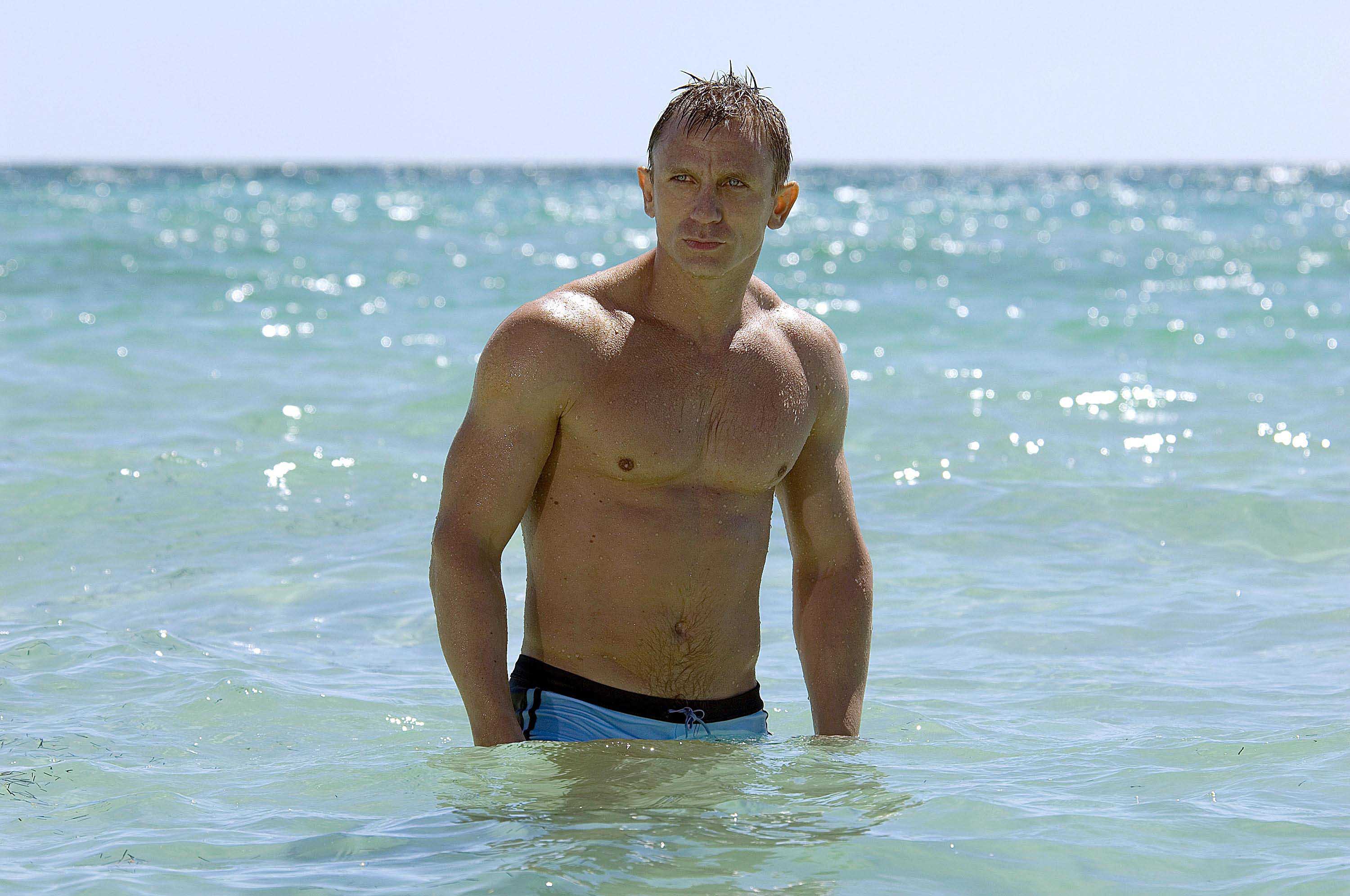
  1. Casino Royale (2006) - rebooting Bond with Daniel Craig was utterly inspired. A little darker and more serious - less spoof and more spy - than previous outings in the Bond franchise, the third screen version of this Ian Fleming novel relied more on practical stuntwork than the CGI placements of former films. The torture scene is both excruciating and disturbingly erotic. The scene in the stationary vehicle was more thrilling and dramatic than when they are chasing each other through picturesque landscapes in high octane pursuits. We are also introduced to the DBS, which has the potential to steal the show. The acting is stellar as you would expect from folk more used to theatre; Judi Dench as M sparks off DC with the direct current those initials suggest, and Mads Mikkelsen does a great turn as the baddie, Le Chiffre. Sadly, the 'Bond girl' trope still puts pouting over substance, and Eva Green as Vesper Lynd is insubstantial. As these things demand, however (if Bond falls in love, the object of his affection must be elminated to give him motivation), she dies at the end - shutting herself into a lift in a derelict Venetian palace that crumbles into the Grand Canal.


  2. Quantum of Solace (2008) - generally panned when it was released, I think this film has a lot more to offer than many suggested. Daniel Craig (or his stunt double) rides a motorbike, runs over rooftops, flies a plane, pushes bodies off buildings and through windows, walks across deserts, steers a boat, hangs off dodgy-looking scaffolding in building structures, executes dangerous overtaking manoeuvres on narrow twisting roads, and wears sunglasses like a boss. You want more? The Bond girl is actually good! Olga Kurylenko plays Camille Montes as a Bolivian agent who actually does something interesting. Mathieu Amalric is the main villain, Dominic Greene, who claimed to model his perfomance on 'the smile of Tony Blair and the craziness of Sarkozy'. We also get to see Rory Kinnear, Phil Ritter and Gemma Arterton (always a bonus) and the opening salvo by Jack White and Alicia Keys is pretty good too, although a departure from the popular Bond-ballad style of theme tune usually preferred. 
  3. Skyfall (2012) - many people's favourite, and for very good reason. The opening sequence is worth the price of admission alone, as Bond fights a baddie atop a moving train and M instructs Moneypenny to 'take the damn shot'. As she does so, she accidentally shoots Bond who falls into a river and is presumed dead. Of course he isn't, although he takes advantage of the presumption for early retirement, only returning to service in London when the MI6 computers are hacked and their building blown up. There's some shennangians in Shanghai with a thrilling casino scene and even more palpitations in the London Underground - 'Health and safety; carry on.' Ben Wishaw pops up as Q, Naomie Harris is Moneypenny, Javier Bardem is top-notch fabulous villain, Raoul Silva, and Adele cashes in with the theme song. We see a softer side to Bond as he returns to his ancestral home in the Scottish highlands and Ralph Fiennes succeeds Judi Dench as M in a heartbreaking and brilliant handover.  
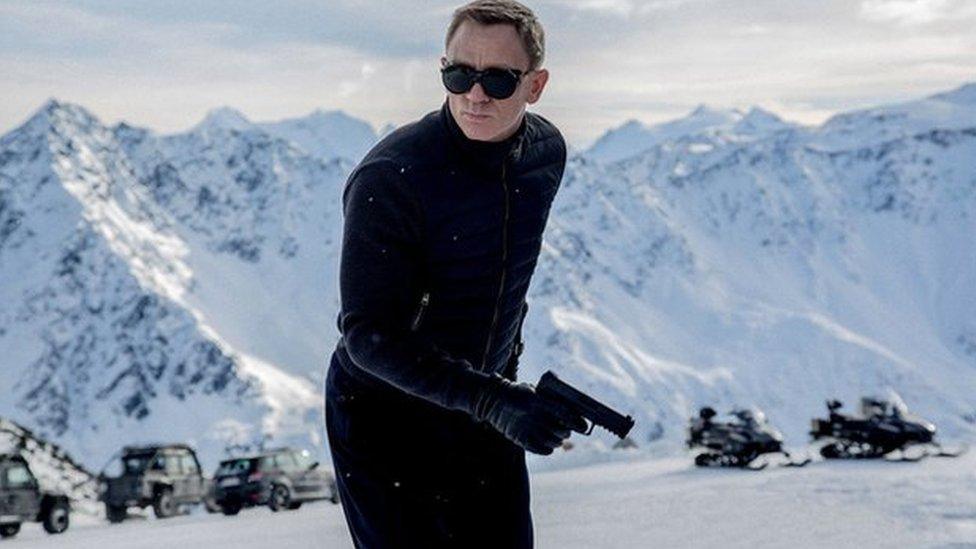
  4. Spectre (2015) - Bond is once again sidelined due to unauthorised action, and M (Ralph Fiennes) is in a power struggle with Max Denbigh dubbed C (played with unctuous indifference by Andrew Scott). We have scenes in Mexico City (Day of the Dead), Rome (The Forum), Austria (snow), and London (helicopters crashing into bridges), and some decent stunts. Unfortunately the insipid Bond girl returns (Lea Seydoux as Madeleine Swann), and Bond falls for her and makes ridiculous choices. On the plus side we get Christophe Waltz as big daddy baddy Blofeld, Monica Bellucci providing an age-appropriate dalliance, and a throwback to an exploding gadget. We also get to see M take down the duplicitous C and say, 'And now we know what C stands for' - supposedly it's 'careless', after he hasn't checked the bullets in the gun, but I think we all know differently.
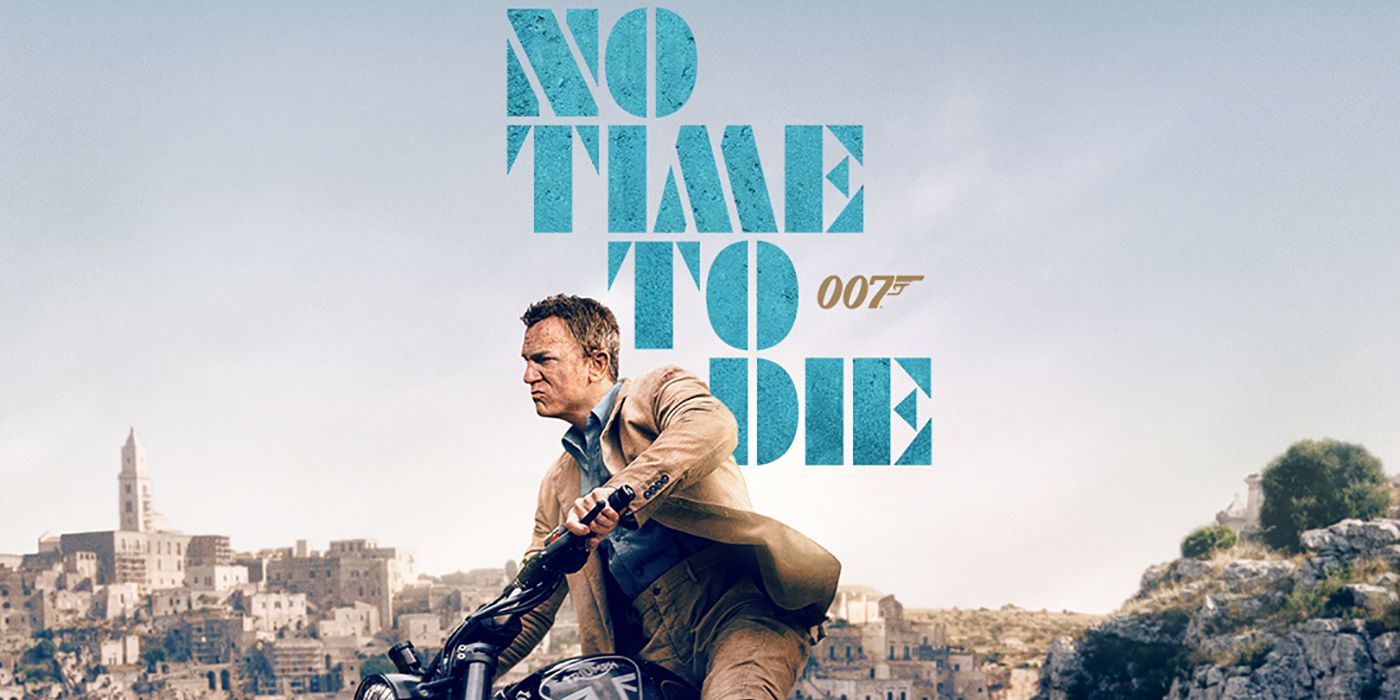
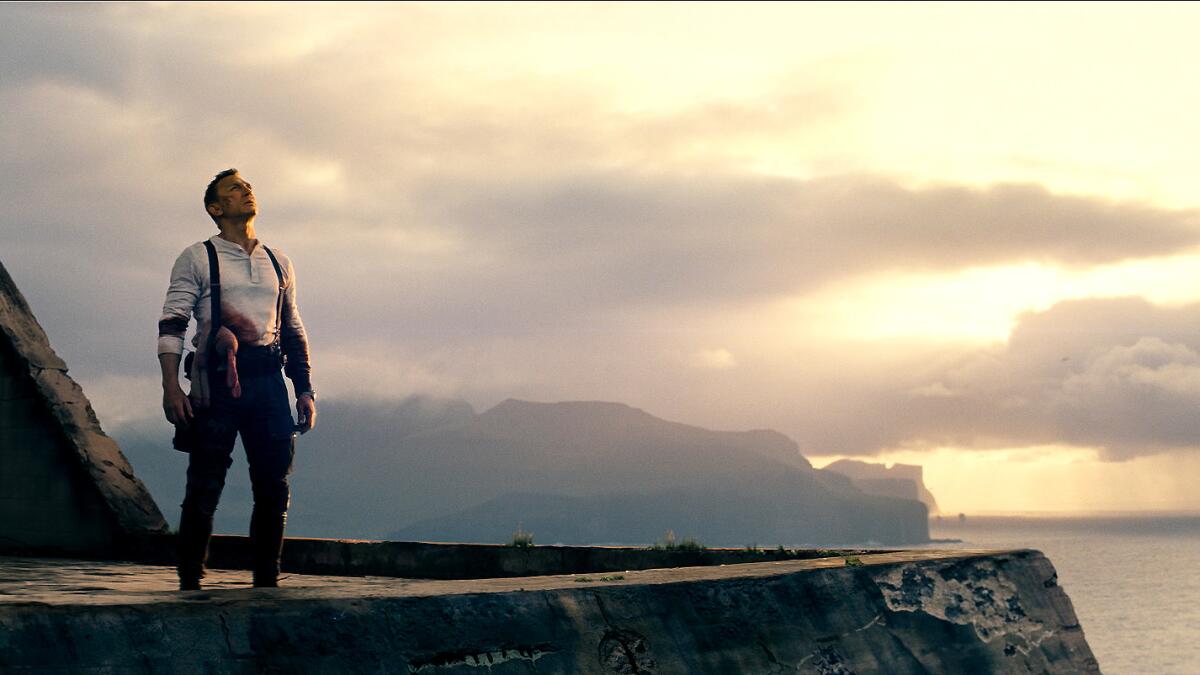
  5. No Time To Die (2021) - There were all the spoilers in the world for this film. Mainly the connections to Jason Bourne - there was never just one. Daniel Craig is still superb and the supporting cast of M (Ralph Fiennes), Q (Ben Wishaw), Moneypenny (Naomi Harris), Felix Leiter (Jeffrey Wright) and Bill Tanner (Rory Kinnear) are all delightful. The new agents are a revelation. Lashana Lynch as the new 007 has gravitas, and the CIA agent, Paloma (played by Ana de Armas), is admirably engaging. Less so the charisma-free Lea Seydoux who returns to her Yoko Ono-esque role to mess up the Bond we know and love. The ending has way too much mawkish sentimentality and, with its sledgehammer points about the importance of parenthood, it made me nostalgic for the old sign-offs of double entendres and smutty humour.

Monday, 11 June 2012

My Week With Marilyn: Wiggle It


In this entertaining and engaging film, Colin Clark, an employee of Sir Laurence Olivier’s, documents the tense interaction between Olivier and Marilyn Monroe during production of The Prince and the Showgirl. It really does concern the events of one week (although they seem to be typical and exemplary of a much greater timespan), allowing director Simon Curtis to maintain a tight focus and avoid the rambling pitfalls of many a biopic.
Eddie Redmayne is charming and fresh as the besotted Colin Clark
Of course, Marilyn is the star of the show and Michelle Williams outstandingly captures her allure and vulnerability. She is crippled with insecurity about her true identity and her acting talent, surrounding herself with an entourage of admirers and sycophants, including Milton Green (Dominic Cooper in truly unctuous form) who supplies her with pills for everything, and drugs her up to manage her, and the chauffeur and chaperone, Barry (Jim Carter), who attempts to exert some measure of concerned control.

She particularly shines among the ‘common people’ – at Eton or the local pub, where she tells the landlord, “Nice place you’ve got here”. It is enough to warm his soul and he would dine out on such a chance remark for years. She knows it, but she can afford to be generous with her winsome smile.

"Shall I be Her?"
“Shall I be her?” Marilyn asks on a trip to Windsor Castle, where she is shown around by Sir Owen Morshead, Colin’s relation, acted with sensitive understanding by Derek Jacobi. She is struck by the fabulous dolls’ house and opens it up to look inside, murmuring, “Every girl should be told how pretty she is and how much her mother loves her.”

Marilyn grew up in other people’s homes with her own mother in an asylum. She doesn’t know who her father is and seeks approval from the establishment who are smitten with her sex appeal although they don’t much care for her personality. Her current husband, Arthur Miller (played with assured nonchalance by Dougray Scott) complains, “I can’t work; I can’t think; she’s devouring me” and he leaves her to return to America, which threatens to tip her into suicidal despair. Green explains, “You don’t leave Marilyn alone. She thinks everyone’s abandoned her”, and she questions through a drug-induced haze, “Why do the people I love always leave me?”

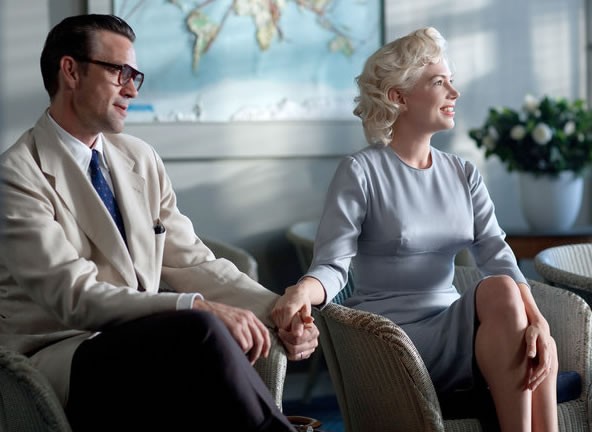
Dougray Scott as Arthur Miller and Michelle Williams as Marilyn Monroe
Marilyn worries that no one cares for who she really is; they are simply besotted by her persona. “All the people want is Marilyn Monroe and then they realise I’m not her.” Yet she plays to the myth, pouting and winking and talking in her ridiculous baby doll voice. Although she claims, “I’m not a goddess. I just want to be a regular girl,” she is keen to seduce Colin (Eddie Redmayne), taking her clothes off before him to swim in the Thames, and giggling under a blanket with him to try and escape her bodyguards.

"Did she break your heart? Just a little bit? Good, it needed breaking." - Emma Watson as Lucy considers her 'rival'
Everyone warns Colin that Marilyn is a heartbreaker and not to get involved – even the dowdy-by-comparison wardrobe mistress, Lucy (Emma Watson), who might have been his girlfriend before she was so dazzlingly eclipsed. Colin seems carefree and charming as he wins the affections and confidences of the delectable and delicate Marilyn, but the film is based on his diaries, so he would be made out to be a bit of a hero.

Kenneth does Larry
Sir Laurence Olivier (Kenneth Brannagh) fares less well. Anxious despite his gravitas, he can be hectoring and bullying to hide his own lack of self-confidence. Brannagh acts this perfectly, He seems intolerant to Marilyn fears, ranting, “We’re all scared. I’ve spent half of my life in abject terror. It’s what we actors do.” He tells Marilyn to “Rely on your natural talents”, suggesting she work her sex appeal and not trouble with acting.

Marilyn persists with acting coaching from the brilliantly bristling Paula Strasberg (Zoë Wanamaker) although Olivier fumes, “Trying to teach Marilyn to act is like trying to teach Urdu to a badger.” Larry doesn’t like method acting; it’s new and it frightens him. Marilyn is the future, which makes him feel threatened. When he removes his make-up before the mirror, he reveals the man beneath the actor, admitting that he wanted to feel young again by working with her, but “when I look at that magnificent face, all I see is my own inadequacy.”

Vivian Leigh (Julia Ormonde), Olivier’s wife and remarkable actress in her own right, is 40, which is too old to play on screen what she can on stage. She sweeps into rehearsals to dispense benedictions but also to check on her competition. Marilyn is 30. Hollywood demands young women, although hypocritically dominated by older men.

There is much warmth and generosity of spirit (and acting) in the film, but none more so than from the simply spectacular Dame Judi Dench. Who could possibly want a greater mentor than her or her character, Dame Sybil Thorndike? She makes excuses for the forgetful and stumbling Marilyn, always has a gentle word to ease her into the situation, and commiserates with Colin's infatuation pains. She also becomes embroiled in a stand-off between union members (over whose job it is to move a chair), which she calms by reminding us, “If the unions fall out, only the management benefits”. She is clearly on the side of us; the workers.

The ever-fabulous Dame Judi Dench as Dame Sybil Thorndike
My Week with Marilyn is a glorious film about a stunning woman, but it is also a film about films and acting, with many superb actors. The screen was eclipsing the stage and there is tension between the classical and more natural delivery, with a smattering of Shakespeare quotes throughout. A new generation of celluloid luminaries were emerging and the previous stars were losing their lustre. Acting is ephemeral and Olivier calmly accepts that “We are such stuff as dreams are made on.” And what wonderful dreams they are...

Monday, 15 February 2010

Nine: Screen Test

To begin, let me say I quite liked Nine, although my friend the Bad Fairy didn’t. She is a fan of musicals, both theatrical and cinematic, and this has been from screen to stage and back again.

What I didn’t know at the time, but do now, was that the original 1982 Broadway production of Nine was nominated for 12 Tony Awards and won five, including Best Musical. The writer (Maury Yeston) sought the permission of his inspiration – Frederico Fellini – to interpret (the original Fellini film based on the number of films Guido had directed to date) for stage – and has now given director Rob Marshall his blessing to make this film.

Knowing all that, I began to wonder whether if you already know the story/have read the book, you are less likely to enjoy the film. Incidentally, I saw Disgrace this weekend and although it faithfully followed the book, I wondered why anyone had bothered to make the film, unless it is just another chance to prove that John Malkovich is indeed, odd. Him Outdoors says it simply brings the story/concept/dilemma to a new audience through a different media. I do so hate it when he’s rational. (And right.)

But back to Nine. It is a male fantasy about the terminally self-obsessed writer/director Guido Contini, surrounded by glamorous women. The women have names, but these don’t matter as they are merely constructs to massage Guido’s ego and only exist in their relation to him. He is trying to write and direct the film Italia, which proves to be too big a job. Perhaps it is impossible to condense the spirit of a country into one film. A nice touch sees the lead actress, played by Nicole Kidman, adorning a billboard to promote the forthcoming film which never eventuates – in a less-than-subtle reference to the teeth-achingly dreadful Australia. I’m not surprised he has writer’s block with a plastic Madonna for a mother and a simpering ninny for a muse.

There are many elements of the film version of Chicago (which Rob Marshall also directed) such as mixing up black and white with colour shots, and interspersing a full set with a theatrical construct. Him Outdoors liked the cars and the intimation of La Dolce Vita.

I was disappointed by the lack of Italian scenery (although a few backdrops of the Coliseum and the Amalfi Coast were thrown in) and felt the script was weak considering it was penned by Michael Tolkin (who wrote the screenplay for The Player – one of my favourite films) and the late, great Anthony Minghella.

A lot of the numbers sounded as though they could have come from any other musical and only a couple stood out. This might be the fault of the ‘singers’ rather than the songs. Bad Fairy questions why they don’t get someone who can actually sing and use their voice instead; it’s not as though it’s ‘live’ so it is actually dubbed anyway. They did it to a cute kid in Berlin, while the ugly kid sang off-stage; that’s show business, folks! She reckons it lets down the integrity of the film when all the other production values are so slick. Fair point, albeit quite controversial.

And so to the cast...

The director: Daniel Day-Lewis – approaching fifty with a mid-life crisis looming (although I doubt he’ll live to 100 with his lifestyle), he assumes a role in which I would have expected to see Rupert Everett as a wonderfully burnt-out genius; he could have come straight from an Oscar Wilde play. His singing is Rex Harrison-esque and the interview scene where he fronts up to reporters with nothing yet ‘in the can’ is transplanted straight from Chicago.

The wife: Marion Cotillard – one of two people in the film who can sing. The song where she makes a dignified exit from the restaurant, insulted that the mistress has turned up (My Husband Makes Movies) is an understated delight. The one where she parodies a striptease, giving all the material trappings to the man who has already taken her soul (Take It All) was re-written for the film (originally it was a trio for her, the muse and the mistress) to showcase her wide acting and vocal range.

The mistress: Penelope Cruz – sexy but vulnerable; a good role for her, although the supposedly erotic scene (A Call From the Vatican) is like something out of one of the less ‘tasteful’ porno mags. She is used and discarded, although our sympathy is tempered when we see her husband whom she is betraying. Her brief is to be childlike and kittenish (all pouts and fluttering eyelashes) and attempt an overdose in melodramatic fashion.

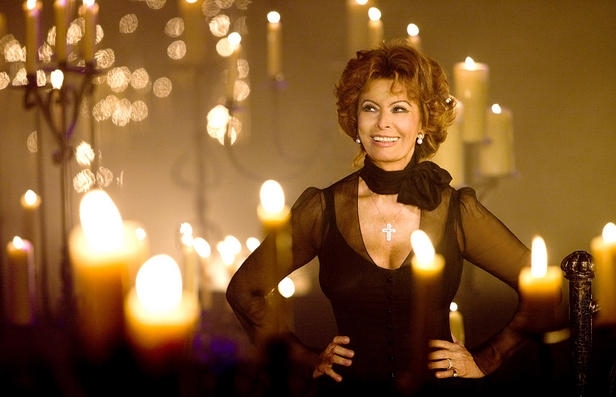
The mother: Sophia Loren – she used to be beautiful when she could move her face. Now she looks like a blow-up doll and it’s hard to act when you can’t form an expression. Their scene of Italian son’s obsession with his mama and the lullaby Guarda La Luna is mawkish in the extreme. Apparently it is her spirit to whom he is appealing as she is actually dead, which would explain the death mask and the wooden acting.

The muse: Nicole Kidman – ditto. When she removes the wig and says, ‘This is me’ I wanted her to put it back on immediately. She looks like something from Mars Attacks! and with similarly out-of-this-world acting, as in completely alien. Rumour has it that Catherine Zeta-Jones was originally cast in the role but pulled out when Rob Marshall refused to expand the role for the film. She made a wise decision, although he did not. If this character were more motivational (not to mention the fact that she could actually sing and dance) it would have been easier to understand her allure over Guido and his need for her. As it is the song, Unusual Way, is weak and insipid; more tepid than Trevi.

The mentor: Judi Dench – a perennial favourite. I saw her in Merry Wives; the Musical and she has a beautiful catch in her throat which, although she is far from a ‘great singer’ makes everything she sings sound emotional. Her song, Folies Bergères (Razzle Dazzle by any other name) wasn’t great, although it was an excuse to swan around with a feather boa and who wouldn’t want that? Her relationship to Guido is similar to M’s affectionate tolerance for Bond’s roguish ways, but the costumes are better. She has a wonderful speech about the role of a director and how little they actually do in pulling together a film.

The prostitute: Fergie – the other one who can sing. Her song, Be Italian, is the one song I remember and can still hum weeks after seeing the film. I loved the staging of it, with handfuls of sand being raked through fingers and flung across the set to create powerful visual effects. I spent the rest of the film wondering how I could incorporate that into a play and who would do all the sweeping up afterwards.

The fashion journalist: Kate Hudson – still the bubbly beautiful girl reprising her role in Almost Famous. Her song (Cinema Italiano) was written specifically for the movie (and it is unashamedly a movie, rather than a film) and sounds exactly like Buenos Aires from Evita – this could have been another opportunity to showcase the glamour of Italy and yet it is set on a catwalk and in a bar.