All’s Well That Ends Well at The Globe, London
First trip to The Globe of the year and probably not an obvious choice of play to go and see. All’s Well seems to be viewed as one of Shakespeare’s ‘problem plays’, but I am not sure I see the problem in the same way as I am meant to. The problem is meant to be that the main characters are a flawed bunch. While I agree that they are, another problem is the story. Some bits just don’t add up. Why would Diana give that lengthy performance in front of the King of France at the end and end up with being threatened with being thrown in jail? Is Bertram really so dim that he did not realise that the ring he is given was the one worn by Helena? How come he did not realise that the Italian he was in bed with had suddenly developed a French accent?
Putting aside my pedantry for a moment, this was a great performance. The only bad review I could find of it in the London press was from the Daily Telegraph. To me that means it is worth seeing, although worryingly the Daily Mail gave it a good review. I had no idea who any of the actors were in it, even though I should apparently know of Janie Dee who plays the Countess of Rousillon. I always think you are on safe ground with UK actors if you say you have seen them in The Bill or Casualty and move the conversation quickly on.
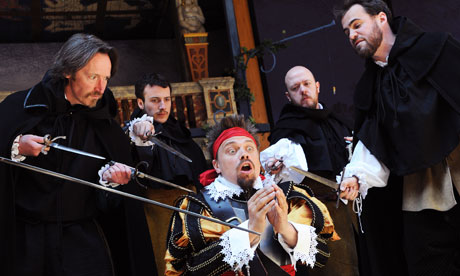
To me the star of the show was James Garnon’s Parolles. But with such great lines to deliver and playing the buffoon it’s probably hard to mess it up. Ellie Piercy as Helena was also great despite one reviewer calling her dull and drab. I might be biased though because I think I have a crush on her. I did have a bit of a problem with Sam Crane as Bertram. He looks very young and a bit like the Tory Chancellor George Osborne. Plus he was being very rude about the lovely Helena. I was tempted to ask him outside at one point but decided I would see him afterwards.
I feel a bit metrosexual about this next point but think I am going to make it anyway. The costumes were stunning. Usually when I watch Shakespeare acted out in Jacobean costumes, they are par for the course and unremarkable, but there really was something stunning about these ones. I could quite happily prance about in the King of France’s togs but doubt I would make it to the end of my street in one piece.
That’s all for now, I have a train to catch and work to pretend to do. Next up is Merchant of Venice at the revamped RSC theatre in Stratford.
Adieu... from Our Man in London
Showing posts with label Sam Crane. Show all posts
Monday, 23 May 2011
Thursday, 21 October 2010
Henry IV, Part One: Buzzing on the Banks of the Thames
Henry IV, Part One
Shakespeare’s Globe Theatre
July 8 – October 3, 2010
Dominic Dromgoole’s production of Henry IV, Part One at The Globe is sensitive and rambunctious; traditional and contemporary; and overall compelling viewing. It ranges from royalty to riff-raff; battlefields to brothels; city to countryside and high politics to low humour, and all of it is immensely entertaining.
The play examines the troubled relationship between sons and their fathers (both real and surrogate), and the nature of friendship as it alters with power, responsibility and age. Prince Hal has diametrically opposed father-figures, although he eventually rejects both of them, ‘breaking through the foul and ugly mists’ to emerge blazing as his own man.
I’ve always thought the part of Henry IV was a bit ineffective but Oliver Cotton delivers his conscience-wrestling quandary with dignity, sincerity and a great command of the language. On the other hand, there is the irrepressible Roger Allam as Falstaff. Falstaff is an unashamed scene stealer, milking every nuance to just the right extent, working his audience like a stand-up comedian so that we feel part of the show. He is morally reprehensible with a terrible attitude to life and impeccable comic timing. Whether he is exaggerating his part in a duel or delivering an in-depth and unfavourable analysis of honour – musing on philosophy as he casually devours a tub of ice-cream – he is a joy to witness.
The fact that Allam doesn’t dominate the entire play, however, is due to the comprehensive direction and the brilliance of the other characters. Jamie Parker has made me fall in love with Prince Hal and Henry IV, Part One all over again. From the moment he emerges from a trapdoor with his pants around his ankles and a twinkle in his eye, his conflict of self-interest is fantastic. The trading of insults with Falstaff is sublime: if only pub slanging matches were so witty. Hal maintains his irreverent sense of fun even as he matures before our eyes through the course of the play.
He can be noble and resolute and not afraid to shirk responsibility when it falls upon him. He knows what will be expected of him, and is itching to get down to the job. He mocks his father when he imitates him in a pub, but he defends him bravely in battle and foreshadows his steely rejection of Falstaff, ‘like bright metal on sullen ground’. The opposing natures of the young prince are both excellently explored. Will the real Prince Hal please stand up? I desperately want him to play Henry V – I’d follow him into a breach any time.
Hal also has to contend with Harry (Hotspur) Percy as a model of valour. Sam Crane indulges his fiery nature to provoke humour but also respect. He may be all-too prepared to fight for his beliefs, but at least he has some. Glendower (Sean Kearns) tries to restrain him with a steady hand and a mellifluous voice, but Hotspur remains tempestuous. He may be heated in battle, but lacks passion in his domestic relationships, much to the frustrated chagrin of his wife, Kate (Lorna Stuart). She behaves a little as though she is auditioning for The X-Factor and is too focussed on herself to interact with the others, although once again, you can hear every word that she intones.
The play (and its sequel) contain a good deal of principles and affairs of state, but the scenes are acted so well and spoken so clearly that you are never lost in the potential mire that could be English ‘War of the Roses’ history. Politics are given edge (literally) in sword fights and tavern scenes. The set, designed by Jonathan Fensom, incorporates rustic qualities as minimal touches elicit maximum effect. Heraldic banners hang from all the banisters and a simple backcloth unfurls to denote our locations, from the Boar’s Head tavern to the battle encampment or the King’s bedchamber. It is a delight and an honour to experience this production in its spiritual home.
It may be a traditional production in period dress but don’t be fooled into thinking it is sedate. It is infused with high energy from the riotous mummers’ performance at the beginning to the sardonic dance at the end which sends the audience out buzzing to the banks of the Thames. Music and singing enhances the play throughout with musicians augmenting the slick scene changes to ensure the action never flags.
Shakespeare’s Globe Theatre
July 8 – October 3, 2010
Dominic Dromgoole’s production of Henry IV, Part One at The Globe is sensitive and rambunctious; traditional and contemporary; and overall compelling viewing. It ranges from royalty to riff-raff; battlefields to brothels; city to countryside and high politics to low humour, and all of it is immensely entertaining.
The play examines the troubled relationship between sons and their fathers (both real and surrogate), and the nature of friendship as it alters with power, responsibility and age. Prince Hal has diametrically opposed father-figures, although he eventually rejects both of them, ‘breaking through the foul and ugly mists’ to emerge blazing as his own man.
I’ve always thought the part of Henry IV was a bit ineffective but Oliver Cotton delivers his conscience-wrestling quandary with dignity, sincerity and a great command of the language. On the other hand, there is the irrepressible Roger Allam as Falstaff. Falstaff is an unashamed scene stealer, milking every nuance to just the right extent, working his audience like a stand-up comedian so that we feel part of the show. He is morally reprehensible with a terrible attitude to life and impeccable comic timing. Whether he is exaggerating his part in a duel or delivering an in-depth and unfavourable analysis of honour – musing on philosophy as he casually devours a tub of ice-cream – he is a joy to witness.
The fact that Allam doesn’t dominate the entire play, however, is due to the comprehensive direction and the brilliance of the other characters. Jamie Parker has made me fall in love with Prince Hal and Henry IV, Part One all over again. From the moment he emerges from a trapdoor with his pants around his ankles and a twinkle in his eye, his conflict of self-interest is fantastic. The trading of insults with Falstaff is sublime: if only pub slanging matches were so witty. Hal maintains his irreverent sense of fun even as he matures before our eyes through the course of the play.
He can be noble and resolute and not afraid to shirk responsibility when it falls upon him. He knows what will be expected of him, and is itching to get down to the job. He mocks his father when he imitates him in a pub, but he defends him bravely in battle and foreshadows his steely rejection of Falstaff, ‘like bright metal on sullen ground’. The opposing natures of the young prince are both excellently explored. Will the real Prince Hal please stand up? I desperately want him to play Henry V – I’d follow him into a breach any time.
Hal also has to contend with Harry (Hotspur) Percy as a model of valour. Sam Crane indulges his fiery nature to provoke humour but also respect. He may be all-too prepared to fight for his beliefs, but at least he has some. Glendower (Sean Kearns) tries to restrain him with a steady hand and a mellifluous voice, but Hotspur remains tempestuous. He may be heated in battle, but lacks passion in his domestic relationships, much to the frustrated chagrin of his wife, Kate (Lorna Stuart). She behaves a little as though she is auditioning for The X-Factor and is too focussed on herself to interact with the others, although once again, you can hear every word that she intones.
The play (and its sequel) contain a good deal of principles and affairs of state, but the scenes are acted so well and spoken so clearly that you are never lost in the potential mire that could be English ‘War of the Roses’ history. Politics are given edge (literally) in sword fights and tavern scenes. The set, designed by Jonathan Fensom, incorporates rustic qualities as minimal touches elicit maximum effect. Heraldic banners hang from all the banisters and a simple backcloth unfurls to denote our locations, from the Boar’s Head tavern to the battle encampment or the King’s bedchamber. It is a delight and an honour to experience this production in its spiritual home.
It may be a traditional production in period dress but don’t be fooled into thinking it is sedate. It is infused with high energy from the riotous mummers’ performance at the beginning to the sardonic dance at the end which sends the audience out buzzing to the banks of the Thames. Music and singing enhances the play throughout with musicians augmenting the slick scene changes to ensure the action never flags.
Subscribe to:
Posts (Atom)


