Friday, 12 September 2014

Friday Five: Blooming Spring

The advent of spring brings blossom and flowers. They're pretty and colourful and brighten up the day, so I thought I'd share. 

5 Spring Blooms:

1. Golden wattle
2. Camellia
3. Hellebore
4. Tree Violets
5. Magnolia

Friday, 5 September 2014

Friday Five: TV Programmes

After the excitement of the World Cup, Tour de France and Commonwealth Games, my television viewing has hit a barren patch. There are, however, a few programmes that I will make an effort to watch.

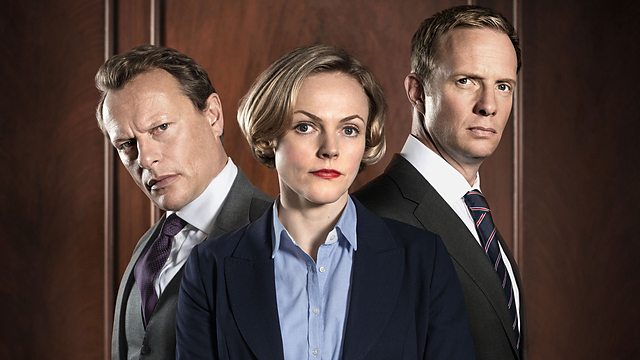
Neil Stuke, Maxine Peake and Rupert Penry-Jones in Silk
Five Programmes I'm Watching:
  1. Silk - created by Peter Moffat and starring Maxine Peake, Rupert Penry-Jones and Neil Stuke, this is season three of the adventures of the barristers and clerks of Shoe Lane Chambers. Each episode is a self-contained piece of drama with some fine acting and larger themes of justice and morality.
  2. Dr Who - He's back and he's Peter Capaldi. I'm still not impressed with Jenna Coleman's Clara companion, and the signs show no indication that she might fade back into the role of assistant rather than trying to take over. The Doctor, however, has a little more of the edgy madness and less of the cuddly doofus aspect that was threatening to spoil the franchise, so I'm prepared to give it time. (Do you see what I did there?)
  3. Utopia - a sort of Australian version of The Thick of It. It's not quite as classy, but office politics and government departments are such rich comedy seams to mine that there are still plenty of nuggets to polish.
  4. The Book Club / At the Movies  - personable people having intelligent discussions and reviewing stuff that interests me (i.e. books and films).
  5. The Project / Have You Been Paying Attention? - information and questions about current affairs both portrayed in a lighthearted manner, or, as they say themselves, 'It's news delivered differently'.
Peter Capaldi as Doctor Who

Monday, 1 September 2014

Random Dialogue: Theology Debate

The Temptation by William Strang
At home with the Blackhursts. This week: theology.

Me: I read recently that the word Paradise comes from the Old Persian, pairidaeza meaning 'walled garden' and the writer questioned whether the wall was to keep people in or out. But I think the question should be why a wall is required at all.
Him: To keep the bad stuff out.
Me: What bad stuff? It's Paradise!
Him: The snakes.
Me: The snake wasn't necessarily bad.
Him: Yes, he was. He bit them.
Me: No he didn't.
Him: He bit the apple.
Me: No he didn't.
Him: Well, there was a snake and there was an apple. And someone bit the apple, and they all got kicked out.
Me: Eve bit the apple.
Him: That's right, and the snake made her.
Me: Well, the snake suggested it, but she chose to do it.
Him: Well, there you are then. It was a bad snake and so there was a wall to keep it out.
Me: Snakes can slither up walls, can't they?
Him: No, they can only do trees, because they can wrap themselves around the trunk.
Me: What if it's just a small wall?
Him: What, like Hadrian's Wall?
Me: Yes, ok, if you like.
Him: No, I don't like, because Hadrian wasn't in Paradise, so he wouldn't have built a wall.
Me: Well, someone did; if Paradise means 'walled garden', there must have been a wall, so who built it, and why?
Him: God knows.
Me: Quite.

Friday, 29 August 2014

Friday Five: Books at Bedtime


I have many books on the pile by my bed. Here are some of them.

5 Books I'm Reading:
  1. The Letters of Noel Coward edited and with commentary by Barry Day - as research. I'm also reading the collected plays and his diaries. There's a good deal of material there.
  2. King Arthur: The Bloody Cup by M.K. Hume - it's part three of a trilogy which is adequate rather than brilliant but I am both obsessed by all things Arthurian and unable to finish something midway through.
  3. The Quincunx: A Novel by Charles Palliser - recommended to me by a friend as, 'one of the best books I've ever read'. No pressure there, then.
  4. The Second Sex  by Simone de Beauvoir - I read it ages ago and wonder if it is still as relevant.
  5. Carthage by Joyce Carol Oates - some light relief, if that's what you consider tales of loss, grief and the atrocities of war to be.

Tuesday, 26 August 2014

Blind Lines

In the morning when the sun slants through the blinds to cast shadows in my bedroom, I feel as though Gordon Walters has painted my wall.

Modern abstract design by Gordon Walters

Friday, 22 August 2014

Friday Five: Screen Adaptations

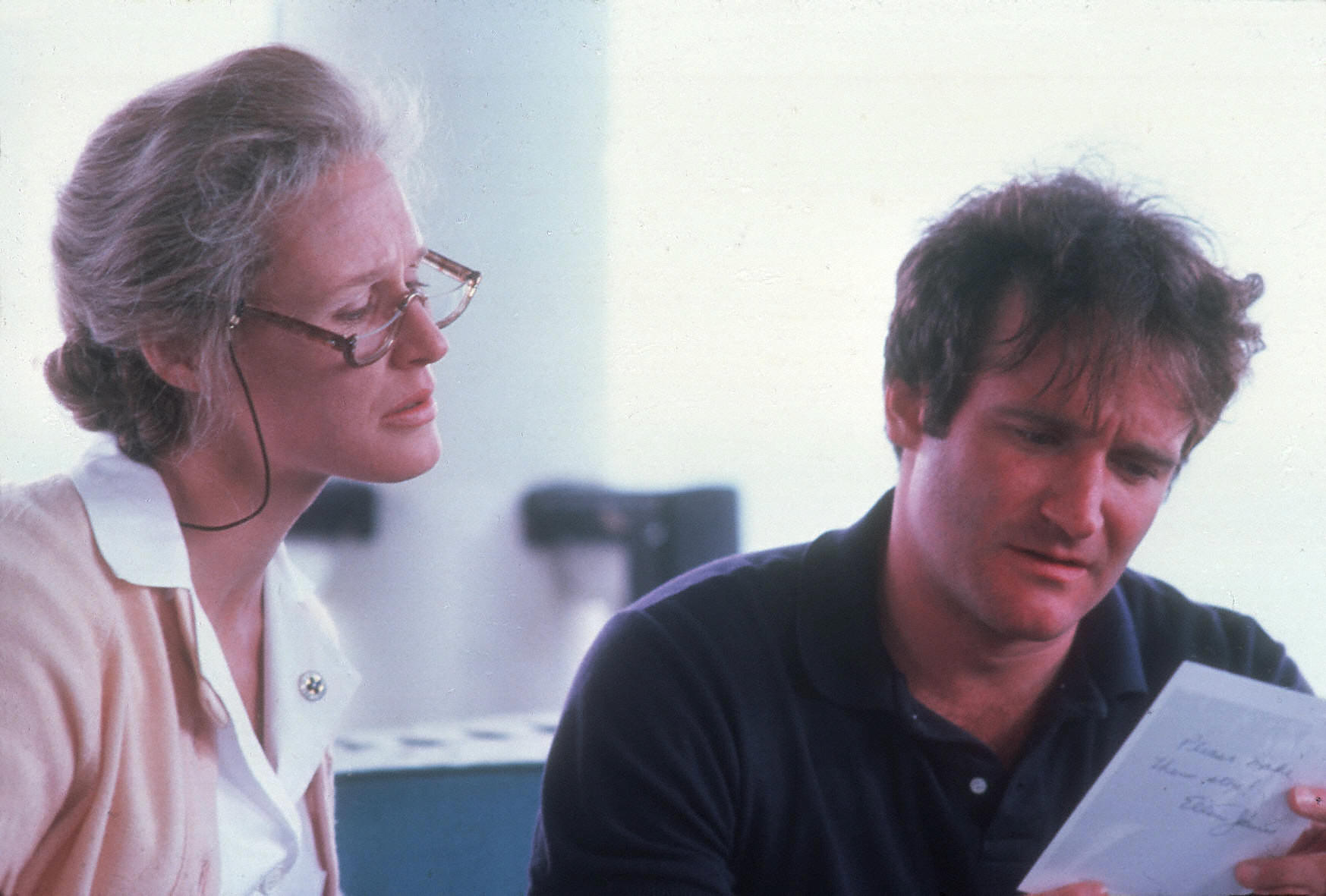
Glenn Close and Robin Williams in The World According to Garp
In all the obituaries afforded Robin Williams and the reviews of his eclectic body of work, I have only once seen a reference to what I consider to be his best film: The World According to Garp. Released in 1982, this was also the debut for Glenn Close and it was a stylish film which left a lasting impression, not least because it was excellent adaptation of a brilliant novel.

It doesn't always work that way. In fact, it very often doesn't. Recently, the film of Life of Pi was a great disappointment, as the novel is one of the best I have read, and the less said about Baz Luhrmann's The Great Gatsby the better. Conversely, Silver Linings Playbook was a very good film although a bit of a shambolic mess as a novel, and Anthony Minghella's The English Patient made a sweeping sentimental saga out of Michael Ondaatje's pretentiously tedious novel.

I finally got round to reading Gone with the Wind earlier this year and I thought it was fantastic, but I have yet to see the film (I will never first see a film if I want to read the book on which it's based) so I can't add that to my list. Because this list is only meant to add up to five, I have got many honourable mentions, such as Trainspotting, which launched careers (Danny Boyle; Ewan McGregor; Robert Carlyle) and brought a raw potency to Irvine Welsh's words, but I didn't like the addition of the female character as a (under-aged) sex interest, which I felt was unnecessary and made me uneasy about exactly to whom this was meant to appeal.

Both One Flew Over the Cuckoo's Nest and To Kill a Mockingbird are excellent adaptations of seriously good novels in the classic American tradition. Stanley Kubrick's version of A Clockwork Orange was challenging and confronting in a way that mirrored Anthony Burgess' dark dystopian vision, although Burgess was unhappy with the altered ending. 

Sam Mendes directs Kate Winslet and Leonardo DiCaprio to give outstanding performances in Revolutionary Road, but it doesn't quite make the cut because Richard Yates' heart-rending book is even better. And a special mention has to go 1984, with superb performances from John Hurt, Richard Hamilton and Suzanna Hamilton, and a sensational Eurythmics-driven soundtrack. But good as this film is, it is not in my top ten, whereas the novel most certainly is.
Kate Winslet and Emma Thompson in Sense and Sensibility
  1. Sense and Sensibility (1995) - Emma Thompson (who wrote the screenplay), Kate Winslet, Hugh Grant and Alan Rickman star in this classy, funny and lively version of Jane Austen's classic. The nineteen-year old character of Elinor Dashwood was changed to twenty-seven to make it more realistic, both that modern audiences would recognise a spinster and that the thirty-five-year old Thompson could get away with playing her. It works. Supporting cast includes Robert Hardy, Tom Wilkinson, Hugh Laurie, Harriet Walter, Imelda Staunton, and Imogen Stubbs amongst others.
  2. The Color Purple (1985) - Steven Spielberg directed Alice Walker's ground-breaking novel in a film that doesn't just join the dots, but addresses the issues of racism, sexism, poverty and abuse in a whole new manner. Again the soundtrack is exceptional. The film was nominated for eleven Academy Awards including best picture, best actress (Whoopi Goldberg), best supporting actress (Margaret Avery and Oprah Winfrey) and best music - it didn't win any, equalling the unenviable record for most Oscar nominations without a win.
  3. Misery (1990) - Steven Kings's books make fabulous films (several critics rave about The Shining, Carrie, and Psycho) and this one is a stand-out. James Caan and Kathy Bates are perfectly imperfect together, and the hobbling scene is simply unforgettable. Director Rob Reiner ratchets up the tension and gives us a crazed fan and a psychotic nurse rolled into one. It's deliciously intense and conceptually terrifying.
  4. Tristram Shandy: A Cock and Bull Story (2005) - If you want a director to make an impossible film (Laurence Sterne's literary masterpiece The Life and Opinions of Tristram Shandy, Gentleman is considered uncinematic) you call in Michael Winterbottom. If he wants actors to play multi-layered personas with warmth, wit and deceptive levity, he calls in Rob Brydon and Steve Coogan. This self-referential film is funny, clever and outstandingly entertaining. 
  5. A Room with a View (1985) - There aren't enough superlatives for the direction (James Ivory), the acting (Helena Bonham Carter, Maggie Smith, Daniel Day-Lewis, Julian Sands, Simon Callow, Judi Dench, Rupert Graves), the adaptation (Ruth Prawer Jhabvala), the scenery (Florence and Kent), the production values (Ismail Merchant) and the glorious respect displayed for the story by all involved. They've all done E.M. Forster proud.
Julian Sands and Helena Bonham Carter in A Room with a View

Monday, 18 August 2014

Hilda Rix Nicholas: Paris to Monaro

Paris to Monaro: Pleasures from the studio of Hilda Rix Nicholas
National Portrait Gallery (May - August 2013)

Pied Piper (1911)
Hilda Rix Nicholas is known for many things in the world of art, not least her war paintings. These are deliberately excluded from this exhibition which focuses on her standing as a ‘female’ artist. It highlights her imagination linked with a practical mind, resulting in intricate costume designs, images of her son in every possible guise, and a love of colour and clothing.

Born in Ballarat in 1884, Emily Hilda Rix left Australia in 1907 and travelled with her mother and sister to London. She studied at the New Art School and then the Académie Delecluse in Paris. With her sister, Elsie, she spent time in Tangier, Morocco, where she made many striking portraits and sketches, reflecting her love of light and vibrancy. One of these paintings, Grand Marché, Tanger, was bought by the French government after an exhibition.

Marchands du charbons de bois (Charcoal sellers) (1912)

The Well in the Blue, Arab Quarters (1914)
In 1916 she met and married Australian soldier, Major George Matson Nicholas DSO. He died within weeks leading a battalion in France. She drew charcoal and pastel on paper portraits of George and his two brothers, Frank and Athol; the one of her husband is particularly remarkable and the catalogue notes that the brothers evoke the Australian soldier of legend; “raffish, iconoclastic, and proud all at once”.
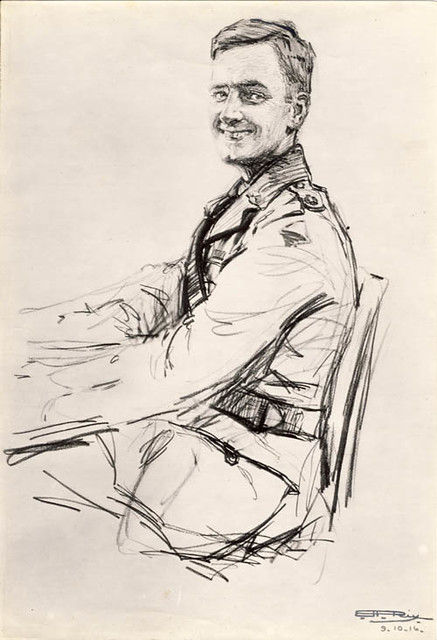
George Nicholas (1916)


Also during the First World War, she lost her sister and mother to typhoid fever. With amazing positivity, she continued to design and draw costumes for a matinee fundraiser for the Anzac Club and Buffet in 1917 – the exhibition includes her designs for magpie, wool, cheese, gold, gum blossom and warratah.

Hilda Rix Nicholas (as she now signed her paintings) returned to Australia in 1918 and settled in Mosman by Sydney Harbour, where she lived among ‘arty-party-loving people’. She made costumes for parties and illustrations for fairytales – Mary Mary; Simple Simon; Jack and Jill; Little Miss Muffet; Mother Hubbard; Pied Piper etc.

In 1928 she married Edgar Wright, grandson of James Wright – first magistrate of Queanbeyan and pioneer white settler of Lanyon, Cuppacumbalong and Booroomba in the Canberra region. Edgar was severely injured at Passchendaele (buried in the earth by one blast and regurgitated by another explosion). He was repatriated and took over the family farm. The Fleece is a fabulous study of her husband Edgar as he goes about his business.


The Fleece (1944)
On her travels to Europe, Hilda Rix Nicholas was determined to show viewers the virtues of the bush and pioneer life, following in the tradition of the Heidelberg School and writers such as Henry Lawson and Banjo Patterson. Her portraits of men and women of the land capture an earnest respect for hard work and rugged beauty.
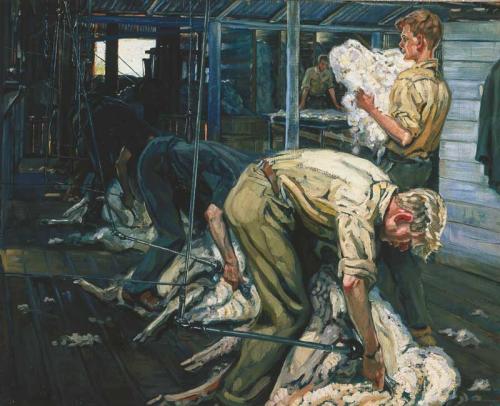
The Shearers (1922-23)
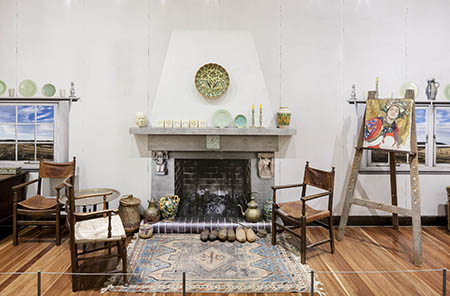
At Knockalong, Hilda Rix Nicholas had a studio built to her specifications, which was completed in 1930. It was French provincial in style with a broad mediaeval-style fireplace, huge windows, soaring ceiling, a loft and a stage. It is recreated in this exhibition and furnished with mementoes from foreign lands: robes, clogs, vests, bags, belts, rugs, slippers, pots and plates, and paintings.  


It is a treat to see these artefacts collected here, along with the pictorial representations of them. Among the clothes which she loved and collected in a trunk, are a Chinese robe and Spanish shawl that she painted with a meticulous eye to the expansive colours and design. 

When she was 46, Hilda had a son, Rix, who became the focus of her life. She loved to tell him stories and play games with him, making wire and wadding minikins for their entertainment. She made portraits of Rix in every aspect of life: as a soldier, scout and shepherd among other things.
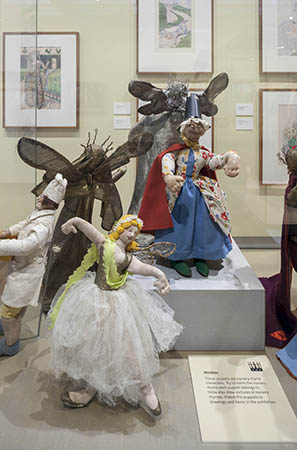
Some of the minikins Hilda made for her son, Rix
The Shepherd of Knockalong (1933)

She loved her garden and the natural surrounds, painting them with bright blue skies and Pissaro/ Cezanne-like colours. The style may evoke French Impressionism, but the eucalypts are pure Australia.


Spring in my garden, Knockalong (1940)


Country Garden, Knockalong (1945)
Hilda always loved horses and riding, and many of her paintings feature Rix’s governess and jillaroos as models.

Bringing in the Sheep (1936)
The Fair Musterer (1935)
A neighbour described Autumn evening’s golden glow as combining Hilda’s favourite subjects: humans, horses, flower garden and the Monaro landscape brought together on one large, joyously vivid canvas.


Autumn evening's golden glow (1935)