The 5th National Indigenous Art Triennial: After the Rain features ten large-scale, immersive and multidisciplinary installations that celebrate intergenerational legacies and cultural warriors of the past, present and future. The works, commissioned by established and emerging First Nations artists from across Australia, create an important platform for art and ideas.
The artistic director, Tony Albert, Girramy/ Yidinji/ Kuku-Yalanji peoples, has brought together projects which resonate with ideas about rebirth and cycles and cleansing. Following its presentation in Canberra, the exhibition will tour nationally.

On the approach to the gallery itself, the walls are covered with what looks like monochrome street art. This is a major new mural by Aretha Brown (Gumbaynggirr people) titled The Birth of a Nation: The True History of Australia. Brown's ongoing The Teach Blak History Project includes "large-scale public murals, performance and merchandise that seek to foster awareness and real change through conversation and self-reflection". She describes herself as a young, queer, Blak artist and says her practice is "grounded in truth-telling and celebrates First Nations history, knowledge and empowerment".


"Our Gumbaynggirr line work is very distinct. We don't have dots in our community, we use line markings and scar etchings. I consider rock art to be public art and so what I am doing as a street artist is nothing new, I've just changed the medium. Aboriginal people, especially women, have been making public art since the dawn of time." - Aretha Brown


The next room is full of red, white and black, and tells a story. It draws the audience in, questioning meaning as there are two characters in a large space. As the viewer walks through the installation they are invited to respond, surrounded by hanging sculpture, which represent flying foxes.
Alair Pambegan (Wik-Mungkan people) continues his ancestors' traditions with innovative sculptures that use the distinctive red, white and black ochre from his Country in Cape York Peninsula. Pambegan is custodian for Kalben-aw, a significant ancestral narrative and story place along the Archer River that is connected to the creation of the Milky Way.
Kalben-aw story place of Wuku and Mukam the flying fox brothers is the artist's most ambitious installation to date including over 500 suspended flying foxes, and honours the legacy of his father, reverend lawman, elder and artist, Arthur Koo'eeka Pambegan Jr (1936-2010), who was featured in the 1st National Indigenous Art Triennial: Culture Warriors.


"Two young men, they broke the law. Aboriginal law. They said to themselves: look, early tomorrow morning we'll be going somewhere, don't listen to the Elders. So they did, first light in the morning while everyone else sleeping, they went off, went away... They killing more than might be two or three hundred flying foxes... So they picked them up and put them in the oven and they went to have a sleep... From then, all the flying foxes, still at the mangroves, they circling round and round and round and came back down to the two young fellas... took those two young fellas up and they never came back and they turned into flying foxes." - Arthur Koo'ekka Pambegan Jnr., Wik-Waya/ Chaa-Ngkoth/ Wik-Mungkan/ Winchanam peoples


The artwork in the next room is equally striking, in a different way. It is dimly lit and features an arrangement of gurneys, with images projected onto them of people and patterns. This is Warraba Weatherall's Mother-Tongue, which examines the profound relationship between body and land, and the parallels between cultural suppression and environmental destruction.
Culture and Country are interconnected forms of knowledge, memory, and care that require active maintenance to thrive. This is embedded in Kamilaroi language that shares words between the anatomy of the body and that of a tree. Mother-Tongue elaborates on how land, cultural knowledge and bodily experience form an interconnected system, and in this darkened space the viewer is invited to recognise their position and consider their responsibilities toward cultural and environmental sustainability.
"In Kamilaroi language. 'Yuru' is the word used for both rain and cloud, although more commonly used today is the word, 'Galibaraay'. rain promotes regrowth and new growth and brings out a lot fo the animal. It restores a bit of life and vibrancy. In one word, After the Rain is renewal." - Warraba Weatherall


"From a Kamilaroi perspective, our anatomy mirrors that of a tree - legs as a trunk, arms as branches, and tongues as leaves. The mother-tongue we inherit shapes our worldview, yet this inheritance has been complicated by histories of forced assimilation and systemic suppression." - Warraba Weatherall, Kamilaroi people

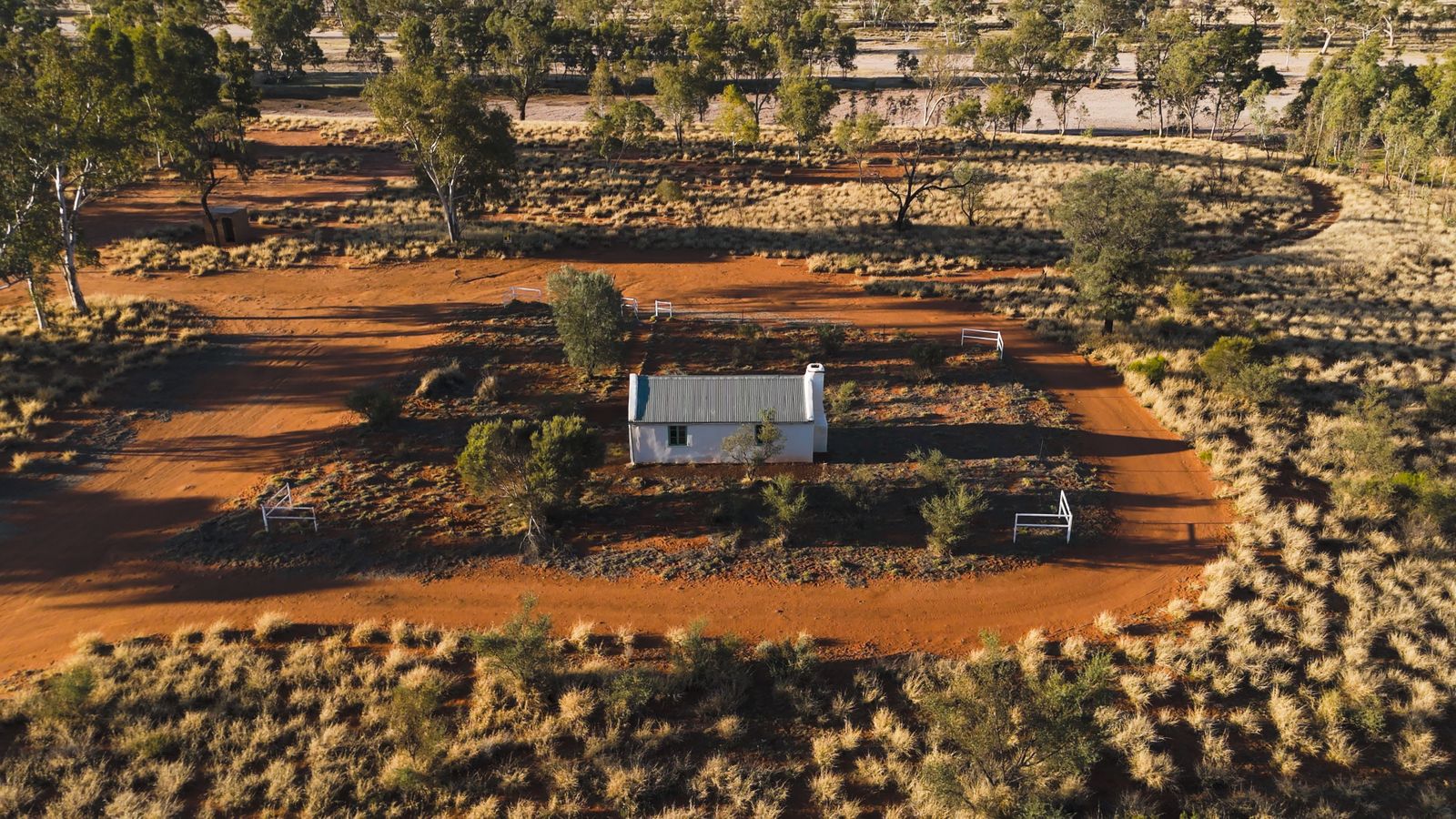
In the early 1940s, on the banks of Lhara Pinta/ Finke River in Central Australia, Albert Namatjira built a home for his family using materials procured from the sale of his watercolour paintings. Made from local sandstone and lime with an iron roof, this sturdy two-room house stands today on the outskirts of Ntaria/ Hermannsburg, Namatjira's hometown and Country.
Throughout the 1940s, when he was not travelling to paint, Namatjira lived here with his family establishing a home and garden. This was a decade of great experimentation for Namatjira. His work was recognised nationally with the monograph The art of Albert Namatjira selling roughly 20,000 copies; the short colour film Namatjira the painter was released in 1947.
Today, Namatjira's artistic ambition, excellence and vision for his family endure in the generations of artists who have followed him. This multi-generational multidisciplinary installation House of Namatjira brings together 57 artists from Albert Namatjira's family and community including artists from Hermannsburg Potters, Iltja Ntjarra Art Centre, and his great-grandson, Vincent Namatjira from Iwantja Arts.


"After the rain makes me feel more refreshing, like I wanna be more new, powerful and spiritual. It also makes me feel cleansed. It rains maybe four times a year in Indulkana where I live and have my studio. The rain here refreshes Country. It gives good smell over the whole land and even washes away negativity and bad feelings." - Vincent Namatijira, Western Aranda people
The multi-generational salon hang presented in the room features 41 artists from Albert Namatijira's family and Ntaria/Hermannsburg Community. It spans more than 70 years of artistic practice. Many draw attention to issues affecting their Community including homelessness and environmental destruction caused by mining.


"I've inherited history and story from my family. When you go out Country visiting, you think of what your family told you, and you think about the children and the next generation and passing on that knowledge. The old ladies inspire me." - Beth Mbitjana Inkamala, Western Aranda people, Hermannsburg Potters


Award-winning artist, Rex Battarbee, formed a historic artistic partnership with Albert Namatjira that launched the Hermannsburg School of watercolourists after vising the Ntaria (Hermannsburg) Mission in Central Australia in 1934 and teaching Namatjira the Western techniques of light, shade, and perspective, revolutionising Australian art. In a letter to Rex Battarbee in March 1940, Albert Namatjira writes,
'…please one more question about my son. he got one paint box. please send some cheap paper so he can learn just like that I had before. All my familis [sic] thank you very well to thank you very much. Your friend Mr. Albert Namatjira'
 |
| Royal Albert by Vincent Namatijira (2005) |

 |
| Mission Days: Vincent Namatijira's ute and Rex Batterby by Irene M Entata (2010) |


Dylan Mooney's Resilience in Bloom is an unabashed celebration of queer love among people of colour, as he shares stories of resilience, connection and love in his highly colourful and decorated portraits of First Nation peoples. Large scale banners adorn the gallery walls featuring Mooney's portraits of couple embraced and entwined in vibrant Country. In these detailed images droplets of water appear as glistening jewels, sweat and tears, revealing how the personal and political are combined.
Legally blind, Mooney works primarily with digital technology, backlit screens enable him to create complex images that can be reproduced on paper, canvas, or multi-storey buildings. His images are informed by community stories and current affairs and share a deep optimism and pride.


"I've inherited from my family a lot of cultural knowledge, stories and history. I bring these stories into my contemporary art practice, telling them in my ways. I want to convey the stories that have been passed down and continue that on for future generations. That passing on of cultural knowledge and family information is very important to being a Blakfulla" - Dylan Mooney, Yuwi people, Zenadth Kes/ Torres Strait and South Sea Islander

"For me, After the Rain means sunshine, beautiful days and that there is good to come. It is joyfulness, celebration and pride." - Dylan Mooney

Together, these works form an urgent call to action - a cry to adopt practices that embrace the preservation of our environment. First Nations people are among the least responsible for human-made climate change, yet the first to feel its effects.
"Growing up and being raised as a fisherman, I have seen huge differences in our reef and surrounding environment. These have and will continue to impact the way we hunt if we do not do something about it today. We need to do something now for our future generations." - Jimmy John Thaiday, Kuz/ Peiudu peoples

Naminapu Maymuru-White's Milniyawuy (Milky Way) invites viewers into deep time, sharing the artist's Yolnu perspective of the universe from her Mangalili homeland, Djarrakpi, on the western side of the Gulf of Carpentaria. For Mangalili people, Milniyawuy has a dual reference as the mayan (river) of stars that crosses the night sky in the Milky Way and the mayan on earth that flows out into Blue Mud Bay. Featuring major bark paintings held in the national collection and exhibited for the first time in Kamberri/ Canberra, the exhibition invites audiences to slow down and be immersed in Yolnu ways of being and understanding that have existed in this continent since the first star shone in the sky.


"My father Nanyin's younger brother Narritjin who I also call malu (father) took a special interest in me and encouraged me to become an artist. My two fathers wished this life for me. They wanted me to keep the culture alive through our art. They taught me everything that I needed to know. They handed me the brush and said 'You have to do this. Continue. Teach your children.'" - Naminapu Maymuru-White, Mangalili people
 |
| Beautiful Ulkumanu (old woman) by the Yarrenyty Arltere Artists |
Yarrenty Arltere Artists work together to create unique soft sculptures and invigorate their town camp Community at the base of Alhekulyele/ Mount Gillen in Mparntwe/ Alice Springs. For more than two decades, the artists have gathered daily to make art and share wisdom and skills. Their practice is grounded in Country and inspired by their family and kinship relationships, which connect them to the Namatjira and Perkins families.


"Standing with that good feeling in her stomach for what is going to grow and come and be re-born. She is standing strong, watching and waiting. Beautiful Ilkumanu walked a long time on her Country, seeing many days coming and going, some were good and some were really bad. But after the rain she stood there waiting and watching, to see what would come up. She saw all the bush foods and flowers and ngkurlpa (native tobacco) grow up and cover her all over, and she was so beautiful, and she was so happy. Some people cry for ngkurlpa but not this Ulkuman, she can just pick it whenever she wants, that is her lucky gift for her for all her years doing all the work, looking after Country, looking after family. Beautiful Ulkumanu becoming Country after the rain with that easy happy feeling." - Yarrenyty Arltere Artists
 |
| Rise 2 by Thea Anamara Perkins |
Thea Anamara Perkins' dynamic storytelling draws from her deep observation of the world around her. Her paintings express the love and strength in First Nations families and situate the joy and belonging found there within our collective imagination. Perkins' practice asserts resilience and refutes the misrepresentation of Aboriginal people.
Still I Rise references the spirit of unwavering perseverance expressed in the poem of the same name by African American civil rights activist Maya Angelou. It echoes the famous quote of Perkins' maternal grandfather, Aboriginal rights campaigner Charles Perkins: 'We know we cannot live in the past, but the past lives in us."
"After the rain there is a feeling of release that also has a celebratory quality. The soils and the air feel charged and enriched and there is a lovely feeling of possibility." - Thea Anamara Perkins, Arrernte/ Kalkadoon peoples


"In town it's hot, but after the rain it feels cool. We love rain because if it don't come for a long, long time it isn't good. Through the hotness we drink a lot of water and feel hot. Kwatja is water and rain. After the rain we feel fresh. When the rain comes we clap, we get happy. Country gets really green after rain, there's all them animals out looking for food." - Marlene Rubuntja, Yarrenyty Arltere Artists

At the conclusion of the exhibition, and on behalf of all After the Rain artists, Yarrenyty Arltere Artists invite visitors to participate in a ceremonial cleansing practice. As Artistic Director Tony Albert explains, this practice allows visitors to reflect on the journey they have undertaken, to hold onto the stories they have learnt, but also not be held down by this knowledge.


On leaving the exhibition space, there was a supplementary exhibition, ALWAYS Remember the Rain, a contemporary lifestyle presentation of First Nations design, fashion and art conceived and produced by Blaklash, a design studio and social impact enterprise led by partners Amanda Hayman and Troy Casey.
The project celebrates Blak excellence and offers a space for reflection, relaxation and renewal. Featuring art, fashion and a new furniture range, ALWAYS remember the rain is an expression of Blaklash's core philosophy that 'it always starts with Country'.


"I think of water as a connector. It connects the land, sea and sky, but also people. When rain falls, droplets connect to create puddles, streams and even rivers. Like water, if we can come together, we can make waves." - Amanda Hayman, Kalkadoon/ Wakka Wakka peoples


"Relationships are about creating reciprocal benefits, looking out and supporting one another, and ensuring that an opportunity for me is an opportunity for us. As practitioners, we must give back to the Community that we are a part of." - Troy Casey, Kamilaroi people

No comments:
Post a Comment