Showing posts with label Alexander McCall Smith. Show all posts

Friday, 6 March 2026

Friday Five: Books Read in February

  1. The Deep Blue Sea by Terrence Rattigan (Nick Hern Books) - A very fine play set over the course of a day in a shabby London flat in the 1950s. The play begins with the discovery of Hester by her neighbours and landlady after she has failed in an attempt to take her own life by gassing herself. It soon becomes apparent that the source of her anguish is her relationship with Freddie, a former RAF pilot, who cannot love her as she wishes to be loved. Her husband, Sir William, a respectable judge, is reluctant to grant her a divorce on the grounds that he now cares for her more than ever. But is it enough or is it just because she is "simply a prized possession that has now become more prized for having been stolen."? While others tip-toe around her predicament, it is the straight-talking struck-off doctor, Mr Miller from upstairs, who is able to force her to face reality. The play is a great expose of social mores across ever-widening chasms of class and culture.  
  2. The Wife and the Widow by Christian White (Affirm Press) - A well-written, suspensful and engaging novel with plenty of intrigue that examines the consequences of hiding feelings and burying emotions. When Kate's husband, John, dies, part of her grieving process is to return to their holiday home on a fiction island (which seems remarkably like Bruny Island), that "represented a cold exclamation mark at the end of a sentence." As the title suggests, there is another viewpoint from which the story is narrated, that of Abby, the wife, with husband Ray. There is of course the secret life aspect that is no surprise when it surfaces, some aspects of the novel are unoriginal and over-explained, and it’s difficult to tell whether the occasional gender-reductive viewpoint is that of the character or the author, or both. Overall, however, sharp writing, original similes and colloquial appeal make this an intense and compelling thriller which is hugely readable and atmospheric.
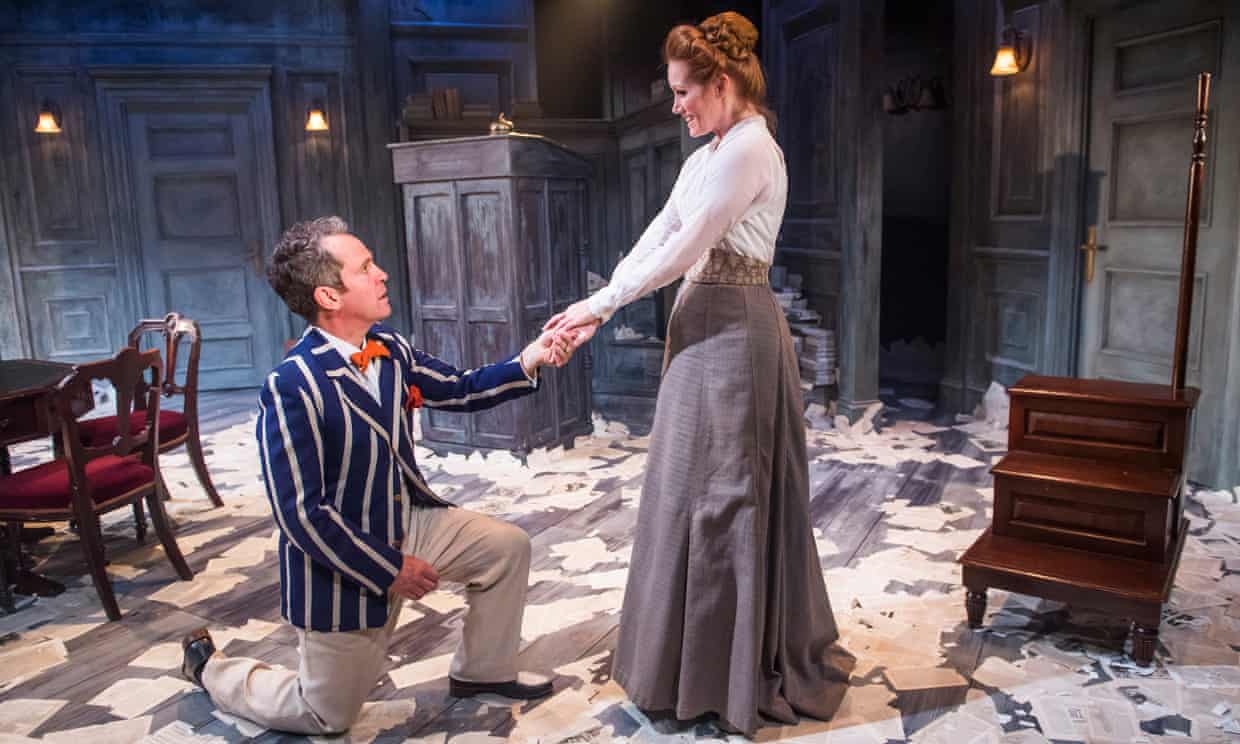
  3. Tom Hollander as Henry Carr and Clare Foster as Cecily in Travesties, directed by Patrick Marber in 2016
  4. Travesties by Tom Stoppard (Faber) - The characters in this sublime play include Tristan Tzara (Dadaist who wears a monocle), James Joyce, Lenin, and Henry Carr – based on a real character from history who performed in The Importance of Being Ernest, directed by Joyce when they all live in Zurich. Carr then sued and was counter-sued by Joyce over nonpayment of tailor’s bills due to Carr’s insistence on wearing sartorially elegant trousers for the production, and Joyce believing he had not been reimbursed for ticket sales. This is mentioned in a minor footnote in Ulysses, and Stoppard picked it up and turned it into a play. In much the same way as in Rosencrantz and Guildenstern are Dead, the characters of Gwendolyn and Cecily from Ernest come to the fore, and in similar fashion to Arcadia, time and place overlap – like a derailed toy train that must be set back on its rails – this is also in part due to Henry Carr being old and senile (we see Old and Young Carr, both played by the same actor), and an entirely unreliable narrator – he may not even have been the consulate he believes he was/is. There are so many layers of understanding and allusion – recycling and reappearing like the Dadaist anti-structure which removes meaning, context and cause – that it needs to be read and deserves to be seen.
  5. The Good Husband of Zebra Drive by Alexander McCall Smith (Abacus) - As with all the novels in the No. 1 Ladies' Detective Agency series (this is the eighth), the crimes themselves - a person stealing stationary supplies, three suspicious deaths in a hospital at the same time in the same bed - are secondary to the characters, their development (or otherwise) and relationships to each other. Mma Makutsi is greatly looking forward to her future life with her fiancĂ©, and she bridles at her apparent lack of authority with Mma Ramotswe. Meanwhile, Mr J. L. B. Matekoni is bored with his job and asks to take on some detective work. He lands the role of investigating for Mma Botumile, who suspects her husband is having an affair. She is the “rudest woman in the whole of Botswana” so he wouldn’t be surprised, although he tells himself he must not judge. He asks what car her husband drives so he can follow him after work and see where he goes, but she only tells him it is a red car, which horrifies him – how can she not know the make and model? Of course, he follows a different red car and investigates the wrong man. Charlie, the apprentice, buys a Mercedes Benz and leaves Mr J. L. B. Matekoni’s garage to become a taxi driver. He is distracted by dreams of greatness and girls, and his fledgling business fails to launch. And, once again, we return to the comforting bush wisdom of Mma Ramotswe, who believes that women make better detectives because they observe more detail and have natural intuition. “There was room in this world, Mma Ramotswe thought, for things done by men and things done by women; sometimes men could do the things done by women, sometimes not. And vice versa, of course."
Friday, 10 May 2013

Friday Five: Merry Murders


As part of my research into the role I am playing in Agatha Christie's The Hollow, (Tempo Theatre, May 17-25), I have been reading lots of murder mysteries. Not the gory forensic ones or the grisly serial killer twisted psychopathic ones (often set in Scandinavia and clearly doing wonders for those country's tourism boards) but the ones set in country houses (or, disturbingly, theatres) where everything is very jolly and people gather patiently at the end to learn whodunit from the brilliant detective.

There's always an assortment of folk with motives and alibis - everyone is a suspect except (although not always excluded from the list) the victim. When the person has been murdered, there is never any real grief or emotion; just a curiosity as to the perpetrator. And all ends are neatly tied up with a pleasant reassurance.

Some people inherit or even get married and it's all happily ever after - except, of course, for the victim and the murderer who either gets meekly led away to face justice (they never get off on a technicality) or conveniently kills themself, thus sparing everyone else the trouble of a trial. Lovely!

5 Murder Mysteries I've Recently Read:
  1. The Hollow/ Three Act Tragedy/ The Seven Dials Mystery - Agatha Christie. Classics.
  2. Death at the Dolphin/ A Man Lay Dead - Ngaio Marsh. Not the most pleasant of detectives in Roderick Alleyn, but he always gets his man, or woman.
  3. The Full Cupboard of Life - Alexander McCall Smith. The fifth in the No 1 Ladies' Detecive Series. I've read the others and enjoyed them, so this was really just an excuse. There is barely any detection but quite a lot of bush psychology and tea-drinking.
  4. The Murder Room - P.D. James. A modern-ish take on the genre and there is a serial killer, but the other stuff is all present and correct.
  5. Gaudy Night - Dorothy L Sayers. A murder mystery without a murder. Curious. But it's set in Oxford so one should expect high-brow existentialism.

Monday, 16 July 2012

Books read in March 2012

The following are short reviews of the books that I read in March 2012. The marks I have given them in the brackets are out of five.
 
The 10pm Question – Kate de Goldi (3.9)

Frankie’s mother doesn’t leave the house because she suffers from depression. Is it hereditary? This is one of the many things that Frankie worries about, but is unable to ask her with all his other questions, which he poses each night at 10pm before he goes to bed. Frankie seems to be a normal, inquisitive 12-year-old boy. His aunties come to visit regularly; he leads a terribly active life playing cricket and taking lessons for everything from trampoline to trumpet; he has a cat with the fabulous name of The Fat Controller, a big brother, Louie, and sister, Gordana, with whom he has the usual sibling spats, and a best friend, Gigs, with whom he shares a secret vocabulary named Chilun.

Frankie worries about almost everything and mentally recites lists to keep calm and stop him worrying. He likes order and routine. And then he meets a new friend, Sydney (her sisters are called Galway and Calcutta), a girl who has lived everywhere, can play cricket, and asks even more questions than he does. He enjoys her company and, despite guilt that he may be disloyal to Gigs, shares his secrets with her, although he withholds the details of his mother’s illness because he doesn’t understand it himself.

When Sydney’s mother (who chooses not to work but relies on rich boyfriends to supply her necessities – such as a Porsche) decides they will move on, Frankie is devastated by the loss of his friend and withdraws into a self-obsessed bundle of anxiety and misery. His own mother isn’t much help, but his siblings come to his assistance.

Someone who has or knows someone with depression or anxiety will understand the mental health issues in this novel. Someone just reading it as a story, waiting for something dramatic to happen, (and De Goldi’s target audience is young adults) will be disappointed, because it doesn’t. Frankie himself notes, “It really was a continual disappointment, how all the little pieces of story magic were eventually crushed by the weight of reality.” Frankie is a normal child in a typical world, but the prescriptive nature of modern society insists that everybody has to be diagnosed with something to make them feel special.

The Limpopo Academy of Private Detection – Alexander McCall Smith (3.6)
This is the latest (thirteenth) in the No. 1 Ladies Detective Agency series. I have missed the last eight but it doesn’t seem to matter because all the characters have been previously established and they remain true to their attributes. The storylines are not as important as the style and tone of the novels with their strong sense of morality and understated humour. In this particular instalment, one of the local mechanics is accused of handling stolen goods, Mma Potokwani is summarily sacked from her position at the orphanage, and, most thrilling of all, Mma Ramotswe and her (recently promoted) associate, Mma Makutsi, meet Clovis Andersen, the author of The Principles of Private Detection, by which they have devotedly run their agency.

This is a world where loyalty and polite manners are paramount; Botswana stands for “decency, quiet, courtesy – the things that were slipping away in the world but that were remembered and pined for.” McCall Smith fills in all the small-talk, and random pleasantries of daily communication, which gives his dialogue authenticity. People like to know family links or have at least a tiny bit of personal knowledge of a people or place. Mma Ramotswe is patient and tolerant, Mma Makutsi loves shoes, and imagines that they talk to her, and inanimate objects take on personalities.

The laconic style is full of deliberate contradictions. Chapter headings such as ‘A Lawyer Spills Tea Over His Shirt’, ‘There Are Some Nice People on the Road’ and ‘I Shall Simply Look Up in the Sky’ could be intellectual profundities or empty aphorisms, or perhaps both. In many respects, this is a calm and gentle vision of Botswana, but we are reminded of the inhospitable land in which they live. “A journey out into the Botswana bush was not something that could be undertaken lightly” featuring pitted roads, limited fuel and water, and the possibility of being stuck miles from civilisation in extreme temperatures with wild beasts. Once again, Alexander McCall Smith draws us into his charming world, but there is always an element of danger lurking beneath.

Witch Light – Susan Fletcher (4.3)
Corag is a legendary figure, who was accused of being a witch, but also warned the MacDonalds of Glencoe to flee before the king’s soldiers, so many of them escaped massacre (although many others were killed). In this novel, she relates her story to Charles, a fanatic Jacobite from Ireland, who interviews her in prison. He also writes letters to his wife, Jane, and slowly his feelings towards ‘the witch’ alter and soften until he pities her plight and attempts to prevent her from being burned at the stake.

The novel is atmospheric with the mists, mountains, forests and lochs of the Scottish Highlands. Corag escapes here, to avoid being taken as a witch as her mother and grandmother both are before her. She loves nature in all its guises: the curl of a leaf; the movement of a snail; the majesty of a stag; the patterns of the clouds. Her weather is winter, for she was born in the winter and seems impervious to cold. It is her friend as she waits in her cell, for they will not burn her until the snow and ice thaws, and she sits listening to the drips in fear.

Originally Charles is anti-witchcraft and believes Corag is a heathen. Through talking to her over time, however, he comes to realise that she merely has a different attitude to God and prayer to his limited strictures.

If there is a criticism of the novel, it is that it is too childlike and simplistic, with irritating passages of over-explanation and repetition. Perhaps this would be an ideal introduction for a young adult into a shameful period of history in which horrors were inflicted on brave, solitary women who loved the outdoors, practiced traditional medicine and lived simply with the seasons. It offers no great insights, but is written in a calm and fluid, almost Zen style that calms the reader with a gentle embrace.

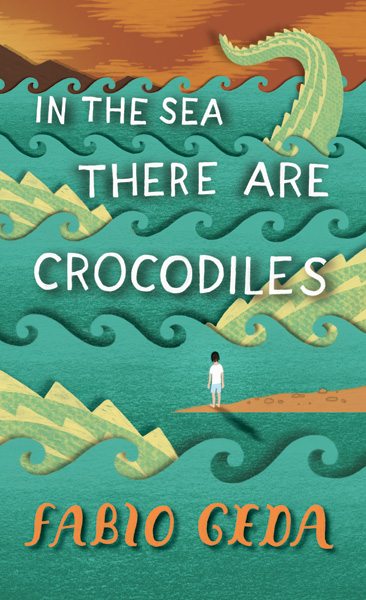
In the Sea There Are Crocodiles – Fabio Geda (3.8)
This is the story of a young boy, Enaiatollah Akbari, who escapes from Afghanistan to Italy to find refuge. He travels as an illegal immigrant in horrifically dangerous circumstances, and his plight reminds me a bit of The Silver Sword, or I Am David although I read both of them a long time ago so perhaps I am wrong. Just before Enaiatollah goes to sleep, his mother tells him three things: don’t use drugs; don’t use weapons; don’t steal. When he wakes up the next morning, she is gone and he must fend for himself (he is about ten). She has returned to his younger siblings and started him on his journey through Asia and Europe.

The story is told to an Italian (Fabio Geda) and then translated by Howard Curtis. Enaiatollah Akbari explains to Fabio Geda, “I don’t want to talk about people, I don’t want to talk about places. They aren’t important. Facts are important. The story is important. It’s what happens to you that changes your life, not where or who with.” This might be the voice of youth (albeit told by an adult through his childhood reminisces) or just an excuse for the lack of detail, but either way, we could do with more padding, as the bones are extremely bare.

As promised, he doesn’t dwell on anything but the linear narrative, which is certainly tough as he journeys through freezing mountain passes without food, hides in the fake bottom of a lorry packed in with others so he can barely breathe, and stows away in a container on the sea. As well as hardship, he encounters great kindness but there is no time for introspection as he struggles to stay alive. He merely seeks out shelter, food and work.

Enaiatollah uses references both from his rural Afghanistan childhood, and his Americanised present – even though he lives in Italy, MacDonalds and baseball are ubiquitous, which is sad in itself. When he meets some lads from France and Brazil, he can’t speak their language and they all try to get by in English. All he knows of their country is Zidane and Ronaldinho respectively: the language of football is universal. All they know about Afghanistan is Taliban. History precedes him.

He decides to stay in Italy because of the kindness he has been shown there and because he is tired of travelling. His physical journey may have finished, but one suspects his inner searching has just begun. With very little descriptive colour, Enaiatollah Akbari presents us with a very different kind of travelogue through some countries we may have heard a lot about, but from a wholly different and starker perspective.