Showing posts with label Italy. Show all posts

Monday, 9 February 2026

2026 Winter Olympics Opening Ceremony


Because I actually enjoy these things, I watched the Winter Olympics Opening ceremony and listened to the Stan Sport coverage including Ally Langdon, Todd Woodbridge and Lydia Lassila. Sometimes the commentators sounded as though they were reading out words provided to them by a scriptwriter whose first language was not English, and their AI content had been put through Google Translate. For example, they commenced the Opening Ceremony with the words:
"Human potential is revealed through movement. The Olympic Winter Games is not just a competition; it's a bridge between preparation and performance - between individual ambition and shared celebration. Sport distils life to its essentials: discipline; courage; respect. This is where, in a few fleeting seconds, years of training could be validated; it's where focus meets pressure and where determination turns into possibility, and Italy, this country shaped by craft and creativity, is the natural home for such moments: a passionate place that understands that greatness is built, not rushed."
All this makes me wonder how that equates with the young schoolkids doing their flicks and tricks on snowboards, some of whom only got the call-up the week before - they giggle and snort and roll their eyes and use their youth jargon, which is all very well in the X-games, but is it the equal of a talented and determined Olympian who has trained for years? Mine is not to reason why, etc.


So it begins at the San Siro, as these things often do, with graphics and a video montage. We are treated to classic Italian images: a single skier carving a track down a mountain through pristine snow; alpine horns, traditional garb and stunning backdrops; food, wine and coffee; goatherds (thankfully of the non-yodelling variety); design and fashion in everything from cars to architecture.
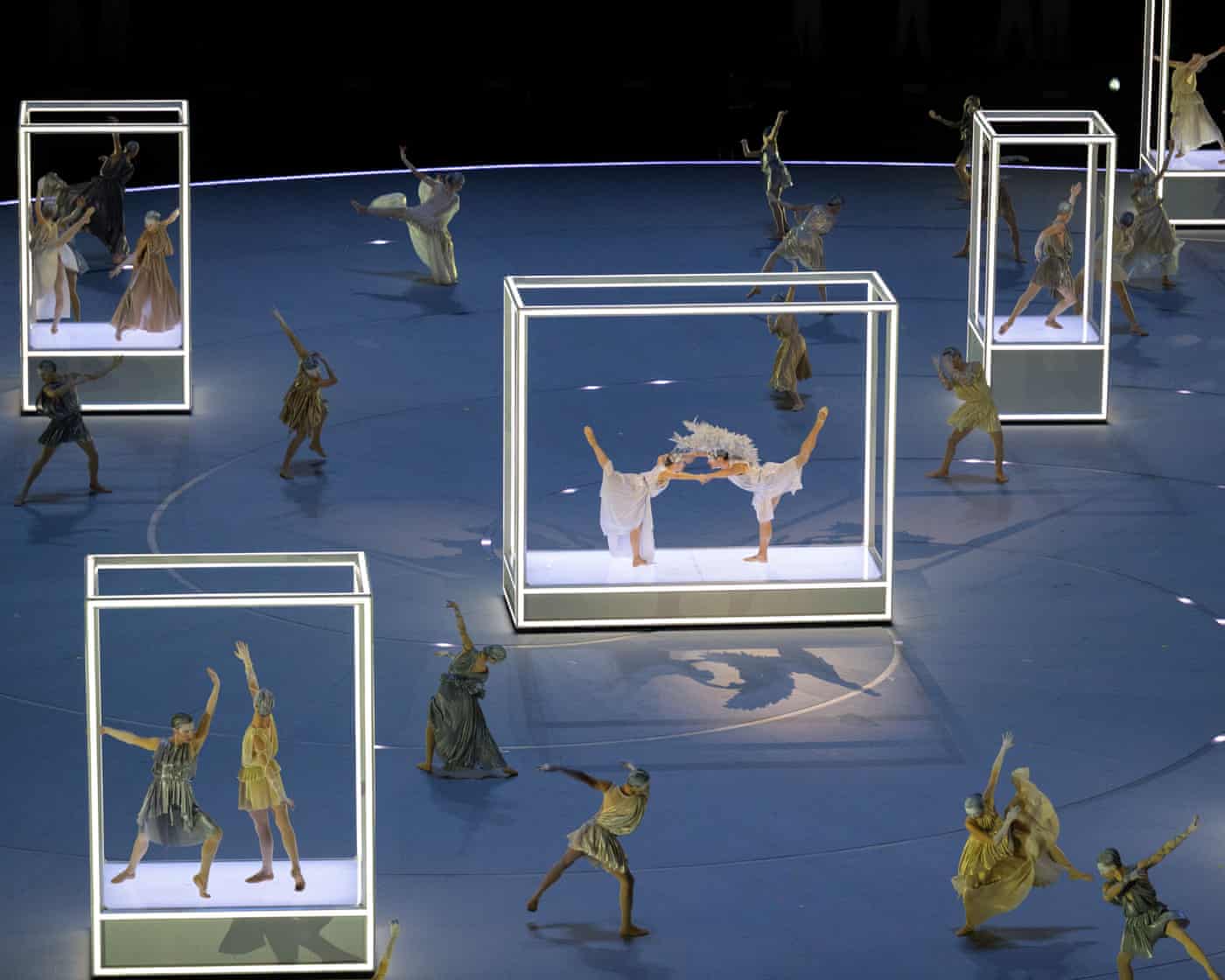

The opening live number is of people dressed as marble statues in light boxes. This is titled Armonia (harmony) and is apparently a narrative designed to unite territories, people and values with a shared vision or 'bringing together what is different'. It is an homage to neo-classicist 18th century sculptor Antonio Canova, who is known for his skill in bringing marble to life. There is something about Cupid wakening Psyche with a kiss, and then the statues become ballet dancers pirouetting and plie-ing about the stage. I learn that they are dancers from La Scala choreographed to evoke the fluid, dynamic movements of winter sports.  


Men in suits with cameras surround a woman on a catwalk (I guess Italians invented the paparazzi too) in a chic velvet gown with shoulder ruffles inspired by piano keys, waving a conductor's baton about. She is 'famed Italian actress' Matilda De Angelis and she leads another set of dancers cald in black and white bodysuits, representing 'dancing notes in a kaleidoscope of Italian imagination' This is a reference to Guido d'Arezzo, an 11th-century monk from the Order of Saint Benedict and musical theorist who is regarded by many as the inventor of modern staff notation. These games will often to be referred to as the most gender equal as women are represented as much as men for the first time. The NBC commentator calls multi-award winning 30-year old actor De Angelis a 'starlet', so we clearly have some way to go with that then. 


She is joined by three men with giant bobble heads for a Fantasia section inspired by three greats of opera: Verdi, Puccini and Rossini. They do a dance which is incredibly naff and apparently one of the repeated motifs of these games. The phrase 'rivoltarsi nella tomba' springs to mind.
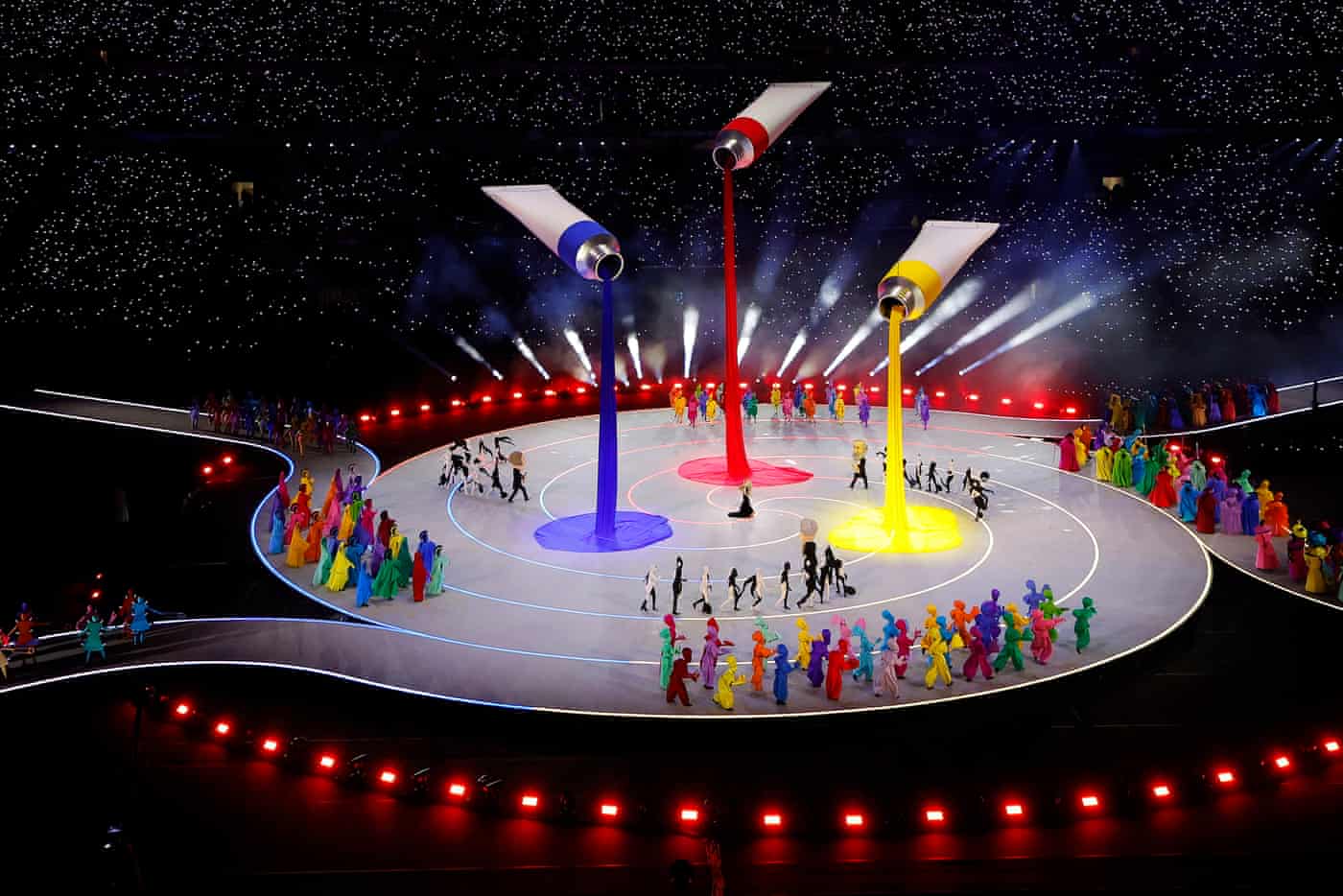

Paint tubes appear from the ceiling in the primary colours of cyan, magenta and yellow, and they 'drip' sheets of cloth which combine to make every colour in a rainbow swirl on the stage. There is now a giant parade of characters from Ancient Rome to the Renaissance who traverse in a grand Passeggiata. We have walking colosseums, coffee pots, picture frames, cut-out pattern dresses, chefs, gondoliers, figures from literature and opera singers in a tribute that combines the beauty and function of Italian design. They all form into a colour wheel and the segment ends with fireworks and the final notes of Nessum Dorma.
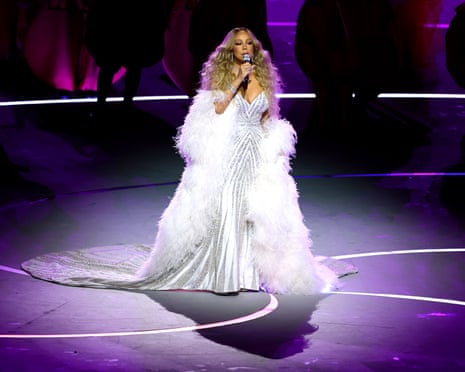

Mariah Carey for no apparent reason pops up and warbles and screeches her way through Volare and some drip-fest called Nothing is Impossible. she is redundant, sorry, I mean resplendent in a sparkly white gem-encrusted frock and draped in feathers and waves of hair. Why is she even here? If we are going to have an Italian-adjacent American, I'd much rather see Stanley Tucci. Anyway, she's presumably wheeled off, and we get to continue.

There is another video montage with shots of trams, fountains, families and illuminated buildings at night. Various Olympians get on a tram and a kid drops a mascot (I'm not surprised; those weasel things - named Milo and Tina after the host cities - are weird), which is handed back to them by a twinkly old gentleman who turns out to be the president of the Republic of Italy, Sergio Mattarella. And it transpires that the tram was being driven by Valentino Rossi, presumably at 46kph.
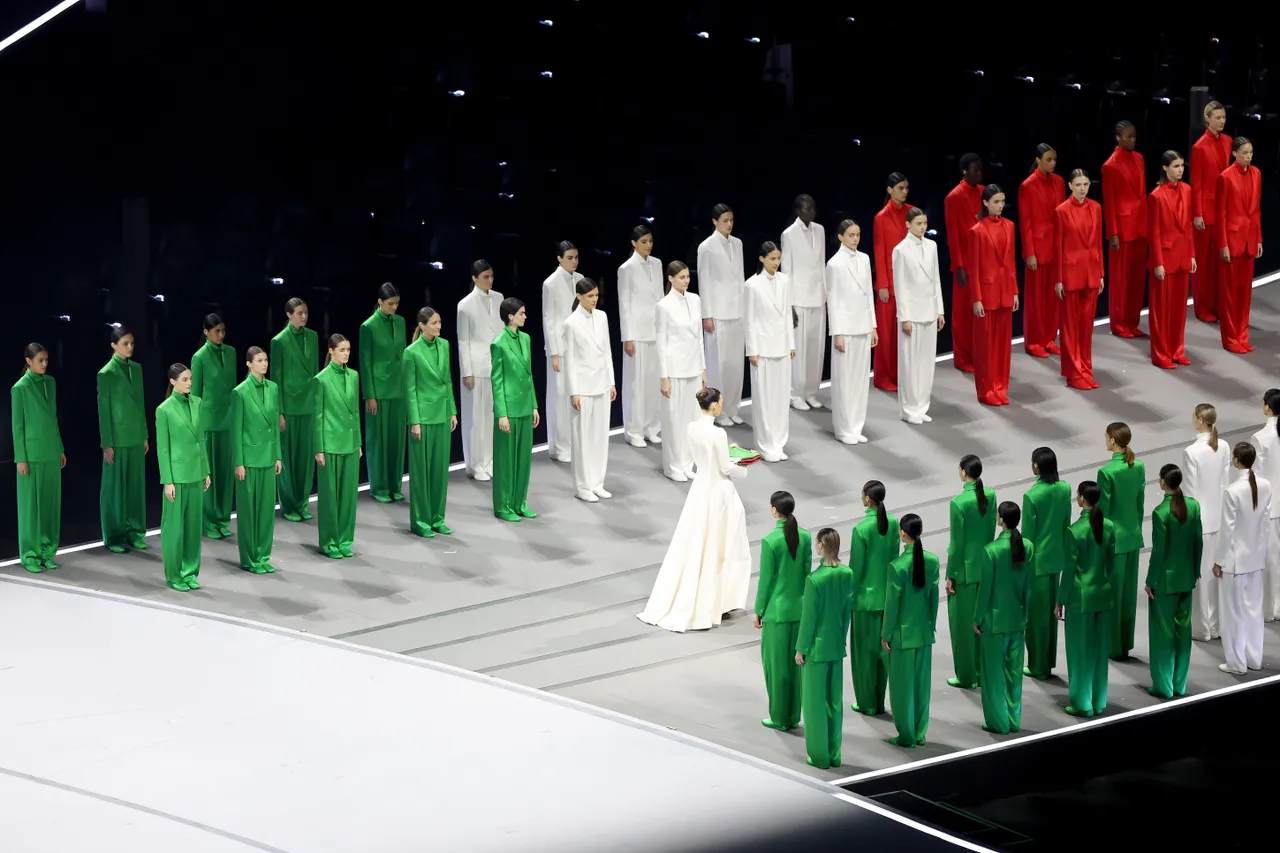

We now have a tribute to fashion icon Giorgio Armani, longtime designer of the Italian Olympic uniform and internationally-renowned Milanese, who died last year. Female models clad in suits of either red, white or green stalk down a catwalk to represent the Italian flag in human form. Armani design is said to embody simplicity over trend as the flag becomes a living expression of his style. Supermodel Vittoria Ceretti, the face of the last Armani collection carries the flag and hands it to a bloke in a plumed helmet - a member of the Corazzieri, the Italian Corps of Cuirassiers, to be precise - to raise it up the pole. 

Because the Games are spread out across Italy, certain elements of the opening ceremony (including the raising of the flag and the parade of athletes) are being held over four venues: Milan (ice-hockey; figure skating; speed-skating) Cortina in the heart of the Dolomites (men's alpine skiing, curling and sliing events), Livigno in the Italian Alps (snowboarding; freestyle skiing; men's alpine skiing; ski mountaineering) and Predazzo in Trento (ski-jumping; Nordic combined; cross-country skiing). Meanwhile, back in Milan, Laura Pausini performs a stirring version of the national anthem.
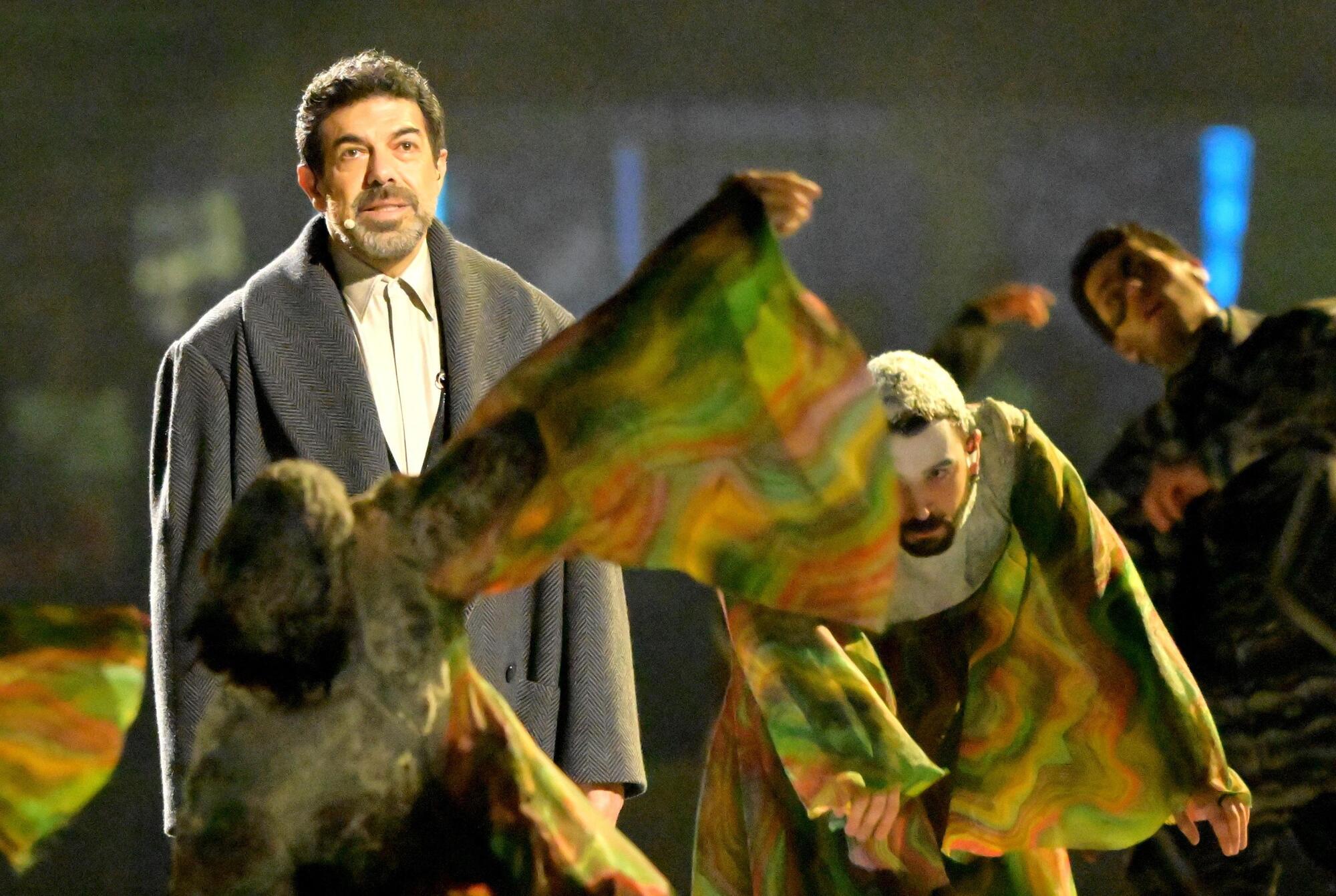

Then a chap in a suit recites a poem. It turns out (from a quick look on Google) that this is renowned 56-year-old Italian actor and film producer, Pierfrancesco Favino (I wonder if NBC referred to him as a starlet) wearing Armani and the poem is Giacomo Leopardi's L'infinito. The poem embodies a yearning to travel beyond restrictive borders and to experience more of the world of wonder. He is accompanied by a violinist (Giovanni Zanon) with an original composition, in the start of a section about how to balance human ambition and the natural world, incorporating performers representing the mountains and the city to show the harmony between them.
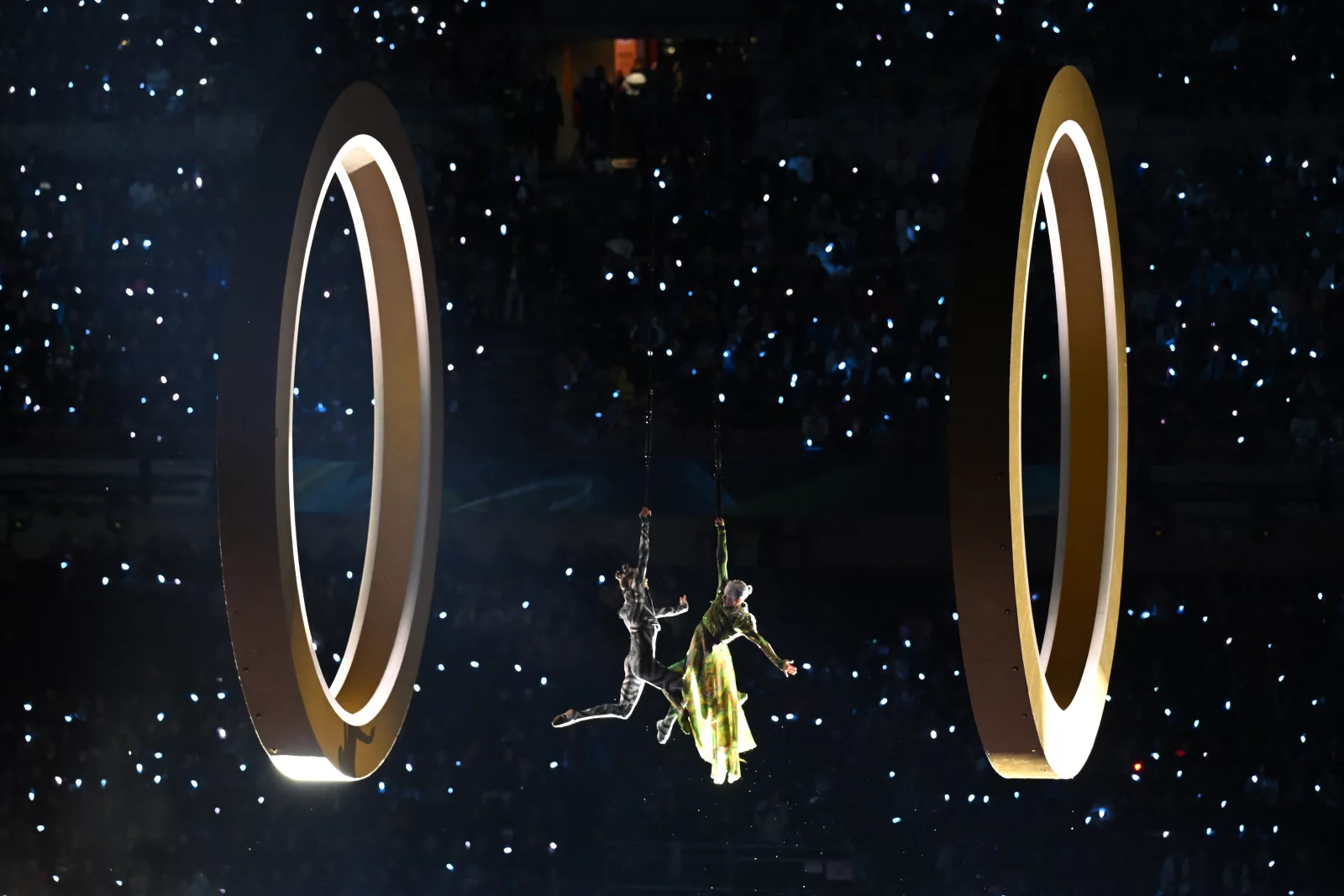

The harlequin-esqe dancers in earthy green tones dance around a couple of large rolls which are soon hoisted aloft to become two of the Olympic rings. These two represent the coming together of Milano and Cortina, and there are aerials as each ring contains one of the performers and they meet mid-air. The other rings join in until all five are up there united in harmony and pyrotechnics.
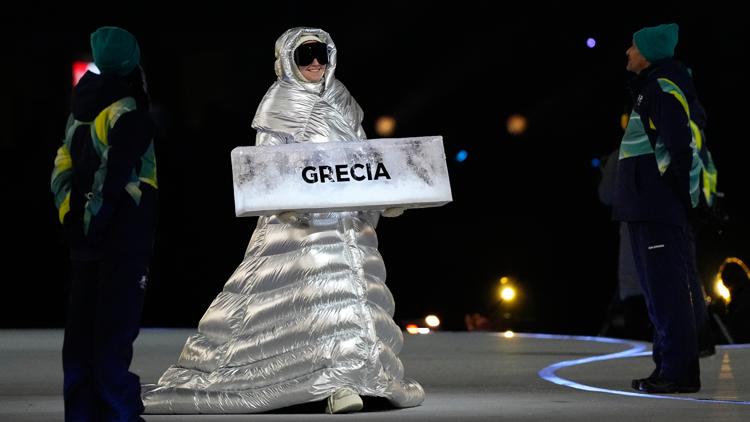

And so we come to everyone's favourite fashion parade as the nations all march in at their various venues - as noted above. Each nation follows a person dressed wrapped in padded tin foil and holding a iceblock etched with the country's name into the stadium, except sometimes the nation's athletes aren't in Milan and the name-bearer enters alone like they've been trapped in a walk-in freezer. Apparently this was the case with Australia's flag-bearer Matt Graham, whose parents were so excited when they heard he would lead the parade that they bought tickets to the opening ceremony in San Siro, and he proudly waved his national flag... in Livigno. Ooops.

Beceause I clearly know heaps about this fashion malarky, I shall be going into detail about these outfits elsewhere, but for now, let's progress with the rest of the ceremony, which continues with a section introduced by a montage summarily dismissed by the internet cognoscenti (another Italian word - see what I di there?) as AI slop. An actor (Sabrina Impacciatore) appears to be sitting on a sofa when disturbed by giant Olympic mascots (I have mentioned before - they are pretty disturbing) before morphing into an anime character who skates, skis, boards, slides and jumps her way through different art deco style former Olympic locations before arriving as herself at the stadium in an oddly-conceived white and gold spandex number.


She then dances through the decades with backing dancers beginning with jazz hands, wool and tweed, segueing into bold colours and 60s/70s funk and frug, through the best-forgotten 80s pastel and dayglo shellsuit combo (although I did like the elcetronica version of 'faster, higher, stronger' - music provided by green-haired DJ Mace, who had previously accompanied the athetes' parade), and culminating in a time-travel triumph to modern dance and techno, accessorising with a shaggy jacket, fluffy hat and big boots.  
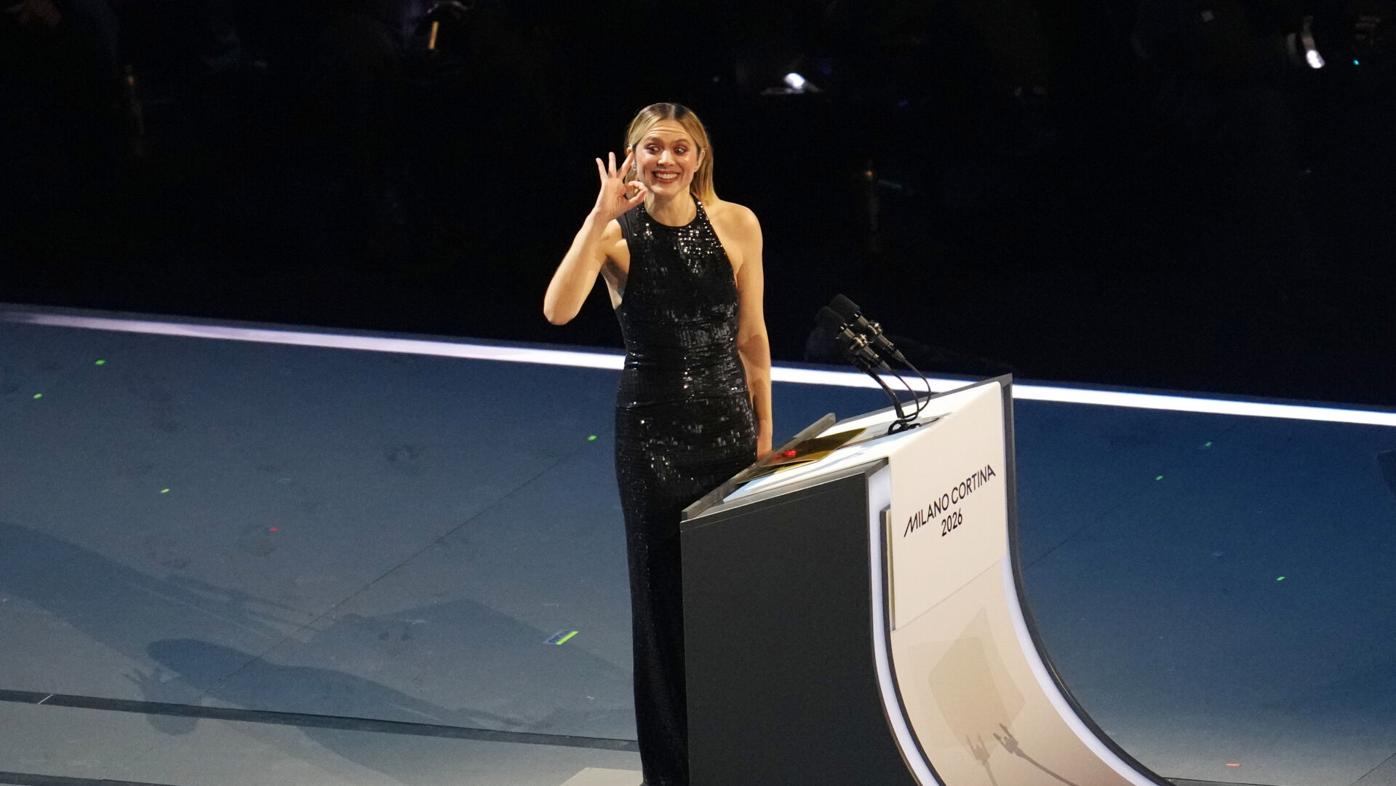

The tricky trifecta of long dress, high heels and desending steps is hard to watch but it transpires it is a comedy skit performed by Brenda Ladigiani in homage to Italian hand gestures as she attempts to get someone to switch on her microphone. It's sweet, funny, and succinct, and a great way to welcome us to Italy before all the nations' flags are raised in unison and the offical speeches get underway.

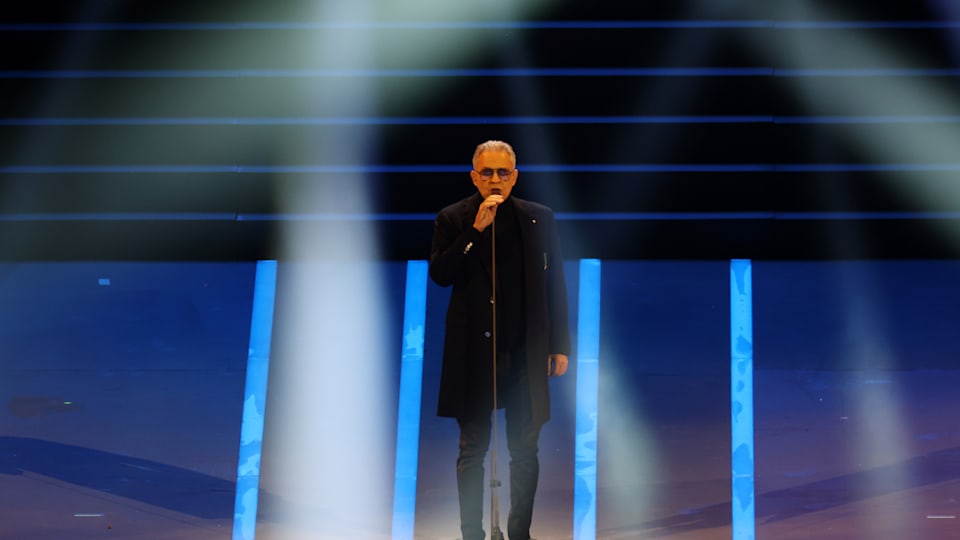
This bit is usually well-meaning but tedious, and we hear from the president of the Milano-Cortina organising committee, Giovanni Malago, the first female IOC president, Kirsty Coventry, and Italian president Sergio Mattarella (the twinkly bloke from the tram). Quotes include, "I love my country, I love sport, and I love the Olympic movement", and, "United by sport, the universal language'. It's practically Eurovision! My favourite is "It's not just about winning. It's about respect, empathy, courage and heart." But mostly, it's about winning.


Thankfully Andrea Bocelli takes to the stage and shows how it's done (take note, Mariah - just the one and stick to it) with a spine-tingling rendition of Nessum Dorma. At the literal high point, the Olympic torch makes an appearance carried by footballers Franco Baressi and Beppe Bergomi who both captained Italy and AC Milan and Inter Milan respectively - a nice touch as we're kicking about a harmony theme.
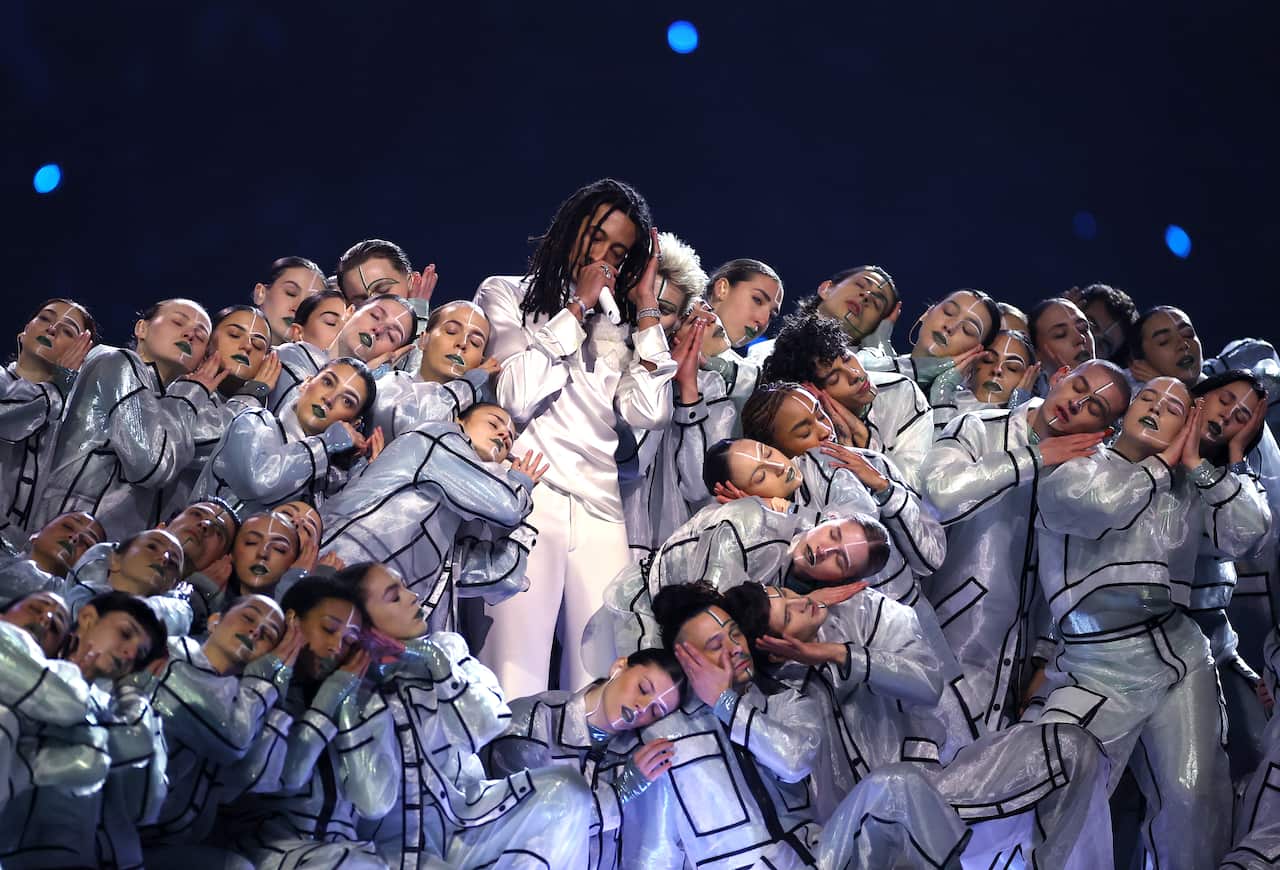

We move into the peace bit and nothing says Olympic Truce like a troupe of dancers in plastic macs and black and white facepaint. There are violins and strobe lights as Milanese rapper Ghali performs Gianni Rodari's Memorandum in four different languages, including a line about, "There are things you must never do. For example, war". I hope JD Vance is feeling uncomfortable. We get a peace dove juxtaposed against a pile of bodies, and I'm sure everyone must be feeling uncomfortable.


And then Charlize Theron pops out as the UN Ambassador for peace and quotes some words from her fellow countryman, Nelson Mandela, "Peace is not just the absence of conflict. Peace is the environment where all can flourish".

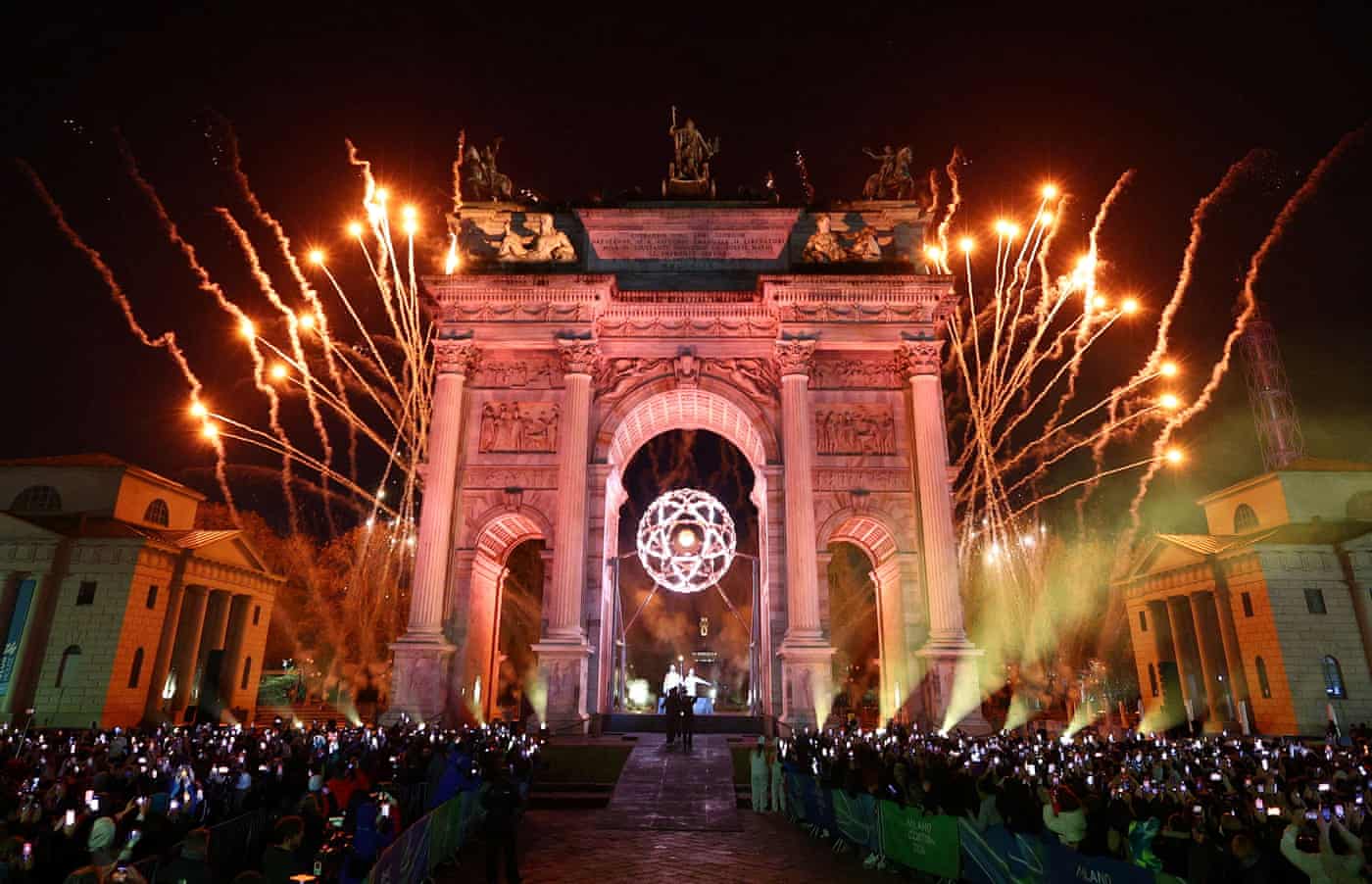
In all the venues, we now have the passing on of torches and flags. In Milan the Olympic anthem is sung rather wonderfully by mezzo-soprano Cecilia Bartoli accompanied by a children's choir and Lang Lang on keys (Chinese pianist because apparently Italians don't play piano...?). In Predazzo they are probably all down the pub by now singing along with Joe Dolce (because they gotta no respect and it's flippin freezing standing about in the cold night air). The theme of the European union (Ode to Joy) is belted out and the stars of the European Union is projected ont the Arco Della Pace. 


While we wait for the torch bearers to arrive at their cauldrons (there are two this year, in a first for the Olympics), there is some palaver about a small child experiencing the wonder of the galaxy with a model of the solar system, before she is joined by Samantha Cristoforetti (the first woman to command the space station) who is supposedly symbolically bringing a bright sun to the stage, highlighting the need to "care for the planet, bridging scientific curiosity with environmental responsibility". There are more dancers who apparently create the Milky Way, but unfortunately, close up, they look like they are trapped in condom-clad trombones. Apparently the 108 dancers are a variation on NASA's Golden Record from the Voyager probes. (You can learn a lot from the internet if you know where to look). 


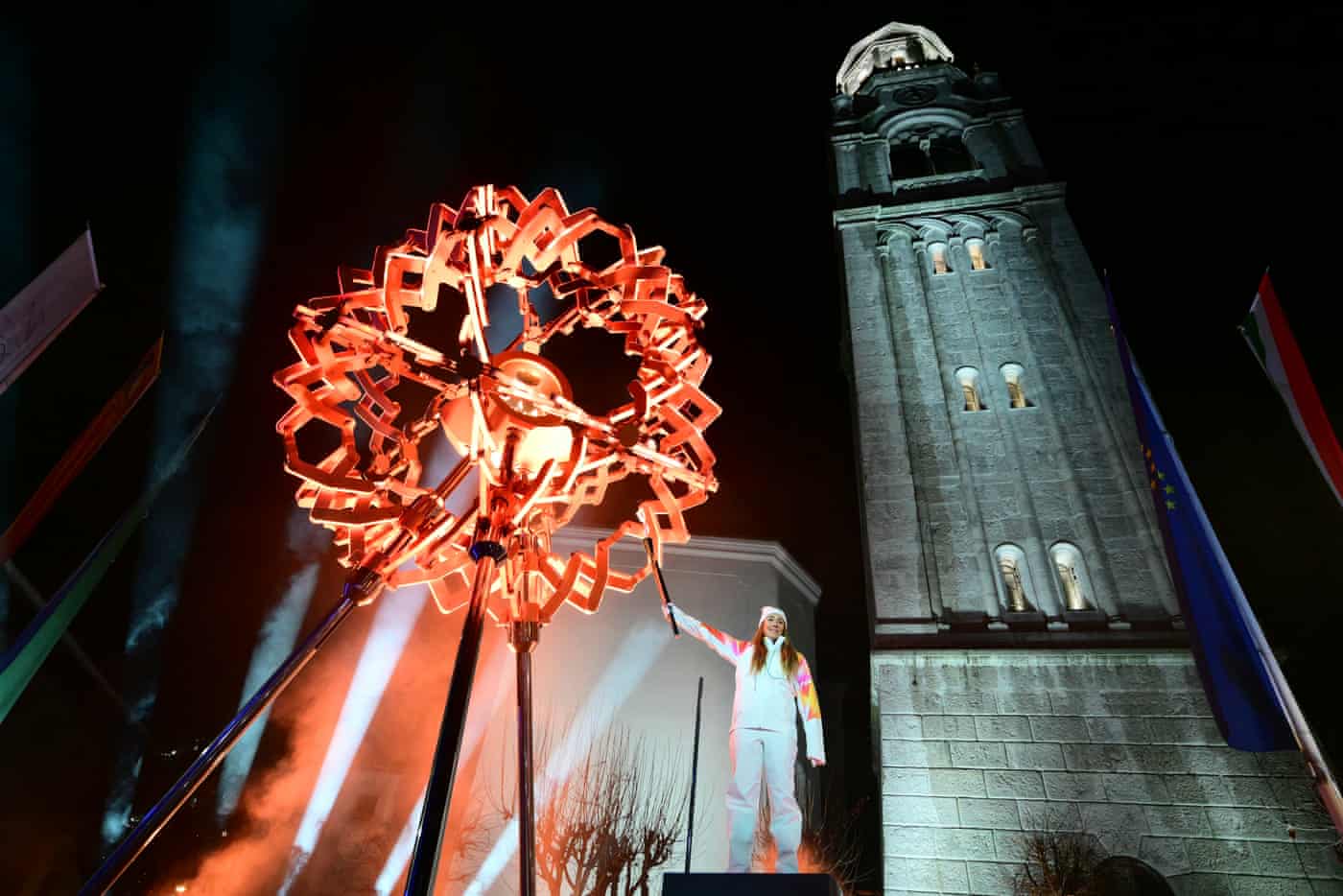
And finally the cauldrons, designed by Marco Balich and inspired by Leonardo da Vinci's geometric studies, are lit at the Arco della Pace in Milan and Piazza Angelo Dibona in Cortina. The former is lit by past gold medal winning alpine skiers Alberto Tomba and Deborah Compagnoni, while current hopeful Sofia Goggia does the honours in Cortina. More fireworks; more cheers; more bright lights, and everyone heads off for some hearty Gluhwhein - except for those in Predazzo and Livigno who are probably well on their way. And that's it for tonight. Let the Games begin (apart from the curling, which has already been going for the last couple of days and in fact goes for every day of the Winter Olympics, but let's not quibble)!
 

Friday, 11 October 2024

Friday Five: BorrowBox

I don't usually listen to audiobooks - I prefer the tactile nature of reading a book and will never ceased to be amazed by the fact that printed words on a page can conjure precise worlds in the mind. However, a friend introduced me to BorrowBox, an app affiliated to my local library, where I can borrow books to listen to, and I decided to give it a go. 

I am particularly intersted in autobigraphies and other works in which authors read their own words and tell their own stories. Here are five I have listened to and enjoyed so far. 


Candid and amsuing autobiography from a young woman who suffered a traumatic childhood, fragile mental health, the death of her son and a terrifying stalking incident that culminated in a home invasion. her voice is authentic as she describes learning about the highs and lows of the music industry (number one singles and mainly male media backlash) in a very public spotlight. Her father, Keith Allen, does not shine through this account despite his obvious assistance in her career - he gave her a recording contract and abandoned her to take drugs at Glastonbury. She is aware of her position of privilege, but also that she has worked hard for her success.


Gabriel Byrne has one of those voices that I could listen to reading the phone book. This is much more interesting than that. He speaks a lot of his youth and his training to be a priest and then a plumber, before trying acting, which he quickly discovered was his true vocation. His is a story of searching for acceptance and finding it in a passion rather than a place. Although he is occasionally sentimental and whimsical about the Ireland he has left behind, he is thankful for his chance to escape and create a life for himself, which he guards against the frivolities of fame.


Not just an amazing footballer, Megan Rapinoe is also a firm advocate of women's rights and social justice. She had a fairly typical loving family upbringing in the semi-rural town of Redding, California, the youngest (with her twin sister, Rachael) in a family of eight. She and her sister chose football - it pains me to read soccer, but she is American so I have to get used it - as an early means of self-expression. She talks of training, of games, of injuries and triumphs as one would expect from a sport memoir. She also talks of the drug epidemic, the penal system, the understanding that she was a lesbian, the reaction to her coming out, and the fight for equal pay. Her stand on taking the knee made her an outcast in her own team and to the likes of Donald Trump and those who want to 'keep politics out of sport' when it suits them to do so. She denies she is unpatriotic - she is proud to captain her country - but is still prepared to call out injustice, which makes many of the target white republican audience mad. "I know what it means to look at the flag and not have it protect all of your liberties." She has a strong work ethic and believes in learning from mistakes and trying to do better. It may sound simple, but it is sadly unfashionable. She also believes in using her platform (and as an olympic gold-medal and two-time World Cup winner, she has a pretty big one) to speak up for those who don't have a voice. 


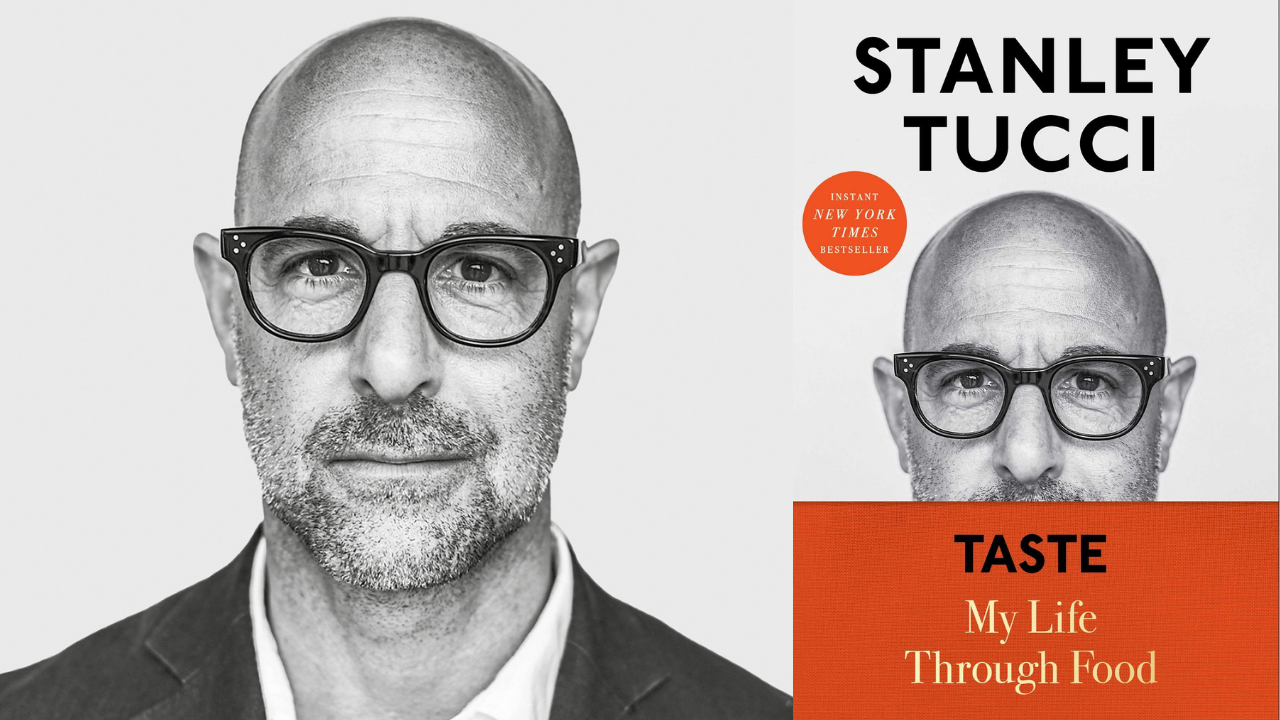
Another beautiful voice, coupled with a love of food and family - this was music to my ears. Stanley Tucci relates his life through important gastronimical touchstones which invoke memories and discoveries as he learns about his culture and his past and relates it all to his present and his career. He has a delightfully sardonic style and a dry humour, which is unusual for Americans, and he tends to steer clear of hyperbole, which is frankly refreshing. Through film narratives, health scares, loss of a sense of taste, and a delight in family and friendships, he shares anecdotes and recipes in a way that has the listener drooling - only partly for the food.


William McGonagall is often lampooned as the world's worst poet. That is a pretty bold claim and I have been insterested as to why he is so called. His poems are bad - they feature endless repetition, deridable rhymes, irrelevant details, poor scansion and weak metre. The mockery existed during his lifetime (1825-1902) and continues today with his work being celebrated with an Ig Nobel award in 2011. (He was also J.K. Rowling's inspiration for the name of her beloved character Minerva McGonagall.) He had no idea of this ridicule and fancied himself as having a calling to write, announcing himself as The Queen's Poet. Despite Queen Victoria refusing him patronage, he walked almost 100 kilmoetres from Dundee over mountainous terrain and through a violent thunderstorm to present himself at Bamoral where he was refused entry and had to return home. He made some money reciting his poems in pubs (the anti-drinking ones were particularly ill-advised), theatres, and the streets. As his reputation grew, his performances were attende by raucous crowds who drowned out his recitations and occasionally forcefully carried him out of venues. He found lucrative work performing his poetry at a local circus where he was pelted with eggs, flour, herrings, potatoes and stale bread. His story has many parallels with that of Florence Foster Jenkins, and one could perhaps feel great discomfort at his treatment (he was very probably on the autism-Apserger's spectrum), were it not for the fact that his self-aggrandising writings are incredibly pompous and dismissive of others. His poems, biography and other works are read by Scottish actor David Rintoul in brilliant fashion. He allows the unintentional humour to shine forth and reveals the terrible poetry in all its magnificent awfulness. It is a thing of unimaginable joy.

Tuesday, 25 April 2023

Middle-Aged Fantasy: The Winter Sea

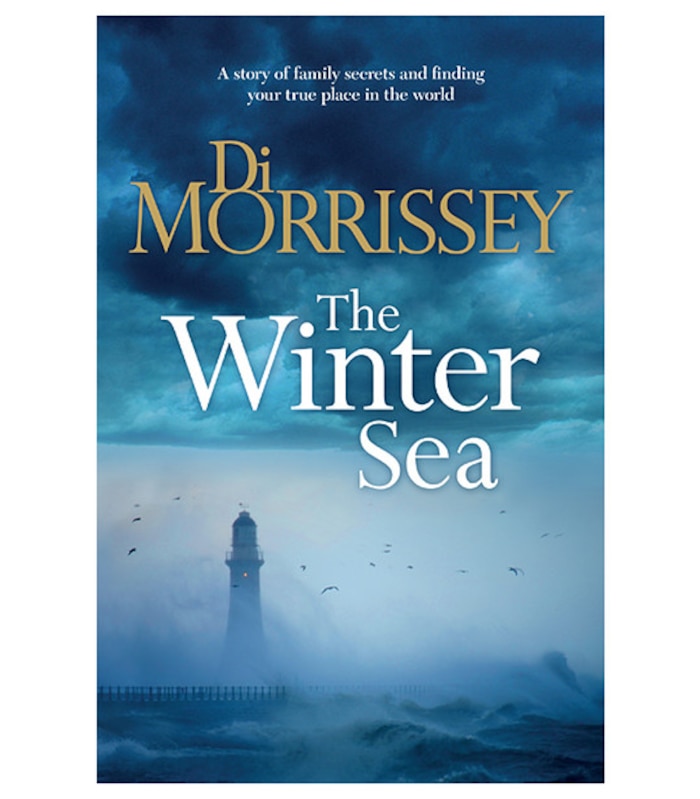
The Winter Sea by Di Morrissey
Pan Macmillan
Pp. 416

This novel is pure escapism and wish fulfilment. Cassie decides to leave her high-paid but unsatisfying legal job and husband in Sydney for a holiday on the coast. On a whim she buys a dilapidated restaurant and turns it into a roaring success with the help of the local fishing community. The spanner in the works (of course there has to be one) is in the form of a historic family incident with far-reaching repercussions. Because it's a typical holiday read there is a caring community for affirmation, an abandoned dog for company, and a handsome vet for romance. It contains a lot of stereotypes which are completely undemanding.

One of these stereotypes is the notion of Italy and the history of emigration. There are several flashbacks, which direct the reader to the old country where “Italian families are always there for each other” in a sort of Sicilian Godfather-like way. Italians love fishing and women, and they have romantic notions of both.

Characters describe things to each other in a manner that is clearly meant as exposition for the reader, and historical nuggets are dropped into the narrative with resounding clangs. The transition to being Australian is not easy; as someone worries that their English might not be good enough to pass the test they are told, “It could be in any language. If they don’t want you, they will make it impossible for you to pass.” We are reminded that Italians were put into internment camps during the war. “People are in here just because they’re Italian. Doesn’t matter what their political convictions are – Fascists, Communists, neutral. It almost makes you cry when you think of the poor buggers who left Italy to escape Fascism only to end up here.”

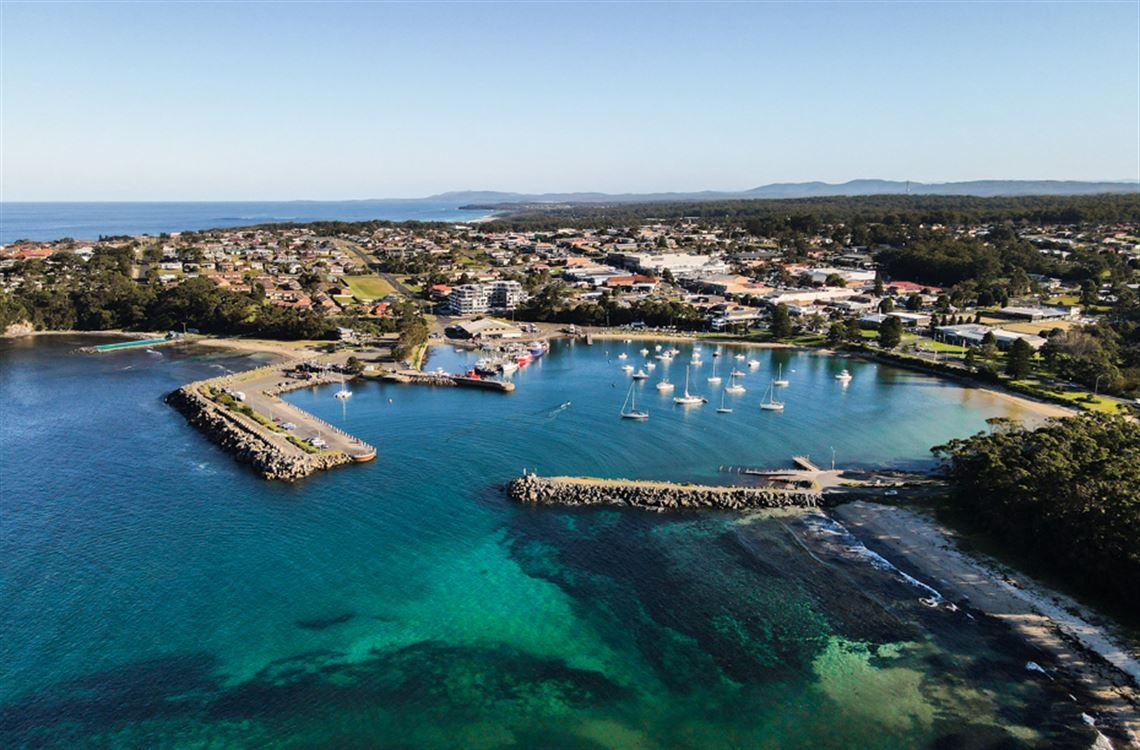
Cassie is a modern woman who decides to make a break, in parallel with these characters from the past. We are meant to see her as an independent woman, who is better-off without her overbearing husband, Hal and patriarchal career. This burgeoning feminism is not extended to other female characters, however – more Italian stereotypes. Moving home and setting up a new business is remarkably easy to do as Cassie buys a place in Whitby Point, by the sea (Ulladulla, NSW coast), with a more relaxed pace of life than in her previous Sydney home, which suits her interests. She extends this minimalism to her restaurant, which she decides to run with no real business plan. It is busy but idyllic and the dream of many a middle-aged idealist.

By trying to force a modern character into a tried and tested romance formula, Morrissey’s character’s credibility strains at the seams, but she has enough fans who will love it anyway and there’s no point in ruining a perfectly good fantasy with realism and detail.

Ulladulla Harbour and Foreshore

Friday, 7 August 2020

Friday Five: Pass the Pasta

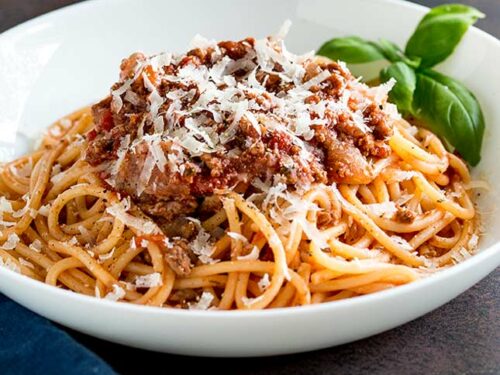
Spaghetti Bolognese

Spaghetti Bolognese; Seafood Linguine; Macaroni Cheese: It took me a long time to realise that these were composite meals and that Bolognese sauce could exist without spaghetti or that linguine could accompany things other than seafood. In fact, as a student, when not living exclusively on potatoes, I would make variants of a dish that incorporated spiral pasta (fusilli), onions, tuna, white sauce and turmeric; yes, it was a bit odd, and yes, it did leave yellow stains all over the kitchen.

I have since learned that there are over 600 pasta shapes, each with an individual history and gastronomical function. Some can be stuffed or used in soups; some are better suited for holding sauces in their ridges; others work well with baked dishes. They have evocative names which may refer to the region form which they originate (Linguine is from Italy's Liguria region - and, I was pleased to see, was created to be paired with seafood or pesto).
Strozzapreti pasta

The names may be due to more exotic etymology, such as Strozzapreti, for example, which means 'priest-choker' or 'priest-strangler' in Italian. Apparently, this is not because the hand-rolled pasta typical of the Emilia-Romagna, Tuscany, Marche and Umbria regions resembles a rolled towel fit for the purpose, or even that the shape could be construed as a clerical collar, but because the pasta was so delicious that gluttonous priests ate it too fast and ended up choking themselves. 

I have heard that by the time one becomes a responsible adult, there will be at least one type of pasta that you don't like. This is yet further evidence that I have not reached that stage of development yet, because I haven't got any particular dislikes. I do, however, have favourites.
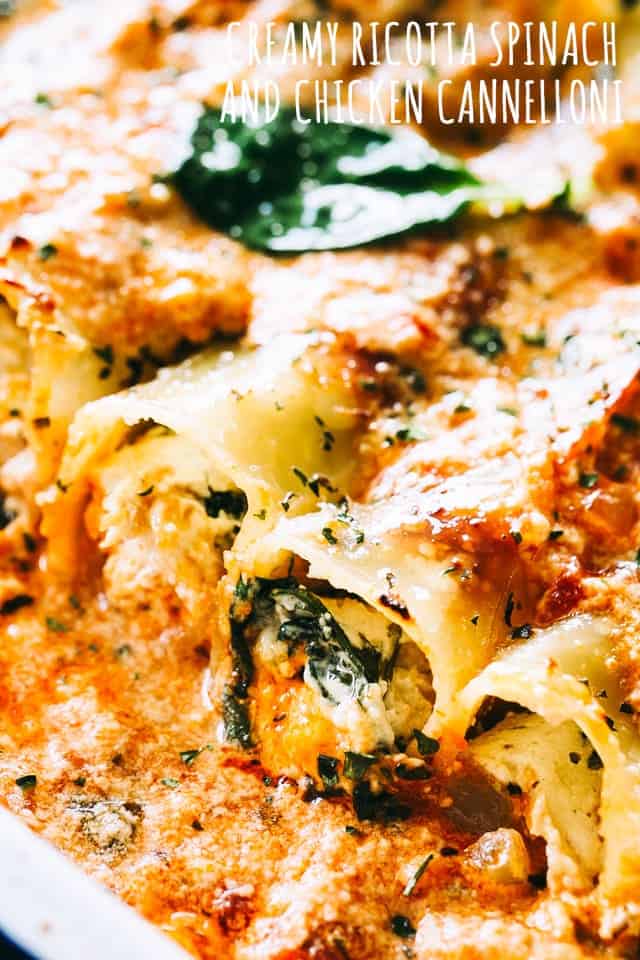
Ricotta, spinach and chicken cannelloni
5 Favourite Pastas:
  1. Bucatini - It resembles spaghetti but with a hollow centre. Ideal for holding sauces like cacio e pepe (cheese and pepper in other words), it produces a weird but pleasant sensation when sucking up the strands.
  2. Cannelloni - This cylindrical pasta is a filled noodle, baked and covered in sauce, that literally means 'large reed'. Basically, a tubular lasagne, it is popularly stuffed with spinach and ricotta or minced beef, and drenched in tomato sauce and Béchamel. I once made a recipe for 'cannelloni for a crowd', without reading through to the end of the recipe before I began. It was delicious but I ran out of pans in which to bake it, as it turned out to serve 12. Of course, the clue should have been in the name, but it was a good lesson to always read the complete recipe first before beginning the procedure (not necessarily something I have entirely learned so the words 'marinate overnight' can still strike dread into my heart).
  3. Conchiglie - I like the name; I like the shape; the shells come in a range of sizes and are wonderfully versatile allowing for thin and chunky sauces.
  4. Penne - A tubular pasta cut at an angle to resemble quills sounds incredibly artistic. It is excellent when cooked al dente and can be used in all manner of dishes from salads to casseroles. 
  5. Tortellini - These circles of pasta are folded in half to form a semi-circle after the filling is added, and then twisted to form the shape of a little hat (much like wontons in Chinese cooking). A larger version of tortellini is called tortelloni and is the size of a walnut. Originally from the Emilia region of Italy, they are typically stuffed with a mix of meat or cheese and topped with light sauces or served in broth. They are similar to ravioli, but somehow seem more exotic, especially when called by their alternative name, ombelico, which means belly-button.
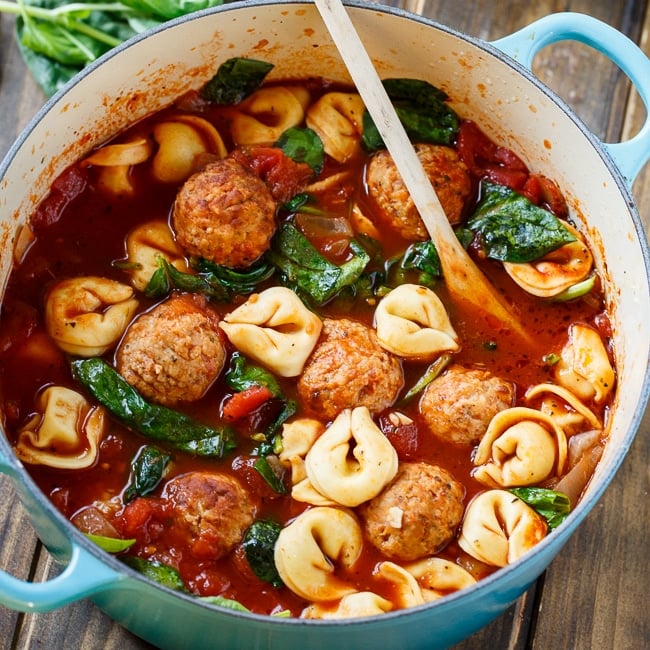
Meatball and tortellini soup

Wednesday, 21 December 2016

Only Connect

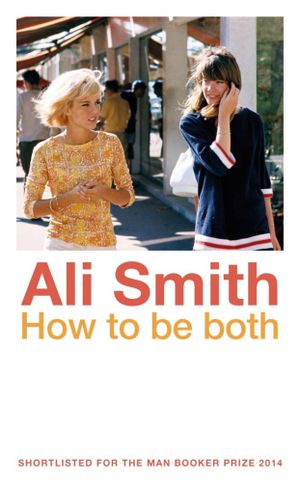
How to Be Both by Ali Smith
(Hamish Hamilton)
Pp. 371


This ambitious novel twists strands of tales together like the DNA double helix molecule that symbolises the story. The first half concerns Francesco del Cossa in an out of body experience – she may be dead, but she doesn’t remember dying; perhaps this is purgatory? She is drawn to a girl who is looking at her painting in an art gallery. The second half concerns George, the girl from the gallery, trying to cope with the death of her mother, Carol, who became obsessed with the unknown painter of frescoes in Ferrara, Italy and took her daughter there to see them in situ.

The halves of the novel are both numbered One; half of the books are printed with George’s story first and Francesco’s second. They can be read in either order because everything is connected, and all things overlap. Sitting in an Italian piazza and discussing the prevalence of over-painting images, George’s mother asks her, “Which came first? The chicken or the egg? The picture underneath or the picture on the surface?” George says the picture underneath, of course. “But the first thing we see, her mother said, and most times the only thing we see, is the one on the surface. So does that mean it comes first after all? And does that mean the other picture, if we don’t know about it, may as well not exist?”

These palimpsests become a metaphor for life. Francesco is really a girl, but disguised as a boy so that she can have a career as an artist. Pictures record things past their death; they capture immortality. Carol was an art activist, “It was her job to subvert political things with art things, and to subvert art things with political things.”

After her mother’s death, George feels as though her life has been split into two entirely separate halves. “That before and after thing is about mourning, is what people keep saying.” She discovers a woman with whom Carol had a relationship, and George stalks and photographs her every day. She recalls how her mother used to think she was being spied upon and ‘Minotaur-ed’; was she just being paranoid? Or is this the self-enveloping effect of time’s continuum? Both art and surveillance involve watching and being watched, and there is always more going on than meets the eye. Carol taught George, “Nothing’s not connected. And we don’t live on a flat surface.” History is ever-present and the weight of all this connectivity can be oppressive.


The novel is a complex work of meaning and metaphor: a classic story of love and loss, told in a fresh and modern way. Both genre and gender bending, this is a work of parallel universes, palimpsests, fluid time and space, paranoia and mystery – almost too clever by half, and certainly challenging, but definitely memorable.

Sunday, 27 May 2012

Last Week's Thing

Once again; the main stories that were making the news last week in my view.

9. The aptly named Ryder Hesjedal became Canada's first grand tour winner as he snatched victory from Joaquim Rodríguez on a dramatic final stage of the Giro d'Italia. Rodríguez, the Katusha rider who wore the race leader's maglia rosa for 10 days, took the considerable consolation of winning the points classification by a point from Mark Cavendish.


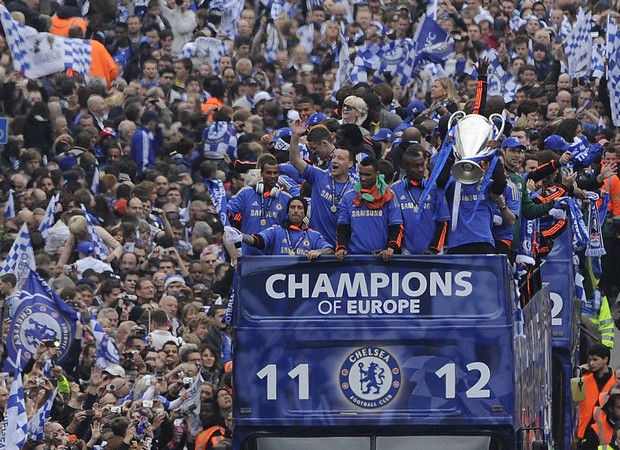
8. Chelsea won the Champions League Final over Bayern Munich on penalties. It was an exciting game and now they've got a pretty stunning double (having won the FA Cup as well) and I don't begrudge it all - even though they beat Liverpool in the final. Florent Malouda finally let get of the trophy to allow Chelsea to parade it down the Kings Road.
 

7. It's tough being Queen. To celebrate 60 years of the job, poor old Elizabeth had to go to Burnley. She took a barge trip down the canal with Prince Philip and Prince Charles, visited the Weavers area (rejuvenated through the work of Prince Charles' charity) and was 'entertained' at Turf Moor. Obviously she didn't have to watch an actual game (that would be stretching the definition of entertainment a bit too much), but she did have lunch there - Hollands pies perhaps? Apparently Prince Charles is already a Burnley fan, so Him Outdoors now reckons that the mighty clarets are by Royal Appointment.
 

6. State of Origin is a rugby league thing between New South Wales (the Blues) and Queensland (the Maroons). It is a hotly contested title, fought (oops, I mean played) over three games - best of three wins. In the first game, we had it all: biffo; dubious tries; captains whinging that referees don't listen to them (so that's not just a Kiwi thing then...); sinbins and hanbags. Oh, an in case you care, Queensland beat New South Wales 18-10.
 

5. Aftershocks are still shaking Northern Italy after the 6.0 earthquake that hit last Sunday leaving seven people dead, dozens injured, and thousands homeless. Hundreds of buildings have been destroyed across the historic and prosperous Emilia Romagna region, and the parmesan production (which contributes two billion Euros annually to Italy’s economy) has been badly damaged – Italian government has declared a state of emergency.
 

4. 108 people have been killed in the most recent massacre in Syria. In the town of Houla according to a United Nations statement the offensive "involved a series of government artillery and tank shellings on a residential neighbourhood" and the Security Council has condemned the action "in the strongest possible terms". Syrian foreign ministry spokesman Jihad al-Makdissi insisted that it was not the government and is blaming terrorists for the attack. The rebel Free Syrian Army (FSA) warned that unless the international community took concrete action it would no longer be bound by Annan's UN-backed peace plan and his April 12 ceasefire which has been violated daily. Adviors to the UN warn that civil war is imminent.


3. Schapelle Corby has had her prison sentence for drug smuggling reduced by another five years, so she is due for release in September 2017. At 34 years old, she has already served eight years of the term and appealed for clemency due to suffering from mental depression in prison. Indonesian law imposes harsh penalties on drug traffickers (she is convicted of trying to smuggle 4.1kg of marijuana into Bali in a bodyboard bag) and it can carry the death penalty. Apparently some people in Indonesia are outraged that she has been given clemency because she is a Westerner. Tensions abound when politicians and lawmakers draw comparisons between terrorism and drug smuggling.
 

2. Robin Gibb died aged 62. One of the members of the Bee Gees he was a voice of a decade and, with his brothers in the band, received a CBE in 2004 for contribution to music. It may not be my music, but Saturday Night Fever is certainly memorable. As are the hairdos and outfits.
 

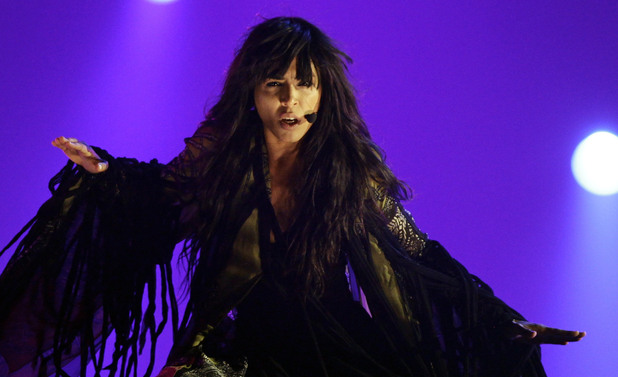
1. Sweden won the Eurovision Song Contest with a song that sounded like Kate Bush trying to escape from an asylum. The wind machine was so overworked that it produced snow, and the angry little moth was happy, apparently. The song is called Euphoria. The entry from the UK sung by Englebert Humperdinck came second last with a total of twelve points, barely above Euro whipping boys Norway (of nul points fame). I liked the Russian Baboushki who came second and were clearly the audience favourite. This is a big deal in Austrailia, apparently. People have parties and play elaborate drinking games - I will blog about this further.
 

Friday, 27 April 2012

Friday Five: Our Daily Bread

I love bread. There's a reason why people bake bread in houses they are trying to sell - the smell is divine. The way the loaf rises in the oven is almost magical (yes, I know it's actually due to a chemical reaction involving the yeast, but that's somehow not as romantic) and there is a wonderful symbolism in breaking bread to share with others. Of course many Bible stories feature the humble loaf, but it's more than that. So with apologies to my carbohydrate and gluten-free friends:

5 Favourite Breads:
  1. Baguettes - cycling through French vineyards with one of these tucked into the panniers, knowing we were soon to devour it with gooey cheese, fresh tomatoes and a bottle of bubbly... The anticipation was almost as good as the event. Almost.
  2. Calzone in Florence and Siena - the Italian sandwich; easy to eat while sight-seeing, walking and standing, or simply sitting in the piazza watching la passeggiata.
  3. Granary bread from Asda - fond memories of coming home after school and eating this with lashings of butter and jam in the kitchen (the warmest place in the house) with mum. She would be marking books and we would drink Vimto and chat about nothing.
  4. Garlic naan - as long as you both have it. From a good restaurant or curry house it tastes delicious, but it tastes strong and the flavour lingers, if you know what I mean...
  5. Jamaican gingerbread - I usually think savoury with bread, but this sweet treat is another happy childhood reminiscence.

Wednesday, 8 April 2009

Happy Blog-day

I see it's been a year since I started this blog. I had no idea where it would take me when I began. I checked out the 'labels' which tell me the topics I have written about most. It may not surprise those that know me to learn that the top five are:
  • Liverpool Football Club
  • theatre and plays
  • travel (Italy & America)
  • beer
  • sport in general

So those would appear to be my main interests. Should I put them on my CV?

Thursday, 18 December 2008

Reflections of Venice 3

There are churches galore which, according to the tourist guide, all contain ‘important works’. We pass their façades, either as we sweep by on the water or as we walk through the web of waterways. The only one we enter, Chiesa della Pietá has an exhibition of violins and related woodwind instruments on account of Vivaldi being one of Venice’s favourite sons.

Other notable Venetians include Cassanova and Marco Polo – men of exploration and swagger; hedonistic rather than scholarly. I can’t imagine Leonardo da Vinci sitting down to his inventive drawings here. He would have been out partying in the streets, drinking and revelling, hiding behind a mask and not taking responsibility for his actions.

All is pretence in Venice, and not just the multitude of Carnivale masks. There are a couple of stone lions still in the city – the statues look friendly, but you used to be able to denounce someone by writing their name on a piece of paper and placing it in the lion’s mouth – the ensuing events were then far from friendly. I want to see these lions but we don’t seem to go their way.

The Venice Lion (St Mark’s symbol) is everywhere; in paintings and sculptures, carved on the side of buildings or stood atop pedestals – he is winged so could take off at any moment. I suspect those wings are clipped and his majesty is fading, otherwise I doubt he would remain here, and he looks sad rather than proud.


The Romanesque-Byzantine style of Saint Mark’s Basilica seems ostentatious with its gilt mosaics and five cupolas; its splendid marbles and gilded copper horses. The adjacent campanile was once a lighthouse although no longer, and the practical purpose of guiding ships into the harbour seems far preferable to me than a repository for a dead man’s bones.

The Torre dell’Orologio is something special with its blue and enamel face with zodiacal depictions to indicate the phases of the moon and its sundial and hands for pointing out the time rather more prosaically. It is familiar from having a baddie thrown through it by Bond in Moonraker and has pieced itself back together very nicely indeed.

Many of Venice’s treasure were hidden or removed when the Germans occupied the city during the war – the Venetians had learned their lesson from Napoleon’s previous plundering. Rooms were sealed up and ornate painted ceilings covered with tar to prevent the invading army from enjoying the gaze of cherubs – which might actually have put them off. But the Germans, with their love of art and fine things, did not destroy Venice; it remained intact throughout the war.

Long before the Germans’ arrival, however, there were specific areas for segregating the Jewish community. In 1516 the Ghetto was instituted by the Venetian republic as a compulsory place of residence for Jews. The word itself originates from Venice, being a contortion of the word ‘geto’, meaning to throw or cast as the foundries were located here in early times. There is an air of money-making with unfavourable connotations, which Shakespeare picked up in The Merchant of Venice.

But despite all this, I still like the place. I like the bustling market around the Ponte di Rialto; I like the occasional peaceful canals (literally backwaters) with the reflections of light from the water dancing on the brickwork.


I like drinking a glass of prosecco; the bubbles even eliciting laughter from a jolly gondolier who has popped into the bar for a break, his boater askew. I like watching the gondoliers negotiating the waterways and jostling for position outside the hotels, hitching their gondolas to the palina (the coloured striped pole painted in the noble family’s colours) while casually smoking cigarettes or chatting on cell phones.

And I like standing on the bridge, leaning on the balustrade and watching the lights of the shops and restaurants winking on in the dark; their reflection broken only by the watercraft that still plough up and down the canals with red and green lights hung for navigation.