The Art of Banksy
The Paddock, Federation Square (the dodgy car park, behind the Fed Square car park). Melbourne
7 October 2016 - 31 January 2017
Some time ago, I found myself in Melbourne, with a Banksy exhibition on my doorstep. I've always been intrigued by Banksy and his art. And, yes, I do think it is art, even though it is stencil and spray-paint and not always even by him. I find his ideas interesting, and warm to the way he takes the personal and makes it political. I know it has been described as crude and simplistic, but I find it inspirational in its clarity. It is direct and accessible and refutes the notion that art is for the elite. It is self-referential and deprecating in equal measure, and literally brings art out of auction houses and into the streets.
 |
| I Can't Believe You Morons Actually Buy This Shit (2007) |
And yet an exhibition such as this takes it off the streets and puts it back into the gallery. Artwork such as Barcode Shark, Festival, or Consumer Jesus decry the fundamental ideas of capitalism, while there is, of course, a gift shop, selling these images on t-shirts, postcards and mugs begging the question who is the mug, here? One exhibit actually features t-shirts hung as works of art rather than clothing, further confusing the boundaries between ideology and practicality.
 |
| There is no exception to the rule that everyone thinks they're an exception to the rule - Banksy |
Consumers of this art are being ridiculed even as they admire it. We must face the consequences of our desire to scorn the herd, just as we are a part of it. And we may want to feel special and different, but we aren't. And that hurts.
 |
| Have a Nice Day |
This exhibition was curated by Steve Lazarides, a British art gallery owner. Having studied photography at Newcastle University, he was working on a photo-shoot when he met Banksy and became his agent. He subsequently launched the website 'Pictures on Walls' to promote street artists and urban art. He and Banksy parted ways in 2008 and yet he obviously still champions his former client's work - again one wonders whether the relationship is amicable and mutually beneficial.
 |
| Rude Copper |
The majority of the paintings in this exhibition were originally exhibited and sold in some of Banksy's seminal shows, which included two of the artist's most well-known; Turf War which took place in Dalston in East London in 2003, and Barely Legal in Los Angeles 2006.
Lazarides explains that with the ability and skill to exercise a wide palette of contrasting techniques and mediums, these inside works retained the same motifs and ideas that were presented in the outside street pieces. The difference, however, was that they were created with the intention of being viewed within the context of an exhibition environment. While an outside street piece was always created to be transient - there one minute and gone the next - Banksy's inside paintings instead required the scrutiny of a longer view. These artworks would instead potentially be admired for several lifetimes.
 |
| Girl with Balloon (gold) |
The Art of Banksy features over 80 pieces of original art and screen prints in a pop-up gallery on The Paddock at Federation Square. It does not have Banksy's permission and is therefore an unauthorised exhibition. But if you attack corporations for greed and insist that all work should be public, can you criticise the curators for holding such a show?
 |
| The Burger King Kid |
"It is not my place to give you my opinion on what these pieces are about. That privilege lies with the artist and I'm pretty sure that isn't something he'd ever do. You as a viewer have as valid an opinion on these works as either me or Banksy. They mean whatever you, the viewer, think they mean - there is no right or wrong." - Steve Lazarides
 |
| Flower Thrower (on tarpaulin) |
 |
| Dorothy Police Search |
Many of these spray-painting images have become ironic icons. From the flower-throwing rioter to the American soldier searching Dorothy's basket, the pictures are dripping with sarcasm and subverting authority but also tinged with hope. They seem to say that if we recognise that rampant capitalism is eroding our freedoms and poisoning our communities, then others will too. And perhaps there is a a glimpse of a brighter future. Even the trashed Mini has a stencil of the girl with the hope balloon near the empty fuel tank.


The smiley face features heavily in this exhibition. Now used as an emoji - a symbol of happiness when vocabulary fails - the classic design by Harvey Ball in 1963 represented sunny hedonism to raise the morale of employees at State Mutual Life Assurance Company. In the early 1970s, two brothers based in Philadelphia, Bernard and Murray Spain, added the words 'have a nice day' to sell novelty badges and other paraphernalia to a nation determined to forget the traumas of Vietnam.
It also suggests the late-80s acid house culture, when the logo appeared on acid tabs implying that one could only have a good time by getting out of one's head because 'real' life was too banal and depressing. Thus a simple child's drawing became hijacked by a number of corporations (Wal-Mart tried to trademark it in 2002) which makes it ripe for inclusion on Banksy's work.
 |
| Smiley Grim Reaper |
 |
| Smiley Angel Policeman |
Naturally one would expect a street artist to be anti-capitalist and against rampant consumerism. In this regards, Banksy doesn't disappoint.
 |
| Festival |
 |
| Barcode Leopard |
 |
| Very Little Helps |
 |
| Consumer Jesus |
 |
| Barcode Shark |
By taking art from its hallowed walls and desecrating traditional-style paintings Banksy gives art back to the people. He seems to intimate that it should belong to us all, and that we should all be able to see it, rather than it disappearing into the hands of private collectors - which turns full-circle when his own alternative prints are hung in galleries, sold at auction and hidden from public view.
 |
| Turf War |
|
|
Bullet-proof David; Suicide Bomber (2006)
|
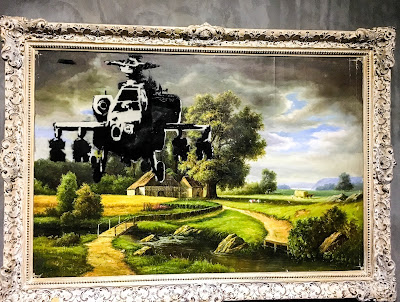
Banksy did a series of 'defaced' work in which stencilled imagery is sprayed upon a found canvas, perhaps purchased from a flea market or salvaged from a dumpster. He was known for sneaking into art galleries and hanging his works alongside Old Masters, complete with interpretive panels explaining the 'hidden meanings'.
Violence and the resulting fear is another common theme - whether painting military weaponry or police brutality towards protesters, he frequently highlights the scaremongering and fear which grips nations. This corporate violence leads to a death of innocence, which he seems to decry - using powerfully deceptive imagery in stylistic silhouettes, such as might be found in a child's picture book. Personal possession, which denies communal appreciation seeks to own and control rather than share.
 |
| Warning Sign |
 |
| Bombing Middle England and Weston-Super-Mare |
 |
| La American Flag |
 |
| Kids on Guns Hill |
 |
| Pooh Bear Trap |
"Imagine a city where graffiti wasn't illegal, a city where everybody could draw whatever they liked. Where every street was awash with a million colours and little phrases. Where standing at a bus stop was never boring. A city that felt like a party where everyone was invited, not just the estate agents and barons of big business. Imagine a city like that and stop leaning against the wall - it's wet." - Banksy
His artwork is temporary and ephemeral, but never whimsical. It is often painted over, or dismantled, if it is in the form of installation art. Just before the gift shop was an installation of an old-fashioned sweet shop with jars of sweets, looking like simple treats. On closer inspection they bore copies of his protest images - something to sugar-coat the pill, perhaps?
Obviously the gallery couldn't recreate these impermanent exhibitions, but it included photos and videos of them, to spread the word and the ideas.


He is a keen animal rights campaigner, which makes sense for someone who gives voices to those who need most support. In Sirens of the Lambs, a slaughter wagon full of cuddly toys was driven around the streets of New York. He has previously spray-painted sheep (the RSPCA deemed their treatment was humane) and included a live elephant in a room, which he instructed people not to mention.
But perhaps his most famous animal creation is the rat; pressed into service for propaganda and sloganeering, it equally represents the trapped commuter we recognise who gets stuck in the maze of making money to survive.
Throughout the exhibition are signs exhorting us to take photos and to share this stuff - art is not the preserve of the elite; it belongs to the masses. And yet we were charged $30 to enter - and there were queues to get into the tent in the 'dodgy carpark' behind Federation Square.
Is Banksy laughing all the way to the bank? Is he now part of the establishment he set out to rail against? Has he well and truly passed the tipping point? I like his ideas and his presentation of them, so I don't care if he is swimming with the current of the dreaded mainstream. And I get the impression that he doesn't either.