Showing posts with label church. Show all posts

Tuesday, 10 May 2022

Eora by Jake Nash

Eora by Jake Nash

This amazing artwork is Eora by Jake Nash, which is immediately outside the National Office of The Smith Family in Sydney (on the corner of Kent Street and Market Street). 

The Eora are an Aboriginal Australian people of New South Wales. Eora is the name given by the earliest European settlers to a group of Aboriginal people belonging to the clans along the coastal area of what is now known as the Sydney basin in New South Wales, Australia. The Eora share a language with the Darung people, whose traditional lands lie further inland, to the west of the Eora.

2 Market Street

Jake writes:

"My mother’s Country is Daly River, west of Darwin, and while I am not from Sydney and it is not my ancestral land, for the last twenty years I have lived, worked and created here and it has now become my home and my family’s home.

"Eora sits at the crossroads of the city, a point of intersection between the past, present and future, and is surrounded by institutions that have shaped and governed our land: the Law Courts, the Church, as well as the Hyde Park Barracks. These buildings, both now and in the past, symbolise white governance in this city and represent the very beginnings and formalisation of colonisation.

St James Church from Hyde Park Barracks

"These historical and site-driven factors are what underpin Eora, as the artwork makes a statement about resilience, cultural strength and the everlasting relationship between people and place and reminds us all that the land on which this artwork and these buildings stand, always was and always will be Aboriginal land.

"Eora is a contemporary, timeless symbol and can be passed down through the generations into the future. It is a message stick, within a city which has many cultural narratives running across its surfaces, that describe who we are as a contemporary, multi-cultural people with a shared history and shared future.”

I think it is an outstanding artwork that welcomes interaction and reflection from the design incorporated into the sandstone wall, which we are encouraged to observe, to the outline reflected in the ground on which we walk. I love that this is outside the head office of the place where I work.

Wednesday, 15 April 2020

COVID-19: We Aren't Gathered Here Together


Last weekend it was Easter. I am a 'wishy-washy Anglican' (not actually my words, but I have been called thus) and only really attend Church at the major religious festivals - Christmas, Easter and Whitsun being the big dates in my calendar. Of course, this year I could not go to Church - no one can - and I missed it. I missed singing the songs and saying the prayers; I missed turning to my fellow members of the congregation and wishing them peace and good will. And I missed them doing the same for me. I missed that communal feeling.

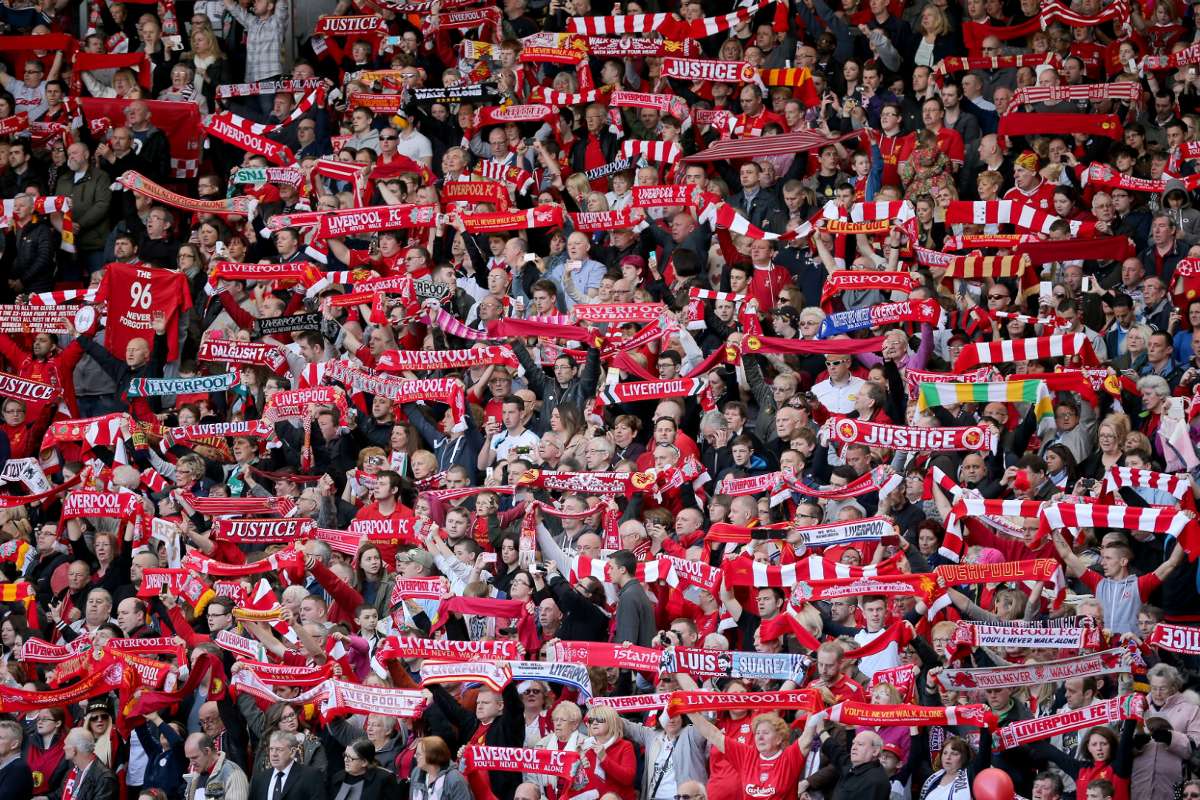
For the same reason, I love watching sports and theatre; I enjoy a shared experience. Knowing that you feel the same thing as others is a wonderful thing. When I breathe in the hallowed turf of Anfield, it is a spiritual moment; all the home players and supporters know what I mean - we stand and sing together and no one cares how out of tune we are; we are in time. Our time. Any true fan will tell you the same (although they will worship at a different shrine). 


When the curtain raises on the stage and everyone takes a collective breath, we are all waiting to see what unfolds together. This moment will never be repeated - every performance is different - and we know we are privileged to witness it. And when the curtain falls and people applaud, they do it together. I have been part of a cast that received a standing ovation. It was magical and unforgettable. We did it for the audience and the audience appreciated us; and we were one. It was incredible.

I like listening to a band, but I prefer going to a gig or a festival. I don't need to then hear this gig again; I'm not a fan of live albums because generally the sound quality isn't as good, and the whole point is the being there. I am pleased the National Theatre, The Globe and the RSC are screening some of their performances so we can all enjoy things that we couldn't otherwise see - but we are still watching them alone. The roar of the greasepaint and the smell of the crowd is missing. (Yes, that was deliberate.)

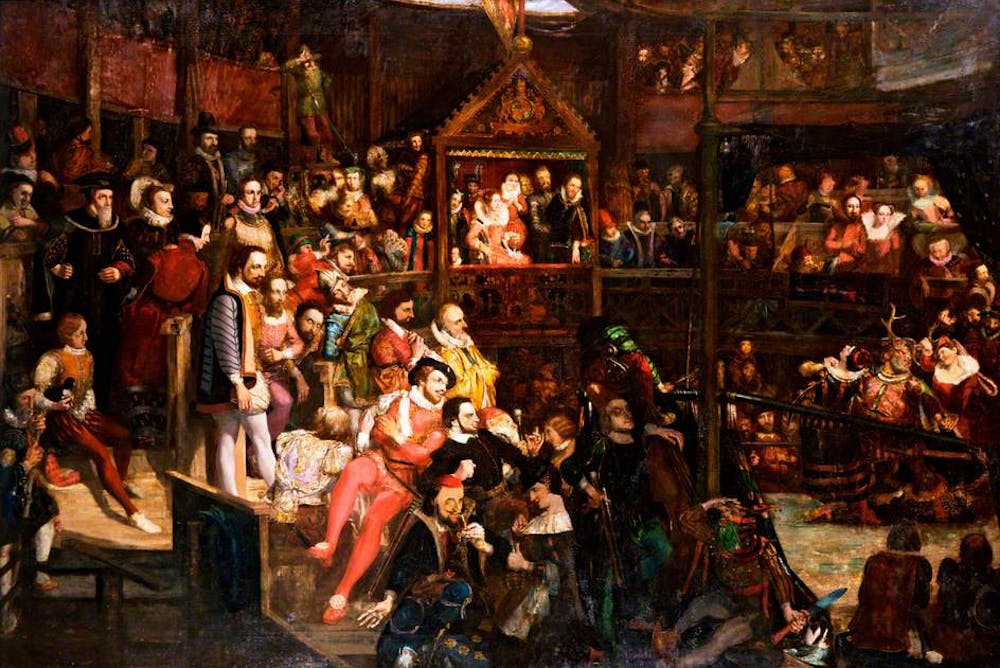
'Queen Elizabeth viewing the performance of The Merry Wives of Windsor, at the Globe in Merrie England' by David Scott
I like a drink as much as the next person. But there's a reason I go to pubs and clubs, even if the beer is often ridiculously overpriced. I like the atmosphere of sharing things with like-minded folk. Restaurants and cafes are better when they're busy (not cramped and heaving full, but with a low-level hum of noise). Silence is good when it is shared. Have you had a moment's silence in public? Then you know what I mean: there is nothing more moving than a collective memorial. 

Over the last few weeks I have held many on-line conversations and 'attended' conferences and meetings; I have done group trivia quizzes and play readings; I have watched re-runs of football matches and 'live' theatre. But I have missed the physicality. I will stay at home, and I will practice the physical distancing, because it saves lives and that's what matters. But when all this is over, I will find my flock and I will join them again, and we will sing our songs. 

Because it may be elitist; it may be exclusive; but being there is everything.


Tuesday, 24 March 2020

COVID-19: Dreaming is Free


Stories are my saviour. Whether told on the page, stage, screen (large or small) or radio, they inspire, enlighten, challenge and comfort me. It may not be the best idea to be watching World on Fire at the moment, but last night we watched the final episode of the first series. The series is set during the Second World War in France, Germany, Poland and the U.K. and it follows several families and characters from 1939-1940. It's tough to watch at times (and there seem to be a few anachronisms in terms of speech and accent), but it is well acted and sufficiently tense and dramatic to keep me involved.

I am tempted to see parallels with our current global situation, and slightly reassured that I 'mustn't grumble: things could be worse'. No one is shooting at me, or trying to bomb me, or threatening to hang me because I am the 'wrong' race, colour, ability, sexuality or political persuasion. Not yet, anyway: I don't live in America - cheap jibe, sorry. But there is a preponderance of panic buying, propaganda, misinformation, uncertainty and an extremely rapid pace of change. Life (and death) goes on in altered circumstances; people still get born; get married; fall in love; fall out... not necessarily in that order. And like World War II, those in the midst of it have no idea of when and how it will finish. Trust me, I've just seen the last episode of World on Fire and there is no satisfying sense of closure - sorry if that's a spoiler.

Our COVID-19 situation also sees leadership, and the lack thereof. Boris has been chewing his way through speeches by Churchill and Plato and now emerges blinking from his shabby chrysalis as a somewhat unlikely statesman; Prince-Hal-like, the foppish fool has sobered up to face the future. Jacinda is calm and firm; just and fair, dealing with a hideous situation with sense and sensibility. Scotty is floundering about like a lumpfish in shallow water but out of its depth. Make some decisions; be bold and resolute; lead!

In Australia we are told that schools are 'pupil-free' but they remain open and no one is turned away. We are told that only essential services should remain open - yet many businesses have not been made to close, so people are still heading to the office, hoping for a gold star from the boss. We are not allowed to gather so theatres, cinemas, gyms, pubs, clubs and restaurants have been closed. Art galleries and museums are choosing to close. There is no statewide ban on beaches, although people are 'advised not go' - yep, we've all seen how well people are following those guidelines.

Hairdressers and beauty salons are still open - it's important to look good in your coffin, apparently - but no one will be there to see you. Churches and places of worship are closed except to very small gatherings; weddings and funerals are not allowed indoors except in small groups observing the one person per four square metres rule. I am a sporadic church-goer; my places of worship are hills and woods and the great outdoors. I worship a mixture of myth and religion - I would like to believe in a golden thread that we can follow out of this darkness into the light once more.

I do usually go to church at Christmas, Easter, and Whitsun, however: they are the significant touchstones of my faith. This year, I will not be attending live services, but I will be commemorating the occasion in my way. Many people are suggesting ways to occupy their time in isolation (although Australia has not moved to this yet, and people are still congregating in entirely unnecessary groups); one of my pass-times is cross-stitch. I have been stitching little Easter designs of baskets and bunny rabbits, surrounded by eggs and flowers.

All this is probably what informed my dream last night in which I was trying to stitch together a Polish fabric that had been destroyed by Germany. It was my duty to reconnect the border by unpicking the existing stitches and working them back into an unbroken line with a golden thread. I believe our dreams are important - not in a Freudian way, but because they are a coping mechanism in which the brain shuffles events and tries to impart some meaning. My bible is the bard, and I find words to fit every event in his plays and poetry. And so it is with dreams, which come to us in sleep:
"Sleep that knits up the ravell'd sleave of care,
The death of each day's life, sore labour's bath,
Balm of hurt minds, great nature's second course,
Chief nourisher in life's feast."
I know I have employed that quote before (it's one of my favourite, from one of my favourite plays), so here's something else that's been on my mind.


Friday, 25 September 2015

Friday Five: The Mesmeric Magic of Crowds


Following on from last week's Friday Five, I've been thinking about the mesmeric influence of dancing in a club; of the wonderful vibe experienced at a rave. A lot has been written about the brutality of the mob; about how being part of a crowd can make a person lose their individuality and behave in an ugly and anti-social manner. At this point some sort of reference is made to riots, hooliganism and/or the French Revolution. But I think that sometimes crowds can have a beatific influence, and their collective nature can be a force for good. And please stop waving your phone/tablet about and ruining it for everyone else. Aren't you capable of remembering stuff?

5 Times it's good to be part of a crowd:
  1. Music/ dancing - as discussed. Of course one can dance with oneself, but the experience is a lot different if there are 'twenty thousand people standing in a field'
  2. Theatre/film/sport - A live audience is a wonderful thing. The shared emotion makes a film even more memorable - watching Silence of the Lambs in a cinema where the code of conduct was impeccably observed and everybody jumped at the same instant was unforgettable
  3. Battle - That speech of Henry V wouldn't have been so inspiring if no band of brothers were there to listen
  4. Church/vigil - Whatever your belief or religion, if you share it publicly with others through song, prayer, or silence, the feeling of togetherness is indescribable
  5. Rally/ threat - There is power in a union: The people united will never be defeated

Tuesday, 26 April 2011

Easter Weekend

Good Friday

Actually, the long weekend started last night when we had friends round to dinner. I made baked figs with blue cheese (and prosciutto for the non-vegetarians among us); penne pasta with mixed mushrooms and goat's cheese, served with a big green salad drizzled with parmesan infused olive oil, and apple and peanut butter crumble (made with apples from Jo Reid's garden) and Bird's Eye custard (from a tin). We drank Easter bubbles from France, oaked chardonnay from Hawke's Bay and pinot noir from Central Otago. This morning we cleaned up.

I submitted some artwork to the Arrowtown Autumn Festival - photographs I have taken and had framed or stretched on canvas. Arrowtown is so peaceful in the morning before the visiting hordes arrive that it is worth taking a moment and reflecting how lucky we are to live here. I picked up some pains aux chocolat and a baguette from the French bakery, which I took home and we had them with coffee on the patio.

Him Outdoors was competing in the Lake Hayes Duathlon, which with the main event of the associated triathlon, is the oldest surviving triathlon in the country. He came second by 45seconds to his main rival in his age-group; quite distressed because 'Dave's got a new bike!'


I, meanwhile, mountain biked around the lake and along some local tracks shouting, cheering and generally supporting with a couple of friends who also had nothing better to do.

Afterwards we thought we might have a drink at the local pub but it was closed and the one down the road was charging a surcharge (which I loathe - they make enough money to be able to pay their staff without hiking the prices - if you don't think you can afford to open on a public holiday; don't) so they lost out on four meals and several rounds of drinks from us, as we went home and drank red wine in the front room instead.

Picture from Fakers starring Matthew Rhys, Kate Ashfield, Tom Chambers, Tony Haygarth, Art Malik, Rula Lenska, Bruno Castra, Ilaria DElia, Sam Mancuso, Dominique Ventura, Jonjo ONeill, Larry Lamb, Stephen Greif, Félicité du Jeu, Edward Hibbert, Paul Clayton, Jonathan Cecil, Paul Lacoux, David Florez, Peter Barnes, Sally Mates, Sarah Paul, David Henry, Angela Bradley
Later in the evening we watched The Fakers, 'a funny, sharp and fast-moving tale of blackmail and forgery set in the upper echelons of the international art society'. The 2004 film is billed as an off-beat comedy along the lines of The Thomas Crown Affair or The Italian Job - those are two of my favourite films and it doesn't live up to them, but it's not bad. It stars Matthew Rhys whom I've only ever seen as Kevin Walker on Brothers and Sisters, and he's actually very good - and Welsh! Who knew? I have more respect for him now - not because he's Welsh, but because he can really act.

Easter Saturday

Him Outdoors had some vouchers that he won at the Motatapu Adventure Race burning a hole in his pocket, so we strolled into town along the river and paid our respects at the cenotaph (it is Anzac Day tomorrow and will be heaving so we got in early) before popping into the shops and buying woolly jumpers and a flat cap for everyday (he still has his grandad's 'for best').

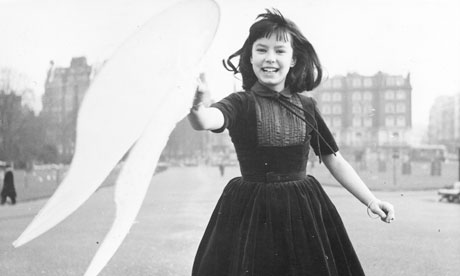
Back home we watched a couple of short films on a DVD I got free with The Observer when I was in England last year. It features 'five early short films from Britain's most influential filmmakers'. First was Amelia and the Angel (1958) directed by Ken Russell. In black and white with a gentle voice-over, it tells the tale of Amelia who takes home her angel's wings to show her mother, 'even though she will see them tomorrow at the school play'. When her horrid brother destroys them, she searches throughout London for another pair (including cemeteries and rag and bone carts), despairing until she stumbles across an artist's studio where a bearded sandal-wearing painter dresses up his models in theatrical outfits.

The clear narrative arc, dramatic music and omniscient narrator reminded me of an episode of The Clangers - things were simpler back then, even for Ken Russell it seems. Some of his early directorial touches are evident; the low camera work intended to mimic a child's view would have been considered a stroke of genius, although commonplace now.

Next was Boy and Bicycle (1965) directed by Ridley Scott. A teenaged boy bunks off school and cycles around Hartlepool instead - you'd have to imagine school was pretty dire if this is his preferred pastime. The strteets are empty; the beaches are deserted; the factories are grim. The young man provides a self-consciously assured voice-over in a landscape that seems almost post-apocalyptic.

The tracking shots and building of tension are clearly the director's trademarks and it's interesting to see them in their infancy. Scott was a photography student when he made this, which is apparenty in the perfect composition of the shots. Living in a world where we are bombarded with audio pollution and sensory stimulation, this was almost soporific (perhaps intentially - the revolving spokes of the bicycle wheel being particularly hypnotic), and so we decided to leave the rest for another day.

Later still (in the middle of the night) I watched Liverpool take Birmingham apart. Not only was the 5-0 scoreline (including a hat-trick from Maxi Rodriguez) something to celebrate, but I was hugely encouraged by the way the team played with energy, enthusiasm and something like the passing precision of old. I miss Stevie G, of course, but it's also great to see the 'youngsters' coming through the ranks - Jay Spearing, Jack Robinson and Jack Flanagan all played well and, although they may be tested by tougher opposition, things are finally looking up for the future.

Easter Sunday

As I walked to church this morning, I saw a lady in her slippers and pyjamas distributing chocolate eggs through her dewy garden. When she saw me she smiled, put her finger to her lips and whispered, 'Shhh, I'm the Easter Bunny'. I didn't have the heart to tell her that she wasn't.

The service at St Paul's was joyful and positive; emotions I could use at present, and naturally, I love a good sing-a-long. An extract from the order of service stated, 'Faith is like a bird that feels dawn breaking and, while it is still dark, begins to sing.' I think that sums it up nicely.

We spent the afternoon in Clyde at the Wine and Food Harvest Festival. As you can tell from the images, a good time was had by all. We came home to rehearse for the show I am directing; Cribbies for the Arrowtown Autumn Festival. It opens a week today, which is more than slightly scary. We went over all the dance moves; many of which I have set, so they are not exactly complicated!

Easter Monday

My cold is catching up with me and I woke up this morning with difficulty breathing. It may not have been the best idea, then to walk up Tobin's Track, but friends called up and that's what we did. The views are as glorious as ever and the couple of dogs that we had for company were certainly entertaining. How wonderful to be a dog when everything is fresh and every smell could be an adventure. They bounded up and down and made us all feel tired so we came home to drink coffee and eat chocolate ducks and rabbits.


Another rehearsal in the evening at which we ran the play for the first time without a prompt. Things are coming together and, although I'm doing all I can, I don't know how you can make people learn their lines! And so I came home to a large glass of pinot noir, a warm fire and a hug from Him Outdoors. It's not been a bad Easter weekend.

Monday, 2 November 2009

Dunedin - buildings and beer


Dunedin really does have some spectacular buildings. Apparently the court house and prison were built in ‘the first wave of public buildings that changed Dunedin from struggling settlement to established town.’ Is this a sad indictment of society or a simple fact of life?

The Octagon is the meeting place for people new to the place and not so new. Lined with the art gallery, the Regent theatre, St Paul’s Cathedral, the town hall and several bars and restaurants, it really is the hub of the town.

In that attempt to maintain connections with the Scottish capital, the central statue is of Robbie Burns, known as the ploughboy poet for his earthy, womanising poetry, incompatible with contemporary Victorian morality, and largely undecipherable to any but the most pedantic of literature undergraduates. More often than not these days he has a traffic cone on his head after some jolly student jape.

Among the churches, cathedrals, universities and civic buildings you can find coats of arms or gargoyles – little gems in grand settings. These always imply to me that the architect or perhaps the builder had a sense of humour and a personality after all.

And among the most iconic buildings in town are the twin Cadbury towers. You can tour the factory like Charlie although I doubt you’ll encounter Willie Wonka.

I didn’t go for chocolate this time as I was sidetracked by beer instead. Dunedin is slowly moving away from the beer swilling student ‘culture’ to more discerning drinking. We like the Duke of Wellington for the atmosphere and the selection of fine ales, and on this visit we happened across the Inch Bar which felt like it was in the middle of nowhere. We were actually heading for a restaurant, but we forgot to go.

I blame the Emerson’s hoppy porter – hops and porter; it’s a match made in heaven, or a Dunedin brewery. It is described as ‘an awesome wall of floral tropical fruit hop aroma clambering out of the beer glass, hitting the nose with sensory pleasure…mmm. Followed by a subtle smokey malt mouthfeel that really complements the hop profile.’ Admittedly it is described thus on Emerson’s own website, but I feel it is a pretty accurate summation.

So, cheers to Dunedin for a fine couple of days. I couldn’t live there – it’s too isolated and dour for me – but it has some high points; beer and buildings being two of the highest.

Sunday, 31 May 2009

Winds of Change

Today is Whitsun or Pentecost. From the Ancient Greek meaning fiftieth day, Pentecost is not the noise made by Ivor the Engine (as I used to imagine when a child), but is rather the fiftieth day after Easter.

According to the New Testament, it was the day when the Holy Spirit came upon the apostles ‘as of a rushing mighty wind’ with ‘cloven tongues as of fire’ and they all began speaking in tongues, going out and about preaching to crowds and gathering new followers to the church.


This all sounds highly dramatic and is the basis of many works of art depicting a strangely violent purification process. I particularly like this from Linda Schmidt who is a textile artist and quilter. I can imagine ribbons of flame make a great subject for patchwork.

One of my favourite parts of the story is that when the disciples all started babbling away in foreign languages, sceptics claimed it was because they were drunk or ‘full of new wine’. Our vicar pointed out that ‘alcohol rarely helps me speak English any better, let alone a foreign language!’ Peter is said to have leapt up indignantly and announced that they couldn’t possibly be drunk because it was ‘but the third hour of the day.’ Like that’s any excuse!


Alexander Sadoyan also warms to the theme with this remarkable portrayal in oil on canvas.

In legend, King Arthur always gathered his knights to the round table on Pentecost and had a big feast and declared a quest. In reality, medieval English folk had a ‘benefit feast’ to which everyone was invited and made a small contribution to the church which was used for repairs or distributed as alms to the poor. Special ales were brewed and Morris dances were performed. Any excuse for a festival. As with most traditions, it was partly parish and partly heathen but it sounds like a lot of fun and a time to celebrate community.

It is a day I have always associated with wind, in which case, what better place to celebrate it than Wellington? Or perhaps Christchurch where the famed nor’westers drive everyone mad, although they do get the sheets dry. I found a poem that I wrote two years ago about the wind in Wellington, which I feel fits perfectly here.


Morning regime

It’s windy in Wellington,
No surprises there.
No wonder the women all have short hair
I think as I walk past covens in cafes
And down to the sea.

Waves whisk foam like frothy cappuccinos
And the wind whips my breath
And the salt and seaweed away.
I lurch sailor drunk in erratic zig-zags
Sea-legs on shore.

The in and out pebbles
Clatter like castanets;
Driftwood dances tangos.
Is this what they mean by multicultural?
Kirikiritatangi.

I am blasted by sand and water
Rough edges smoothed out
Dead cells sloughed off
No need for further beauty or exercise regimes
I am ready to face the city.
Picture by Tiffany Chantel.

Sunday, 19 April 2009

Easter Sunday

As it is Easter Sunday, I go to the little church in Riversdale – it is gorgeous. The vicar is a farmer, a youngish bloke who has the Tinui district as his diocese. He has no little (or large) helpers to assist with the Eucharist and does it all himself.

The service is very interactive; there aren’t enough prayer books or hymn books to go round and there is neither an order of service nor an organ or piano. People just nominate an appropriate hymn that they like and everybody sings it. A volunteer is asked to do the reading, another passes round the collection and people are encouraged to call out the names of those they would like to be remembered in the prayers.

Tania from Camp Anderson
tells me there are 62 permanent residents at Riversdale Beach and the congregation swells during the holidays. The simple wooden church is packed to the rafters with worshippers and wasps – there’s a nest here apparently.

Tania and her husband run programmes at the adjacent camp for boys and girls during the holidays. Usually they are mixed, but this week they are running one just for girls with lots of art and craft activities.

Tania says she is struck by how many girls don’t know that they are beautiful and she finds this very sad. It leads to abused and broken women and she wants to help them develop their strength and their self-esteem and to know that their beauty has nothing to do with their looks. What wonderfully positive and noble sentiments.


The sermon likewise, is that we should all just be good to each and share the love – we don’t need to become priests and spread the word – simply listening to someone’s sorrows or baking a banana cake for the person down the road is enough to support those in our community.

I receive the blessing – I love the beautiful words, and I feel at peace. The congregation disperses to their family commitments and I drive back to our bach to Him Outdoors and bacon butties.

Monday, 24 November 2008

Chiantishire

The area dismissively known as Chiantishire really is beautiful, with rolling hills covered in olive trees and vines – it could catch on! I can see why people with money would want to renovate tumbledown villas and turn them into holiday homes with ensuite vineyard. I’m just jealous.

The Lonely Planet sniffs, “The hype has been just a trifle overdone. There’s plenty of more spectacular country to be seen in other areas of Tuscany. Let’s not put you off, but the Tuscan countryside by no means begins and ends in Il Chianti.”

You haven’t put me off, and I think it’s just gorgeous. I love the Romanesque churches (known as pieve) dotted about the hills and the little villages – three of which comprise the ‘League of Chianti’.

We call in first to Gaiole, but it is siesta-time. Nearly everything is shut and Him Outdoors is upset by that (“I feel I’m not supposed to be here”).


We take a back road which, by happy accident, leads to San Donato in Perano – a sort of winery on top of a hill where we are able to get a glass of wine, which cheers him up no end.

At Vertine, a castle from the 10th century is enclosed in an oval walled perimeter. We enter through the elegant gate and walk around the extremely sleepy village – the only people in evidence are a reading group sitting in a circle outside the church.

We walk around the wee town of Radda – the founder of the league. It is a beautiful place and supposedly has discount shops – factory outlets – but when I look at the shoes they don’t seem that cheap to me – not that they have any in my monstrous-not-tiny-Italian size. There are a lot of chavs done good, shopping around with their Chanel handbags, ostentatious bling and sugar daddies.

Down a side street we find a cellar with tastings on offer – an enoteca. A very kindly lady initiates me into the fantastic flavours of Chianti Classico – a blend of red and white grapes which is sold under the Gallo Nero (black cockerel/rooster) symbol. It is very fine indeed and of course we buy a couple of bottles before heading to Castellina, the third of the league.


This is another beautiful castle town, which was a frontier town between warring Siena and Florence. You are met at the entrance by huge cylindrical silos. They may look industrial, but they are, in fact, full of Chianti Classico, which has to be a good thing. Him Outdoors says this is his favourite town of the day and he even goes so far as to look at house prices.

We stock up on provisions in Stradda to go with our vino. We get bread, cheese, ham, olives and mayonnaise from the supermacto and some tomatoes from a chap in a fruit and veg shop who refuses to accept any coins for our meagre purchase of 0.20 euros.

Returning to our hotel, we make ourselves a little feast and watch the television which features films dubbed into Italian and some sports results. Florentina played in the UEFA Cup a couple of days ago and the referee was Mike Riley, which explains why Him Outdoors spotted him strolling across the Ponte Vecchio – as you do.

Saturday, 20 September 2008

Postcard from Gisborne

It was a glorious morning in Gisborne when I went for a wander around the streets and found a really great cafe for breakfast. Next to a secondhand bookshop, Cafe Ruba is fantastic - great coffee and an excellent bagel served with smoked salmon scrambled eggs.

A small vase of fragrant flowers (possibly jasmine; I'm not very good with my flora) and a bottle of water appeared on the table as if by magic.

Folk greet the morning here, discussing the world on the chairs outside. Boys in school uniform sit at a large table well-stocked with glossy magazines and sip coffee with a nonchalance that belies their years.

Baking tempts from behind the glass cabinets. The service is friendly, smiling, welcoming, prompt and adroit. I was impressed.

Gisborne is home to one of the largest carved meeting houses in New Zealand. Te Poho-O-Rawiri Marae is a beautiful building.

It is surrounded by beautiful green hills, bush and countryside. The red and white wooden embellishments to the building stand out in a powerful manner. The marae has hosted many people and many matters have been discussed here. Another great place for a meeting.

Close to the marae sits a Presbyterian church - at least I assume it is Presyterian due to the blue and white colouring. I don't know how long either of these buildings have been here or how well they coexist, but I like to think of them sitting side by side with the guardians or gods of each watching over their people and welcoming in all those who wish to enter.