Showing posts with label jungle. Show all posts

Tuesday, 28 September 2021

'God's Chosen People': Tanamera


Tanamera by Noel Barber
Corgi
Pp. 736

Tanamera (from the Malay meaning ‘red earth’) is the saga of the eponymous house and all who live in her, namely the Dexter family. It is a tale of a dynasty, narrated by John Dexter, and, by extension, a novel of Singapore. Of course it is a white colonialist’s view of Singapore and contains all the inherent classism, racism and sexism one would expect to find in a novel written in 1981. It claims to be both a witness to the change in the country before and after the Second World War, and a love story, but it is so partisan that it can barely be either, especially as the women are very poorly drawn caricatures.

The descriptions of Singapore are as viewed by an ex-pat; there are tennis clubs and gin and tonic on the veranda. And it is hot, and full of insects. The Dexter dynasty, and the house, was established by Grandpa Jack who made his money through rubber (Dunlop), railways, shares in tin mines, and setting up Raffles. The novel condenses the history of rubber and those who control the price and the export of it. The colonialist attitudes are jarring but not unusual: the casual racism and exploitation of the local people is hugely unpalatable but typical of the time. This attitude of superiority extends to gender and sexuality, as the narrator says of his brother, “even though Tim’s sickness manifested itself in his trousers, it was the head that needed attention.” He also refers to Tim, as “that fairy” and “a bugger boy”.


The narrator cannot write a credible female character. Julie, his love interest, is docile, compliant and beautiful, like an ex-pat’s colonial dream of an Asian woman. She is happy for him to take her virginity and does not mind that she is not allowed in his tennis club or at his parties, saying demurely, “I’ll always be yours if you want me.” Her looks and desirability to other men raise her value in his eyes and he admits to a “fierce feeling of possession and intimate knowledge of showing Julie off. Of course Johnnie marries and has children with someone else, while claiming to retain undying love for Julie. He tries to justify his actions as Julie forgives him for sleeping around and marrying someone else because there is licence to cheat during the war, apparently. She is light-hearted and never remonstrates with him but quotes poetry instead in a parody of the accommodating oriental mistress.

It is unlikely that he appreciates a woman’s ability to enjoy herself sexually; he has sex with a friend, Vicki, when they are both married to other people and she tells him, “Every married woman secretly dreams of being raped – by a friend of course.” Later, Julie repeats this nonsense, with the exact same words. This dangerous fantasy of his displays a complete lack of respect and understanding. Dramatic scenes later in the novel linger on the prurience of a gang-rape of his wife and sister, Natasha.
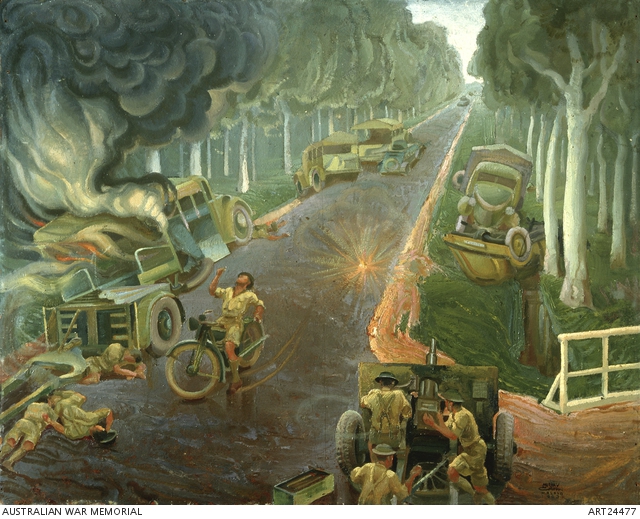
Action at Parit Sulong, January 1942 by Murray Griffin

There is some merit within the book, however, and it is in the description of war and how it affects Singapore (as seen through a colonialist’s eyes). There is a strong ‘end of an era’ atmosphere as can be expressed when viewing it in hindsight. War, when it comes, is initially just another reason for exploitation and profiteering, as it is seen from a distance as capitalists prepare for its approach. Eventually Singapore falls and the war comes directly to the Dexters, as John fights in the jungle, and there are detailed descriptions of making bamboo bombs and the sadistic torture methods and general savagery of the Japanese. As Barber’s reflections become more political and less personal, he includes footnotes to historians’ writing as if to back up his fiction with fact. He is better at understanding the big picture than individual motivations.

As a rambling novel of a family saga with Singapore as a backdrop, this is an ambitious work. One is reminded of James A Michener’s Tales of the South Pacific. He couldn’t write women either and approached the situation from a white male colonialist viewpoint, but it won him a Pulitzer Prize in 1948 when that was the only perspective that mattered. Hopefully times are changing.

Tuesday, 31 August 2021

Heart of Delusion: Marlow's Landing


Marlow's Landing by Toby Vieira
JM Originals
Pp. 294

Has any book had more effect on the literature of the jungle and the ‘other’ than Joseph Conrad’s Heart of Darkness? It is true that any story of a river trip into the unknown will call his novel to mind. Toby Vieira is counting on it, so much so that he names the mysterious destination to which his narrator is travelling (the title of the book) after Charles Marlow, the narrator of Conrad’s masterpiece. Vieira’s narrator is a dull accountant from Hull who is so bored with his mainstream job at an Antwerp-based gem dealer, that when Goldhaven, a man he has never met before, sidles up with promises of untold riches if he will just do a little job for him, he seizes on what he sees as an opportunity, unware that he is being played for a fool. There follows a fast-paced narrative of diamonds, deception and double-crossing.

Goldhaven is a shadowy character, and we are never sure if he is a hero or villain; chameleon or chimera. He certainly whets the narrator’s appetite. “Had I ever wondered, he said, what it would be like. To get my hands on a big pink stone. To hold what no one had held before me. To feel what no one had felt before me. To caress what no one had caressed before me.” What is it with men and their need to get their hands on something pristine? Diamonds and beautiful things come from hard and dirty conditions – mud and river beds – which lead to uncomfortable environments.

The narrator journeys up the river into the Caribbean jungle to meet with a dealer at Marlow’s Landing. The cover story is that he is a birdwatcher and he reminisces about “crammed hides and the smell of wet wool and mint cake.” He is unsure of where this place is and, despite a guide book and a real-life guide, he is none the wiser. “What does Babbon have to say about the part of the country Old Road is taking me to? Not much, since Old Road is heading into the heart of the biggest white patch on Babbon’s map. Babbon, it turns out, never made it back from the white patch. Babbon died before he could finish his book.” He is in constant fear of dangerous creatures; insects; snakes; Caymans; things that bite and sting, and his excitement does not last long. “I am sick of the tropics. Scabs come and scabs go. I have a giant blister on my ankle, the size of half a tennis ball, a neat globe, opaquely translucent, filled with liquid and with blood. Slime-covered lizards fall out of my clothes in the morning. I have strange headaches, on and off.”

The novel is written in a disorientating style, that makes the reader unsure of where we are or who is narrating and whether this is all a life-flash-before-your-eyes moment. While the story slips in and out of the reader’s grasp, it is the author’s style that keeps us absorbed, with descriptions that are vivid and chaotic. It is not just the unseen insects and nightmarish beasts that keep him up at night. The writing highlights the heat, illness, sickness, hallucinations and disease. As he gets more remote and further from known territory, he fears the lawlessness of his isolation as dead bodies riddled with bullet holes float down the river. This is a psychedelic whirlwind ride (one might call it the ambiguous definition of a trip) and perhaps a cautionary tale, suggesting that excitement might be overrated and boredom undervalued.