Friday, 29 June 2012

Friday Five: Romantic Comedies


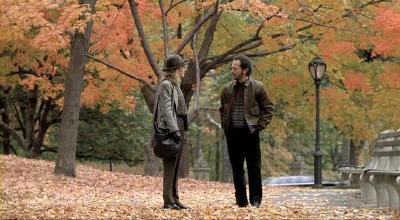
Following the sad death of Nora Ephron (writer; director; producer), tributes are flooding in, all of them mentioning her memorable romantic comedies such as When Harry Met Sally, Sleepless in Seattle, and You've Got Mail. These were great films in a genre I don't particularly favour, but she really made both the romance and the comedy work by providing great scripts for both male and female, which were delivered expertly by appealing actors.

I realise the blogosphere will be full of favourite romantic comedy lists, but I am not averse to joining in. Now, the definition is a bit tricky - there are comedies without romance and romances without comedy. I don't consider myself an expert in the field, but I know what I like: both the male and the female leads have to be convincing; there has to be chemistry; the dialogue has to be good, by which obviously for this category we mean funny; and it has to tug at your heartstrings a wee bit.

They are pretty standard, by definition, but I've yet to see a good same-sex romantic comedy - I'm not saying they don't exist; just that I haven't seen one. Perhaps this is because rom-coms are typically light-hearted and a bit fluffy, with a requisite happy ending. While films such as My Beautiful Laundrette or My Summer of Love are excellent, I'm not sure they fit the formula.


5 Favourite Romantic Comedies:
  1. Almost anything starring Hugh Grant. I know this is a bit of a cop out, but otherwise the entire list would be made up of films such as Four Weddings and A Funeral, Love, Actually, Notting Hill, Bridget Jones' Diary, Music and Lyrics, About a Boy, Two Weeks Notice... See, that's the whole list right there!
  2. Pretty Woman - an absolute classic fairytale with a hooker
  3. Shakespeare in Love - I don't usually like people messing with Shakespeare, but in this case, I'm fine with it
  4. Please Don't Eat the Daisies - of all the 'old' films I saw when I was a child, this one from 1960 with Doris Day and David Niven always stuck with me; they did things differently then, and with more than a touch of class
  5. Working Girl - I'm not sure why, but my mum loves it and it always make me think of her, so that's got to be a good enough reason. Plus it has great acting, really strong roles for women, it's an ode to New York, and has a theme tune that makes me cry. You go girl!

Monday, 25 June 2012

Literally Lying

Apparently a new season of X-Factor is due in Australia. I know this because a season of The Voice has just finished. Now, rather than programmes being ruined by endless previews of 'singers' popping up to stand and scream on stage, while people twitter on about them being awesome and giving them goosebumps (it would appear this is a very pimply nation) we have to endure promotions in which presenters blather on about how great it felt in the last series of X-Factor when they made their latest discovery, which they proceeded to inflict on the general public in a frenzy of unmerited hype and hoopla.

The most recent offender is some bimbette (Natalie Bassingthwaighte apparently, who used to be in Neighbours) who prattles that when she saw someone or other perform, it was so good that her jaw literally hit the floor. At last; something that would have been worth seeing!


Unfortunately, I suspect she is merely another in a long line of 'celebrities' who think that mangled grammar and excessive use of hyperbole make them sound intelligent, or even interesting. I know that language is fluid and that words assume new meanings and connotations, but 'literally' has a pretty fixed meaning, surely. I suggest you learn what it is, or try to keep the aforementioned jaw firmly shut.

Friday, 22 June 2012

Friday Five: Child's Play


The Bible tells us that when you are a child you speak as a child and understand as a child, but when you become a man, you put away childish things. I’m not so sure. I prefer the bit about there being a season for everything and a time for every purpose – “a time to weep, and a time to laugh; a time to mourn, and a time to dance” etc. And I think that the time to be childish and play with games does not finish with childhood.

I recently bought my nephew some Lord of the Rings LEGO (sorry if he hasn’t already opened his present, but he’ll know soon enough…) with a little Gandalf, a hobbit and a horse and cart. One of the pictures on the box showed Gandalf feeding the noble steed a carrot, which was bigger than the horse’s head – it was all I could do to wrap up the box without tearing it open for a quick play. I loved LEGO as a kid, and it seems I still do.

It made me think about my favourite toys as a child. Of course, there were the cuddly animals who went everywhere with me – they were great companions and could be dressed up and made to play all sorts of games. They were often lined up in front of a blackboard while I taught them stuff. I’m not sure I was a very good teacher because I definitely had favourites who got most questions right (little swats) and some who were very thick and had to be beaten with the bamboo cane to improve their learning ability – yes, I’m afraid this was the 70s.

Some of them remain in my old room at my parents’ house, some are in a box in the attic and some have travelled around the world with me. There is a scene at the end of The House at Pooh Corner, in which Christopher Robin must go to school that breaks my heart. “But wherever they go, and whatever happens to them on the way, in that enchanted place on the top of the forest a little boy and his bear will always be playing.”

Books were my other great love, and I disappeared into them for hours and then made up adventures and stories of my own to play – they were fantastic for imagination and literacy development, but I’m not sure they can be counted as toys. The games I played (either with friends or aforementioned cuddly animals) were interactive, but the books themselves weren’t.

When it was the last day of term at school, people brought in board games to play – do they still do that, or is the whole of schooling just one long doss these days? Others had Buckaroo or Operation. I used to like Monopoly but the game usually lasted for hours and ended up in tears and tantrums (when Dad said we had been ganging up on him. He was right, we had). For some reason I was never a fan of Scrabble or Cluedo – too much unnecessary speculation resulting in frustration.


I liked Guess Who, although I didn’t have my own version and it took me a while to work out the right questions to ask. (“Is it third from the left in the second front row?”) I had a game called Headache which I loved. I used to draw up tournaments between all my cuddly toys (which went from group stages to knock out rounds) and play it for hours in my bedroom. I think it was the Pop-o-matic bubble in the centre of the board that held most appeal.

I went through a cards phase as a teenager, although I didn’t really know any games except gin rummy, whist and patience. I used to play Racing Demon with Our Gracious Hostess and her sister in a furious frenzy when I was meant to be doing my homework. It got pretty raucous and her parents tried to ban us from playing it, which meant that we just did it more – oh what fun we had ‘but at the time it seemed so bad...’ Well, we were hardly sniffing glue or nicking cars were we?

I had a couple of dolls, but mainly I liked their accessories. Sindy had a horse and a tent, so she could go riding or camping. When my sisters were at big school and I wasn’t yet, they very kindly made me a whole set of school books and a uniform for her – I think they made a hockey stick and PE kit as well – which was wonderful, but they wouldn’t actually play any games with her (or me, for that matter).

My brother ‘played’ with me – by which I mean that he threw my cuddly toys down the stairs (or out of the window) claiming they had found a secret passage. He would wait until I had gone down to collect them and returned upstairs again before he threw the next one down. It was hours of entertainment – for him.

I also remember a game in which we ‘raced’ cars along the hallway. This involved hurling the toy vehicles as far as we could along the carpet until they thudded into the skirting board (sorry, Dad). We raced them in pairs and, again, I drew up a knock-out tournament. The ambulance was pretty good, although the articulated lorry was crap, especially when it was carrying plastic pipes.

And then there was the stuff we did outdoors: playing football, shooting the netball, whacking a tennis ball against the side of the house, skipping (both ‘normal’ with a rope and French with knicker elastic), rollerskating along the footpath, and batting a shuttlecock back and forth with Our Gracious Hostess. We had favourite shuttlecocks and always tried harder with those ones so they could win the tournament – I think there may be a theme developing...

And I loved my bike. Mum always said ‘Stay where I can see you’ but she wasn’t actually watching. I rode my bike up and down the kerb a lot (sorry, Dad) and once Our Gracious Hostess rode hers into the river and I had to sneak home and find some dry clothes for her to change into while she hid in the bushes so her parents would never know. Yep, we were dangerous. Our man in London says we used to ride round and round the green cackling in a terrifying manner, but I don’t believe it (the cackling bit).

So, I guess if I had to sum it up (and I really should), this would be it.

5 Favourite Childhood ‘Toys’:
  1. Cuddly toys
  2. Books
  3. Board Games
  4. Cards
  5. The Great Outdoors

Wednesday, 20 June 2012

Tales of the Unexpected


England are through to the quarter-finals of the 2012 European Chanpionships. I wasn't expecting that! They topped their group, which was also unexpected, and they managed to defeat the co-hosts, Ukraine, with a single goal scored by Wayne Ronney (which is probably slightly more expected).

So next, England get to play Italy. I cynically suggested penalties would make an appearance as in the knocked-out-of-quarter-finals-due-to variety, but Him Outdoors insists that Germany must be part of that particular equation.

We haven't got the satellite package that allows us to watch the live games and have to make do with highlights each evening on terrestrial TV. Apart from the England games, which I get up in the middle of the night to follow on the Guardian live blog. It's anxious stuff sitting in the dark biting my nails by the glow of the computer screen, while the rest of the street/ city is alseep. I hope it continues, although I don't really expect it to...

Tuesday, 19 June 2012

Elvis Calling

Ok, so London Calling is one of the best albums EVER (I don't know why writing about music makes me write like a teenager with random capital letters and excessive exclamation marks!!!!!) and this album cover, released in 1979, is one of the best pieces of artwork too, summing up the anger and disaffection of the generation. Like all good students, I had this poster on my wall as I attempted to osmote some cool. (Yep, I know that's not a word but I like it, and you know what I mean, and we're going with the whole teenage underdevloped vocabularly thing here.)


Now I know I should have known this already and I am aware that I am exposing myself to ridicule from certain friends (yes, I'm referring to you Bad Fairy and Our Man in London), but I never realised that it was done as a homage to Elvis Presley's first album released in 1956. The black and white image; the design, layout and font; the special relationship of one man with his guitar...


In A Brief History of Album Covers, Jason Draper writes, "A mixture of punk, reggae and rockabilly, London Calling may well be to punk/ post punk music what Elvis Presley was to rock 'n' roll - a collection of influences wider than the genres the artists were recognized as spearheading."

Incidentally, another band to riff on the themes of the album cover is the phenomenally perennial Chumbawamba. Check out Tony Blair, sent to everyone on their UK mailing list in 1999.


Friday, 15 June 2012

Friday Five: Current Favourite Words


Once as an undergaduate when I was writing an essay about eighteenth-century drama, a friend challenged me to get in the words paradiddle, iconoclastic and whirligig - which I managed. I actually got an A for the essay so either the lecturer wasn't reading it very closely, or he appreciated the linguistic contortions necessary to fit in seemingly irrelevant words.

Ever since then, I have loved the appearance of slightly out-of-the-ordinary words popping up in unusual places, whether it be football commentary or furniture assemblage leaflets. Perhaps it is not so, but I always imagine that the author/ speaker has had a bet with someone that they will somehow insert this word into their particular piece of prose. My favourites change often, but here are the current crop.

5 Words to Slip into Sentences:
  1. Scatological - often applied to humour
  2. Discombobulated - a state I find myself in a lot
  3. Anthropomorphise - mum used it just the other day and it reminded me what a great word it is to use (and say!)
  4. Kerfuffle - a close cousin of the equally appealing shemozzle
  5. Peripatetic - indeed, I used it to descibe myself very recently
There's a whole load of other words like that I like because of their plosive qualities (pepperpot; bumpkin; bombastic), onomatopeic merits (effervescent; gargle; clatter) or because of their associations (champagne; sleep; laughter), but these are the words I favour presently. What are yours?

Monday, 11 June 2012

My Week With Marilyn: Wiggle It


In this entertaining and engaging film, Colin Clark, an employee of Sir Laurence Olivier’s, documents the tense interaction between Olivier and Marilyn Monroe during production of The Prince and the Showgirl. It really does concern the events of one week (although they seem to be typical and exemplary of a much greater timespan), allowing director Simon Curtis to maintain a tight focus and avoid the rambling pitfalls of many a biopic.
Eddie Redmayne is charming and fresh as the besotted Colin Clark
Of course, Marilyn is the star of the show and Michelle Williams outstandingly captures her allure and vulnerability. She is crippled with insecurity about her true identity and her acting talent, surrounding herself with an entourage of admirers and sycophants, including Milton Green (Dominic Cooper in truly unctuous form) who supplies her with pills for everything, and drugs her up to manage her, and the chauffeur and chaperone, Barry (Jim Carter), who attempts to exert some measure of concerned control.

She particularly shines among the ‘common people’ – at Eton or the local pub, where she tells the landlord, “Nice place you’ve got here”. It is enough to warm his soul and he would dine out on such a chance remark for years. She knows it, but she can afford to be generous with her winsome smile.

"Shall I be Her?"
“Shall I be her?” Marilyn asks on a trip to Windsor Castle, where she is shown around by Sir Owen Morshead, Colin’s relation, acted with sensitive understanding by Derek Jacobi. She is struck by the fabulous dolls’ house and opens it up to look inside, murmuring, “Every girl should be told how pretty she is and how much her mother loves her.”

Marilyn grew up in other people’s homes with her own mother in an asylum. She doesn’t know who her father is and seeks approval from the establishment who are smitten with her sex appeal although they don’t much care for her personality. Her current husband, Arthur Miller (played with assured nonchalance by Dougray Scott) complains, “I can’t work; I can’t think; she’s devouring me” and he leaves her to return to America, which threatens to tip her into suicidal despair. Green explains, “You don’t leave Marilyn alone. She thinks everyone’s abandoned her”, and she questions through a drug-induced haze, “Why do the people I love always leave me?”

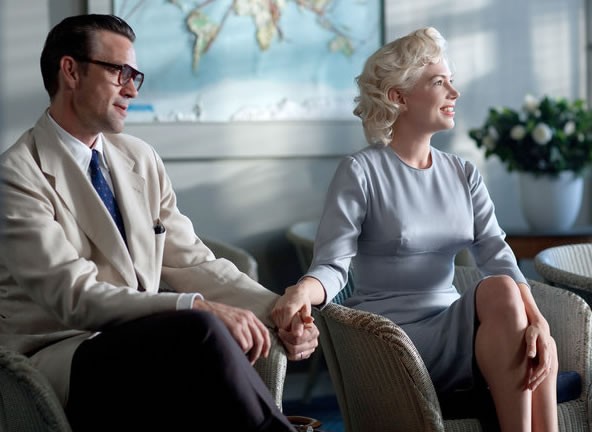
Dougray Scott as Arthur Miller and Michelle Williams as Marilyn Monroe
Marilyn worries that no one cares for who she really is; they are simply besotted by her persona. “All the people want is Marilyn Monroe and then they realise I’m not her.” Yet she plays to the myth, pouting and winking and talking in her ridiculous baby doll voice. Although she claims, “I’m not a goddess. I just want to be a regular girl,” she is keen to seduce Colin (Eddie Redmayne), taking her clothes off before him to swim in the Thames, and giggling under a blanket with him to try and escape her bodyguards.

"Did she break your heart? Just a little bit? Good, it needed breaking." - Emma Watson as Lucy considers her 'rival'
Everyone warns Colin that Marilyn is a heartbreaker and not to get involved – even the dowdy-by-comparison wardrobe mistress, Lucy (Emma Watson), who might have been his girlfriend before she was so dazzlingly eclipsed. Colin seems carefree and charming as he wins the affections and confidences of the delectable and delicate Marilyn, but the film is based on his diaries, so he would be made out to be a bit of a hero.

Kenneth does Larry
Sir Laurence Olivier (Kenneth Brannagh) fares less well. Anxious despite his gravitas, he can be hectoring and bullying to hide his own lack of self-confidence. Brannagh acts this perfectly, He seems intolerant to Marilyn fears, ranting, “We’re all scared. I’ve spent half of my life in abject terror. It’s what we actors do.” He tells Marilyn to “Rely on your natural talents”, suggesting she work her sex appeal and not trouble with acting.

Marilyn persists with acting coaching from the brilliantly bristling Paula Strasberg (Zoë Wanamaker) although Olivier fumes, “Trying to teach Marilyn to act is like trying to teach Urdu to a badger.” Larry doesn’t like method acting; it’s new and it frightens him. Marilyn is the future, which makes him feel threatened. When he removes his make-up before the mirror, he reveals the man beneath the actor, admitting that he wanted to feel young again by working with her, but “when I look at that magnificent face, all I see is my own inadequacy.”

Vivian Leigh (Julia Ormonde), Olivier’s wife and remarkable actress in her own right, is 40, which is too old to play on screen what she can on stage. She sweeps into rehearsals to dispense benedictions but also to check on her competition. Marilyn is 30. Hollywood demands young women, although hypocritically dominated by older men.

There is much warmth and generosity of spirit (and acting) in the film, but none more so than from the simply spectacular Dame Judi Dench. Who could possibly want a greater mentor than her or her character, Dame Sybil Thorndike? She makes excuses for the forgetful and stumbling Marilyn, always has a gentle word to ease her into the situation, and commiserates with Colin's infatuation pains. She also becomes embroiled in a stand-off between union members (over whose job it is to move a chair), which she calms by reminding us, “If the unions fall out, only the management benefits”. She is clearly on the side of us; the workers.

The ever-fabulous Dame Judi Dench as Dame Sybil Thorndike
My Week with Marilyn is a glorious film about a stunning woman, but it is also a film about films and acting, with many superb actors. The screen was eclipsing the stage and there is tension between the classical and more natural delivery, with a smattering of Shakespeare quotes throughout. A new generation of celluloid luminaries were emerging and the previous stars were losing their lustre. Acting is ephemeral and Olivier calmly accepts that “We are such stuff as dreams are made on.” And what wonderful dreams they are...