Monday, 11 September 2017

Kelmscott Manor: Useful and Beautiful

Kelmscott Manor
William Morris once wrote, 'Have nothing in your house that you do know know to be useful or believe to beautiful'. If one thinks of one's house as one's life, then I believe this is a statement by which to live. When I wrote copy for a real estate company, I tried to use the maxim in the marketing, but the editor scrapped it saying, 'that's too high-brow for our readership'. Sigh.

It should have come as no surprise then, that William Morris's Cotswold retreat at Kelmscott Manor was perfect. Everything is just so and nothing seems out of place or contrived. It is the equivalent of those people who spend hours on their look to give the impression that they have just got out of bed, and yet are designed to within an inch of their life. And I loved it.


When William Morris first saw Kelmscott Manor in 1871, he was apparently delighted by this 'loveliest haunt of ancient peace'. He signed a joint lease for the property with his friend and colleague Dante Gabriel Rossetti (who was deeply in love with his wife, Jane Morris nee Jane Burden) and it became a haven for the Pre-Raphaelite Brotherhood. What could possibly go wrong?

Blue Silk Dress - Dante Gabriel Rossetti
Jane Burden - Dante Gabrielle Rossetti
The Manor is open from April to October on Wednesdays and Saturdays - one might say it was incredibly fortuitous that these opening times coincided with our Thames Path Walk schedule (which was exceptionally tight). Or, one might say that there were two things I planned around which to fit the walk - this being one of them. 

The staff are all volunteers and they are helpful and knowledgeable; welcoming and friendly - I couldn't recommend them highly enough. When we first arrived with our rucksacks, we were apologetically informed that we would have to leave them at the entrance, and I think we quite startled the lovely lady on reception with our great sighs of relief!

The house is furnished with an outstanding collection of the possessions and works of Morris as well as of his family and associates (Benson, Burne-Jones, Rossetti and Webb among them) that includes furniture, original textiles, pictures and paintings, carpets, ceramics and metalwork.


Penelope was designed as one of a series of wall hangings depicting heroines from literature and myth, adapted from one of Morris's favourite books - Chaucer's Legends of Good Women - written in the 1380s. It was designed by William Morris for the drawing room at Red House and worked by Bessie Burden (Jane Morris's sister).

Penelope
Guinevere
Guinevere is another of the Red House wall hangings. This one, for which Jane Morris was the model, was never completed. Neither was the room's ambitious decorative scheme ever completed but eight of the panels survive - three of them at Kelmscott Manor.

Designs for the Signs of the Zodiac by Edward Burne Jones (1865)
Morris, Marshall, Faulkner & Co.'s second major commission was for the Green Dining Room at South Kensington Museum, now the Victoria and Albert Museum. Philip Webb designed the overall scheme with the decorative plasterwork and wooden panelling; the Zodiac designs were for the small painted and gilded wall panels. 


Even William Morris' overcoat is superb in its simplicity and detail. Unfortunately, I spent the rest of the day humming 'in my William Morris overcoat' to the 'tune' of Joy Division Oven Gloves


All the rooms are exquisite, with everything immaculately spaced and curated to give a sense of calm and satisfaction when walking around the house. Every object draws you to it, inviting you to touch it, pick it up, sit on it... you can't: one woman did and she was severely reprimanded in the most Society of Antiquaries of London manner - she was asked to 'please don't touch, madam'.


"Everywhere there was but little furniture, and that only the most necessary, and of the simplest forms. The extravagant love of ornament which I had noted in this people elsewhere seemed here to have given place to the feeling that the house itself and its associations was the ornament of the country life amidst which it had been left stranded from old times, and that to re-ornament it would but take away its use as a piece of natural beauty." - William Morris, News from Nowhere
Possibly the only thing that looks as though it is 'displayed' is deliberate. In the closet the shelves were designed specifically (by Philip Webb) to house the Morris's superb collection of blue and white patterned china.


The staircase is sensational - the wooden stairs themselves; the mirror; the tapestry on the wall; the curtains... Sublime.


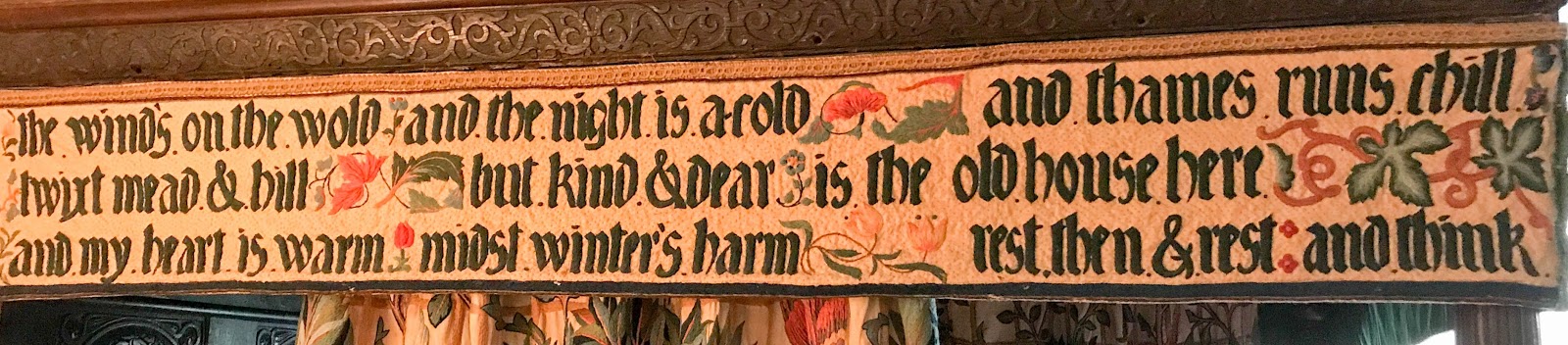
Morris's bedroom is dominated by the early-seventeenth century carved oak four-poster bed. This beauty with its multiple adjectives would be glorious enough, and yet it is made even more so by the soft furnishings. The valance and bed-hangings were designed in 1891 by May Morris (his daughter) and worked by her with the help of Lily Yeats and Ellen Wright (two Morris & Co. embroiderers).

The bed moved Morris to poetry and he composed Inscription for an Old Bed, the words of which surround the pelmet. The bedcover with its elegant and intricate depictions of plants of flowers was designed by May and embroidered by Jane. It's clearly a magnificent and inspirational piece of furniture.


Jane's bedroom also manages to be both a comfortable space and a thing of great beauty. The bed is, once again, utterly magnificent featuring the Homestead and the Forest cot quilt designed by May Morris and embroidered by her mother, Jane. It depicts a child-like representation of the Manor surrounded by the Thames and amidst a delightful miscellany of wild and domestic animals, birds and fishes - including foxes, a giraffe, elephant, tiger, crocodile and bear. Of course the lions are my favourite - those paws!

The borders of the piece are decorated with proverbs and quotations, which show how closely May was aligned with the socialist ideals of her father. Everyone should have a quilt like this. It has only recently been returned to Kelmscott Manor after having been held in private hands for 70 years. It's wonderful that it is back where it belongs.

Homestead and the Forest

Naturally, even the towels and fire screens are elaborately embroidered, but nothing feels excessive and is all done with impeccable good taste. The late seventeenth-century inlaid marquetry chest is intricate and eye-catching, but while the small jewel case is equally well-crafted, it leaves me cold. This is probably because, while it belonged to Jane, it was decorated by Rossetti and his wife, Elizabeth (aka Lizzie Siddal). The central panel depicts lovers, which is not exactly subtle as Rossetti was conducting an affair with Jane at this time under the nose (and roof) of her husband and his wife. 


The Tapestry Room was used by Rossetti as a studio. When he left Kelmscott, William and May both used it as a working space. It is lined with tapestries which were in situ when Morris found the house. Depicting the life and death of Samson, many of them are wickedly violent but the naivete of style, rich decorative detail and faded colours make them attractive and fascinating. Rossetti didn't like these images, finding them creepy and disturbing - Morris did like them, however, so they stayed.


The late seventeenth-century Portuguese desk has small drawers inlaid with paler olive wood and ivory. The fireplace has blue and yellow or grey patterned tiles. But the focal point of the room is the long oak table specifically designed by Philip Webb. It is currently used to display a facsimile of The Works of Geoffrey Chaucer designed and printed by The Kelmscott Press. 

The Kelmscott Press was one of Morris's attempts to preserve the old relationships between the artist and his art and his society. In 1891 he rented a cottage near Kelmscott House and set up three printing presses, intent on printing and binding fine books, influenced by Mediaeval illuminated manuscripts and the work of early printers such as Caxton. The books issued by the Kelmscott Press were expensive - Morris designed his own typefaces, made his own paper, and printed by hand - but they were beautiful. They were designed to be read slowly; to be appreciated; to be treasured. 

The Works of Geoffrey Chaucer is considered to be the finest achievement of the Kelmscott Press. Designed by Morris and illustrated by his old friend, Edward Burne Jones, it occupied much of the last six years of Morris's life and appeared shortly before his death. It was arguably the most beautiful book of its day.


The attic rooms are breathtakingly simple and sparse and ultimately beautiful. I know I sound besotted and, in truth, I am. The angles; the light; the beams; the wood; the nooks and crannies that seem to echo with children's laughter - almost unbearable nostalgia. William Morris wrote in News from Nowhere about,
"the strange and quaint garrets amongst the great timbers of the roof, where of old time the tillers and herdsmen of the manor slept, but which a-nights seemed now, by the small size of the beds, and the litter of useless and disregarded matters - bunches of drying flowers, feathers of birds, shells of starlings' eggs, caddis worms in mugs, and the like - seemed to be inhabited for the time by children."
Easier on the body than on the mind

The attic rooms also contain a couple of printed screens and books of swatches of Morris & Co. designs that are still available for purchase.


William Morris certainly never dismissed tapestry as 'women's work' or thought of it as inferior. Indeed, when he first took the lease on Kelmscott Manor he wanted to design and create his own tapestry. Although he didn't really have a clue what he was doing, he was inspired by the embroidery and weaving that he had seen at The South Kensington Museum, and he decided to have a go himself, resulting in the tapestry, If I Can.


Having mastered the art of illuminating manuscripts, designing for stained glass, wallpaper and textiles, weaving, poetry and Icelandic, Morris decided to branch out into tapestry production. The Acanthus and Vine tapestry was his very first effort. He designed the loom himself, working at it in his bedroom at Kelmscott House (Hammersmith, London) whenever he found a spare moment. His diary tells us that it took him 516 hours to complete. 

His ruminations on the art-form, however, can't have been too popular with the honest folk down the pub who must have taken issue with his grandiloquent designs.
'If a chap can't compose an epic poem while he's weaving tapestry, he had better shut up; he'll never do any good at all.' 

Morris felt that tapestries made the walls look more warm and welcoming. The Daisy wall hangings (1860) was the first project William and Jane worked on together after their marriage and their move to the Red House. Jane later recalled how she had purchased
'a piece of indigo-dyed blue serge I found by chance in a London shop... I took it home and he was delighted with it and set to work at once designing flowers. These we worked in bright colour in a simple rough way. The work went quickly and when finished we covered the walls of the bedroom... to our great joy.' 
Daisy wall hangings designed by William Morris and worked by William and Jane Morris
The Strawberry Thief design reflects how William Morris found inspiration everywhere at Kelmscott Manor, which he called 'very stimulating to the imagination'. His daughter May later recalled how the design came about.
'You can picture my father going out in the early morning and watching the rascally thrushes at work on the fruit beds and telling the gardener who growls, 'I'd like to wring their necks!' that no bird in the garden must be touched.' 
The Strawberry Thief
Having fully explored the house, we emerged into the gardens, which are as perfect as the interior. Again, each path beckons; each lawn comforts; each bower soothes. On first laying eyes on the place, William Morris claimed that it looked as though it had 'grown up out of the soil'. It still does. 


Naturally, Him Outdoors was fascinated by the brewery, which is housed in one of the outbuildings. It also served as a kitchen, and I was instructed in the ways of the copper kettles and the old mash paddles.


I was inspired by the plethora of prints on show to get creative with the camera in the garden. I reckon these quince fruit, fig leaves and redcurrants against a lichen-spotted stone wall would make excellent designs.


NB: Fittingly on the last day of our Thames Path Walkway, we encountered The William Morris Society building in Hammersmith, which is open to the public as a museum at limited hours. In a way it was fortunate that it was closed the day we passed it or we would have run out of time on our walk. We'll just have to come back.


Friday, 1 September 2017

Friday Five: And Yet More Theatre Outings

And the latest offerings are (admittedly from a while back before I got engrossed with my own show):

Talk by Johnathan Biggins at The Playhouse
  1. Noel Coward Double Bill (Weatherwise & Mild Oats) at Teatro Vivaldi - Director Tony Turner unearths two delightful short (one-act) plays by The Master. A simple drawing-room set serves to provide all the context required to enjoy these theatrical morsels between meals. They are perfectly suited to the dinner-theatre theme with humour arising from well-acted awkward situations. Whether unaccountably thrown together in a bachelor's apartment (awkward pauses are perfectly played by Henry Strand and Alessa Kron) or dealing with a hypnotised woman who believes she's a dog (a great comic turn by Elaine Noon), strict adherence to manners and deportment are not negotiable. They combine to form a veritable amuse bouche.
  2. First Seen 2017: Hired Mother at The Street - The First Seen programme helps playwrights develop their work by presenting them in rehearsed readings to the public, who then engage in conversation which will hopefully lead to further progress and production. Cathy Petocz's imaginative play deals with mother/daughter interactions and how they affect (and are affected by) the greater cosmos. One of the characters is a piece of moon rock who witnesses the maternal breakup and attempts to put the relationship back together. However, as she falls for the daughter and wonders about the need for a powerful female figure in her life, she waxes and wanes in both provocation and potency. There's a lot to like here and I look forward to seeing it hit the stage.
  3. Talk produced by the Sydney Theatre Company at The Playhouse, Canberra Theatre Centre - Jonathan Biggins' writing epitomises social and political satire in action. Set in a fantastically realised radio station, a talk-back jock (played with toe-curling credibility by John Walters) ignites vigilante justice: 'Whether it's using an i-pad or a pitchfork; a mob is still a mob.' A traditional journalist quits in despair after trying to pass on tips of the trade and ethics to an intern more bent on reporting a sizzling soundbite than cold hard facts. Meanwhile the TV executives are playing a ratings game which tramples on truth and lives to achieve figures and awards. It's all rather depressing but brilliantly executed. 
  4. Verdict produced by Tempo Theatre Inc at Belconnen Community Theatre - Tempo Theatre under the helm of Jon Elphick tackle their latest Agatha Christie with their trademark enthusiasm and solid production values. Professor Karl Hendryk (Paul Jackson) is a romantic in terms of education but less so in other areas, much to the chagrin of his long-suffering invalid wife (Nikki- Lynne Hunter whose wheelchair confinement doesn't hamper her expressive performance) and her cousin (Monique Dyson) who also yearns for him. As we actually see the murder committed on stage (by an infatuated student - Kirsten Doyle), this particular puzzle is not so much a whodunnit as a willtheygetawaywithit? It's a faithful rather than an inspiring production, but it poses some interesting questions such as whether principles more important than people, and the Queen of Crime's less-than-sparkling dialogue is once again carefully handled. 
  5. The 39 Steps produced by Canberra Repertory at Theatre 3 - Despite inexplicably deciding that the great Scottish hero, Richard Hannay (Patrick Galen-Mules) should be Canadian (with all the jarring inconsistencies that creates), Jarrad West and cast and crew attempt to squeeze every ounce of humour from Patrick Barlow's adaptation of Alfred Hitchcock's film of John Buchan's novel. Steph Roberts is spectacular in her several roles, bringing nice differentiation to each. There is no corresponding subtlety in the clowns (Helen McFarlane and Nelson Blattman) who are somewhat overblown and their broad-stroke performances tend to merge multiple characters into one. If you're after a fast-paced frolic; a ridiculous roller coaster ride; a preposterous performance, and some jolly good fun, however, you could do worse.

Monday, 28 August 2017

Laughing all the way to the Banksy?

The Art of Banksy
The Paddock, Federation Square (the dodgy car park, behind the Fed Square car park). Melbourne
7 October 2016 - 31 January 2017

Some time ago, I found myself in Melbourne, with a Banksy exhibition on my doorstep. I've always been intrigued by Banksy and his art. And, yes, I do think it is art, even though it is stencil and spray-paint and not always even by him. I find his ideas interesting, and warm to the way he takes the personal and makes it political. I know it has been described as crude and simplistic, but I find it inspirational in its clarity. It is direct and accessible and refutes the notion that art is for the elite. It is self-referential and deprecating in equal measure, and literally brings art out of auction houses and into the streets.


I Can't Believe You Morons Actually Buy This Shit (2007)
And yet an exhibition such as this takes it off the streets and puts it back into the gallery. Artwork such as Barcode Shark, Festival, or Consumer Jesus decry the fundamental ideas of capitalism, while there is, of course, a gift shop, selling these images on t-shirts, postcards and mugs begging the question who is the mug, here? One exhibit actually features t-shirts hung as works of art rather than clothing, further confusing the boundaries between ideology and practicality.


There is no exception to the rule that everyone thinks they're an exception to the rule - Banksy
Consumers of this art are being ridiculed even as they admire it. We must face the consequences of our desire to scorn the herd, just as we are a part of it. And we may want to feel special and different, but we aren't. And that hurts. 

Have a Nice Day
This exhibition was curated by Steve Lazarides, a British art gallery owner. Having studied photography at Newcastle University, he was working on a photo-shoot when he met Banksy and became his agent. He subsequently launched the website 'Pictures on Walls' to promote street artists and urban art. He and Banksy parted ways in 2008 and yet he obviously still champions his former client's work - again one wonders whether the relationship is amicable and mutually beneficial. 

Rude Copper
The majority of the paintings in this exhibition were originally exhibited and sold in some of Banksy's seminal shows, which included two of the artist's most well-known; Turf War which took place in Dalston in East London in 2003, and Barely Legal in Los Angeles 2006.

Lazarides explains that with the ability and skill to exercise a wide palette of contrasting techniques and mediums, these inside works retained the same motifs and ideas that were presented in the outside street pieces. The difference, however, was that they were created with the intention of being viewed within the context of an exhibition environment. While an outside street piece was always created to be transient - there one minute and gone the next - Banksy's inside paintings instead required the scrutiny of a longer view. These artworks would instead potentially be admired for several lifetimes.


Girl with Balloon (gold)
The Art of Banksy features over 80 pieces of original art and screen prints in a pop-up gallery on The Paddock at Federation Square. It does not have Banksy's permission and is therefore an unauthorised exhibition. But if you attack corporations for greed and insist that all work should be public, can you criticise the curators for holding such a show?


The Burger King Kid
"It is not my place to give you my opinion on what these pieces are about. That privilege lies with the artist and I'm pretty sure that isn't something he'd ever do. You as a viewer have as valid an opinion on these works as either me or Banksy. They mean whatever you, the viewer, think they mean - there is no right or wrong." - Steve Lazarides

Flower Thrower (on tarpaulin)
Dorothy Police Search
Many of these spray-painting images have become ironic icons. From the flower-throwing rioter to the American soldier searching Dorothy's basket, the pictures are dripping with sarcasm and subverting authority but also tinged with hope. They seem to say that if we recognise that rampant capitalism is eroding our freedoms and poisoning our communities, then others will too. And perhaps there is a a glimpse of a brighter future. Even the trashed Mini has a stencil of the girl with the hope balloon near the empty fuel tank.


The smiley face features heavily in this exhibition. Now used as an emoji - a symbol of happiness when vocabulary fails - the classic design by Harvey Ball in 1963 represented sunny hedonism to raise the morale of employees at State Mutual Life Assurance Company. In the early 1970s, two brothers based in Philadelphia, Bernard and Murray Spain, added the words 'have a nice day' to sell novelty badges and other paraphernalia to a nation determined to forget the traumas of Vietnam. 

It also suggests the late-80s acid house culture, when the logo appeared on acid tabs implying that one could only have a good time by getting out of one's head because 'real' life was too banal and depressing. Thus a simple child's drawing became hijacked by a number of corporations (Wal-Mart tried to trademark it in 2002) which makes it ripe for inclusion on Banksy's work.


Smiley Grim Reaper
Smiley Angel Policeman
Naturally one would expect a street artist to be anti-capitalist and against rampant consumerism. In this regards, Banksy doesn't disappoint.

Festival
Barcode Leopard
Very Little Helps
Consumer Jesus
Barcode Shark
By taking art from its hallowed walls and desecrating traditional-style paintings Banksy gives art back to the people. He seems to intimate that it should belong to us all, and that we should all be able to see it, rather than it disappearing into the hands of private collectors - which turns full-circle when his own alternative prints are hung in galleries, sold at auction and hidden from public view.

Turf War
Bullet-proof David; Suicide Bomber (2006)


Banksy did a series of 'defaced' work in which stencilled imagery is sprayed upon a found canvas, perhaps purchased from a flea market or salvaged from a dumpster. He was known for sneaking into art galleries and hanging his works alongside Old Masters, complete with interpretive panels explaining the 'hidden meanings'.

Violence and the resulting fear is another common theme - whether painting military weaponry or police brutality towards protesters, he frequently highlights the scaremongering and fear which grips nations. This corporate violence leads to a death of innocence, which he seems to decry - using powerfully deceptive imagery in stylistic silhouettes, such as might be found in a child's picture book. Personal possession, which denies communal appreciation seeks to own and control rather than share.

Warning Sign
Bombing Middle England and Weston-Super-Mare
La American Flag
Kids on Guns Hill


Pooh Bear Trap
"Imagine a city where graffiti wasn't illegal, a city where everybody could draw whatever they liked. Where every street was awash with a million colours and little phrases. Where standing at a bus stop was never boring. A city that felt like a party where everyone was invited, not just the estate agents and barons of big business. Imagine a city like that and stop leaning against the wall - it's wet." - Banksy
His artwork is temporary and ephemeral, but never whimsical. It is often painted over, or dismantled, if it is in the form of installation art. Just before the gift shop was an installation of an old-fashioned sweet shop with jars of sweets, looking like simple treats. On closer inspection they bore copies of his protest images - something to sugar-coat the pill, perhaps?


Obviously the gallery couldn't recreate these impermanent exhibitions, but it included photos and videos of them, to spread the word and the ideas.


He is a keen animal rights campaigner, which makes sense for someone who gives voices to those who need most support. In Sirens of the Lambs, a slaughter wagon full of cuddly toys was driven around the streets of New York. He has previously spray-painted sheep (the RSPCA deemed their treatment was humane) and included a live elephant in a room, which he instructed people not to mention. 

But perhaps his most famous animal creation is the rat; pressed into service for propaganda and sloganeering, it equally represents the trapped commuter we recognise who gets stuck in the maze of making money to survive.


Throughout the exhibition are signs exhorting us to take photos and to share this stuff - art is not the preserve of the elite; it belongs to the masses. And yet we were charged $30 to enter - and there were queues to get into the tent in the 'dodgy carpark' behind Federation Square. 

Is Banksy laughing all the way to the bank? Is he now part of the establishment he set out to rail against? Has he well and truly passed the tipping point? I like his ideas and his presentation of them, so I don't care if he is swimming with the current of the dreaded mainstream. And I get the impression that he doesn't either.


Friday, 18 August 2017

Friday Five: Best of Beervana

Beervana has always been one of my favourite beer festivals. And when I say 'always', I mean from 2005 when I first went to it. From the early days in the basement of The Old Bank Arcade through the wilderness years in the Overseas Passenger Terminal, and the muscle-flexing times at the Town Hall, to its current incarnation at the Stadium. I've met people here who have become friends; I've formed memories and lost others; I've seen brewing trends come and go; I've seen hops, hops and more hops; and I've tasted many many beers.
A couple of hoppy people peering through the lights
This year I flew back to Wellington for the weekend. Direct flights between the New Zealand and Australian capitals were clearly meant to assist politicians, but the added benefit for beer drinkers is pleasantly palatable. I saw friends and family (and the much-mentioned four seasons in one day) and (according to my records on Untappd), I drank 62 beers. This was the best of the booze (in alphabetical order).


5 Favourite Beers:
  1. 8 Wired Brewing Wild Feijoa (6.7%) - when he tasted this, Him Outdoors made a sound a bit like a kookaburra; 'Woohoohohohohohahahaha!' I think that means he liked it. I did too - it's sour and tart and packed with fruit flavour and for the first time ever feijoas don't taste like soap.
  2. Behemoth Brewing Company Brave Bikkie Brown (6%) - Exceptional! Coconut and biscuity bready spices supported by a great English brown ale.
  3. Emerson's Brewery Barrel Proof Imperial Stout (11.5%) - Decadent Imperial stout with big boozy flavours and fantastic balance of malts.
  4. Te Aro Brewing Company Flanders Red Ale (7.6%) - Sour red, oak-aged funk with strong base malts: insanely good.
  5. Yeastie Boys Royal Tanninbomb (8%) - I love this earl grey tea marvel. Two of my favourite things (tea and beer) are combined by one of my favourite brewers. The tannins in this brew are perfect.
Stu McKinlay and me
 

Behemoth Brewing Company had this whole beer and sweet matching thing going on; the theme was a chocolate factory with helpful oompa loompas in orange t-shirts handing out treats (chocolate fish; coffee beans; spoonfuls of nutella; Anzac biscuits) to enhance the flavours of the beer.

5 Favourite Breweries (Based on a complicated points system I can no longer remember):

Tasting paddles from Kereru
Fabulous kereru head-dresses for the people serving the ale