Wednesday, 10 April 2019

In Homer's Shadow: Bridge of Clay


Bridge of Clay by Markus Zusak
Picador
Pp. 579

It has been highly publicised how long it took Markus Zusak to write this book, and the implication is always that it means a lot to him and is a labour of love. That is entirely understandable, but, at almost 600 pages, it reads as if he doesn’t know where to start, or finish, or even what to say.

The novel revolves around five boys growing up in a semi-rural suburb in New South Wales. Their mother, Penelope, died a long slow death from cancer and their father, Michael, abandoned them to deal with his grief alone. He returns asking for assistance to build a bridge so that he can get to and from his remote dwelling place on an island. Metaphor, much? Most of the boys refuse outright to help, but Clay offers to go with him, although he knows this will involve a severe beating at the hands or fists of his brothers when he comes home.

The oldest boy, Matthew, narrates the story, although he claims it belongs to Clay. The boys are hard to tell apart because they don’t do anything demonstrably different from each other – they all fight and drop out of school. Matthew tells us about them, rather than allowing their actions to individualise them. Thus we learn that he is the breadwinner of the family (although we are not exactly sure what he does; is he a labourer?), Rory is the biggest bruiser who likes a drink, Henry likes 80s films, and Tommy collects animals: a cat (Hector), a goldfish (Agamemnon), a pigeon (Telemachus), a cat (Hector) and a mule (Achilles).

Clay (he of the bridge building) is the quiet one. He is in training, although it is not specified for what. He runs a lot and fights. He also has a relationship with a young jockey, Carey (they live by a racetrack), which seems to involve them lying on an old mattress and him being tickled by her hair. They give each other cryptic gifts (a lighter; a broken peg; an old book) and speak in what are presumably meant to be deep aphorisms, but sound like the bits S.E. Hinton thought were too naff for one of her Young Adult novels. Incidentally, this is the first of Zusak’s novels to be promoted as general fiction rather than for young adults. The distinction appears to be length rather than content, as the general world of the teenage boys is no grittier than the setting of The Book Thief.

As the names might suggest, this is clearly meant to be an homage to Homer. The boys’ mother, Penelope Lesciuszko is a refugee from Europe, impelled by her father, Waldek, to escape the tyranny of totalitarianism. Her imagination has been formed by the 39 books Waldek owns, especially his copies of The Iliad and The Odyssey. Homeric epithets may work in epic poetry but the same descriptors (clear-eyed Cary Novak; warm-armed Claudia Kirkby), sonorous syntax and sentence length are tiresome in this novel.

Zusak plays with chronology, suggesting that nothing is straightforward, but the segments (each headed with font that looks as though it was typed on an old typewriter, as we are led to believe it was) are very short – often not more than a couple of paragraphs – and it is sometimes hard to tell where we are in the story. The Odyssey was spoken aloud and passed on to other narrators; Bridge of Clay simply has a number of unnecessary tricks which pall far too fast. Each statement is written as a new line, and the foreshadowing is overbearing.

“After all, Penelope would die.
Michael would leave.
And I, of course, would stay.
Before any of that could happen, though, he would teach me and train me for Hartnell.
This was going to be great.”
The narrative seems needlessly convoluted in structure merely to create suspense by with-holding information. One reviewer described it as ‘Bridge of Delay’, and the revelations are not worth the wait – Michael is described as The Murderer for several hundred pages before it becomes clear that his ‘crime’ was to leave the boys after his wife died. By this time I am past caring. When Matthew tells the story of Penelope and Michael (and Abbey, the woman Michael loved before he met Penelope), the novel is interesting. They met when Penelope’s piano was wrongly delivered to Michael’s house. He writes ‘Please Marry Me’ on the keys, and long after their presence has gone from the house, the faded writing on the notes reverberates as the piano remains as one of those resounding symbols Zusak so enjoys.

Clay is interested in his parents’ pre-occupations, including their obsession with Michelangelo and building. The brief chapters on the bridge-building could be interesting but they are crushed beneath the weight of their own metaphor. We learn more about how manly (stupid?) they are as they dig out earth and rocks with their bare hands and sleep under the stars in the riverbed. All too soon we are back to the rest of the family with their fighting and inarticulate relationships.

Matthew writes, “It’s a mystery, even to me sometimes, how boys and brothers love.” Despite the lengthy story presented here, it remains a mystery to me too. As annoying teenagers used to say, ‘build a bridge and get over it’. I loved The Book Thief. I shall remember Zusak as the author of that and put this down to an over-engineered folly.

Saturday, 6 April 2019

Shepherd Island Discs

Umbagong Park
Today I went for a walk, as I often do in the later afternoons and evenings. The clocks go back tomorrow, so there will be fewer opportunities to get out in the coming months. My knees don't like to run anymore but I still love to get out in the fresh air, and I usually listen to podcasts as I walk around the parks and back roads.

Desert Island Discs is one of my favourite podcasts, and today, as the sun lowered towards the horizon and inflamed the branches of the autumn trees I listened to an episode from a couple of months ago featuring James Rebanks, Shepherd and Writer. He mainly talked about Herdwick sheep, The Lake District, and farming in general, as you would expect. I like these things, and he was erudite and interesting about them, his family, and the education he embarked upon later in life. 

He had sound musical choices (by which I mean I liked them all, apart from Johnny Cash). He chose tracks by Kirsty MacColl, Nina Simone, Pulp, and Billy Bragg & Wilco. I was a bit disappointed that he chose Ernest Hemingway's The Old Man and the Sea as his book and said that he didn't really want The Bible or the Complete Works of William Shakespeare. He claims to be a writer, so surely even if he has no interest in religion or sixteenth-century drama, he can appreciate the stories and the storytelling within these literary canons. 

What really stood out for me in the program, however, was a throwaway comment that he made. He said he had read somewhere that the average British child today spends less time outdoors than the average prisoner. I looked into this when I got back indoors and found a survey from 2016 which seems to verify this. I was shocked. 

I love being outdoors and I did as a kid. Climbing trees, riding my bike, playing a peculiar version of badminton, walking by the river, even just sitting on the grass and making daisy chains are some of my favourite childhood memories, and the basis of some of my earliest friendships. Being outdoors and breathing fresh air restores my mental and physical health. I know that some places are too polluted to enjoy these environmental benefits and that I am lucky to live where I do. 

And yet, it's true that I rarely see young folk playing outside, despite the beautiful scenery, parks and open spaces that make up this Bush Capital of Canberra. My walk takes me past this rather odd sculpture of a group of kids playing football. They are regularly given different shirts to wear, dressed up warmly in winter, and treated to Santa hats at Christmas time. People obviously care about them and in some strange way want to incorporate outdoor play into their community. Sadly, these motionless mannequins are displaying way more activity than most young people today.

Friday, 5 April 2019

Cross-Cultural Chekov: Hotel Sorrento


Hotel Sorrento by Hannie Rayson
Eltham Little Theatre Inc

Eltham Little Theatre, 15 Feb - 2 March 2019

Australian amateur theatre groups love Hannie Rayson’s Hotel Sorrento, with good reason. It is by a local playwright with resolutely Aussie themes and it features strong roles for women (who make up most of the auditionees in community theatre).
The story centres on the Moynihan sisters who grew up together in the seaside town of Sorrento. Hilary (Alison Jones) still lives in the family home with her father, Wal (Roderick Chappel) and her teenage son, Troy (Mason Frost); Pippa (Michelle Cooper) is a businesswoman visiting from New York; and Meg (Sharenya S Kumar) is a successful writer who has returned from England with her husband, Edwin (James Chappel). When the three sisters are reunited after ten years apart, they feel the constraints of family life and sibling rivalry as ancient grudges and old grievances re-emerge.
Middle sister, Meg, has written a book which is shortlisted for the prestigious Booker Prize, and has set the local community alight. Neighbour, Marg (Chris Perkins) is fascinated by the details within; her friend, Dick (Peter Helft), is offended by what he sees as Meg’s dismissal of her background; and all concerned want to know how much is ‘true to life’ in the semi-autobiographical fiction. Hotel Sorrento is largely about family ties and the reliability of collective memory; the main focus is the relationship between three sisters and who has the right to tell their story, so it is a great positive that these relationships worked well.
Hannie Rayson creates plausible characters, and through their interactions, she layers the text with deeper social concerns. It’s a lot of responsibility, but the trio shoulder it admirably and present a solid grouping, despite some different acting choices. Alison Jones brings a calm patience and warmth to the role of Hilary; her gentle mannerisms a delight to watch as she embodies so much more than she says. Sharenya S. Kumar is a touch melodramatic as Meg; although the flamboyance may suit the character, it feels at times as though she is performing in a different play, or perhaps a musical or pantomime. Much needed naturalism is introduced by Michelle Cooper as Pippa, whose every facial and bodily gesture expresses a range of emotion from frustrated resentment to unbridled amusement.
Alison Jones as Hilary and Michelle Cooper as Pippa
The question of storytelling – who gets to do it and who owns the narrative – is approached from many angles ranging from personal and intimate to political and global, and everyone gets their say. In a 2014 interview, Hannie Rayson explained, “Who has power, how do they wield it and who suffers at the hand of it, are questions [that] always interest me. So I go to the family to explore them. I understand it in a family context. I can take the audience with me on that and make the links between what we understand in our known worlds with how the tensions might express themselves politically, in a bigger national canvas.”
In this production, directed by Kath Buckingham, the impulse to expand every metaphor proves a hindrance. The set (designed by Phil Holmes and Brad Buckingham) is too crowded with all the elements given equal weight and therefore jostling to find space. The conflicted characters in Hotel Sorrento spend a lot of time internalising their thoughts and emotions while gazing out to sea; the surrounding ocean is a strong image with its omnipresent ebbing and flowing and relentless energy, and the scenes on the edges of the stage are those that work best when actors and characters alike are unencumbered by furniture and free from physical and metaphorical restrictions. It would be satisfying to see them given greater release.
Troy (Mason Frost), Hilary (Alison Jones), Edwin (James Chappel), Dick (Peter Helft) and Meg (Sharenya S. Kumar)
Meg and Edwin’s interchanges before they leave England are conducted at the back of the stage with poor lighting and projection, which makes them difficult to see and hear. Similarly the pivotal scene where Hilary connects tenderly with Troy is handled sensitively by both actors but undone by awkward staging. The indoor/ outdoor effect of the porch of the house opening directly onto the dining room/ kitchen is confusing and hampers the speed of action as actors cannot move seamlessly from one location to the next. Lighting changes are slow, with some scenes held for far too long whereas a quick snap change would help with pacing.  Many lines are lengthened and several cues are late leading to dialogue, which should be fast-paced interchanges, instead becoming ponderous and dragging the narrative down.
Sharenya S. Kumar as Meg with James Chappel as Edwin
The theme of cultural cringe is a contentious one. It was a timely topic in 1990, but a quarter of a century later, these lengthy debates seem somewhat unnecessary. The scenes in which Marge and Dick argue over identity and (ex-)patriotism, and their introduction to the family dinner table to swap stereotypical slurs are the weakest moments of the play. This is no fault of the actors (Chris Perkins and Peter Helft handle their expositional roles with charm and commitment), but rather due to the fact that we have moved on to such an extent that these once-fresh discussions now seem tired and clichéd.
Indeed, Hannie Rayson herself said several years ago, “If I were producing the play now for performance, I would cut most of the references to the cultural cringe in relation to Britain. That time has passed… I think Australia has a pretty robust sense of self. The swagger born of insecurity about our cultural worth has all but disappeared”. She continued, “Hotel Sorrento was a play I wrote very early in my writing life. I think it is structurally flawed and expresses much of my inexperience as a dramatist… It was a journey of the soul, and even though I now think it's clunky in part, it's strange because actors, directors and audiences love it. It is my most produced play. It has had hundreds of productions.”

The reasons for that are still clear, and it is largely due to the humanity of the three sisters. Like Chekov’s multi-faceted counterpoints they are flawed and repressed, and often unable to express their feelings for each other and the situations they find themselves in. But they are also bright and funny and deep and complex and we know them; in fact we are them and we are ineffably drawn into their circle of light.

The cast of Hotel Sorrento

Thursday, 28 March 2019

FFF: Cultural Inappropriation


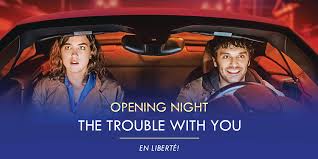
Last night I went to see a film at the Alliance Française French Film Festival. The film, The Trouble with You/ En Liberté was fine – it was a typically Gallic comedy/ thriller/ romance involving a corrupt cop, wrongful imprisonment, comedic crime capers, and slightly ditzy women who enjoy being subjugated.

The problems I had were not with the film itself, but with the audience and the screening experience. As a member of the Church of Wittertainment, I am a dedicated follower of the Code of Conduct with its strict guidelines on cinema-going etiquette (turn off all mobile phones; turn up on time; don’t talk during the film; do not eat or drink anything audible – soft rolls alone are permitted as nourishment etc.). These are broken way more often than I would like, but at this particular screening, the rules were broken more than they were observed.

To begin with, the lights were not extinguished until about 20 minutes into the film. I suspect the person in charge (I realise the days of projectionists are long gone, and now the head mech merely presses a button on a desk) forgot to run the trailer reel, as the film also finished about twenty minutes before the running time on the ticket. I could have gone and asked someone to dim the lights in the auditorium, but I would have had to find someone and, as there was a function going on in the cinema foyer, this would probably have proved difficult, and I would have missed a good ten minutes of the film.

Secondly, there was a lot of implied sex and violence in the film. Now, I appreciate that it was cartoon violence (indeed the title credits appear as ‘zap! kapow! comic-book graphics’), but people get shot, stabbed and punched; ears are bitten off; deep gashes are stitched back together; robberies are committed with gigantic sex toys and scenes are set in S&M brothels. There is also a mild-manner serial killer who keeps bringing bags of dismembered body parts into the police station only to be ignored by the love-struck inspector. Unsurprisingly, this is billed as a certified M film.

The M certification in Australia is defined as ‘not recommended for children under 15 years’. Two young girls (about six years old I’d guess) were running about in front of the screen. Their parents fed them huge buckets of exceptionally noisy popcorn and left them to it. At the end of the film one child commented, ‘I closed my eyes and covered my ears for some bits of it.’ Their parent laughed.

Indeed, there was a lot of laughter throughout the film – huge, raucous, bellyaching guffaws. It was a mildly amusing film, which would have just about passed the six laughs test, but it certainly didn’t justify this level of merriment and ribaldry. I had to wonder whether this excessive laughter at things that weren’t especially funny was an example of people attempting to prove that they are cosmopolitan because they can be amused by a film in French.

There was a lot of movement throughout the film, with people constantly coming and going, waving to each other, bringing in huge platters of cheese and cold meats, talking and refilling glasses throughout the entire session. I wondered whether the audience would behave this way if the film were in English. Did they not expect people to want to hear the words because it was in a foreign language? Or was it because the lights remained up for so long that it gave them the feeling that they were at a drive-through?

To be fair, when I lived in France and saw V.O. English films, I experienced similar lack of respect and breaking of the code. I could not hear the words and so had to read the French subtitles to understand what was being said in an English film. This intrigues me as being the reverse of people behaving badly abroad; are they are behaving badly in their own country because they are being presenting with an alternative cultural experience at home? Does a foreign language relive repression and encourage people to open up to more libertine behaviour? Or was this particular audience just in a state of advanced refreshment?

Saturday, 16 March 2019

Rolling Sculpture: The Shape of Speed


I'm not particularly a fan of vintage or classic cars, or any cars come to that - they're a fine mode of transport, but if it's not an E-type Jag; it's just a car. The exhibition at the Portland Art Museum, however, intrigued me. It was called The Shape of Speed and it featured nineteen rare streamlined vehicles. These models are shiny and glorious with many Art Deco features and precision details but, as with anything new, they took a while to catch on with the public at a time when people wanted something that looked like everything else. 

The concept of streamlining has fascinated people for generations. The years between 1930 and the outbreak of World War II saw rapid advances in the design of aircraft, trains and highways. These changes, along with global events like the 1939 World Fair in New York spurred automotive designers and engineers to create streamlined cars that were aerodynamic, fast, and increasingly fuel-efficient.

The 1934 Chrysler Imperial Model CV Airflow Coupe was miles ahead in safety and strength, and its 'dramatically different shape' was influenced by the fastest railroad locomotives of its time. Unfortunately, however, people purchasing cars wanted something more conservative, and 'its unconventional design was also miles ahead of public acceptance'. Sales figures were 'disappointing'. A less radical and simplified style was brought out the following year, which proved to be 'more marketable to the car-buying public'.

1934 Chrysler Imperial Model CV Airflow Coupe
The cars on display, presented as kinetic art, are indeed rolling sculpture, yet they are eminently capable of dynamic function. As guest curator, Ken Gross, former executive director of the Petersen Automotive Museum in Los Angeles notes,
"The seventeen cars and two motorcycles in this exhibition were designed without the myriad safety and crash-absorbing constraints that affect the look and form of the modern automobile. The operative charge was that they be sleek and streamlined. We will not see their like again."
The Spirit of Motion, more popularly known as the 'Sharknose Graham' appears to be moving while at rest. Its massive headlights are Art Deco-inspired with elaborately scribed lenses and a squarish-shape that must have encouraged considerable comment in the day. The styling was a complete flop in sales.

Graham Spirit of Motion
The 1937 Lincoln-Zephyr Coupe is considered to be 'the first successful streamline car in America'. It sold more than 180,000 units (finally ending production in 1942), saved the faltering Lincoln brand from oblivion, and helped pave the way for more aerodynamic successors. I like the back of it; it looks like there's speed and power in those curves.
1937 Lincoln-Zephyr Coupe
These automobile designs were organic, with many of them emulating the teardrop shape then considered to be perfect for cheating the wind. The results were brought to life in cars whose startling shapes seemed to invite them to be embraced and caressed. Even if they weren't noticeably faster than their predecessors, they looked fast.

American Paul M. Lewis planned an affordable, lightweight, aerodynamic and distinctive-looking car of the future. The museum catalogue informs me that, 'The Airmobile's independent front suspension was composed of tubular shock absorbers, coil springs and control arms. The odd car's single rear wheel, which was smaller than the two front wheel, was supported by a longitudinal, semi-elliptic leaf spring, a lone trailing arm, and a single hydraulic shock absorber.' No, I don't know what any of that means, but it looks like an inverse Reliant Robin from The Jetsons. And it's bright orange.


This shape of speed found prominence in countless other designs of the period, ranging from the architecture of Streamline Moderne to kitchen appliances, radios, and pencil sharpeners. The automobile, however, became the perfect metal canvas for streamlined design. 

The Cord 812 Supercharged is an impressive machine. It was the first American front-wheel-drive car with independent front suspension. New features included hidden door hinges, petrol cap, and headlights (obviously these were visible when they were turned on), rear-hinged bonnet (rather than the side-opening one more usual at the time), and variable speed windscreen wipers. 

The most famous feature was the 'coffin nose', a louvered wraparound grille, which came from designer Gordon Buehrig's desire not to have a conventional grille. The supercharged models were distinguished from the ordinarily-charged models by the brilliant chrome-plated external exhaust pipes mounted on each side of the bonnet and grille. 

As we've established, when it comes to cars, I'm more interested in the design than the details, and I think this looks pretty distinctive. I'm not alone; in 1996 American Heritage magazine proclaimed it, 'The Single Most Beautiful American Car'. In 2006, the 'Classic Cord' Hot Wheels toy car of the 1960s, a convertible coupe, was one of the most valuable and commanded up to US$800 if still in an unopened package. 

Cord 812 Supercharged

The 1938 Mercedes-Benz 540K Streamliner was specially built as a test vehicle for the German branch of the Dunlop tyre company. It was a unique vehicle, used by a US serviceman after the war and then returned to Mercedes-Benz in the 1950s, whereupon its bodywork was removed and most of its mechanical components were taken off and lost. Following the rediscovery of the chassis, restoration technicians at Mercedes-Benz elected to build a new body using traditional methods. Car enthusiasts were suitably enthused. 

Mercedes-Benz 540K Streamliner
Motorbikes are often romantic pieces of engineering design - unless they are those ones where the rider sits back like they're in an armchair: those may be comfortable, but they're ugly and don't really seem to be playing the game. This one is glorious - if probably impractical. The Henderson KJ Streamline Motorcycle from 1930 is a one-off, built by craftsman Orley Ray Courtney. The catalogue notes that it had a 'power hammer-formed steel body and a rear end that looked like it belonged on a speedboat.' Probably.

Henderson KJ Streamline Motorcycle
The catalogue notes, 'Chrysler confidently touted the 1941 concept car, the Thunderbolt, as 'The Car of the Future'. Sporting a smooth, aerodynamic body shell, hidden headlights, enclosed wheels, and a retractable, one-piece metal hardtop (an American first), the roadster was devoid of superfluous ornamentation, with the exception of a single, jagged lightning bolt on each door. It stood apart from everything else on the road, hinting that tomorrow's Chryslers would leave their angular, upright, and more prosaic rivals in the dust.'I think it looks like a liquorice torpedo.

Chrysler Thunderbolt

This 1938 Talbot-Lago T-150-C-SS has lots of numbers and letters in its name, so it must be highly qualified. Or something. Apparently it was the first one of three built with aluminium alloy coachwork and is unique in several ways, thanks to its lightweight body, fold-out front windscreen, and competition-style exhaust headers. It's also pretty and shiny with nice curves and a gorgeous glossy shine.
Talbot-Lago T-150-C-SS
The Bugatti Type 57 Aérolithe is one of my favourite models on the car-walk. Designed by Jean Bugatti, the Aérolithe (French for Meteorite) was a one-of-a-kind model that was built by Bugatti to star at the 1935 London and Paris Auto Salons. After the touring continental show circuit, the one-off Aérolithe disappeared. The one on display is an exact re-creation of the earliest known Type 57 chassis.

Bugatti Type 57 Aérolithe

It may be partially that mint green colour, but it is such a dramatic example of Art Deco styling. It may be reminiscent of luggage or a sofa, but those sloping lines and rivets are glorious. According to the catalogue, 'the avante-garde couple was sensually curvaceous, with a flowing sculptural body that was in marked contrast to the era's square-rigged competitors'. This is not something I would usually say, but just look at that rear end!


Joseph Figoni (French, born in Italy, 1894-1978) and Ovidio Falaschi (French, born Italy, unknown-1978), renowned Paris-based carrossiers (coachbuilders) were noted for their swoopy, elegant custom coachwork in the mid to late 1930s.

Richard Adatto,  resident of Seattle, author and expert on pre-World War II French aerodynamic cars wrote, "Joseph Figoni took modern streamlining to the next level by allowing the optimal aerodynamic shape to dictate the styling. Instead of two pontoon fenders that protruded from the car's body, Figoni found a way to incorporate them into the body, heightening the impression of a singular, flowing form."

1938 Delahaye 135M Roadster

"These sensuous curves are considered the quintessential expression of 1930s luxury European automobiles. Often described as 'rolling sculptures' or 'Paris gowns on wheels', Figoni and Falschi's voluptuous creations were the epitome of Art Deco automobile elegance." It is believed that only eleven of these roadsters were built.

Thursday, 7 March 2019

Significance Supersedes Style


Demons at Dusk by Peter Stewart 
Temple House Pty Ltd
Pp. 326

It took Peter Stewart almost 30 years to write Demons at Dusk and he has researched it thoroughly. The book explores the most infamous massacre in Australia’s history by combining official records and transcripts from the trials to recreate the story of what happened that day, the events leading up to it and its aftermath. It is written in a very straightforward and basic tone with no embellishments and seems more of a text book or a schoolchild’s history than a novel. It is, however, a very important story and needs to be told, which may perhaps mitigate the poor writing style.

In 1838 on a remote cattle station on the NSW frontier a free settler who looked after the property (William Hobbs) invited a group of Aboriginal people from the Weraerai to Myall Creek station with the promise of protection from the bands of marauding troopers and stockmen who roamed the countryside. They developed a close relationship, particularly with Old Daddy, a big elder, Charley, a young boy, and Ipeta, a woman with whom one of the younger hutkeepers, George Anderson, had some sort of relationship. While Hobbs was away, a group of powerful settlers came to the station and massacred 28 unarmed Indigenous Australians.

The massacre itself was not unusual, as many similar events occurred across the country, but it stands out as significant in history as being the first time the murderers were prosecuted. George Anderson’s evidence was instrumental in bringing justice to the Weraerai, and death to the murderers. This is a known story, but Stewart questions why Anderson would speak up, so he introduces a love interest, which many critics find jarring. They argue that for a story based on historical fact, it makes no sense to invent a fictional romance, and detracts from the magnitude of the event.

Because so much of the story is taken verbatim from contemporary letters, newspaper reports and court transcripts, the introduction of assumed emotions is incongruous and the tone becomes preachy and didactic. Some disquiet has also been raised over the perceived patronising effect of a white author putting words into Australian Aboriginal English: “And de tings don’t belongem to eachfella. Everything belongem everyfella. Everyting belongem all mob."

Stewart tries to introduce the tropes of foreshadowing and hindsight. The former is unnecessary: if people know this story, there is no surprise, just horror, so there seems little reason to try and build tension in this portentous manner: “They sat and ate and talked and laughed, unaware it was to be their last meal together, for twenty-four hours later Death would come to the Weraerai camp.”

The horrors of the massacre itself are stated baldly through flashes of atrocity. There are critical complaints that the novel would work better as a film, and on this occasion it is deliberately written in a screenplay style.
"Baby wrenched from mother’s arms and thrown to ground… Sandy and Tommy lunge forward to protect… Two shots ring out… Sandy and Tommy fall to the ground… Sandy struggles to feet, sword slashes back of his neck, severs head… Bobby’s wife knocked to ground, her baby grabbed… Mother wails… Baby screams as held by legs and head smashed against tree… Mother slashed with sword… Terror… Head hacked off…"

Stewart also attempts to explain the particulars of the court case and the attitudes of the time through patently unrealistic dialogue. Much of the court-case communication is taken verbatim from the transcripts of the trials with, as Stewart writes, “only very minor additions to illustrate how someone may have been feeling or to highlight the importance of a particular piece of evidence.” This level of gauche intervention makes it more like one of those American documentaries than a novel.

Defenders of the novel argue that many Australians know little of their nation’s history and they rely on novels to tell them of the past as all they learned at school were tales of British colonialism. They say that the florid writing style and undisciplined language is forgotten as the reader progresses through the power of the narrative. Should we overlook the literary failings due to the historical significance of the story? Stewart is to be commended for bringing this outrage to the attention of a wider audience, no matter what the standard of the prose in which he does it.

Tuesday, 26 February 2019

Oscar Predictions and Failures 2019, or Why I Don't Bet


Before the Oscar winners were announced I made my predictions based on some knowledge and a lot of guesswork. I picked twenty categories; I was right/ wrong in exactly half. Here are the results:

Best Documentary
My choice: Free Solo / Their choice: Free Solo 
I confess I haven't seen any of the documentaries nominated at the Oscars - they have such a short cinema release and are quite difficult to track down - but of all the trailers, this is the one that looks really gripping - that's sort of a pun because the climber must grip the lump of rock he's climbing in order not to fall off... never mind.


Best Foreign Language Film
My Choice: Roma / Their Choice: Roma 
It sort of had to be, really. It has won this category (or BAFTA equivalent 'Best Film not in the English Language') in all of the other award ceremonies this year. For some reason it has had a whole heap of publicity despite being released on Netflix and only released at the cinema for about a day and a half. I haven't got Netflix; I had to watch it at a friend's house. He had good wine, which helped. I'm not sure I could have sat through it without that.

Best Animated Feature
My Choice: Spider-Man: Into the Spider-Verse / Their Choice: Spider-Man: Into the Spider-Verse
I haven't seen it. I don't like cartoons and I don't like super-hero films, but I know America does. The only animated feature nominee I've seen is Isle of Dogs, because I think director Wes Anderson is a genius. It was very good but too clever and too original to win an Oscar. People might even have to use their imaginations while watching it, and we know how well that goes down with Uncle Sam fans.

Achievement in Sound Mixing
My Choice: First Man / Their Choice: Bohemian Rhapsody
It seems I may not know much about these categories. I thought the mix of sound and silence in First Man was outstandingly atmospheric. Apparently the brief was  'to create sequences to be experimental and immersive.' I felt this. In that claustrophobic moon landing sequence (sorry if that's a spoiler for anyone), I was hypersensitive to every sound - the droning hum of air pressure; the metal clicks of belts; the muffled voices and radio static; the creaks and groans of the space capsule; the breathing of the astronauts - I was as close as I could be while being 50 years and 250,000 miles away. Bohemian Rhapsody won because it's about a band that were bloody good at music.

Achievement in Sound Editing
My Choice: A Quiet Place / Their Choice: Bohemian Rhapsody
Ditto above. A Quiet Place is a mastercalss of when to use sound and when to stay silent - the clue is in the title. The opening sequence that reveals the bags of crisps as the only food item left behind in the store sets the sonic tone of the film. Noise can kill you - it is used brilliantly and judiciously throughout as an audacious narrative element. Once dialogue is removed from a film, the power, richness and nuance of sound becomes crucial. Bohemian Rhapsody won because it's about a band that were bloody good at music.

Achievement in Visual Effects
My Choice: First Man / Their Choice: First Man
Ok, so I've not seen the other nominees in this category (Amblin/ Disney/ LucasFilm/ Marvel - it's all just going to be big and brash), but even without having sat through identikit fighting and schmaltz, I believe this is a worthy winner. The visuals are actually effecting and enhance the experience rather than simply padding it out with yet another battle scene or a travesty of my childhood friends. The team (J.D. Schwalm, Tristam Myles, Ian Hunter) used a unique combination of miniatures, archival footage, traditional digital effects, and massive LED screens to re-create the Apollo 11 mission and the events leading up to it. It is a highly impressive achievement.


Achievement in Makeup and Hairstyling
My Choice: Vice / Their Choice: Vice
I suspected correctly that this might be the only category which Vice would win. I enjoyed the film and thought the attention to satirical and heightened detail was exceptional in all things, not least the hair and make-up. Greg Cannom, Kate Biscoe and Patricia DeHaney did a great job of making Christian Bale look unrecognisable, and apparently that is a good thing because from American Hustle to Batman to The Machinist he's often found hiding behind a dodgy barnet, mask, or unfeasible body image. 

Achievement in Costume Design
My Choice: Mary Queen of Scots / Their Choice: Black Panther
If the judges had been British, Alexandra Byrne would have been taking home the gong for Mary Queen of Scots because we all love a good period costume (and I don't mean the red Handmaid's Tale garments). However, Black Panther was nominated in six categories, so it was bound to win a few. Ruth Carter's win for this eclectic collection of 'ethnic couture' made her the first woman of colour to win a costume design Oscar, and it was also the first ever Oscar winner for a Marvel movie, so that should keep the comic fans happy. In her acceptance speech, Carter announced, 'It's been my life's honour to create costumes. Thank you to the Academy,thank you for honouring African royalty and the empowered way women can look and lead on screen.' Fair enough. It may all have looked a bit Lion King but at least the costumes brightened up what was otherwise a rather dull film. 

Achievement in Production Design
My Choice: Black Panther / Their Choice: Black Panther
For all of the reasons above and then some. Hannah Beachler had already made history by being the fist African American to be nominated in this category; she smashed that by also winning it. In her acceptance speech she quoted 'this piece of advice I got from a very wise woman: I did my best and my best is good enough.' Yes it is. 


Achievement in Music Written for Motion Pictures (Original Song)
My Choice: Shallow - A Star is Born / Their Choice: Shallow - A Star is Born
This may have been the most obvious choice of the entire shebang, even if I have never seen the film, and have no intention of doing so. The star-quality-combination of Lady Gaga and Mark Ronson is simply too much for audiences to overlook. If she did the Superbowl; she's going to win an Oscar. The song is exactly the sort of formulaic eighties power ballad with added country croak that they love in the good ol' U.S. of A. Expect it to be sung at every karaoke bar you have the misfortune to be caught in for the next twenty years.

Achievement in Music Written for Motion Pictures (Original Score)
My Choice: Mary Poppins Returns / Their Choice: Black Panther
This one was tough to call. I do like the African drums, rhythms, call and response chants and use of 'world music' instruments on the soundtrack of Black Panther. I have learned what a tambin is (it's a 'diagonal diatonic flute without a bell, made from a conical vine, with three finger-holes and a rectangular embouchere with two wings on either side' if that helps) and heard many other instruments that are rarely played any more. I liked the songs in MPR and I loved the lazy, emollient and seductive jazz tones of If Beale Street Could Talk, but this reminds me of the way I was introduced to new and exciting sounds by Andy Kershaw on Radio 1 back in the mid-eighties, so I'm happy with that.

Achievement in Cinematography
My Choice: Roma / Their Choice: Roma
I'll admit the cinematography was the best thing in this film with carefully staged tableaux intended to recall works of art. Personally I much preferred the brave and dynamic choices in The Favourite with its use of panning shots, challenging angles and fish-eye lens, but everyone knows that black and white is arty, right? 


Achievement in Film Editing
My Choice: Vice / Their Choice: Bohemian Rhapsody
Much of the criticism I have seen levelled at Vice is due to the stylistic decisions made by the director to inter-cut the narrative with explanatory devices which highlight the ambiguity of power and the pursuit thereof. Editor Hank Corwin treats the tale like a Shakespearean history with provocative vignettes and surreal farce. Of course it isn't true - if you want to know the truth read a book or watch a documentary - but it is entertaining. The fourth-wall breaking, non-linear structure, fading to black absence of images while sound still resonates, and introduction of a false ending, give the film a unique dramatic flow. It is solidly edited (and quite brutally - an entire song and dance number set in a congress cafe and overseen by the choreographer from Hamilton no less was left on the cutting room floor). I suppose Bohemian Rhapsody messed with the time-line too, but in a narrative rather than an editing manner. From what I can tell, the editing seems to consist of 'how many cuts can we get into a scene?' and 'If in doubt, cut to Freddie!' The editor (and composer - let's just say he's better at that) said in an interview, "Filmmaking is not just filmmaking. It's all the politics and just praying to God that some things will survive a shotgun blast." Ah, the power of prayer...

Original Screenplay
My Choice: The Favourite / Their Choice: Green Book
I wanted The Favourite to win. It is the best screenplay on this list, full of humour and wit and superb quotable dialogue. I knew American audiences would balk at the colourful language - extreme mysogynistic violence is acceptable, but be shocked by the word c*^t and claim it is anachronistic, despite it being oft used by Chaucer before prudish society made any reference to a woman's parts a heinous profanity. (Tony McNamara's The Great is further evidence of his brilliant writing - it has just been picked up by an American streaming service, so we'll see how they butcher that.) I also thought First Reformed was an excellent choice; it is sparsely and emotionally written as you would expect from the writer of Taxi Driver and Raging Bull. Also Vice and Roma were in this category. In fact, of all the nominations, Green Book was clearly the worst. It is a very obvious (borderline offensive) narrative with dialogue-by-numbers and ludicrously-drawn characters. We're talking about a film written by the man (Peter Farrelly) who brought you Shallow Hal, Stuck on You, and Dumb and Dumber. And it shows.

Adapted Screenplay
My Choice: A Star is Born / Their Choice: BlacKkKlansman
I thought that A Star is Born would probably win as it's a none-too-challenging piece that fools with superficial depth. However, If Beale Street Could Talk and BlacKkKlansman are both outstanding. I felt that If Beale Street Could Talk was beautiful, gentle and generous. Obviously there are significant horrors and atrocities in the lives of these people but (apart from the ex-convict who agreed with Malcolm X that 'white people are the devil') they choose not to dwell on them and instead highlight the positive aspects of humanity, love and relationships. All of the main characters have patience, dignity and great strength - it's so much in keeping with James Baldwin's writing aesthetic it made me weep. I haven't read the source material from which Spike Lee adapted BlacKkKlansman (Ron Stallworth's memoir, Black Klansman: Race, Hate, and the Undercover Investigation of a Lifetime) but I thought the film was well paced and well written, and I'm glad to see Spike Lee finally getting his Oscar.


Actor in a Supporting Role
My Choice: Mahershala Ali - Green Book / Their Choice: Mahershala Ali - Green Book
Again, this was an obvious choice, and it has been the same for every major awards event this season. For all my misgivings about the film (and I have many), the acting is very good. Indeed, if Mahershala Ali can bring this much heft to a thinly-written stereotype, he clearly has talent.

Actress in a Supporting Role
My Choice: Regina King - If Beale Street Could Talk / Their Choice: Regina King - If Beale Street Could Talk 
Why do they present the best supporting female actor so far away from the other acting awards? Is it because they don't value it in the same way? Or is it to whet the appetite for what is to come? Either way it is peculiar. I would have liked to see Rachel Weiss win for The Favourite, but she wasn't going to, because that would have been unfair to Emma Stone and she is America's sweetheart. I would have liked to see Emily Blunt win for A Quiet Place, but she wasn't nominated. Having said that, Regina King puts in a powerful performance in If Beale Street Could Talk, and it seems that this year the Academy are desperate to prove they are #oscarsnotwhite. This is a highly contested category and it went to a worthy winner.


Actor in a Leading Role
My Choice: Rami Malek - Bohemian Rhapsody / Their Choice: Rami Malek - Bohemian Rhapsody
No surprises here - Rami Malek and his prosthetics were bound to clean up. The expression, 'Imitation is the sincerest form of flattery...' is well-known. Less so, is the rest of that other Oscar's quote, '...that mediocrity can pay to greatness.' Christian Bale and his prosthetics probably deserved it more, but we're all busy trying to pretend we're not partisan. Anyway, Malek seems like a nice chap, and he is a self-identified first-generation American immigrant growing up in an Egyptian family, so if you're playing Academy Bingo, you've got yourself a full house! 

Actress in a Leading Role
My Choice: Glenn Close - The Wife / Their Choice: Olivia Colman - The Favourite
Big surprise. Big, beautiful, brilliant surprise. She's my favourite too (and the film was my favourite of 2018) but she's British and the others are not. I feel a little sorry for Glenn Close who holds the record for the female actor with the most nominations without winning and is the living actor with the most nominations without a win. She is remarkable in The Wife and in any other year I would have expected her to win. In fact, even this year I expected her to win, because the part of Queen Anne is so challenging and bonkers and bizarre that I am amazed the Academy went with it. I'm sorry Glenn, but I've rarely been happier to have been proved wrong. Blowing a raspberry to the time-to-wrap-it-up folk during her speech and holding the golden statuette aloft, Olivia Colman hoped her children were watching because 'this is not going to happen again'. Now, I'm not one for predictions (evidently) but I suspect it is. She's been a national treasure for some time now in Britain; she is now an international one - get ready for Colliemania.


Directing
My Choice: Spike Lee - BlacKkKlansan / Their Choice: Alfonso Cuaron - Roma
Roma is long and slow and arty. It's black and white and has has intense scenes without dialogue so it's arty. It has beautiful tableaux situations and surreal scenes so it's arty. Did I mention it was arty? I've been trying to rationalise my dislike for Roma  ever since I saw it, and it finally came to me at the weekend as I was doing the hoovering. We have known for ever that a woman's lot can be full of mind-numbing domestic chores and thankless child-rearing while pandering to a male ego, supporting their career and soothing their inner angst. Apparently we only notice this when it is brought to our attention by an arty piece of pretentious film-making written and directed by a man. The life of a woman can be shit? Please mansplain that to me some more.

Best Picture:

My Choice - A Star is Born / Their Choice - Green Book
Even though there was clearly a best picture in here - The Favourite in case you're in any doubt - I knew it wouldn't win the top honours and so thought A Star is Born would cash in on its musical popularity, and I wouldn't have been surprised if any of the others (except Vice, which is also too good to win) got the nod. However, when Green Book was announced as the winner of best picture, I seriously thought this was another envelope malfunction. Really? Best Picture? What were they looking at? Remember all that stuff I wrote about inclusion and diversity? Scrap that. This is a total throwback to 1980s buddy movies with no stereotype left unturned. 

Yes, the acting is good, and the production values are slick to the point of banality, but the entire product is reactionary. It would be utterly disposable if it weren't so derogatory. In 1988 the KLF wrote a manual about how to achieve a number one record. (The actual product was Doctorin' the Tardis, which hit the top spot proving they knew exactly what they were doing.) They called this manual 'The Manual', told their audience that it was going to expose how they were being insulted, and acknowledged that it was destined to become an 'obsolete artefact' within twelve months. They wrote,
'In parts of this manual we will patronise you. In others we will cheat you. We will lie to you but we will lie to ourselves as well. You will, however, see through our lies and grasp the shining truth within. We will trap ourselves in our own pretensions. Our insights will be shot through with distort rays and we will revel in our own inconsistencies. If parts get too boring just fast forward - all the way to the end if need be.'
I get the feeling the makers of Green Book took this to heart. If you were to apply this advice and fast forward to the end of the film, you would be 'treated' to a scene worthy of a mid-80s rom-com: Moonstruck, say. This is a retrogressive decision that indicates nothing has been learned from those who speak up about inclusion and diversity no matter what the bigwigs say. At least it was presented by the devastatingly beautiful Julia Roberts. If you care about these things, it's sad. If not, as you were.