- The Wasp Factory (1994) This novel is brilliant; there is no other word for it. It was my introduction to Iain Banks through my brother who recommended it to me telling me it was one of his favourite novels, but it could be considered sick. I suppose it could. But the chillingly horrific aspect adds to its excellent spell in which I was bound from the moment I picked it up.
The novel is narrated by Frank, a sixteen-year-old recluse with an overly fertile imagination and certain grotesquely bizarre habits. Living alone with his father in a remote part of Scotland, he admits before the novel commences to have killed three of his relatives and we soon realise he is more than capable of doing so again.
He tortures animals, collecting them on sacrifice poles. He predicts the future through the use of the wasp factory: the wasps choose a certain passage to crawl down, at the end of each is a particularly nasty way for them to die. Frank is generally not a very nice person, but at least he loves his brother, Eric, who is no better, with a penchant for setting light to dogs. Eric is being held in a mental hospital, but he has escaped and is heading home.
Frank is highly intelligent but very intense and even, at times, sensitive, such as in his friendship with Jamie, a dwarf. The novel contains some startlingly graphic images, such as a brain full of maggots, which make the reader more inclined to credit the rest of the novel with its extremely unusual ideas.
It ends with a dramatic twist which makes you want to re-read it in the light of what you now know. It really is a stunning debut novel with tributes pouring in from most papers such as 'brilliant dialogue', 'cruel humour', 'weirdly talented', 'barnacled with the grotesque', 'minor masterpiece', and 'unsettling'. Others were less enamoured, claiming it is sick, crass, repellent, depraved, obscene, lurid, vicious, distasteful, and repulsive. All of which titbits, incidentally, are reprinted in the opening pages.
The Wasp Factory certainly made a shocking impact when first published. Some reviewers loved it, others hated it, but all realised its power and significance. I loved it and wish all debuts were this impressive. Certainly unforgettable and I doubt, as The Times hoped, 'a joke, meant to fool literary London into respect for rubbish.' - The Crow Road (1995)
I had to check The Wasp Factory wasn't a one-off, so I read this one too. It is excellent - a good story and well-written. It has the same shock-tactics, beginning with 'It was the day my grandmother exploded', and continues in a similar style.
Prentice McHoan returns to his family on the west coast of Scotland, having fallen out with his father over a question of religion and principle. His grandmother informs him that he is a 'pivot' and that the rest of the family revolves around him. As he delves into the past, discovering more about his uncles, some of what he uncovers proves to be extremely disturbing to him and his sense of family values.
Prentice has an irritating flat mate, who runs the bath full of hot water and then leaves it to cool down, and fills the kettle to the brim when he only needs enough for a cup of tea. He plays rugby and accompanies Prentice everywhere. Prentice also has an older brother Lewis, who has become a successful stand-up comic by telling jokes about his family, which Prentice resents.
Prentice is also concerned with alcohol, drugs and sex. The only thing which is obvious is that he gets the girl in the end. There is a revelatory scene where Ashley (the girl in question) uses her cervical muscles to spell out 'I love you' in Morse code while having sex.
The rest of the novel is not nearly so predictable. It flashes between time and characters with great regularity as Prentice discovers more about the Crow Road. This is a set of papers left behind by Uncle Rory after his disappearance; the crow road being a place whence people went when they died, according to Grandma Margot.
Many of the novel's excellent snippets make you wonder about Banks' sanity, but none of them can be divulged because they all interlink and would reveal the story. The 500 pages simply fly by. More please! - A Song of Stone (1998)
As I have come to expect from Iain Banks, this novel is weird and wonderful. The narrator, Abel, tells his story to ‘you’, his lover, although she was there for the most part, as he looks back on his life recalling the events that led to his impending death.
Abel owns a castle in Scotland complete with servants, game and trout streams. When a war wages through the country (there are no dates, it appears to be set in some dystopian future, although ‘when’ is immaterial), he and his lover attempt to flee but they are arrested by a lieutenant and her ragged army and imprisoned in their former home.
Possession is a major theme. The army now owns the castle in which it wreaks havoc and destruction. “My home, our home, laid waste, sacked and ruined; the collected treasure of a handful of centuries, an entire family tree of ancestors and half the countries of the world all obliterated in one night of frenzied abandon.” The castle, built centuries ago for defence, cannot stand up to cannon-fire and is eventually razed, outliving its function, and strangely liberating Abel by taking his possessions from him.
The question of possession in relationships is also raised. Abel’s relationship with ‘you’ is very strange. They share each other sexually with others without jealousy or regret, although there is still evidence of affection. Many of their friends think they are depraved and eventually drift away, leaving them isolated. They are not ashamed of their actions and don’t consider them debauched, although they do secretly bury a stillborn offspring, afraid that they have gone too far. This, and other hints, Leads the reader to question the nature of their relationship.
A Song of Stone is a dark nihilistic novel. It looks at the worst of human nature; its brutal side. There are scenes of torture and disgusting images, perhaps reminiscent of Lord of the Flies or Heart of Darkness. Iain Banks has a dim view of humans, believing they are ultimately concerned with themselves and their own gratification, often through destruction of both material possessions and moral strictures. It is as excellently written as the rest of his novels, but left me feeling empty and depressed. - Feersum Endjinn (2002)
This was a rare foray for me into the world of science fiction, but I like Iain Banks, so decided to see what difference an M would make. The style is similar. The prose is lucid, the plot well worked, and the characters distinguished, as the narration leaps between them, some telling their tales in the first person, others having them told on their behalf. The dark nihilism of Banks’ other works of ‘artistic’ fiction (if there is such a category, as removed from ‘science’) is present here, but this world is futuristic, and Banks can allow his morbid imagination to run away with him, and us.
The year is “by the new reckoning….called the second-last”. The Encroachment is coming, like some sort of second ice age, as the sun dims to darkness. In this world, people have seven lives and their accumulated knowledge and experience is held in the crypt, into which people can travel through virtual means - incorporating ‘constructs’ – talking polar bears, sloths, and ants. One of the characters learns as she goes along. Her vocabulary expands with her knowledge. Another cannot spell and records his thoughts phonetically, all of which makes demands upon the reader. Others speak in technical jargon or flit through parallel realities as they stretch the fabric of time. Utterances such as “ ‘U ½, ½ u?’ I sez (& am finkin O-O)” require concentration, but it is well-rewarded. - Transition (2009)
This novel is supposedly the mid-way point between Iain Banks and Iain M Banks, so you get the best of both worlds; nitty-gritty realism and fanciful sci-fi imaginings. From the opening sentence – “Apparently I am what is known as an Unreliable Narrator” – you are immediately plunged into chaos and confusion.
The narrator is a transitionary, someone who can flit between worlds where they can interfere and affect outcomes. Some of the tasks of the Transitionary are to do good; to intervene by introducing people to each other, leaving a book lying around for them to discover, stopping them from entering a building that is about to collapse. But these are not the roles the Transitionary relishes and which keep him awake at night.
Some people are able to tandem, which is to take another person with them when they transition. Most transition with the help of a special chemical in tablet form, called septus, although the Transitionary does it by sneezing, like Nadia Popov in Rent-a-Ghost. An organisation controls the transitions and the quantities of septus, but what happens if people can flit or transition without it? Also, some people are able to pervert the natural order by assuming new bodies and simply refusing to age or die. As with all of Iain (M) Banks’ novels there is an element of paranoia and the fear of powerful corporations, and he advocates disorder and natural arbitrariness.
With or without the M, Ian Banks is instantly recognisable and any novel of his will provide a good read. You know what to expect up to a point. His genius is that he can take similar ingredients each time – sex, torture (this gets a bit preachy and there is an obvious swipe at the Bush administration and Guantanamo Bay), drugs, whisky and of course, Scotland – and create an entirely new concoction.
Showing posts with label Transition. Show all posts
Friday, 14 June 2013
Friday Five: Iain (M) Banks
I really admire Iain Banks. When I was a humble bookseller in Manchester, he came to the shop to do a singing session, which ended up in a drinking session at the pub. I was slightly intimidated by him. He was a large man with a big beard, prodigious talent and uncompromising politics (that I feared included a dislike of the English, but turned out to be a dislike of the Tory government, which I think all of us shared).
It seems to me to be no coincidence that four very important men in my life (Him Outdoors; Hoggy; Will and Scooter) all rate him very highly too. Many of my memories of his books are tied up with memories of these people, and my Manchester bookselling days, which makes him a sentimental favourite as well as a literary legend. I was very sad to hear of his death, which is a loss to the thinking (and drinking) world.
I am currently reading Raw Spirit: In Search of the Perfect Dram, which I bought for Him Outdoors about a decade ago. He read it but I never did, until now. It is taking quite a long time to read the mix of travel, taste, tradiion and tall tales, as I accompany the turning of pages with sipping of malt whisky. Surely there is no ohter way to do it? I'm sure this will make it into my top five favourite Iain Banks books, but here are another five to be getting on with in the meantime. I have included my original notes and the dates I read them.
Five Fabulous Iain Banks books:
Wednesday, 3 February 2010
Books read in September
The following are short reviews of the books that I read in September 2009. The marks I have given them in the brackets are out of five.
The Post-Birthday World – Lionel Shriver (3.9)This might well be subtitled a novel of sex and grammar. It concerns middle-class middle-aged navel gazers, debating whether or not to have an affair, yet it is strangely compelling.
The Sliding Doors concept means the book is written with artifice and mathematical precision, almost like a ‘boy book’ but with a female subject matter, reminiscent of Carol Shield’s Happenstance. The first chapter is the same – Irina and Ramsey go out to dinner on his birthday and she is tempted to kiss him despite the fact that she is in a stable relationship with Lawrence. In the words of the author, ‘Thereafter the narrative splits into two parallel universes: the one in which she gave into temptation, and the one in which she remained faithful to her partner and demurred.’
The eternal love triangle is not exactly a revolutionary theme for a novel, but it is observed with such intense scrutiny that many nuggets are familiar, although some of the dialogue is unrealistic.
The two men offer the choice of companionship versus eroticism, and Irina discovers that not all excitement is good and that security is hugely undervalued. Obviously Ramsey and Lawrence are opposite sides of the same coin. “If you put the two of them together – Lawrence’s discipline, intellect, and self-control, Ramsey’s eroticism, spontaneity, and abandon – you’d have the perfect man.” The reader is practically invited to get involved – which man would you choose? In Irina’s situation, what would you do?
The artifice of the novel occasionally intrudes, and Shriver deliberately draws attention to it. In this novel of linguistics and semantics, every word has significance and connotation. Every utterance is analysed for meaning or pretention and the imagined children’s stories that Irina illustrates are both fascinating and relevant.
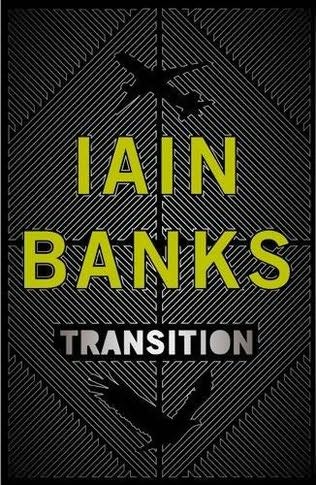
Transition – Iain Banks (4.2)This novel is supposedly the mid-way point between Iain Banks and Iain M Banks, so you get the best of both worlds; nitty-gritty realism and fanciful sci-fi imaginings. From the opening sentence – “Apparently I am what is known as an Unreliable Narrator” – you are immediately plunged into chaos and confusion.
The narrator is a transitionary, someone who can flit between worlds where they can interfere and affect outcomes. Some of the tasks of the Transitionary are to do good; to intervene by introducing people to each other, leaving a book lying around for them to discover, stopping them from entering a building that is about to collapse. But these are not the roles the Transitionary relishes and which keep him awake at night.
Some people are able to tandem, which is to take another person with them when they transition. Most transition with the help of a special chemical in tablet form, called septus, although the Transitionary does it by sneezing, like Nadia Popov in Rent-a-Ghost. An organisation controls the transitions and the quantities of septus, but what happens if people can flit or transition without it? Also, some people are able to pervert the natural order by assuming new bodies and simply refusing to age or die. As with all of Iain (M) Banks’ novels there is an element of paranoia and the fear of powerful corporations, and he advocates disorder and natural arbitrariness.
With or without the M, Ian Banks is instantly recognisable and any novel of his will provide a good read. You know what to expect up to a point. His genius is that he can take similar ingredients each time – sex, torture (this gets a bit preachy and there is an obvious swipe at the Bush administration and Guantanamo Bay), drugs, whisky and of course, Scotland – and create an entirely new concoction.
Desdemona, If Only You Had Spoken! – Christine Brückner, (translated by Eleanor Bron) (4)This collection of eleven monologues was written by Christine Brückner and translated by Eleanor Bron who adapted them for the stage. Brückner wrote imagined monologues of women who were famous but had never had a chance to be heard. The subjects range from the Virgin Mary to Clytaemnestra or Desdemona. Some of the characters are fictional heroines, others are real characters, like Gudrun Ensslin (part of the Baader-Meinhof group) or Katharina von Bora, who was married to Martin Luther, founder of the Protestant movement.
Each speech is introduced with a concise and informative explanation of the character and their relation to history. In these monologues, many of the women rail against their invisibility, demanding to be considered in their own right, rather than as a wife, mother or unpaid housekeeper. Brückner has given these women a voice; all of which are varied, but all of which are real.
Eleanor Bron seized upon the opportunity to translate these pieces and perform them. She confesses she was helped by the fact that, “Monologues, once the province of after-supper recitation and revue, had recently started to find favour once again. This revival owed a lot to Alan Bennett’s television series ‘Talking Heads’, which resuscitated the form by demonstrating its richness and variety.”
All of the women have things to say, which range from relationships and motherhood to politics and war. All of these women are angry, which makes their emergence from the page to the stage very dramatic. All of these women are powerful. All of them deserve to be heard. And Christine Brückner and Eleanor Bron should be commended for bringing them to our attention. Now we just need to sit up and listen.
Lucky Man – Michael J Fox (3.8)When Michael J. Fox ‘came out’ to the media that he had Parkinson’s disease (or P.D. as he terms it) in 1998, the disease came to international attention. He is quick to point out that it affects people differently and their reaction to the drugs they take will vary. He can only relate his story and he does with candour and honesty that is touching and informative.
Dealing with the disease forced him to alter his way of life, deal with his drinking and address his issues with his family and fame. In order to explain what changes he made, he relates details from his career and his lifestyle, some of which he is ashamed.
He describes the world of fame as a hall of mirrors – an unreal world in which you get given free stuff all the time and the police let you off speeding tickets in residential areas. The freedom that came with this fame proved to be his undoing as he constantly pushed the boundaries only to find that there weren’t any and if he wanted some, he would have to put them in place himself.
And then he woke up one morning with a hangover and a twitching little finger that wouldn’t go away. For a long time he denied the symptoms and attempted to carry on life as normal, but eventually he saw an analyst, gave up alcohol and forced himself to confront his illness. “I experience the full panoply of classic Parkinsonian symptoms: rigidity, shuffling, tremors, lack of balance, diminished small motor control, and the insidious cluster of symptoms that makes communication – written as well as spoken – difficult and sometimes impossible.”
He takes medication to quell these symptoms but he can’t stay on it all the time so he experiences a sort of Jekyll and Hyde melodrama depending on whether he is on or off his medication. He arranged his life so that he could act or be seen in public when the drugs were in effect ensuring no-one knew he was sick. When the acting and hiding of symptoms got too exhausting, he finally decided to publicly admit his illness. But he didn’t want pity from his audience; he wanted to be able to do something positive.
He found that breakthrough research is being done into Parkinson’s that cannot be funded – the Bush administration’s stand against stem-cell research is far from helpful, if not downright criminal – but according to a professor of neurological sciences, “of the big three degenerative neurological diseases – Parkinson’s, Alzheimer’s, and ALS (Lou Gehrig’s) – we think P.D. will be the first domino to fall.”
MJF didn’t just want to be a poster boy for P.D. so he set up his own organisation to help researchers find a cure within find a cure within the decade. “Our optimism on this score was matched only by our impatience.” We can only hope that his impetus helps bring a cure for this debilitating disease. And sooner rather than later.
Subscribe to:
Posts (Atom)
