The Quilter's Apprentice by Jennifer Chiaverini
Simon and Schuster
Pp. 271
For a novel with
quilting at its centre, this is as homey and heart-warming as you would expect.
It features friendships, family, forgiveness, sisters and sisterhood, supported
by a wealth of detail about making quilts that those who do will doubtless find
fascinating. Taking disparate scraps and piecing them together into a whole is
an obvious metaphor for storytelling: in quilting the stitches that bind the
fabric together are best if they are nearly invisible. Unfortunately the
working is quite clear in this novel as some of the dialogue is clunky, and the
scenarios are often unrealistic.
Sarah and Matt move
to a new town for his job as a landscape architect. Matt works for an irascible
client, Mrs Compson, at Elm Creek Manor restoring the grounds to their former
glory while Sarah reluctantly takes up a position indoors, helping with the cleaning
and taking lessons from Mrs Compson (an awarded quilter) in return. Sarah is a
trained accountant but she is bored with the work. The characters are privileged,
middle-class and comfortable, and Sarah’s complaints certainly seem petty.
Mrs Compson plans
to sell Elm Creek Manor, but when Sarah and Matt discover that the intended
buyer wants to tear it down and build student accommodation, they are appalled
and try to think of a way to save it. The focus is on conserving and preserving
rather than progressing and assisting potential students with their future
living arrangements.
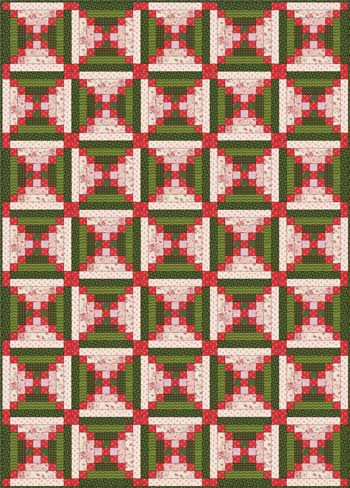 |
| Chimney and cornerstone quilt design |
Looking to make
friends, Sarah joins a quilting circle, befriending the other women, although they
clearly have reservations about Mrs Compson. They welcome Sarah into their
group and help her practice, supporting the individual tutoring she has with
Mrs Compson, expanding upon the techniques of the craft. They discuss different
stitching methods; there are arguments over the preference between hand and
machine stitching; and the skills required to undertake different tasks, with a
level of detail that might be skimmed by those not interested in the minutiae.
The
history of quilting is mentioned, as are individual patterns with their
specific meanings. Mrs Compton explains to Sarah the relevance of the Log Cabin quilt pattern to Elm Creek Manor, which was a
stop on the Underground Railroad during the Civil War. “If an escaped slave saw
a log cabin quilt with black centre squares hanging on the washline, he knew it
was safe to knock on the door.” When Sarah asks wouldn’t bounty hunters see the
quilt too, Mrs Compson replies, “Why, who pays attention to women’s work? Laundry,
hanging on the line? Sorry, can’t be bothered. We’re out doing important man
things.” There is a highly
unrealistic conversation about craft being viewed unfavourably compared with
art as it is considered women’s work, which raises some valid points, although
the dialogue is stilted and deeply unlikely.
Sarah
appreciates her newfound female friendships, and learns about Mrs Compson’s
past through the older woman’s reminisces and reflections of life. She looks to
Mrs Compson as a substitute mother-figure, while acknowledging her complicated
relationship with her own mother. This dynamic is left unresolved – perhaps for
the next novel; this is clearly positioned as the first in a series.
The
theme returns to the purpose of making quilts, whether as a practical hobby and
a leisure activity or an art form to be rewarded. Chiaverini argues that the
value of a quilt is more holistic. Craft as empowerment is not a new theme, but
it is one that this novel embraces warmly bringing gentle comfort. |
| Log Cabin quilt |


