Friday, 4 May 2012

Friday Five: Living Essentials

As we are moving to Australia, we have hired a container and have to pack our belongings into it. They will then be shipped and we shall see them on the other side, as it were, in about a month. So we have to keep certain items with us that we cannot do without and that we think we will need for the next several weeks until our home comforts arrive.

I am not including our cat in this list - he is being flown separately and at great expense, and beside, he is not a possession. If there is any possessing in our relationship, he is certainly not the object.

5 Things I Can't Leave Behind:
  1. A good book - yes, of course I can buy more when I get there, but I have so many in my 'to be read' collection that it would be ludicrous not to keep a few with me
  2. Running kit - if you had told me when I was younger that I wouldn't be able to travel without it, I would laughed in your face (from the comfort of the sofa) but as I've grown older, if not wiser, a good jog can make me feel better most days - and now that I am recovering from a crippling injury I don't want to waste any more time
  3. Oil of Olay - I am not paid for this, I promise, but it is the only moisturiser I use, and it has SPF15 which provides some protection form the sun
  4. Slippers - I just need my own sheepskin snuggle feet to feel comfortable - nana, I know
  5. Trench coat - the most versatile coat I've ever owned; it's lightweight, stylish (I like to think so, anyway), and packs down into a rucksack really well

Tuesday, 1 May 2012

Quote for Today


"Great acting is being able to say 'Pass the salt, please,' without sounding weird or odd or stupid or portentous. Great acting is being able to say 'Horror! Horror! Horror!' without sounding weird or stupid or portentous." - William Boyd, Waiting for Sunrise

Friday, 27 April 2012

Friday Five: Our Daily Bread

I love bread. There's a reason why people bake bread in houses they are trying to sell - the smell is divine. The way the loaf rises in the oven is almost magical (yes, I know it's actually due to a chemical reaction involving the yeast, but that's somehow not as romantic) and there is a wonderful symbolism in breaking bread to share with others. Of course many Bible stories feature the humble loaf, but it's more than that. So with apologies to my carbohydrate and gluten-free friends:

5 Favourite Breads:
  1. Baguettes - cycling through French vineyards with one of these tucked into the panniers, knowing we were soon to devour it with gooey cheese, fresh tomatoes and a bottle of bubbly... The anticipation was almost as good as the event. Almost.
  2. Calzone in Florence and Siena - the Italian sandwich; easy to eat while sight-seeing, walking and standing, or simply sitting in the piazza watching la passeggiata.
  3. Granary bread from Asda - fond memories of coming home after school and eating this with lashings of butter and jam in the kitchen (the warmest place in the house) with mum. She would be marking books and we would drink Vimto and chat about nothing.
  4. Garlic naan - as long as you both have it. From a good restaurant or curry house it tastes delicious, but it tastes strong and the flavour lingers, if you know what I mean...
  5. Jamaican gingerbread - I usually think savoury with bread, but this sweet treat is another happy childhood reminiscence.

Thursday, 26 April 2012

Quote for Today


"Instead of reading for research, or to steal, there are books that recalibrate the original, childish joy of reading to escape. This in turn reignites the urge to write" - Richard Beard as quoted in The Independent

Tuesday, 24 April 2012

The Ninth Annual Blackhurst Beer Festival (Part Two)

And here is the continuation...

Beer Number Six - Peak Brewery, Sollinger Bock (6.5%, New Zealand)
Peak Brewery is a certified organic brewery based in Masterton making beer along classic British and European lines. They name all their beers after him and mountain ranges – the Solling range is in Central Germany, near the city of Einbeck where this style of beer is reputed to have originated (‘bock’ being a derivative of ‘beck’).

A bock is a strong lager of German origin (originally dark, although modern examples range in colour from light copper to brown) with several substyles including maibock (or helles bock), which is a paler, more hopped version generally made for consumption at spring festivals and (Northern hemisphere) Easter.

Colour: Hazy amber golden
Nose: Yeast; hops
Taste: Yeast; banana; fruity; tangy; touch of spice; leathery finish

Comments:
I’ve had this before – smoked gone right
Pineapple, mango, citrus, tangelo, watermelon, grass, horse piss and green tea – tasty; chewy; mmmm
Tobacco flavours, smoky cigarette water but quite nice
Mmmm, I like this; fizzy little number
Mmmm, nice with Huntley and Palmers and crackers but still a little sweet for a whole night worth of drinking
All my sensory organs have deserted me – wait... floral delicate nose; perfumed rose water
Yes please – malty; I can taste brown sugar
Tastes like home brew but isn’t – indescribable

And this was our winner - with 74 points it was the favourite in 1st place!

Beer Number Seven - Moylan’s Kilt Lifter (8%, USA)
Brendan Moylan was just a normal chap in California with an accounting degree. Naturally he realised this was incredibly dull and bought himself a Christmas present of a beer brewing kit. ‘One thing led to another’ and he had soon built his own brew pub. This is beginning to sound familiar.

His beer has since won six gold and four silver medals at the World Beer Championships, and was the California Champion at the US Beer Tasting Championships seven times out of the last ten. This is no mean feat as beer in America has come a long way, baby. Moylan claims, ‘Prohibition in this country ended our brewing tradition. Budweiser and a few others moved in fast and captured many of the larger markets. Now we’re entering a new phase of beer brewing. I think you’ll see it continue to grow.’ How very perspicacious.

The Kilt Lifter is, unsurprisingly, a Scotch-style ale (also known as Wee Heavy), described as robust and strapping. The term Scotch Ale was first used to describe ales exported from Edinburgh in the 18th century and is a popular term in the USA. It is not to be confused with what French and Belgian brewers call Scotch Ale, by which they mean peat-smoked, malt-flavoured beers. The ale should be slightly warmed in the glass to ‘enhance the truly bold character’ and ‘sharing is encouraged’.

Colour: Dark ruby-amber with ferocious off-white head (little retention)
Nose: Dark roasty chewy caramel malt; nuttiness and graininess; oak and earthy notes
Taste: Strong malt profile; complex spices and oakiness; toasted biscuit; caramel custard; figs and dates; earthy hops round out the finish

Comments:
Smoked fruit salad served with a whisky side – quite acidic – Scottish?
Strawberry liqueur followed by marmite and a fag
Sweet with horse manure and malt overtones
Maltexo
Pudding – dark chocolate overtones; dates; caramel sauce – reminds me of Speights’ Old Dark Ice Cream
Reese’s Peanut Butter Cup; peat single malt
Smells like the rubbish bin after the bin men have been – Tastes better than it smells
Peachy, malty liqueur

Apart from one person who liked it very much, and one person who really didn't, this beer recieved the most average award of the evening and came in equal 5th position with 48 points.

Beer Number Eight - De Molen Heen & Weer (9.5%, The Netherlands)
De Molen is Dutch for the mill – in the Netherlands, all mills are windmills unless specifically stated. Heen and Weer means back and forth, because the De Molen Brewery has two separate locations and the beer folk spend a lot of time driving between the two – those crazy Dutchies!

It is an Abbey Triple style: the term ‘Abbey Beers’ was originally given to any monastic or monastic-style beer. In a champagne-esque move, the Union of Belgian Brewers introduced the logo ‘Certified Belgian Abbey Beer’ in 1999 which could only be borne by beers brewed under license to an existing or abandoned abbey, with the monastery having control over certain aspects of the commercial operation and reaping a proportion of the profits. Heen and Weer is not one of those, but just has a vaguely monastic branding.

The term ‘triple’ comes from the Low Countries and is believed to relate to the strength of the beer as indicated by the number of crosses on the cask – X being the weakest strength, XX being medium strength, and XXX being the strongest (approx 3% abv, 6% abv, and 9% abv respectively).

Colour: Hazy orange
Nose: Sweet malt; soapy sprucy hops; vegetable notes; apples; oranges; sweet caramel; gentle toffee; brown sugar
Taste: Sweet fruits and huge malt; oats and oranges; coriander; wheaty yeasty; honey; aggressive alcohol; slightly bitter with a malty hop aftertaste

Comments:
Patchiouli and malt – strong malt flavour with no hops – high alcohol?
Tastes good at first but fizzles out
Malty fizzy golden syrup
Clear, refreshing on the back of the tongue
Starting to get a smooth finish with whisky overtones – must be North of the border
Toffee caramel – not for me, thank you
Smooth, cooling caramel – like eating caramello
Smelled peaty at first, then less so, then rusty aftertaste

Strong, malty and chocolately caramel must be popular among the group as this beer ranked 3rd with 68 points.

Beer Number Nine - La Guillotine (9%, Belgium)
In 1906 Leon Huyghe founded Brouwerij Huyghe in the city of Melle in East Flanders on the site of a brewery which had been in operation since 1654. La Guillotine was first brewed in 1989 to commemorate the bicentennial of the French Revolution, which had such a devastating effect on the Belgian monasteries and the associated breweries. In 1790 the National Assembly seized all church lands and all religious orders were officially dissolved. Those religious buildings that didn’t close were destroyed and any remaining priests and monks were imprisoned or massacred.

La Guillotine has top-fermentation with re-fermentation in the bottle. It is curious as to why a Belgian brewer would choose to commemorate such an event, but perhaps the suggestion is that at 9%, more than two of these strong blond beers would cause you to lose your head.

Colour: Clear golden
Nose: Lemon; tulip petals; toast; spicy; yeasty; earth; grass; candied sugar; golden syrup; fruit cake; cereal
Taste: Lemon; leaves; cloves; grapes; sweet bready malt; light honey hints; soft caramel; vanilla; cough drop

Comments:
Aromatic, but not in a way that appeals, sorry
Like the previous one but keeps on giving – me likey!
Smooth, sweet and fresh
Not overpowering – I like it
Must have overloaded my taste buds – I can’t taste a blinking thing – Lemony Snicket
I did not detect lemon, grass, candied sugar, fruit cake, or tulip petals – I did get a hint of Chester’s urine
Syrupy smooth with a light finish
Lime and malt; great taste. Sell the family car; we’re buying the brewery – Yum!

Quite a popular little number (it appears we like them strong), this came second overall with 71 points.

Beer Number Ten - Ise Kadoya Stout (5%, Japan)
According to the label, ‘Ise Kadoya has made miso and soy sauce according to ancient tradition in a centuries-old wood building in old Ise, and now brews beer in small batches in the same traditional, natural way.’ Perhaps someone should tell them the process is a little different...?

They also have a restaurant and recommend this stout as an accompaniment to their oyster dishes. The restaurant was originally established to provide nourishment for the numerous pilgrims that journeyed to Ise City (one of the most sacred cities of the Shinto religion) and Ise Shrine from all over Japan.

Colour: Black opaque with thin tan head
Nose: Deep dark chocolate; roasted grain; coal smoke; cherry skins; some milkiness
Taste: Roasted grain; dark chocolate; caramel; soy sauce; dry roast malts; convincing ashiness; smoking toast; tingly mouthfeel; coffee finish

Comments:
Brown sugar but quite light in the mouth; sour rather than bitter – dark lager
Black beer – fizzy tarmac
Chocolate liquorice; candyfloss beer
I’ve run out of descriptive words
Fizzy dark – the champagne of darks, only it smelt like curry
Spaz’s home brew – I have just realised that may look offensive – I mean, perhaps a good start?
Gassy for a stout – not creamy and heavy as I expected
Smells of chocolate; malty

Not a spectacular finish, perhaps because expectations weren't met. This beer was awarded 44 points and finished 8th equal.
So the winner on the night was the Kiwi offering, which is interesting to note. Also of interest was the fact that the beers that I like (the hoppy, bitter ones with clean refreshing bite) were not popular with the group. I can only imagine that this is because for the first time in nine Blackhurst beer festivals, our tasters were predominantly New Zealanders.

Thanks to all for taking part in our not-at-all-scientific tasting extravaganza. And so, for another year, that's all folks!

Saturday, 21 April 2012

The Ninth Annual Blackhurst Beer Festival (Part One)

If you've been following my blog for any length of time, you know how these things work. Ten beers; a group of friends; tasting notes; random comments. Let the reviewing commence!
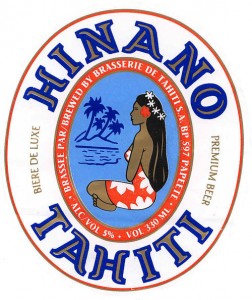
Beer Number One - Hinano (5%, Tahiti)
Claiming to be ‘the official beer of Tahiti’, Hinano sponsors beauty pageants (the Miss Hinano contest) and produces calendars of ‘dusky beauties in bikinis’. In 1990 it also began sponsoring the Miss Tahiti contest while raising its alcohol content from 4% to 5%. The website concerns itself greatly with the design of the vahine (woman) on the label, paying particular attention to the size of her breasts, which are altered every couple of years, although I note she has only got four toes.

As for the beer itself, it announces that it is ‘brewed in Tahiti since 1955, using only the finest ingredients from Northern Europe. Hinano satisfies the most demanding connoisseurs with its freshness and quality.’ Those at www.ratebeer.com respectfully disagree, although it is very popular in China. And, we presume, Tahiti.

Colour: Golden yellow
Nose: Malt; wet grass; sweet grain; skunk hop
Taste: Toast; cheese; cooked vegetables; slightly metallic; corn notes; light bitter finish

Comments:
Next!
It’s alive!
Sharp and flowery in an insipid way – astringent flavours
Easy to drink – smooth but watery
Light, fizzy, cold, tasteless
Lovely oat colour/ lemon dishwasher on nose/ good hop mid palate/ steely – all a bit bland
Metallic aftertaste
Easy drinking – no specific taste

Despite being the name of a friend's dog, Hinano rated the not-so-grand sum of 45 points (out of 100)making it 7th (out of 10).

Beer Number Two - Coopers Mild Ale (3.5%, Australia)
Thomas Cooper was a stonemason in Adelaide in 1862 when his wife asked him to brew up a batch of ale from an old (Yorkshire) family recipe to help cure an illness. Like a good husband, he did so and, due to the fact that his beer was made from pure ingredients (malt, hops and water), the doctors were soon recommending it to all their patients – this could explain a lot about South Australians. Coopers is now the sole remaining family-owned brewery in Australia.

Coopers Mild Ale is very commercial and very popular with the Australian drinking public, and if you like it, you can make your own because the good people at Coopers have posted the recipe on their website. You can also make your own label with their label maker to stick on your own homebrew bottles and ‘impress your mates’... or not.

Colour: Red-gold
Nose: Grain; apples; grassy hops; cardboard; toffee; hint of banana; dandelion leaves
Taste: Minerally; hints of grain; apples; pears; bread crust maltiness; light caramel; metallic finish

Comments:
No nose – does it have syphilis? There are many greeblies in it so it wouldn’t surprise me
Spaz’s socks after a long run – home brew?
After panicking slightly at the sight of so many floaties, I find this beer light on flavour
Smells like wet socks – tastes better than that though
Some spotty teenager’s wrung out and what I would imagine it would taste like if you licked them
Pineapple, little burnt scent on nose, nice mouth feel
Bland – low alcohol?
No smell, no taste, ‘Mr. Boring’

Clearly not a favourite from Coopers, coming in firmly in final place with 34 points.

Beer Number Three - Buxton Brewery, Kinder Downfall Golden Ale (4.3%, England)
The folk at Buxton Brewery name all their beers after Buxton and surrounding geological features (and to be fair, it is a very beautiful part of the world) with the exception of Old Big ’ead, named after Brian Clough in tribute to his services as manager of Derby County, Nottingham Forest and his brief but controversial spell at Leeds Utd. Ah, football and beer: a few of my favourite things (you can keep your raindrops on roses and brown paper parcels!) But I digress...

This golden ale is named after a waterfall on Kinder Scout in the Peak District of Derbyshire – over which I can only surmise unsupervised German children came a cropper. The beer is described as ‘a solid sessioner’ so perhaps people are understandably too busy drinking to worry about waterfall woes.

Colour: Golden yellow; creamy off-white head; clear but cloudy
Nose: Fruity, citrus, grapefruit; faint pineapple jelly; light malt; hint of honey; some dough; grass; sour gooseberry undercurrents; dandelion hop
Taste: Citrus: mellow marmalade; light white sugar; gentle earthy malt background; lemony jellied orange hops; lightly toasted grains; mild doughy bread; hint of grass; spicy; pepper; some glue; bitter finish

Comments:
Smoked; hopped; it’s an IPA that’s gone nuts!
Dark exotic hints – I couldn’t drink more than one mouthful
Sweet, honey and orange on the nose, which I liked until I tasted it – way too hoppy for little old me!
Cloudy – phwoar; what a stink! Far out, that’s foul – bitter and hoppy
Nooooo!
Jekyll and Hyde: all light and fruity and tra-la-la; then it turns round and rodgers you
Marmite, cocoa, molasses, cigar box, truffles
Hoppy – this is a big fat bunny; heavy tannins, metallic aftertaste
Hops and wee; was used to put out a house fire and then spooned back into the glass

Although I liked this beer very much (in fact it was my favourite of the evening), it seems I was in a minority among the group as it scored a measly 44 points to make it equal second last.

 
Beer Number Four - Nøgne ø Saison (6.5%, Norway)
‘The name Nøgne ø means ‘naked island’; a poetic term used by Henrik Ibsen to describe any of the countless, stark, barren outcroppings that are visible in the rough seas of Norway’s southern coast where the brewery sits. The founders gave Nøgne ø a subtitle – The Uncompromising Brewery – a plain statement of their mission: to make ales of personality and individuality. Brewing in traditional styles but thoroughly inspired by the boldness of American brewing, these Norweigan brewers fearlessly chart their own course’ – from the label.

For a while Saison beer (French for season) was an endangered style, but has recently become flavour of the month, particularly among American breweries. It was traditionally a low-alcohol pale ale brewed seasonally in farmhouses in Wallonia (the French-speaking region of Belgium) for farm workers to consume during harvest season. There was no particular style, as each farmer would brew his own and it was just a loose term for a refreshing summer ale.

In America, Saisons tend to copy the yeast used by Brasserie Dupont (whose Saison Dupont was named ‘the best beer in the world’ by the Men’s Journal in July 2005) which ferments better at warmer temperatures than the standard fermenting temperature used by other Belgian Saison brewers. They also tend to be brewed with an average range of 5% to 8% abv, although there are still plenty at the more traditional strength of 3.5%.

Colour: Hazy yellow
Nose: Paint; pineapple; lemon; wheat; sugary meringue; hay; horse dung; bready pepper; sour fruitness; floral; clover; light iron
Taste: Zesty citrus; tangerine; pineapple; spiced yeast; breadiness; sweet malt; mild hops; grass; banana tones

Comments:
Hay – dry and grassy; tastes a bit chlorinated – unpleasant, like drinking out of the kids’ pool at the end of the day
Finally, a beer I like! Cumin and orange peel
Tastes a bit shandy-ish and a bit yeasty also
Cloudy, spicy – nice mixture
Honey, honey; one for the money
The smell of a dentist’s work room; pineapple and banana mostly
Flavoursome; light and hoppy – this is a smaller, lighter bunny
Carbonated horse wee with a little citrus

A slightly more favourable reaction for this one, totalling 65 points (which is the first over the 50% mark) and ranking 4th.

Beer Number Five - Mikkeller Centennial Single Hop IPA (6.9%, Denmark)
Two young home brewers from Denmark (probably fed up with the predominance of Carlsberg and Tuborg) wanted to make beers that “challenge the Danes’ taste buds with intense taste adventures”. Founded in 2006 in Copenhagen by Mikkel Borg Bjergsø and Kristian Klarup Keller, the brewery has gone from a kitchen hobby to international fame (Since August 2007 Mikkel Borg Bjergsø has run Mikkeller on his own). Mikkeller is possibly the world’s most productive brewery. In 2010, the good Danish beer folk launched 76 new beers – God bless them, and all who sail in them…

They take inspiration from all around the world, including the up-and-coming American breweries, which aren’t afraid to play and break the rules of brewing. Mikkeller Centennial Single Hop IPA is an American Style India Pale Ale, brewed and bottled by a Danish company in Belgium, imported to Minneapolis, USA, and then redirected to The Beer Store in Hamilton, NZ before finding its way to our back garden in Arrowtown. I think that’s what’s known as beer miles.

Colour: Vibrant orange, frothy, white head
Nose: Soft citrus: peaches; honey; creamy banana; sugar cookies; some mango; a little pine; smooth hopping
Taste: Citrus: grapefruit; orange; light to medium strong bitterness; fruity hops; elegant and floral; long bitter finish; full body and creamy mouthfeel; juicy profile

Comments:
Uplifting! The bitterness at the end is vaguely resinous and fruity – an orchard in a pine forest
The bitter big brother of the previous one – probably has a criminal record
Bitter and twisted – smells of wet earth
Pithy bitter
Air freshener masking public toilet smell... blocked my nose and tasted fizzy caramel
Macintosh toffee on the nose; peaty, yeasty, marmitey marmalade
No smell but strong aftertaste
Citrus; honey; malt; chocolate

Probably the most divisive beer of the evening - some loved it; others hated it. Only two tasters ranked it in the middle, but that's where it ended up - 5th equal with 48 points.

This is now becoming a very long post, so I shall continue in another one...

Friday, 20 April 2012

Friday Five: Feline Lessons

As we work out the logistics of moving to Australia, Chester is a primary concern. He needs to be micro-chipped, have all his vaccinations up-to-date, and undergo a thorough medical check. He needs to clear customs and bio-security, pass through the Ministry of Agriculture and Fisheries, and be exported as live cargo. This means his transport costs more than mine and Him Outdoors' put together.

It would have been cheaper (although illegal) to buy him a seat on the plane . He could have chosen his own movies (Puss in Boots) and selcted his own meal (not fish - he is the possibly the only cat in existence who doesn't like fish). And before you ask, no, it has not occured to either of us to leave him behind - he is part of our family. Besides, he entertains, amuses, and greatly benefits our general welfare (it is hard to be stressed when there is a streched out cat asleep and snoring gently beside you). He has also taught me a few lessons in life...

5 Things I've Learned from My Cat:
  1. There is no problem that doens't improve by sleeping - in fact, sleep is the great panacea
  2. It is important to keep your nails (claws) and nether regions scrupulously clean
  3. If you assume you are beautiful/ important, other people will too
  4. Seek out warmth in winter and shady spots in summer
  5. If something/ someone is unpleasant for any reason, just walk away