Monday, 11 February 2019

Advent Calendar Beers of 2018

Our traditional advent calendar (in which I buy the odd-numbered beers for Him Outdoors and he buys the even-numbered ones for me) was looking a bit sad at the end of November...


...but fortunately we filled it up in time for a range of boozy delights (still in Liverpool colours).


For those who are interested, I shall name and rate (out of five) the 24 beers of Christmas. For those who aren't; you might want to skip ahead to the next post.


Beer #1: Passionista by Wayward Brewing (Sour - Berliner Weisse 3.8%) - Tart and refreshing; fruity and light; a great palate cleanser. 4.25/5


Beer #2: Nieuw Bruin (Sorrenberg Yeast) by Bridge Road Brewers (Collaboration with 8 Wired Brewing Co. Brown Ale - Belgian 8.3%) - sour and dark is weird but good, like malty sour cherries. 4.25/5


Beer #4: Blood Red Sky by Innis & Gunn (Scottish Ale/ Wee Heavy 6.8%) - Malty caramel, dark toffee, vanilla, raisins and a whiff of rum. Spice up your life! 4.25/5


Beer #4: Et Tu Brut? IPA by Two Birds Brewing (IPA Brut 6.5%) - Very hoppy and fresh, and super dry, but in a good way; not in a Hahn way.  4.25/5


Beer #5: Pavlova by Brekeriet (Sour fruited 6.5%) Sweet and sour; raspberries, strawberries and cream; funky and rich. Very tasty indeed. 4.75/5


Beer #6: Weizenbock by Red Hill (Bock - Weizenbock 7.9%) - Not too sure about this: malt and alcohol and not too much else. 3/5


Beer #7: Tea Party by Two Birds Brewing (English Pale Ale 5.2%) - Earl grey tea and lemon with a large dose of malt and a touch of cucumber. This is beautifully crafted, like Pimm's with hops. 4.25/5


Beer #8 Pissenlit by Brasserie Fantome (Saison/ Farmhouse Ale 8%) Yeasty esters with spice, light caramel notes and a hint of banana. Sweeter than a usual saison and pleasantly funky. 4.5/5


Beer #9 Two Wolf Moon by Moon Dog Brewery (Biere de Champagne/ Biere Brut 8.5%) Interesting - gin and champagne yeast with beer. Very dry and crisp with citrus hop flavours against a sort of Pilsner background. 4/5


Beer #10 Cher & Choco by Brouwerij de Molen (Stout - Imperial Oatmeal, 10%) Intense chocolate and cherry flavours - very tasty. 4.25/5


Beer #11 & 12 (what are the chances?) Stone Free Hoppy Sour Apricot Ale by 8 Wired (sour - fruited 4.4%) Hoppy, apricot and dry rather than sour. Refreshing like a Berliner weisse. 4/5
  

Beer #13 & 20 Past Masters 1981 ESB by Fuller, Smith & Turner (Extra Special/ Strong Bitter 5.5%) Ahh, proper beer. Malt and hops in perfect harmony. Nutty and earthy: lovely. 4.5/5


Beer #14 Bede's Chalice by The Durham Brewery (Belgian Tripel 9%) Intense and fruity with bubblegum and banana esters balanced by orange peel bitterness. 4/5 


Beer #15 Coral Sour by Young Henrys (Sour - Gose 5.5%) Salty and crisp, but not refreshing - floral, earthy, hibiscus and Davidson plum (apparently). 3.25/5


Beer #16 Dr Shedlove (2018) by Big Shed Brewing Concern in collaboration with Doctor's Orders Brewing (Stout - Imperial / Double 9.3%) Earthy hops with a slight sweetness and malty hoppy goodness. 4.25/5


Beer #17 The Druid by 3 Ravens (Whisky barrel-aged Belgian-style quad 12%) Dried fruit esters and notes of oak, vanilla and whisky from the barrels in which it was aged. 4.5/5


Beer #18 '88' Robust Porter by Riverside Brewing (Porter 6%) Dark chocolate and coffee flavours: roasty but not bitter. 4.25/5


Beer #19 Halo Milkshake Berliner by Brewski (Sour - Berliner Weisse 4.7%) Fruity and full-bodied; creamy and sour; passion fruit and raspberry Berliner Weisse. Odd and interesting. 4.25/5 


Beer #21 Orval by Brasserie d'Orval (Pale Ale - Belgian 6.2%) 


Beer #22 GingerGueuze by Lindemans (Lambic - Gueuze 6%) Ginger and spicy and funky and slightly sour: goes beautifully with rum and peaches-glazed ham for Christmas drunch. 4.75/5
  

Beer #23 Saison by Forest for the Trees (Saison / Farmhouse Ale 4.7%) Clean and refreshing; zesty citrus and funky spice. 3.5/5


Beer #24 Hellbender by Garage Project (Barleywine - American 11.2%) Malty to the max, with bitter citrus and pine hops; the definition of an American barleywine... brewed by Kiwis. 4.25/5

Friday, 25 January 2019

Sense and Sensitivity

Once Upon a Mattress
Ickle Pickle Productions
Belconnen Theatre
January 2019


In the programme notes, the mission statement of Ickle Pickle Productions is plainly set out; it was ‘established to provide a wide range of original entertainment to the Canberra community, as well as performance and production opportunities for children and adults of all skill levels and experience’. The current production, Once upon a Mattress, clearly fits this remit. Everyone knows the story of the Princess and the Pea, and just in case they don’t, the opening number, Many Moons Ago, sung by the Minstrel (Elliot Cleaves with an appealing delivery), spells it out through inspired use of puppetry and song. And then the show begins, with a slightly different version.

Prince Dauntless (Isaac Gordon) needs a wife, as he is clearly in possession of a good fortune, or at least a kingdom, and the whole universe knows what that means. He is a dutiful if dopey son who spends a lot of time sitting on a bench and swinging his legs while looking totally clueless. Gordon is charming and sweet in the role, but it is evident that his attributes are capital rather than cerebral. An Opening for a Princess is a sprightly tune that indicates how all the princesses have applied for the position of bozo’s bride, but been found wanting by Queen Aggravain (Deanna Gibbs) and her sidekick the Gypsy (Sarah Hull).

This is the first indication of something rotten in the kingdom; the relationship between the mother and her son is deeply troubling, as she repels all his suitors and actually wishes she were twenty years younger, so that she could… what? That’s not nice. Her husband, King Sextimus (Joe Moores), moons about in the background chasing servant girls with plates of food across the stage in a manner that is more than a little creepy. He is mute due to a curse that cannot be lifted until ‘the mouse devours the hawk’ – the metaphor is evident.

Unfortunately, no one else in the kingdom can marry until Dauntless does, which poses a problem for Lady Larken (Alissa Pearson) and Sir Harry (Steven Galinec) as Lady Larken is pregnant. Obviously this will soon become apparent, as they allude to in the none-too-subtle duet, In a Little While, which showcases Pearson’s operatic tones. Sir Harry undertakes the challenge to find a true princess to satisfy the demanding queen, and he returns with one. This princess (Alex McPherson) comes from a watery land (she sings The Swamps of Home in a charming parody of nostalgia) and is strong and brave – she swims the moat; she lifts impressive weights; she ‘wrestles like a Greek’; she drinks ‘drinks just like a lord’ – and, so she tells us, she is shy.

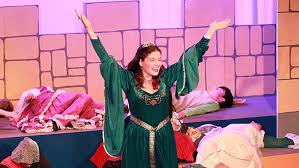
Alex McPherson as Princess Winnifred
The role was originally played by Carol Burnett, who made her Broadway debut and received a Tony Award nomination for her performance. It is entirely to the credit of McPherson and director Anita Davenport that the ghost of Burnett doesn’t haunt the show. Princess Winnifred the Woebegone is nicknamed Fred, which leads to the lively pre-interval Song of Love containing the catchy refrain, ‘I’m in love with a girl called Fred’. McPherson is utterly delightful with her brash and unrefined manners, displayed alongside affection for those who need assistance, and a complete disregard for convention.

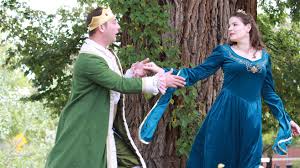
Queen Aggravain chooses a test for her based on sensitivity (apparently only a true princess could feel the presence of a pea beneath a pile of mattresses), imagining that she has none due to her rustic presentation, but even the youngest of audience members knows that Fred has genuine compassion and will pass with flying colours. McPherson and Gordon make a cute couple – they play their characters with energy and brilliance in lieu of intellect; both are sweet and affable enough that one isn’t left wondering what on earth they see in each other. When Dauntless says, ‘I like – I mean, I love you, Fred’, it seems genuine and heartfelt.

Isaac Gordon as Prince Dauntless and Alex McPherson as Princess Winnifred
Once upon a Mattress was originally a shorter play, written in 1953, that was expanded for the Broadway stage. It has remained a popular choice for high school and community theatre productions ever since, although it suffers from age and uneven tone. Davenport has cut some numbers, but the show still feels as though it could do with some tightening and pruning. Some of the songs are weak: Normandy and Spanish Panic could have been trimmed from the end of the first act with no great loss, and The Minstrel, Jester and I and Nightingale Lullaby are slightly tedious fillers. Choreography by Jodi Hammond is simple and tidy, and she creates interesting shapes which fit the varying degrees of talent and experience that she has to work with, but the big dance numbers are somewhat underwhelming.

The subplot of Sir Harry and his lady love is incongruous, and introduces a curious note. Generally the show could be considered children’s theatre: the plot is straightforward; the songs are not challenging; the characters are one-dimensional; it’s a fairy-tale world. However, there is an out-of-wedlock pregnancy and the consideration of the consequences that would have on reputations at court as Lady Larken is not so much a lady in waiting as one expecting. This, a couple of ribald references about living in sin, and the fairly painful song, Man to Man Talk, in which King Sextimus has to mime the business about the birds and the bees to his hopelessly naïve son, put this beyond the realm of the young and innocent.

The gender politics are also complicated, as they often are in shows from a time long ago and far away. Although the notion itself is repellent Davenport handles the issue of women fighting over an eligible bachelor better than many a reality TV show. She can’t overcome the misogynistic stereotype of the harridan Queen, as her character hinges on the premise that women in charge are shrill and manipulative, and the retribution that the King will exact once he has returned to his ‘rightful place’ as ruler of the kingdom leaves a sour taste. However, Davenport has given the Queen a great accomplice by changing the character of the Wizard to a Gypsy, played in a comic interpretation by Sarah Hull as a perfect down-to-earth counterpoint to the Queen’s saccharine superficiality.

The split-level set (Steve Galinec) adapts to represent a ballroom, a courtyard (with off-stage moat) and a bed chamber with minimal fuss, and the bed supporting the tell-tale legume is a further example of practical and efficient design (Ikea, eat your heart out). The medieval costumes (Fiona Leach) are exceptional for the small budget from which they are created. The cast appear to be having fun and it seems as though they and the crew have worked very hard to bring this production to the stage, so if that is the avowed intention of the company; then mission accomplished.

The Minstrel (Elliot Cleaves) and the Jester (Jack Morton)

Saturday, 12 January 2019

A tour de force of story-telling


Washington Black by Esi Edugyan
(Serpent's Tail)
Pp. 417

This is a picaresque novel full of adventures and multiple locations: from the slave plantation in Barbados to the frozen wastelands of the Canadian Arctic; from the structured canals of Amsterdam to the wild coasts of Nova Scotia; from the scientific calm of the London Aquarium to the wind-swept deserts of Morocco. It is peopled by explorers, adventurers, scientists and exploiters. Everyone is seeking something: discovery; freedom; equality or survival, and it can all be realised as Washington Black says to his mentor who warns him something is impossible, “Nothing is possible, sir, until it is made so.”

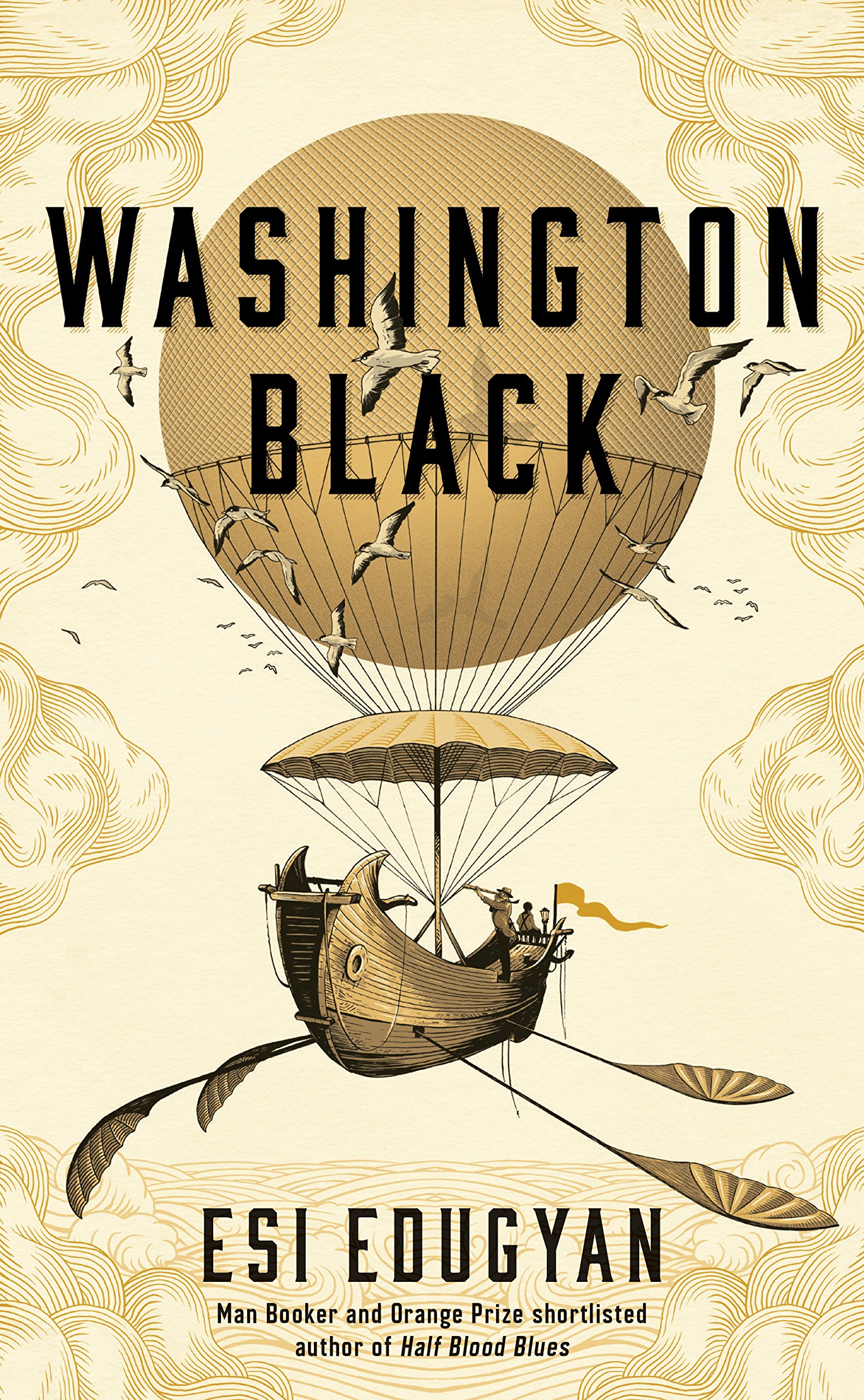
Washington Black is rescued from his brother’s slave plantation by adventurer and inventor Christopher ‘Titch’ Wilde, who says he wants a young boy to help him carry his instruments and take scientific measurements. Titch is trying to sail in a cloud cutter – a craft propelled by both a hot air balloon and more prosaic oars. He encourages Washington’s prodigious gift of drawing and removes him from the daily cruelty of life he has previously experienced. Is he really benevolent, however, or simply using him for his own means?

After an incredibly unfortunate incident, Titch knows that he and Washington must flee and so they affect a wonderfully improbable escape to the Canadian Arctic. Here Washington is introduced to a new world, culture and relationships. When Titch disappears from Washington’s life, he is presumed dead, and Washington must attempt to forge his own way in the world that has hitherto denied him freedom.

Edugyan never flinches from the violence and barbarism of slavery and its consequences, but nor does she dwell upon it. Washington knows his mother was abused and raped, and he writes baldly of the horrors of the slave ships: “The stench of the holds, all of them rolling naked and ill in the dark stomach of the barquentine. The urine and excrement and vomit, men clawing their own throats open with ragged fingernails, bloodied women leaping the deck rails into waters sharp with the fins of sharks. I saw the dozens who had died on the way to Barbados, and I saw those who died once ashore.”

In striving for his freedom, Washington severs his ties with his previous existence and the people he once knew and cared for – it seems that he can only care for himself in order to survive. The novel questions the meaning of belonging. We understand that we do not belong to a person, but can we belong to a place, and how important are family connections? When Washington suspects that Titch may be alive, he begins to search for him, but why? Was he abandoned?

As well as being a sweeping saga of derring-do and outrageous plots, this novel also examines the conundrum of colonialism, survivor’s guilt, and the impossibility of altruism in a pointed and poignant manner. The language is clear and precise as Washington attempts to describe unimagined circumstances, and the fantasy and realism elements blend well in a tour-de-force of storytelling.