Friday, 2 July 2021

Friday Five: Another Quintet of Women of the Odyssey

I'm in the middle of rehearsals for The Penelopiad by Margaret Atwood, which is a retelling of The Odyssey, focussing on Penelope, who was left behind while Odysseus went off to war and then travelled around having adventures rather than returning to her in a timely manner. I'm co-producing and directing the play which will be on at the Courtyard Studio in Canberra from 7-17 July. I have always loved mythology and the value of storytelling, so have thoroughly enjoyed providing a bit of context to some of the characters mentioned in the text. This is Part Three (See Part One and Part Two).

The Birth of Venus by Sandro Botticelli

1. Aphrodite

Aphrodite is the Greek goddess associated with love, beauty, pleasure, passion and procreation. Her major symbols include myrtles, roses, doves, sparrows and swans, and she is consistently portrayed as a nubile, infinitely desirable adult (having had no childhood as she was born fully-formed from sea foam caused by the severed genitals of Uranus - it's complicated), and usually nude. Her Roman equivalent is Venus, hence the famous Bananarama song (okay, I know it's not originally theirs), female razor products (exactly the same as the male ones but twice as expensive because, you know, pink), the fly trap (because stupid creatures will entrap themselves and die for nubile beauty) oh yes, and the above painting.

In The Odyssey, Aphrodite is married to Hephaestus (blacksmith to the gods who makes all sorts of wonderful gadgets, like Q in James Bond) not by choice but through some bargaining with Zeus - she is given to Hephaestus as a bribe (sound familiar?). Aphrodite is frequently unfaithful to her husband, and her lover include Ares, the god of war (Mars in the Roman versions). Hephaestus sets a trap for the lovers and casts a golden net in which they are caught the next time they have sex upon the marital bed. Hephaestus invites all the other gods to laugh at the adulterous pair, but many of the (male) gods have sympathy for Ares and Poseidon agrees to pay Hephaestus to release Ares. Meanwhile, Aphrodite was humiliated and returned in shame and ignominy to Cyprus where she was attended by the Charities (or Three Graces). What's that you say? Rhymes with stubble dandards?

Charybdis before she was a sea monster

2. Charybdis

Charybdis was a sea monster who dwelt in the Strait of Messina. She swallowed large amounts of water of water and then belched them out, creating large whirlpools that resulted in the destruction of passing ships. She was the offspring of Poseidon and Gaea (Water and Earth) and helped her father in his quarrel against Zeus by flooding large areas of land with water - don't you just love how all cultures have a creation and a flood myth? Zeus was angry (it seems to be his default setting - grumpy head god) and punished Charybdis by turning her into a monster that would eternally swallow sea water and create whirlpools.

Scylla, the Huntress, from Game of Heroes

3. Scylla

Scylla was a sea monster who haunted the rocks of a narrow strait opposite the whirlpool of Charybdis. Ships who sailed too close to her rocks would lose six men to her ravenous, darting heads. Homer describes Scylla as a creature with twelve dangling feet, six long necks and grisly heads lined with a row of sharp teeth. Her voice was likened to the yelping of dogs. In classical art she was depicted as a fish-tailed sea-goddess with a cluster of canine fore-parts surrounding her waist. According to late classical writers she was once a beautiful nymph loved by the sea-god Glaukos, but her jealous rival, Circe, transformed her into a monster. Older poets, however, envisaged her as simply a monster born into a monstrous family. 

Scylla and Charybdis by Emmique on DeviantArt

Being between Scylla and Charybdis is an idiom along the lines of 'between a rock and a hard place', 'between the devil and the deep blue sea', 'to choose the lesser of two evils'  or 'out of the frying pan; into the fire'. The situation implies that one must seek to chose between two equally dangerous extremes which will inevitably result in disaster. Scylla and Charybdis were regarded as maritime hazards (a rock shoal and a whirlpool respectively) located close enough to each other that they posed an inescapable threat to passing sailors; avoiding Charybdis meant passing too close to Scylla and vice versa. According to Homer's account, Circe advised Odysseus to pass by Scylla and lose only a few sailors, rather than risk the loss of his entire ship in the whirlpool.
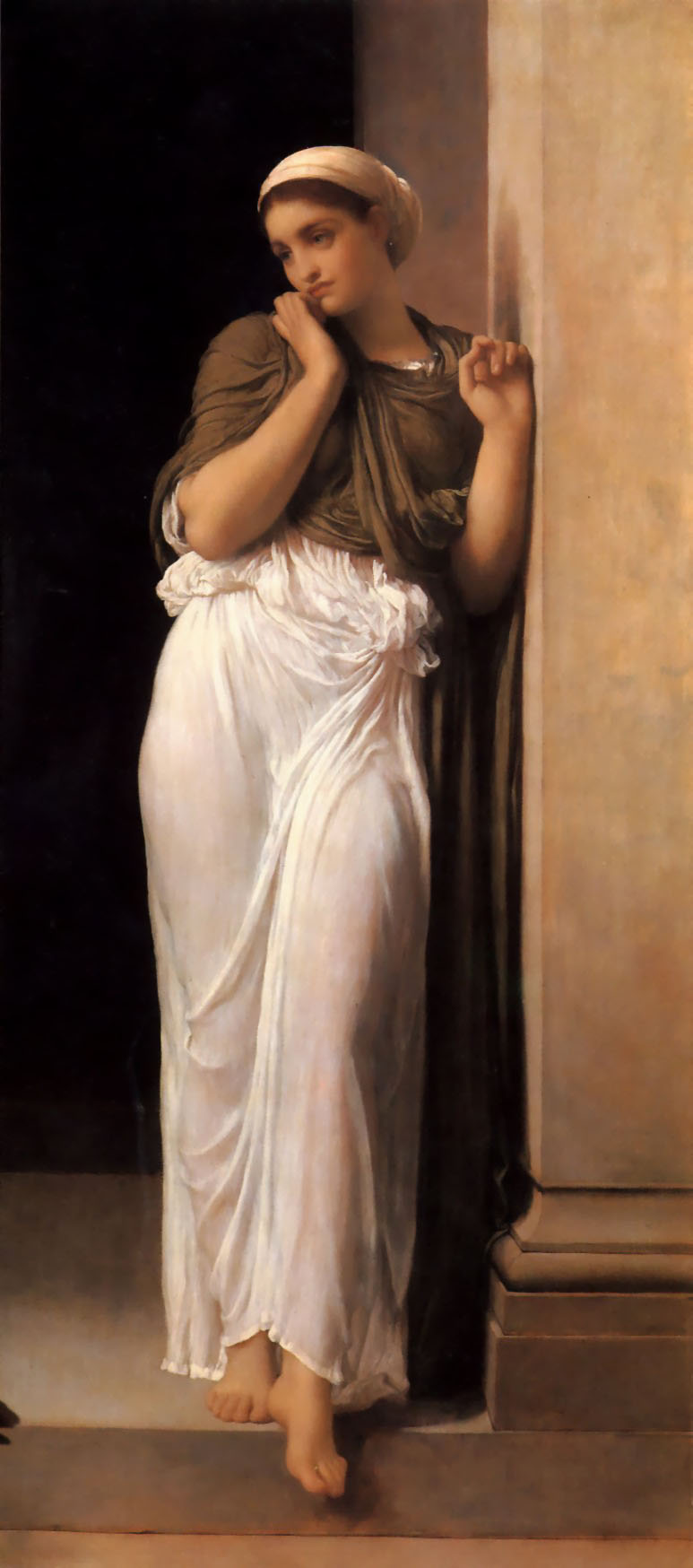
Nausicaa by Frederic Leighton

4. Nausicaa

After leaving Calypso, Odysseus is shipwrecked on the island of Phaeacia, where he is awakened by Nausicaa (daughter of King Alcinous and Queen Arete) and her handmaidens as they wash their clothes at the seashore. He emerges from the forest, completely naked, and the servants all run away terrified. Nausicaa remains and agrees to help him, giving him some of the laundry to wear and advising him to go to her parents' house and make his case directly to her mother, Arete. She and her maids go ahead of him as she doesn't want to give rise to gossip by walking with a stranger. He does as she says, which is a good move because apparently Arete is much wiser than her husband, and when Odysseus wins her trust, she allows him stay with them as a guest. In return for their hospitality, Odysseus recounts his adventures to the court - this forms a substantial proportion of The Odyssey itself. Alcinous then generously gives Odysseus a ship to help him return to Ithaca. 

Margaret Atwood interprets all this in her inimitable fashion in The Penelopiad thus:

"After seven long years there of kissing and woo,
He escaped on a raft that was drove to and fro,
Till fair Nausicaa's maids that the laundry did do,
Found him bare on the beach - he did drip so!" 

Nausicaa is young and very pretty, and she is presented as a potential love interest. She may have had unrequited feelings for Odysseus, but he wins Arete's sympathy and she is determined to help him get home to his wife and child, rather than being tempted to dally with yet another romantic entanglement. There is a deep affection between the two of them, however - she tells him, 'Never forget me, for I gave you life' (which is oddly maternal) - and of all the women he met on his adventures, Odysseus never tells Penelope about Nausicaa. Some accounts say that Nausicaa eventually married Odysseus' son, Telemachus. Could this be a rare occurrence in classical literature of a man actually respecting a young and beautiful woman?

Ulysses and the Sirens by John William Waterhouse

5. Sirens

According to legend, sirens are beautiful seductresses who lured sailors to watery graves with their stunning singing voices. Apparently the sailors, bewitched by the voices, would steer their ships too close to the rocks and end up wrecked. In other versions (particularly Indian myth), their sweet sounds lull the sailors to sleep, and then the Sirens set upon them and tear them to pieces. 

They were believed to look like a combination of women and birds in various different forms. In early Greek art they were represented as birds with large women's heads, bird feathers and scaly feet. Later they were represented as female figures with the legs of birds, with or without wings, playing a variety of musical instruments, especially harps and lyres. Originally sirens were shown to be male or female, but the male Siren disappeared from art around the fifth century BC. Because we all know that only women can fulfil the role of evil tempter, right?

Homer tells that Odysseus wanted to hear the Sirens, and so he acted on the advice of Circe (yep, her again) getting all his sailors to plug their ears with beeswax and tie him to the mast. He ordered his men not to release him no matter how much he ranted and raved. As he passed the sirens he screamed for his men to untie him. In the words of Simon Armitage's translation he begged,

"Untie me now. Now. Untie me, you bastard scum. 
Zeus, hear me. I'll sacrifice everything in your name.
All my flocks and herds, all my lands and estates...
All my servants and slaves... these men... take them...
My son, Telemachus... my wife, Penelope...
Take them all but guide me into these voices...
Zeus, kill me afterwards, but show me their faces...
I CAN'T LIVE WITHOUT KISSING THE MOUTHS OF THE SIRENS."
The extreme feelings make him pass out and when he comes to, the ship is some distance off from the Sirens and his men are standing around him. When he asks why they didn't untie him despite his curses and threats, they reply, "We couldn't hear you. Beeswax - remember." Thus Odysseus becomes the only man to have heard the Sirens and lived. Sound familiar? And yes, I do recall the 1994 film, Sirens, loosley based on the life of artists Norman Lindsay and starring Hugh Grant, Tara Fitzgerald, Sam Neill, Elle Macpherson, Pamela Rabe, Portia de Rossi, and Ben Mendelsohn, which should have been so much better than it was.

Friday, 25 June 2021

Friday Five: Footballer at the Euros or Figure from Mythology


At a costume fitting and general bonding session (for the play I am directing and co-producing, The Penelopiad), I devised a game to entertain those waiting for their session. I made it as topical as possible, and the rules are simple. Is the character a footballer playing at the Euro 2020 tournament or a character from international mythology? Play along at home (without cheating) and I'll put the answers in the comments.

Six Questions: Football or Myth?
  1. Dolberg - 23-year-old Danish striker who just scored his first ever goal at a major tournament OR Multi-headed  Norse goddess with a beautiful singing voice and wings?
  2. Alastor - Spanish left-winger feared for his combative attitude OR Minor Greek God of family feuds?
  3. Yarmolenko - Left-footed Ukraine forward who plays his football in the English premier league OR Mesopotamian minor wizard god with transformative powers?
  4. Kanté - French central midfielder widely praised for his work rate and defensive acumen OR African deity known for skill and assistance with fertility and childbirth? 
  5. Saraswati - Finnish goalkeeper renowned as a penalty-saving specialist OR Hindu goddess of learning, wisdom and speech?
  6. Dazhbog - 36-year-old Austrian defender with record number of international caps OR Slavic river god in charge of dishing out wealth and bringing in the sun?

Tuesday, 22 June 2021

Cliched Romantic Claptrap: A Matter of Grave Concern


A Matter of Grave Concern by Brenda Novak
Montlake Romance
Pp.325

Brenda Novak has written over 50 novels and is a New York Times Bestselling Author, so she clearly has a following, although if trying to place her genre it would be somewhere on the misogynistic side of historical romance. This novel begins with an interesting premise about Abigail Hale, a woman who buys corpses to supply the medical school, run by her father, with cadavers. These corpses are often found illegally by grave robbers or, worse, people who kill in order to have a fresh stock of bodies. 

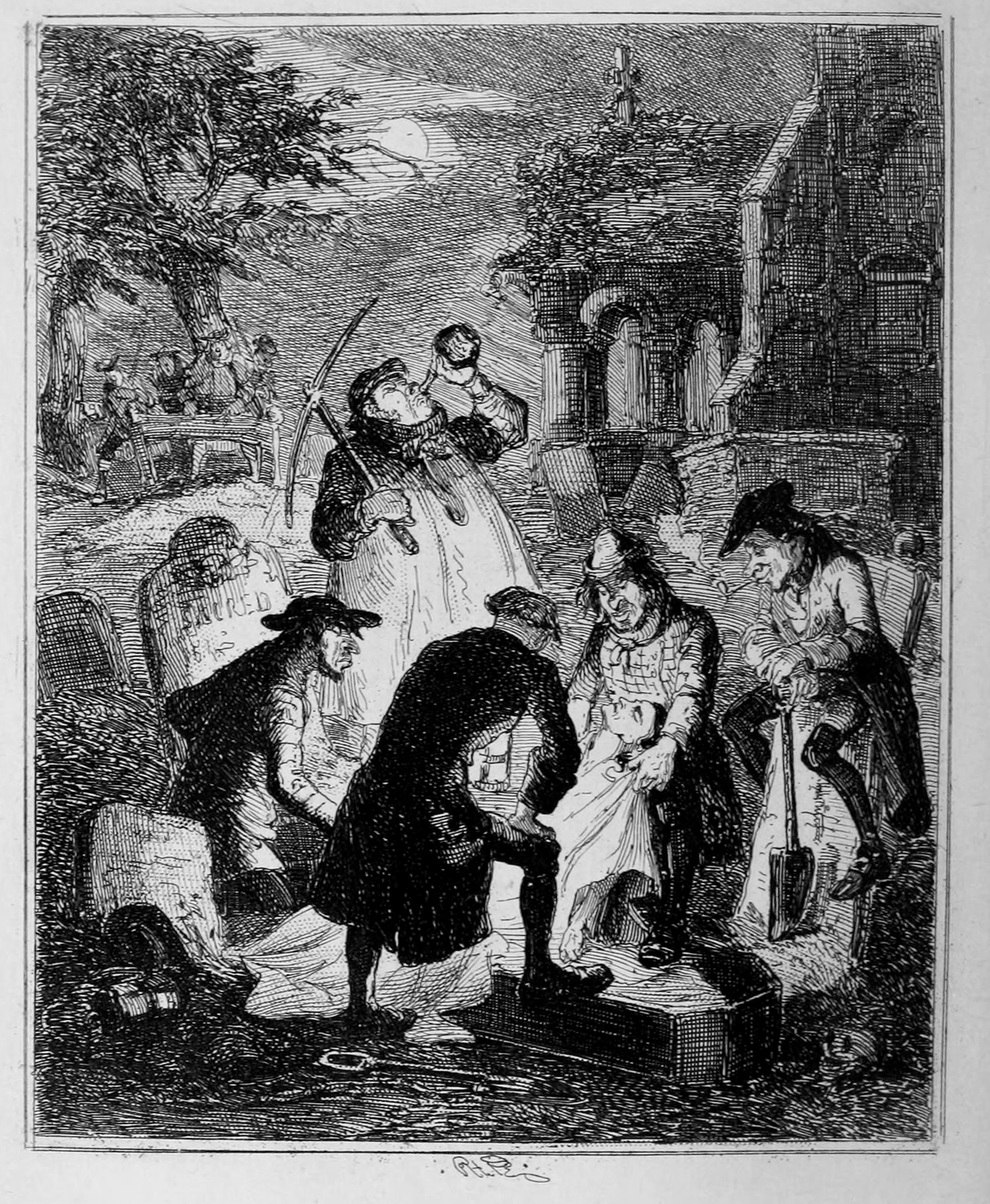
Resurrectionists by phiz

One of the grave robbers in The London Supply Company, Max Wilder, is actually a nobleman in disguise, trying to find out what happened to his step-sister who has disappeared and he fears she has been murdered. This scenario is interesting, but it all goes rapidly downhill when Abby goes to the home of the leader of the gang, Big Jack, to recover the money they took from her. She is captured and she falls in love with Max, who supposedly protects her, but also initiates her sexually while holding her captive; it’s all very distasteful and the sexual fantasy element seems misguided.

Abby dreams of being a surgeon, although women are forbidden from practicing medicine. Supposedly she has some feminist leanings, but she still likes to be dominated and falls for her captor. She refers often to the plight of women in the late Regency period, “Because she refused to adopt the role society tried to press upon her, she had always fought to fit in, even at the college. Lecturers and students alike couldn’t understand why she couldn’t be content to sit in the corner and darn socks.” Women have few options, apart from to go to the alms-houses, which “provided such a cruel and meagre existence that no one wanted to end up there”, and of course, there is prostitution.

There are offerings of historical information which do not blend with the plot, and land with a clang, such as the mention of “Sir Robert Peel’s new police force” or “the notorious gentleman’s guide to the current brothels and prostitutes in London – Harris’s List of Covent Garden Ladies.” It is as though Novak wants to educate as well as titivate, and she is far from subtle with the introduction of knowledge, but she also writes of England for an American market, as evidenced by her slips of language. Although Max is a high class noble (Lucien Cavendish, the Duke of Rowenberry), he tells Abby to, ‘Quit being so smug”, which is not an English expression of any era.

Interior with a Sleeping Man and a Woman Darning Socks by Wybrand Hendricks

Max is supposedly heroic and appealing in the way he cares for Abby, and she is drawn to his male magnetism and controlling aspect. “Max Wilder couldn’t be classified as a saint. There was something dangerous about him, something bordering on the uncivilized. From what she had seen so far, he dared more than a man should. He flouted whatever rule he chose to flout, and seemed to have no compunction about asserting his will in any given situation, regardless of how it affected others.” The novel constantly switches viewpoint, and we are meant to believe that a man so used to getting his own way is attracted to someone who might question his authority.

Abby admits her love for Max only to discover he is betrothed to another woman through an old alliance between families; of course it wouldn’t do for him to have any romantic attachment to anyone but her. Although she is now pregnant with his child (and we have been told about the consequences of unwed motherhood), she does the ‘decent thing’ by not telling him. “If she loved him, she would support him in what would make him the happiest, and she knew what that was.” This is patently ridiculous and a romance novel trope; one of many. There are long scenes of what Max and Abby feel for each other, but the actual plot hurries towards the end. In the last few chapters there are stabbings, abduction, hangings, and circumnavigations of the globe which appear to take weeks rather than months.

The sexual politics are at best uncomfortable and at worse downright offensive. As for the narrative, all of the potential interest in a story about grave robbers, medical science, and a young woman trying to negotiate a life in a man’s world is swept away on a torrent of clichéd romantic claptrap.

Friday, 18 June 2021

Friday Five: More of the Women in The Odyssey

I'm in the middle of rehearsals for The Penelopiad by Margaret Atwood, which is a retelling of The Odyssey, focussing on Penelope, who was left behind while Odysseus went off to war and then travelled around having adventures rather than returning to her in a timely manner. I'm co-producing and directing the play which will be on at the Courtyard Studio in Canberra from 7-17 July. I have always loved mythology and the value of storytelling, so have thoroughly enjoyed providing a bit of context to some of the characters mentioned in the text. This is Part Two (Part One is here).

Helen of Troy (1898) by Evelyn De Morgan 

1. Helen of Troy, also known as beautiful Helen, Helen of Argos, or Helen of Sparta, was said to have been the most beautiful woman in the world. The myths relate how she was born (hatched from an egg) after Zeus 'visited' Leda (wife of Tyndareus) in the form of a swan and 'seduced' her. Helen's appearance inspired artists of all times to represent her, frequently as the personification of ideal human beauty. Images of Helen started appearing in the 7th century BC, with her abduction by Paris (or escape with him) being a popular motif.

In her youth, Helen was abducted by Theseus. He liked the look of her so with his mate Pirithous, the the king of Larissa, he went to Sparta, kidnapped Helen and brought her back to Aphidnae, a small city outside Athens, to be taken care of by his mother. Pirithous then decided he would like Persephone, goddess of the Underworld, for his wife, so the two mates popped down to Hades (the place) to kidnap her. Things didn't go so well, however, as Hades (the god) threw Theseus into prison and let his dog, Cerberus, tear Pirithous to pieces. Meanwhile, Helen's brothers, Castor and Pollux, invaded Aphidnae, rescued Helen and brought her back to Sparta.

When it was time for Helen to marry, many kings and princes from around the world came to seek her hand, bringing rich gifts with them, or sent emissaries to do so on their behalf. Menelaus, her future husband, did not attend, but sent his brother, Agamemnon, to represent him. Tyndareus was afraid to select a husband for his daughter, or send any of the suitors away, for fear of offending them and giving grounds for a quarrel. Odysseus was one of the suitors but had brought no gifts because he believed he had little chance of winning. 

Odysseus promised to solve the problem if Tyndareus would support him in his courting of Penelope, daughter of Icarius, and Tyndareus readily agreed. Odysseus proposed that, before the decision was made, all the suitors should swear a most solemn oath (known as the Oath of Tyndareus) promising to provide military assistance to the winning suitor if Helen were ever stolen from him. After the suitors all swore the oath, Menelaus was chosen as Helen's husband. For some, this marriage marks the beginning of the end of the age of heroes, as Zeus planned to obliterate the race of men and heroes in particular, using the Trojan War as the means to this end.

Cut to Paris (the Trojan prince), who was appointed by Zeus to judge some kind of Greek Goddess Beauty Competition between Hera, Athena and Aphrodite. Aphrodite promised Paris that if he chose her, she would reward him with the most beautiful woman in the world, Helen, as a bribe. Surprise! Paris chose Aphrodite, and incurred the wrath of Hera and Athena, but won the prize, carrying off Helen and kicking off the Trojan War as all the sworn suitors set out to reclaim her. 

This abduction or elopement is deliberately ambiguous, depending on which side you're on and which motif you wish to pursue - in medieval illustrations this event was frequently portrayed as a seduction, whereas in Renaissance paintings it was usually depicted as a rape. This ambiguity continues through her relationship with Paris, Menelaus, and the warriors of Troy. Some tales claim Helen revelled in her fatal mischief, tormented the Greeks inside the wooden horse and rejoiced over the carnage of the Trojans; others suggest she was distraught and racked with guilt at being the cause of so much death and destruction, and was desperately lonely because so many people (particularly women) held her responsible and hated her.

According to some accounts, Greeks and Trojans gathered to stone her to death, but Menelaus demanded that only he should slay his unfaithful wife. When he saw her, however, she dropped her robe from her shoulders and the sight of her beauty caused him to let the sword drop from his hand, and the couple were reunited. 

Helen a la porte scee (1888) by Gustave Moureau

In stories, Helen is a prize; a possession; a temptress and seductress; she forces men to act a certain way and her beauty has been portrayed as potent and destructive. But here's the thing; she is always passive - things are done to her and because of her and for her, but never by her. She is born from rape, abducted, captured, stolen, rescued, contested, and never gets to tell her own story. We know that she is beautiful, but not a lot else, and if beauty is in the eye of the beholder, then she is a blank canvas on which we project our own ideology. Gustave Moreau portrays her as faceless in his painting of her witnessing the destruction of Troy. 

In The Penelopiad, Margaret Atwood refers to Helen as "the sceptic bitch" and "poison on legs". She redresses the balance, however, in her 1995 poem, Helen of Troy Does Countertop Dancing, in which Helen understands that her 'beery worshippers' would like to 'watch me/ and feel nothing. Reduce me to components/ as in a clock factory or an abattoir./ Crush out the mystery./ Wall me up alive/ in my own body." If we're talking about Helen's influence on poetry and plays, we cannot ignore Chritopher Marlowe's lines from his 1604 tragedy Doctor Faustus, in which the titular character sells his soul for (among other things) a night of passion with Helen of Troy, and when he first catches sight of her remarks,

"Was this the face that launch'd a thousand ships,
And burnt the topless towers of Ilium?
Sweet Helen, make me immortal with a kiss.
Her lips suck forth my soul: see where it flies!"

Odysseus Wants to Embrace the Ghost of His Mother (1901) by Jan Styka 

2. Queen Anticlea

Odysseus’ mother Anticleia is a shady character in the Odyssey; we meet her only in the Underworld, where Odysseus has gone to seek the advice of the dead prophet, Tiresias. Initially Odysseus rebuffs his mother as he is waiting for the prophet to approach, but after speaking with Tiresias, he allows Anticleia to come near and lets her speak. She asks him why he is in the underworld while alive, and he tells her about his various troubles and failed attempts to get home. Then he asks her how she died and inquires about his family at home.

Anticleia says that she died from a broken heart, longing for him while he was at war and having given up hope of ever seeing her son again. She also says that Laërtes (Odysseus' father) "grieves continually" for Odysseus and lives in a hovel in the countryside, clad in rags and sleeping on the floor. Penelope has not yet remarried but is overwhelmed with sadness and longing for her husband while Telemachus acts as magistrate for Odysseus' properties. Odysseus attempts to embrace his mother three times but discovers that she is incorporeal, and his arms simply pass through her. She explains that this is how all ghosts are, and he expresses great sorrow.

Odysseus’ futile attempt to reach out to her could be seen as an indication of his distant relationship with his mother. His warm memories of planting trees in the family’s orchard with his father is not matched by any such memories of his mother.

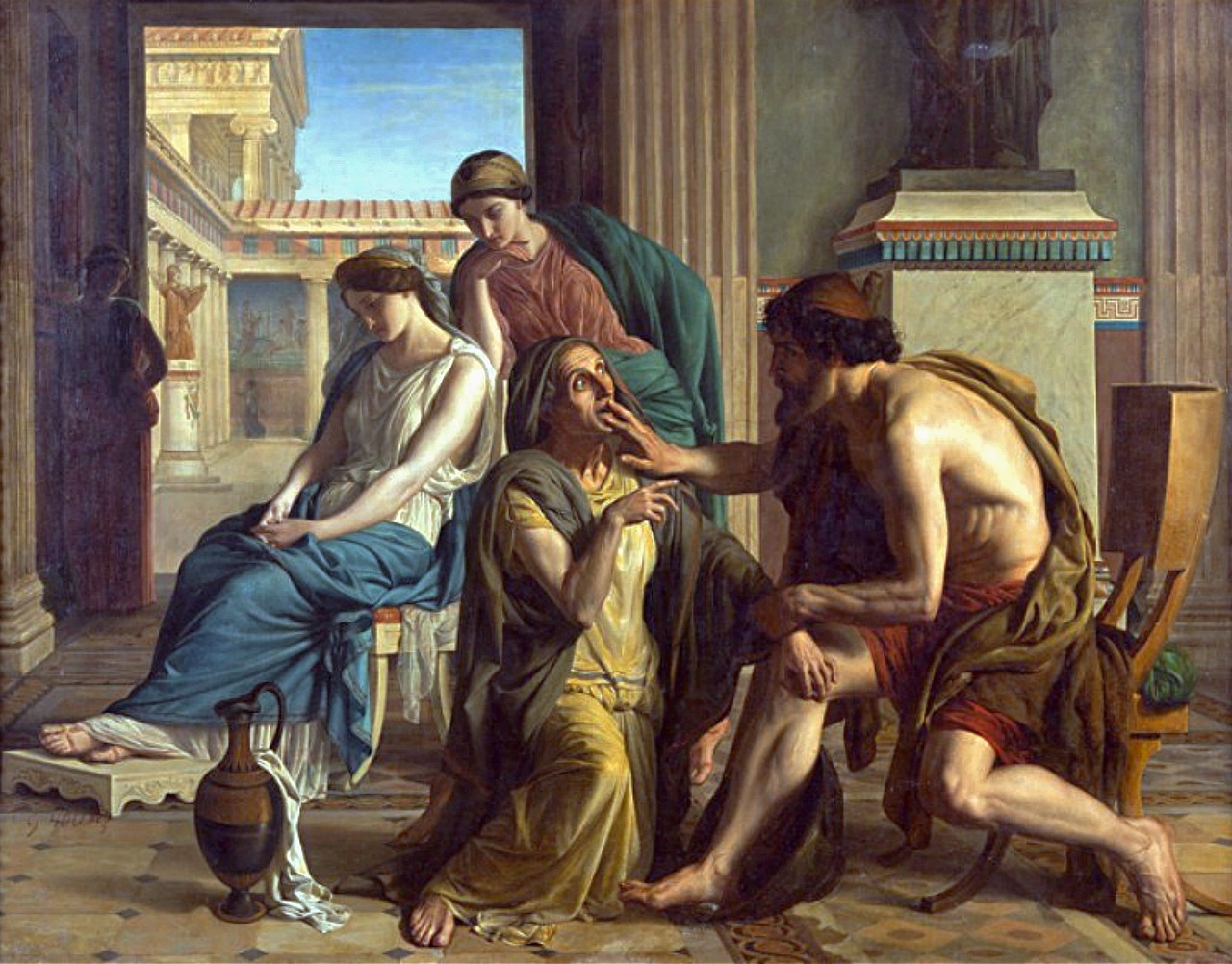
Ulysses Recognised by Eurycleia (1849) by Gustave Housez

3. Eurycleia

As a girl, Eurycleia was bought by Laertes, Odysseus's father. He treated her as his wife, but she was never his consumated lover, so as not to dishonour his real wife, Anticleia. She later nursed Telemachus, Odysseus's son. The name Eurycleia means 'broad fame', while Anticleia means 'anti-fame'. The tension between the meanings of their names can be seen to reflect the tebsion between the aspects of Odysseus's life.

Odysseus was born to Anticleia, a noble woman, but nursed and raised by Eurycleia, a lower-class maid. Odysseus's fame came from his role as a noble hero paralleled to his role as an anonymous beggar. His heroism was essential for capturing Troy; his skills as an orator and a schemer as well as his strength and tactics on the battlefield were instrumental in the success of the Greeks. However, he disguised himself as a beggar at critical moments, such as when he entered Troy and killed the unsuspecting Trojan soldiers, and when he returned to Ithaca and killed Penelope's suitors.

Eurycleia was the only person to recognise him without him first revealing himself (as he did to Telemachus) when he returned home after the Trojan War. She then informed him which of his servant girls had been unfaithful to Penelope during his absence, conspiring with Penelope's suitors and becoming their lovers. His son, Telemachus, hanged the twelve maids that Eurycleia identified.

Eurycleia supports Telemachus in much the same way as she had Odysseus before him, giving Telemachus provisions and supplies before he left for Pylos to seek out news of his father. She swore not to tell Penelope he had left until twelve days had passed, as Telemachus did not want his mother to be any more worried than she already was, or indeed to prevent him from going.

Some classicists argue that the woman who anoints Jesus in the Gospel of Mark is a direct reference to Eurycleia. She is the only one to recognise Jesus, and what she has done will be widely known in the same way as Eurycleia is the only one to recognise Odysseus and whose name means 'widely known'.

Artemis, Goddess of the Hunt, a Roman copy of the original by Leochares circa 325BC
4. Artemis

Artemis, daughter of Zeus and Leto, is the twin sister of Apollo and a goddess of the moon. She was the patron and protector of young girls, and was believed to be able to both bring disease upon women and heal them of it. She was worshipped as one of the primary goddesses of childbirth and midwifery, and was one of the most widely venerated of the Ancient Greek deities: her temple at Ephesus was one fo the Seven Wonders of the Ancient World.

Her Roman equivalent is Diana and she is also known as being a hunter. Homer calls her either 'Mistress of the Animals' or 'She of the Wild', and she is often referred to as 'arrow-pouring' or 'deer-shooting'. Just like her brother she may occasionally be called 'bright' or, even more illustrative of her function as a moon goddess, 'torch-bringer'. Her symbols included a bow and arrow, a quiver, and hunting knives, and the deer and the cypress were sacred to her. 

Women gods and demi-gods traditionally followed one of two paths: sultry or chaste: Artemis was definitely in the latter camp, preferring to remain a maiden and swearing never to marry. This chastity could be interpreted as cruelty or frigidity (fancy not giving her self away to anyone who desired her!) especially by Ovid in his Metamorphoses. When Actaeon stumbled upon Artemis while she was bathing, she was so enraged that he had seen her naked that she turned him into a stag and whipped his hunting dogs into a fury until they turned upon him and ripped him to pieces.

Her legacy lives on in the Artemis Program, formally begun in December 2017 under the Trump administration with the stated intention of landing the first woman on the Moon. Together with commercial and international partners, NASA intends to establish a sustainable presence on the Moon 'for private companies to build a lunar economy' (i.e. to establish commercial mining) and to prepare for missions to Mars. The scale of and motivation behind this project are quite literally out of this world. 

Calypso (1869) by Henri Lehmann

5. Calypso

If Helen of Troy is the face that launched a thousand ships, then Calypso is the name that launched almost as many products, including ships. Tributes to her come in the form of a drink (rum, peach schnapps, orange juice and grenadine), a dance, a style of music, video games, software companies, space craft, British Navy ships, an underwater camera, and a 1942 British minesweeper that was later repurposed as an oceanographic research ship operated by Jacques-Yves Cousteau.

The name means to cover, conceal or hide, and in Greek Mythology, she is a nymph who 'detained' Odysseus on the island Ogygia for seven years when he was attempting to return home to his wife, Penelope in Ithaca. In some accounts this 'detainment" resulted in two children. In others, Odysseus pines for his wife until Athena intervenes and begs her father, Zeus, to order the release of Odysseus from the island.

Zeus orders the messenger Hermes to tell Calypso to set Odysseus free, as it was not his destiny to live with her forever. She is furious and points out the double standards that allow gods to abduct females willy-nilly, but that punish goddesses who have affairs with mortals. Eventually she reluctantly concedes and sends Odysseus on his way after providing him with wine, bread and the materials for a raft. She then takes up the same position on the rock looking out to sea and pining for him, as he had previously sat longing for his Penelope.  In The Odyssey, this is the section of the adventures that begins the tale, before it plunges back into flashback, thus positioning it as an important highlight of the journey.

Tuesday, 15 June 2021

Misfortune; Carelessness; and...: My Sister, The Serial Killer


My Sister the Serial Killer by Oyinkan Braithwaite
Atlantic Fiction
Pp. 226

The novella begins, “Ayoola summons me with these words – Korede, I killed him. I had hoped I would never hear those words again.” Immediately we are in familiar but foreign territory. The structure is reminiscent of Charlotte Brontë’s, “Reader, I married him”, from Jane Eyre, but the shocking content is a lot less comforting. Originally published in Nigeria as an e-book entitled Thicker than Water, this tale of two sisters crosses genre lines from thriller to black comedy and socio-political commentary. As Richard Lea writes in their interview with the author (published at the end of the novel), “A novel that puts the relationship between two sisters at its heart, with men as supporting characters who may or may not make it to the final act, has been greeted as a riposte to crime fiction where the plot is so often set in motion by the gruesome death of young women.”

It clearly strikes a chord as it won the 2019 Los Angeles Times Book Prize for Best Mystery/ Thriller, the 2020 British Book Award for Crime & Thriller Book of the Year, and it was longlisted for the 2019 Booker Prize. As well as being critically praised, it is also popular with the public, and won the 2019 Amazon Publishing Reader’s Award for Best Debut Novel. It is certainly easy to read with short chapters (all with a one or two word title) and a fairly universal theme – we may not all have murderous siblings, but many of us understand sibling rivalry and family dynamics.

As the oldest, Korede is obliged to care for her younger sister, Ayoola, and now, she literally cleans up her sister’s messes. It doesn’t help Korede’s mental state to feel that her sister is outstandingly good-looking, and to constantly compare herself unfavourably. “The resemblance is there – we share the same mouth, the same eyes – but Ayoola looks like a Bratz doll and I resemble a voodoo figurine.”

Ayoola carries a knife on dates and she seems to have little compunction in disposing of her suitors, she claims in self-defence. Korede wants to believe her, but there is a touch of the Oscar Wilde loss of parents about her narrative; after all, she has killed three people; “Three, and they label you a serial killer”. Ayoola is seemingly remorseless and is back partying and posting on Instagram and Snapchat straight after she has killed her partner. She apparently believes that she is entirely innocent: “Her actions were the fault of her victims and she had acted as any reasonable gorgeous person would under the circumstances.” The implication is that she is excused because of her looks – it’s different if you’re beautiful.

When Ayoola shows interest in the doctor with whom Korede works, he of course reciprocates it, despite never having noticed Korede’s passionate feelings towards him. This might inform her questioning her sister’s version of events, at which Ayoola accuses her of victim shaming. “Victim? Is it mere coincidence that Ayoola has never had a mark on her, from any of these incidents with these men; not even a bruise?” At a time when we are struggling to believe women, this seems irresponsible, but education is not the duty of the author. Indeed, in her interview, Braithwaite contends, “I like to have fun. The books where I can tell I’m being taught something are a trial in the reading. If there’s a story and you learn something along the way; it’s a bonus.”

It transpires that the girls’ father subjected them to traditional and tribal cruelty, and Korede is concerned that Ayoola may have inherited some of this inherent brutality. “More and more, she reminds me of him. He could do a bad thing and behave like a model citizen right after. As though the bad thing had never happened. Is it in the blood? But his blood is my blood and my blood is hers.”

There are some things which may seem a little far-fetched for a genuine crime thriller – how could they possibly not get caught? One explanation is that the police force is highly corrupt, as are many other institutions in Nigeria, and they can be bribed to look away. Another consideration is that this is not meant to be forensically accurate. The page numbers are in a font that looks as though letters have been cut from newspaper print, or perhaps a graphic novel where all the information is condensed into one frame. It is currently being considered for film, which will be dramatic but not exactly realistic.

Oyinkan Braithwaite has provided us with a fast-paced, high-actioned, black-comedy crime thriller. It covers a lot of genres and is a terrific story. It seems churlish to expect more from her and we should be grateful for this offering and the knowledge that there are authors who can still deliver a gripping novel.

Thursday, 10 June 2021

Life's Nourishment: Milk by Dylan Van Den Berg

Dylan Van Den Berg, Katie Beckett and Roxanne McDonald in Milk

Milk by Dylan Van Den Berg

Directed by Ginny Savage
The Street Theatre
3 -12 June, 2021

The theatre is a forum for sharing stories; exploring the past; questioning the present; and preparing for the future. ‘Milk’ does all of the above with superb staging and atmospheric sound and lighting featuring pivotal moments in liminal spaces, directed with depth and nuance by Ginny Savage.

We are taken to a metaphysical Flinders Island off the coast of Tasmania, which is created instantly through imagery and sound (Peter Bailey) – the wind is a constant presence. The design of the rock-strewn stage (Imogen Keen) is evocative and versatile; piles of stones can be interpreted as cairns and path-markers, burial sites and weapons. Ranging in size they indicate the passage of time through erosion, and they can be put in a pocket and transplanted to another time and place.

Spanning two centuries the play tracks the conversation between three Aboriginal ancestors coming together on the verge of life-changing moments. The characters are nameless – known only as Character A, B, and C – which suggests a blending of personalities and continuation of stories. Playwright and Character C, Dylan Van Den Berg has just become a father, which has made him introspective. He wants to know where he came from and what he might be passing on to a future generation.

Character A (Roxanne McDonald) and Character C (Dylan Van Den Berg) 

He and the other characters, A (Roxanne McDonald) and B (Katie Beckett), attempt to reconcile what came before invasion and colonisation of Tasmania with what is yet to come. Roxanne McDonald (portraying an old woman from the 1840s) tells her story with honesty and heartbreaking integrity. While the horror and violence of the past is not dwelt upon, there are certainly uncomfortable scenes and a few tears were shed in the audience. A note in the programme reminds us that “a group of Palawa people, mostly women, were removed from their country and taken to the Bass Strait Islands in the early-to-mid 1800s. They were sold, bartered, and gifted as ‘wives’ to the white sealers who lived there.”

Katie Beckett plays Character C’s grandmother, although the actors are similar in age, which leads to an intimacy and shared understanding of identity. The difference is that “You’re lucky with that milky skin. You get no trouble. You get to carry it all on the inside – all the knowledge. Some of us gotta carry it on the outside for everyone to see.” Character B is a middle-aged woman from the 1960s who is attempting to find fun and explore the world through various encounters and relationships, while refusing to be confined by convention. 

Katie Beckett as Character B

Through outstanding physicality, the actors all embody greatly varying experiences and shifts of mood that are entirely convincing and utterly compelling. The costumes, also by Imogen Keen, are designed to accentuate the details of their circumstances, from the rough-looking, sturdy coverings, fashioned like a blanket, of Character A, to the impractical and uncomfortable shiny fabric worn by Character B as she prepares to go on a date and sell herself as something she is not – “I’m a natural blonde, baby… this is just a dye-job.”

They progress and move past grief, shame and self-loathing by literally picking themselves up and carrying on. Lighting by Gerry Corcoran illuminates, defines and conceals spaces in intriguing ways that create conversation. We all have blind spots in our family history, but learning about the past can inform our present and teach us to be more compassionate towards the people around us.

It is apt that Milk opened in a world premiere during Reconciliation Week. It may be a personal story about loss and survival, but it asks us all to question our heritage and to consider our relationship to the land we live on. Again, the programme notes that, “For many years it was said that the Palawa people were ‘extinct’. White history has swallowed our stories. This is just one of many.” A lot of stories and knowledge have been lost through lack of sharing, but in the words of character C, “It’s all out there. Even the stuff we think is gone. We just – have to listen. We just – have to dance.”

This play is stunning and heartfelt. It is personal and it is broader than one man’s story. It affects all of us, as it should. See it; feel it; share it. That is all.

Wednesday, 9 June 2021

Neuroscience Meets Mindfulness: Hardwiring Happiness


Hardwiring Happiness by Rick Hanson
Rider
Pp. 223

Being good to yourself has benefits for everyone, and for the entire planet. That’s quite a grand claim, but Rick Hanson, “a father, husband, psychologist, meditation teacher and business consultant” makes a concerted effort to help everyone do just that. He sets out to show us how to retrain the brain to focus on positivity rather than negativity, which is actually not our brain’s natural and default setting. The balance between science and practicality is fair, and Hanson correctly states, “You won’t need a background in neuroscience or psychology to understand these ideas.”

He has handily distilled his practice down to four simple steps “with the acronym HEAL: Have a positive experience. Enrich it. Absorb it. Link positive and negative material so that positive soothes and even replaces negative. (The fourth step is optional.)” Every new technique seemingly has to have an acronym, and this is a good one. He introduces concepts with analogies and anecdotes, including side tables to condense the information, and a section at the end of each chapter called ‘Taking It In’ that summarises the key points. He includes a table that the reader can print and then fill in with their own experiences that they want to affirm, and there are reference notes and a bibliography later in the book for further study. He even includes a section explaining how to use these steps with children, “while naturally adapting them to the child’s age and situation.”

The basic premise is simple: the brain has a built-in negativity bias to pay more attention to the bad than the good. This is a survival technique because the bad can kill you; the formation of implicit memory is negatively biased, to make us avoid harmful things or, as Hanson puts it, “Your brain is like Velcro for negative experiences but Teflon for positive ones.”

With advice that borrows a lot from Buddhist teachings, Hanson recommends that we focus on the positive and open our mind and body to happiness and good feelings. He describes how to sit and be with positivity, cultivate inner strengths, and absorb good feelings so that they can be recalled in other situations and used to calm and focus. He is keen to encourage feeling good in the moment and taking in the good through simple experiences like looking out of the window or eating an orange. It may all sound a bit Little Book of Calm, but if increased positivity is good for you, why not give it a try?

He focuses on ‘feeling all right, right now’, which he considers to be one of the greatest strengths, and supports experiencing something as it is rather than grasping after it or wanting more – “let sensations come to you rather than reaching for them”. An experience is made more powerful by being particular to a person and linked to their good memories. Hanson encourages holding onto this pleasant feeling to be able to more easily recall it later, through multimodality; sensing good experiences throughout the whole body and being aware of as many aspects of it as possible.

Although much of this sounds rather pleasant, we still have the capability to resist it, so Hanson isolates these negative blockers to our potential happiness. Some may argue that employing this positivity method is simply denial, but Hanson counters, “You’re not looking at the world through rose-tinted glasses, but rather correcting your brain’s tendency to look at it through smog-tinted ones.” Another specific blocker is the belief that there’s no point in feeling good since some things are still bad. Even a little bit of good will increase happiness: you can take a slice of the pie without waiting or wanting to have the whole thing. It is up to us to learn to enjoy experience, and Hanson is aware that this may be difficult, so he brings it home by appealing to our morals and contemporary ethics. “The fearful, greedy and self-centred reactive setting of the brain promotes a kind of gorging of the earth’s limited resources that is causing deforestation, mass extinctions, and global warming.”

He has crafted such a framework that it is morally questionable not to look after ourselves by accepting more happiness into our life and brain. He has supplied a very straightforward and practical manual outlining how to achieve this goal in which neuroscience meets mindfulness. And if he has made some money along the way, well good for him; I have no feelings of envy or resentment. See, it’s working already.