Friday, 9 September 2022

Friday Five: Cross-stitch quotes from Our Country's Good

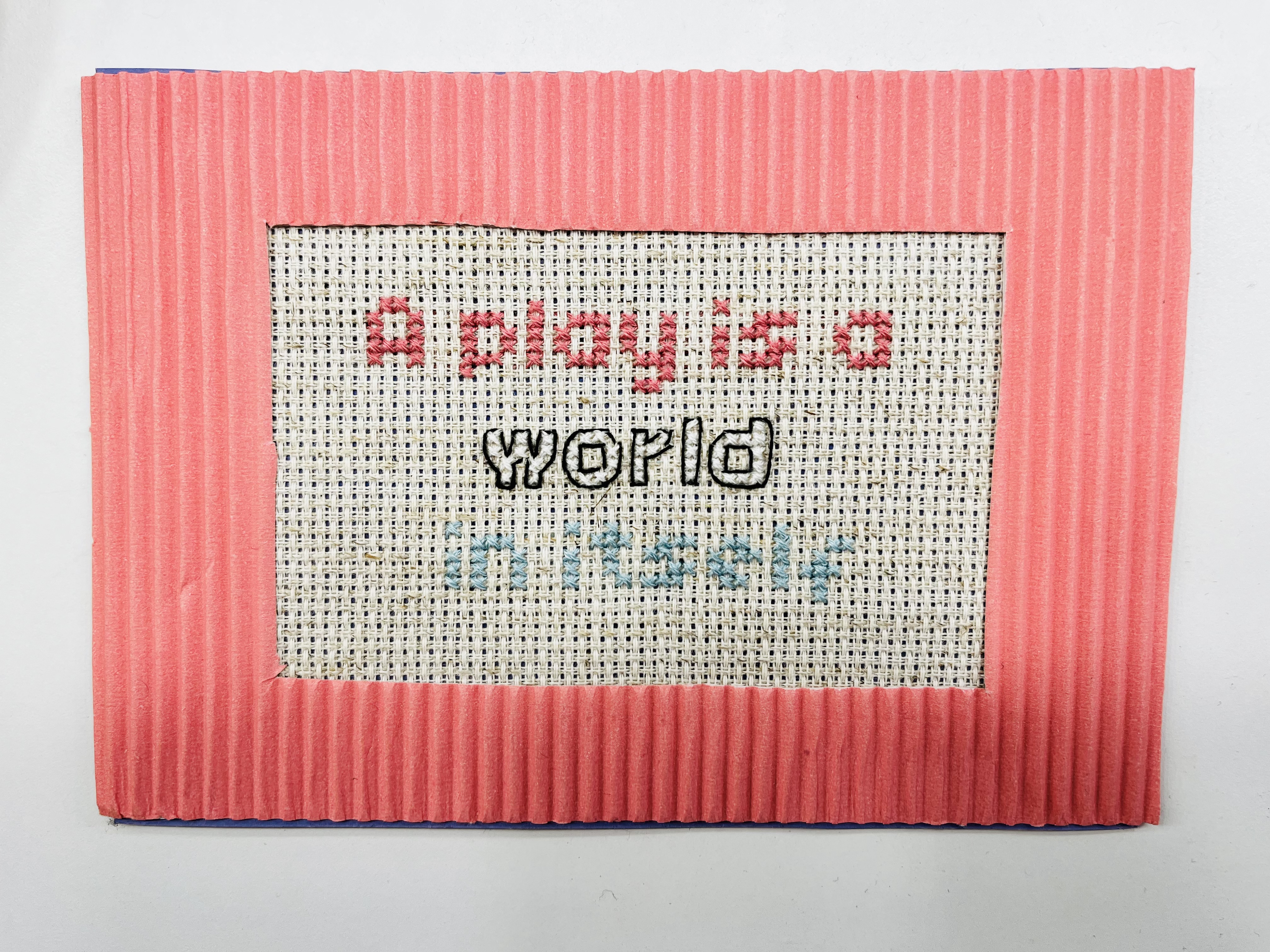
Tonight is opening night of Our Country's Good by Timberlake Wertenbaker at Canberra Repertory Theatre. As I am in it, I have listened to the wonderful words night after night in rehearsal and, as is my wont, in my down time I have created cross-stitch patterns based on the text to make into cards for the cast. 

The colours I have used are based on the plumage of Australian birds (mainly parrots). I remember when I first moved here myself, how taken I was with the avian vibrancy, and so the line, "You have been made Governor-in-Chief of a paradise of birds" (spoken to Captain Arthur Phillip by Captain David Collins) resonates particularly strongly. 

Said by Arthur Philip (played by Amy Crawford) in the colours of a Bald-eyed corella (Cacatua sanguinea)
Said by 'Shitty' Meg Long (played by Meaghan Stewart) in the colours of a Rainbow lorikeet (Trichoglossus moluccanus
Said by Robert Sideway (played by Isabelle Gurney) in the colours of a Sulphur-crested cockatoo (Cacatua galerita)
Said by Liz Morden (played by Alexandra Pelvin) in the colours of a Yellow-tailed black cockatoo (Zanda funerea)
Said by Mary Brenham (played by Rosy Fasano) in the colours of a Galah (Eolophus roseicapilla)

Wednesday, 7 September 2022

Paddock to Plate: Orange Regional Museum

On a trip to Orange, when Him Outdoors was busy competing in a cycling race, I went to the regional art gallery and museum. Their exhibition was Paddock to Plate: a history of food and wine in Orange and the district.


While it did pretty much what you would expect - using historic objects and photographs to illustrate how growing, processing, distribution and consumption of food has changed over time - it was curated in an interesting and interactive fashion, encouraging visitors to learn more about the stories of the people of the region. The exhibition starts with the mountain, an ancient volcano, which created the soils and climate that attracted indigenous people, then others from across the world. 

Stories about producing, processing and forces of change run around the perimeter walls, giving space for large farming objects and showcases containing smaller artefacts. A range of farming tools is mounted on simple white backing boards, so the timelessly beautiful shapes of these objects can be clearly seen. 


Curator Sandra McEwan and the museum team assembled an impressive trove of over 200 historic from around the Orange region with enormous variety of size and scale. Ploughs, refrigerators and a rare wheat flail join whisks, butter pats and dainty mementos of dining in a bygone era. 


Central to the exhibition was the concept of food in the home, and this was represented through a stylised 'kitchen' displaying utensils in a pigeonhole format that echoes kitchen cupboards. Some of these cupboards are see-through, and others have solid doors. Each door has a single word printed on the face giving a clue to the use of the object inside, such as grind, whip, cut, beat, squeeze, shape, lift, protect and hold, which sounds either like cookery, cosmetic surgery or a particularly violent poker game.  


A dining table is covered in a series of projections showing changing styles and tastes of home eating from the 1800s to today. One table features a display of seeds and legumes as in a curiosity cabinet, including wheat, wattle, apple, pumpkin, hazelnut, cucumber, kurrajong and kangaroo grass. 


Paddock to Plate tells the story of food and wine production in this beautiful district through the stories of people, place and a passion for produce. Lists of words always inspire poetry in me, so naturally I took myself to the café where I had coffee and cake and thought of my domestic culinary memories.
Pitter patter of kitchen helper;
patty cake with butter pat,
licking clean the whisk and spoon
with mother in the warmest room:
better batter on baking day.
Friday, 2 September 2022

Friday Five: Books Read in August

Once again it turns out that I have (conveniently for blog purposes) read five books in a month. These are they.

5 Books Read in August:
  1. Chatter: The Voice in Our Head and How to Harness It by Ethan Kross (Vermilion) - We all have voices in our head; some supportive and encouraging; others belittling and disruptive. Kross provides pop-scientific reasons for why and which ones count. Talking to ourselves and others can be beneficial to help us distance ourselves from traumatic experience, but it can also lead us into a vicious cycle of repetition, particularly in the echo chambers of social media. This book presents ways to normalise and contextualise confronting events and suggests methods that enable us to take back 'control'. Easy to read and with a practical 'toolkit' of strategies, this is recommended for anyone struggling with daily overwhelm. 
  2. Cow by Susan Hawthorne (Spinifex) - A sublime book of poetry inspired by the humble (or scared in some societies) bovine beast. From ancient aurochs to nursery rhyme moon jumpers; cattle chattel of Lakshmi, the Hindu goddess of wealth and good fortune to the shape-shifting Io of Greek myth who became a white heifer due to Zeus' lust and Hera's rage, there are cows, "at the edges of every known world/ like it or not we are everywhere."
  3. The Club: Johnson, Boswell and the Friends Who Shaped an Age by Leo Damrosch (Yale University Press) - Named one of the ten best books of 2019 by the New York Times Book Review, this is the story of the phenomenal London club, established in 1764, and the men (and it was only men) who comprised it. It was established in a tavern and was the meeting place of writers, thinkers, economists, philosophers, artists, actors, playwrights, politicians, historians, lawyers, doctors, musicologists, poets, clergymen, botanists, chemists, scholars and statesmen - a who's who of the mid-late eighteenth century. Told mainly through the eyes of James Boswell (he wrote a lot), it captures the characters and the events of the times, such as the cultural climate and political happenings, but, "Above all the Club existed for conversation: not just small talk, but wide-ranging discussion on topics of all kinds."
  4. Fled by Meg Keneally (Echo Publishing) - This novel tells the story of Mary (Dabby) Bryant, who was transported to the fledgling colony of New South Wales for highway robbery. Once there, she manipulated the system as much as possible until she escaped to make her way back to  England, where she thought she had a better chance of survival for herself and her children. She is renamed Jenny Trelawney for the purposes of fiction, and while the 'real' Mary Bryant was illiterate and never wrote down any thoughts or feelings, many of the facts are true and make for an incredible historical adventure. In the Mobius strip-like way that art can unfold, Meg Keneally's father, Thomas wrote a book, The Playmaker, based on the story of the first play ever performed in Australia, with Dabby Bryant being one of the actors - this book was the basis for a play by Timberlake Wertenbaker, Our Country's Good, in which I am currently performing (as Dabby Bryant) at Canberra Repertory.
  5. The Secrets of Strangers by Charity Norman (Allen & Unwin) - When a bloke marches into a café in London and shoots the proprietor, several of the patrons get caught up in the cross-fire and the ensuing hostage situation. We learn about them all individually in a highly stylised manner that makes the novel seem more like a stage play or a series of TV episodes. Among those captive in the café are a grandmother looking after her grandson, a lawyer who is meant to be defending her client in court, a former teacher who is now homeless due in part to a gambling addiction, and a waitress who is hiding in the cleaning cupboard, her presence unknown to the gunman. Their stories all wrap up neatly - everyone has to have a backstory to provide context for their actions, many of which are glossed over or shoehorned into the story as the cause du jour (coercive control; refugee experience; infertility obsession) - and the reader has very few gaps to fill, removing any tension necessary for a thriller. We also hear from Eliza, the police negotiator who is talking to the gunman and trying to secure the release of the hostages - hers is the most interesting and realistic voice in the novel. While the pace is fast enough that one does want to keep turning the pages, there are no surprises and the need to keep everything tidy and completed is distancing and unsatisfying to the point of triteness. 

Tuesday, 30 August 2022

Crime of its Time: Vintage Murder


Vintage Murder by Ngaio Marsh
Fontana
Pp.223

Inspector Roderick Alleyn is on holiday in New Zealand when he gets caught up with a theatre group and a murder, involving a mistimed opening of a jeroboam of champagne. This combines Ngaio Marsh’s interests perfectly, allowing her to give her chapters such titles as Prologue in a Train, Intermezzo, Duologue, and Business with Props. Written in 1937, it is dated in language and attitude, although it was doubtless considered progressive at the time.

Detectives, witnesses and suspects have a lot in common with actors as they rehearse stories, play parts and deliver lines, whereas Alleyn is straightforward and direct with a self-deprecating sense of humour. When he lists the suspects, their possible motives and alibis, he draws up a chart which is included in the chapter Entr’acte to assist the reader as much as himself – naturally, everybody has one.

There is snobbery towards people’s age, size, class and accent, although most prejudice, however, occurs towards the Maori people, as exemplified through the character of Dr Rangi Te Pokiha. A considerably hateful comedian describes Te Pokiha as “the black quack” and “the light-brown medico”, and when Te Pokiha retaliates (he has also been called silly, obviously wrong, and a liar), we are told, “The whites of his eyes seemed to become more noticeable and his heavy brows came together… [His] warm voice thickened. His lips coarsened into a sort of snarl. He showed his teeth like a dog… the odd twenty per cent of pure savage.” One suspect asserts, “There is no colour bar in this country,” but people still use the expression ‘a white man’ to denote a person of good character. Alleyn describes the country and the people with an anthropological aspect that is offensive to modern readers.

The plot is well-crafted, some of the characterisation and theatrical tropes are fun, and the Kiwi setting is original, but the inherent racism, sexism and body-shaming are problematic. Crime novels may remain popular, but fortunately times have changed.

Friday, 26 August 2022

Friday Five: TV Viewing

I've not done a recap of the TV I've been watching for a while, so there's a fair bit of catching up to do. Here are five recent viewing choices.

5 TV Shows I've Watched Recently:

  1. Jekyll (BBC One) - Proving that he would have made a great Dr. Who, James Nesbitt stars in the Steven Moffatt-written 2007 TV series, Jekyll. It has all the hallmarks we have grown to expect from the man who went on to write Sherlock and Dracula also for the BBC. Described by its creators as a sequel to the 1886 novella, Strange Case of Dr. Jekyll and Mr. Hyde, rather than as an adaptation of it, it positions Nesbitt as Tom Jackman, a modern-day descendant of Dr. Jekyll, who has recently begun transforming into a version of Mr. Hyde (also played by Nesbitt, having fun exploring the dark side of a character). Michelle Ryan plays the psychiatric nurse who assists him in his experiments, recording evidence for further interpretation of the deeper workings of the inner mind. It's slick and stylish sci-fi with lashings of horror and a splash of humour, and because it's British it consists of six episodes and then it stops leaving the viewer wanting more rather than dribbling on for several seasons and outstaying its welcome. 

  2. Mr. Mercedes, Season One (SBS On Demand) - Based on the Steven King novel, this TV series is part supernatural horror and part detective fiction. Brendan Gleeson is Bill Hodges, the recently-retired detective who drinks too much, hates everyone and everything except his pet tortoise, and can't seem to let go of an unsolved case from two years previously, when a driver in a clown mask ploughed through a crowd of people waiting outside a job fair. Hodges may not know who the killer was, but the audience does, as Harry Treadway is introduced as Brady, calling himself Mr. Mercedes and taunting the detective with his criminal past. The show begins with a seedy ambience (Brady's family situation is a far-cry from the wholesome American Brady Bunch set up, and his place of work isn't much better) but it is highly polished with snappy dialogue and credible characters - all provided with backstories and sympathetic motivations (created by David E. Kelley). There are another two seasons after this; I'll probably watch them. 
  3. The North Water (BBC First) - A bunch of men go whaling in the mid-nineteenth century. None of them are particularly pleasant, but some even less than others. They drink and fight and kill. Testosterone abounds in the ports and the ship as it travels to the Arctic with a secret agenda and a lot of laudanum. It feels nightmarish and disturbing, as writer/director Andrew Haigh intended: "I always wanted the audience to feel at sea. So they were never quite sure what this was going to become or what it was." The chiaroscuro effects are dazzling - if we are not in the dark belly of the ship we are on the blinding white landscape of ice and snow, splatted with blood and seal carcasses. The acting is excellent (Colin Farrell; Stephen Graham; Jack O'Connell; Sam Spruell; Roland Møller; Tom Courtenay), the motives are shady, the concept is brutal, and the scenery is spectacular. 
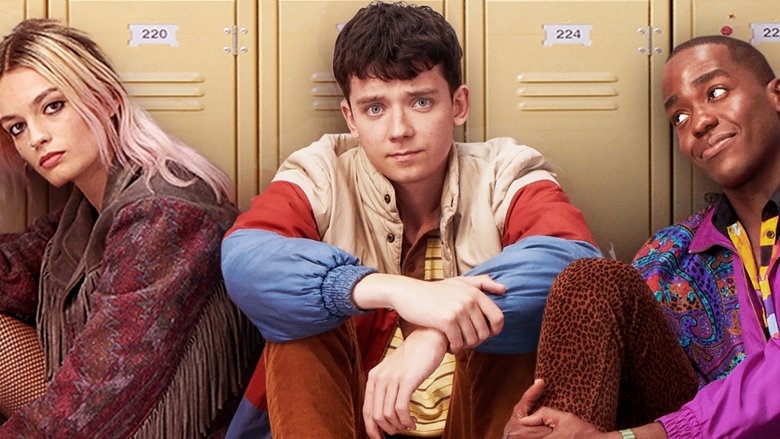
  4. Emma Mackey, Asa Butterfield and Ncuti Gatwa in Sex Education
  5. Sex Education, Season Three (Netflix) - After having binged the first two seasons in a weekend a couple of years back, I admit I watched this mainly after the announcement that Ncuti Gatwa was going to be the new Dr. Who - I didn't want to confuse him with Eric in my  mind, so watched this to get it out of my head(and he is the best thing in it). The first few episodes started slowly but then it picked up momentum, diving deeper into the stories of the talented ensemble than previously. Connor Swindells (Adam), Aimee-Lee Wood (Aimee), Tanya Reynolds (Lily), Chinenye Ezeudu (Viv) are among those who get to flex their acting muscles and create showreels for future auditions. It still tackles tough issues of adolescence and identity, but each one is neatly wrapped up as it begins to feel more American than British. The diversity and inclusion is a bit unicorns and rainbows, the humour is glib and obvious rather than sarcastic and subtle, and I keep expecting the cast to break into harmonised song and choreographed dance.
  6.  
  7. Vigil (BBC First) - Imagine you're in a confined space with a group of people you don't really like. There's a murder and you have to solve it. Did I mention the confined space is a submarine? Did I mention you're claustrophobic and need to take medication to remain calm, but that medication is prohibited on the vessel? And that the submarine is a nuclear stealth submarine? And that it's just been hit? By a suspected ally? And you can't communicate with the outside world because it would give your position away? And no one knows you're there? Right- that's the premise, created by Jed Mercurrio and the team that brought us Line of Duty and Bodyguard. Suranne Jones is both tough and vulnerable as DCI Amy Silva in this preposterous position, and her partner above the waves, DS Kirsten Longacre is Rose Leslie in a performance that is almost good enough to atone for her irritating turn in The Good Fight. Martin Compston (Steve Arnott in Line of Duty), Gary Lewis (My Name is Joe, Billy Elliot), Shaun Evans (Morse in Endeavour), Connor Swindells (Adam in Sex Education), Paterson Joseph (Benjamin in Jekyll and Lyndon in Teachers amongst other things), Adam James (John Bellasis in Belgravia and multiple stage appearances), all give committed and credible performances, and the tension is palpable, although the plot is a bit leaky and the conclusion is all too neat - with an eye on the US market perhaps?

Tuesday, 23 August 2022

If I Could Turn Back Time: Wrong Way Clocks


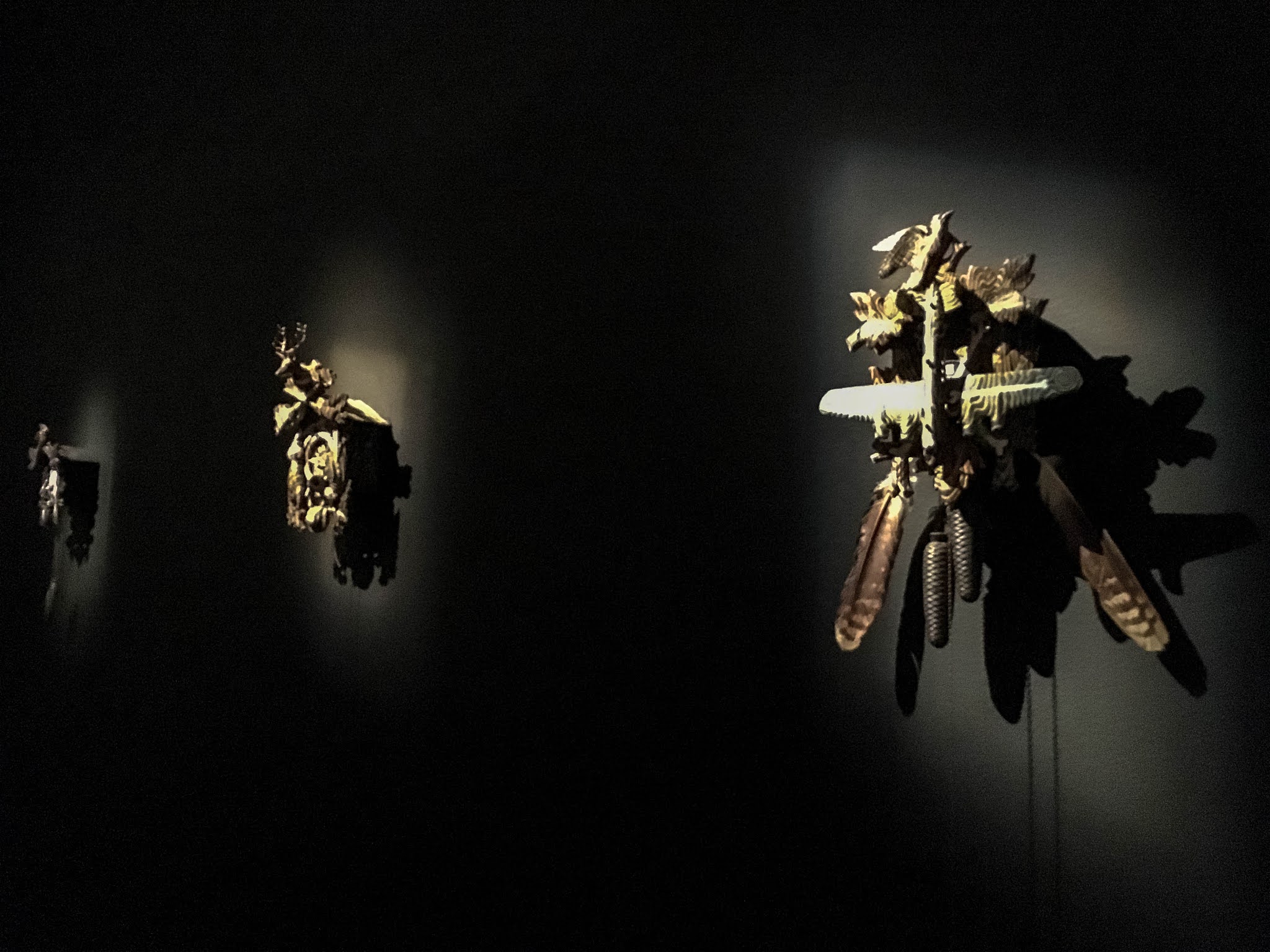
Potentially the highlight of the Wrong Way Time exhibition (more details about the exhibition here) was the section devoted to the physical manifestation of calculating the hours, minutes and seconds, in Wrong Way Clocks.

The clocks have a specific meaning and function within our culture, yet all of them have been altered. By adding text and images in paint, the artist adds to our understanding of what a clock is and what it does. Fiona Hall's clocks become more than just a means to tell the time; they have been transformed into a warning. 

0 is the number
The cheerful cuckoo clock becomes a desperate plea to wake up and look at the world in which we live, its always-expected chimes a reminder that time is precious and finite.


Each of the floor and wall clocks is painted in a different way, but many of them are characterised by skeletons; messages and graffiti cover other pieces. The message is not entirely an omen of death, but memorial totems and protests signs urge people to change their habits and lifestyles. 

A clock face mounted on a tower of charred books indicates that we can learn form the past to arrest the extinction of the future. Time may be running out, but the Doomsday Clock hasn't yet reached Zero Hour and we may still be able to do something about that.

Friday, 19 August 2022

Friday Five: More Theatre


These are brief reviews of five theatre productions I have seen recently
  1. Jane Eyre - shake & stir theatre, The Playhouse, Canberra Theatre Centre: In the spirit of full disclosure I must point out that Jane Eyre is one of my favourite novels, along with Animal Farm, a play of which shake & stir produced last year - review here. Jane Eyre matches the production company's enormously high standards - the pyrotechnics on the set alone (I'm assuming you know the story so this is no spoiler) are worth the price of admission. The new adaptation featuring original music (written and performed live on stage by Sarah McLeod) is simply outstanding. Nelle Lee plays the titular role with passion and repression from the derided young girl to the dignified mature woman she becomes, guided by her impulses, values and strong sense of inner strength. The three other actors play all the other roles with complete conviction; the blend of Gothic Romance and contemporary gender insights is absolutely perfect and so true to the novel it has instantly become one of my favourite experiences. 
  2. Pygmalion - Tempo Theatre Inc., Belconnen Community Theatre: Often overshadowed by the opulent musical, My Fair Lady based upon it, Pygmalion is arguably George Bernard Shaw's masterpiece. Tempo's version is true to the intentions of the socialist polemic, indeed, Peter Fock stands out as Alfred Doolittle railing against middle class mortality rather than as the too-often-seen portrayal as a commitment-shunning buffoon. Adam Salter gives Henry Higgins the necessary academic confidence and boyish glee in 'his' achievements in passing off the flower girl, Eliza, as a well-bred young lady after his elocution lessons, while leaving no room for mature sentiment - this is usually balanced by the gravitas of Colonel Pickering, which is absent in this production. The young man, Thomas Cullen, brings gentleness to the role but removing the title of Colonel changes its focus entirely, with insufficient direction to compensate. The highlights of the play are embodied in the women. As Mrs Higgins and Mrs Pearce, Elaine Noon and Joan White respectively are delightful, providing a calm dignity and reasoned response to Higgins (and, in one scene, to a flimsy set failure). Meaghan Stewart as Eliza Doolittle is stunning, willful, fierce and vulnerable; determined to be her own woman and not a creation of Higgins' to be put on a pedestal or shut in a museum. The audience is with her from the beginning, and contemporary concerns about women's rights in society and their treatment by those in traditional male professions merely accentuate our sympathies.
  3. Arsenic and Old Lace, Canberra Repertory Society, Theatre 3: Joseph Kesselring's 1939 farcical black comedy is probably more alluded to than it is seen - most people have heard of the two seemingly sweet spinster sisters (Abby and Martha) who have taken to murdering gentleman lodgers and burying them in the basement. In Canberra Rep's production, the smiling assassins are the perfectly harmonious duo of Alice Ferguson (the acerbic grand dame who plays it straight) and Nikki-Lynne Hunter (who gives it a gloriously dizzy and ditsy turn). Their art critic nephew, Mortimer (a frenetic Jack Shanahan), has to deal with the increasingly odd events while trying to decide whether to marry the girl next-door (Natalie Waldron, who deserves more than yet another looks-in-lieu-of-character role). The cast is rounded out by Robbie Matthews as the barmy brother who thinks he is a former Aussie PM, Rob de Fries playing the murderous nephew brother whose plastic surgery conceals his identity, and Kayla Ciceran as the alcoholic accomplice who performed the operation.  Director Ian Hart acknowledges the script is outdated and attempts to modernise it by setting it in contemporary Queanbeyan, hence the Aussie PM reference rather than the original Teddy Roosevelt, and Jonathan is now meant to resemble Freddy Krueger rather than Boris Karloff (who actually performed the role in the original stage play). Not all of the updates land, however, such as Hart's awkward approach to gender diversity in casting or the Fawlty-Towers-esque anagram gag adds an unnecessarily creaky element to an otherwise excellent set (Andrew Kay once again with a deft and professional touch). The timing is uneven and efforts to overcompensate frequently fall flat in a desperate stretch for unobtainable laughs. 
  4. Emerald City - Free Rain, ACTHUB: David Williams' 1987 satire of men behaving badly is all about the dialogue. We are harangued with debates about the merit of art - celluloid and literary - and the inherent differences between Sydney and Melbourne. Sydney, with its unsubstantiated promise of fulfilling dreams is the Emerald City of the title, while Melbourne is for urban intellectuals who are motivated by morals rather than money. If you want to hear 'characters' discuss these topics at witty and acerbic length, you could do worse. The actors all excel in the limited range their characters are constrained to demonstrate, and they deliver the dialogue with excellent clarity: every word could be heard, and there are an awful lot of them. Designers have clearly had nostalgic fun with set and costume (Cate Clelland and Fiona Leach), as it's all chic decor and keen angles combined with silk shirts and sharp suits, while director Anne Somes has softened the edges with sartorial metaphors - her subtle use of shoes is inspired. These people are unpleasant, but it is even more disturbing to acknowledge how 80's ambition seems tame in an environment where the bully boys have moved on from verbal sniping to willfully disregarding laws, contesting elections and invading countries. Who knew we would ever look back on the 'greed is good' mantra as the good old days.
  5. Urinetown - Heart Strings Theatre Co., Courtyard Studio, Canberra Theatre Centre - Yes, it’s a terrible title; yes, it’s truly awful subject matter; yes, it’s utterly ridiculous, but Urinetown is a lot of fun! The band are great; the voices are outstanding and the deceptively simple-looking choreography and staging are spectacular. I'm so glad that Ylaria Rogers has finally brought this dream to life. As a self-identifying non- musical theatre fan, I found this to be an unexpected surprise. Is there any other kind? It self-referentially (and reverentially) mocks the genre of musical theatre (particularly Broadway) and parodies specific musicals: I didn't get all the allusions but Les Mis, West Side Story and The Threepenny Opera were obvious even to me, and the song Run Freedom RUn, brought me out in a cold sweat with a flashback to singing Sit Down, You're Rockin' the Boat, but it could be any gospel-inspired show-tune. I also recognised the Our Town 'narrated by the stage-manager' trope, but my theatre-going companion didn't, and he loved it anyway. So there really is something for everyone.