 |
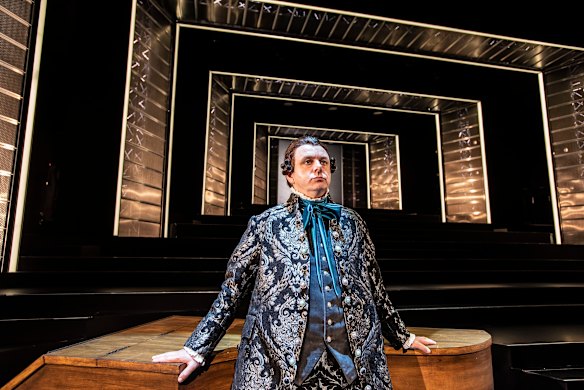
| Michael Sheen in Amadeus at Sydney Opera House |
I realise it's a Friday and that's usually a Friday Five, but as it's the end of the year, I give you a double episode, so here are my ten favourite theatre productions that I have seen this year (in alphabetical order):
- Amadeus - Sydney Opera House, Red Line Productions, and the Metropolitan Orchestra, Concert Hall, Sydney Opera House: Let's face it, Michael Sheen is the draw-card here. Peter Shaffer's play is full of words and wit, interspersed with snatches of music and spectacle, and it requires a triumphant actor to bring the bombast and pathos in equal measure. As he looks back on the rumours concerning his part in the untimely death of Wolfgang Amadeus Mozart (Rahel Romain), Salieri (Sheen) interprets events with a satirical detachment and studied indifference, barely concealing his passionate envy and desperate ambition. It is a masterly performance, and his voice and presence command our attention. The costumes are sumptuous (Anna Cordingley and Romance Was Born) with the rich fabrics, sensational colours and flamboyant designs appearing particularly striking on the austere set (designed by Michael Scott-Mitchell), illuminated by Nick Schlieper's lighting design - heavy on the back-lit scenes - which creates intriguing shapes, silhouettes and shadows. Besides the brilliant pairing of Romain and Sheen, other stand-out performances come from Toby Schmitz as an endearingly foppish Emperor Joseph II, Belinda Giblin and Josh Quong Tart as the frenetic Venticelli who buzz about the stage transporting news and gossip, and the musicians of the Metropolitan Orchestra who supply Mozart's sublime music which, despite Salieri's best (and indeed, worst) efforts, we all know and love.
- The Children - Chaika Theatre, ACT Hub: When people you genuinely like, respect and admire play characters so despicable you have a visceral reaction and want to punch them,… that’s great acting. Michael Sparks, Karen Vickery and Lainie Hart give superb performances in this potentially bleak futuristic drama set in a post-nuclear where you can't work to save your life. But you can save that of others. The pathos and frustration leads to boiling questions about definitions of selfishness. Into this sterile landscape, directors Tony Knight and Sophie Benassi introduce subtle touches of natural processes, and the chopping of a cucumber has never before been such a statement. ‘You don’t even know it, but right there, in that moment, you’ve lost, you’ve lowered your defences and the enemy’s got in, hasn’t it?’
- The Complete Works of William Shakespeare (Abridged) [Revised] - Canberra Repertory Society, Theatre 3: Highly entertaining and very well-delivered with confident performances by Alex McPherson, Callum Doherty and Ryan Street. It is a challenge for the three actors to 'perform' all of Shakespeare's plays (and the sonnets) with mild audience interaction and character development, and the trio rise to meet it with aplomb. Kayla Ciceran's set nods to previous productions on this stage, which reflects the self-referential tone of the piece, and the lighting (Stephen Still) highlights all the right areas at all the right times. It flags slightly when one actor is left alone on stage by themself, but soon picks up the pace again in the second act to address Hamlet with requisite humour and the encores and reprises (including the esirper) do not outstay their welcome.
- Good Works - Lexi Sekuless Productions, Mill Theatre: Director Julian Meyrick brings an intriguing touch to this potentially complicated drama. As the timelines and characters mingle and merge, the actors (Adele Querol, Helen McFarlane, Lexi Sekuless, Martin Everett, Neil Pigot, Oliver Bailey) work as a tight ensemble to highlight the claustrophobic atmosphere and mores of a post-war small-town environment. Some scenes are deeply disturbing as fear and hatred erupt in violence - subjects include corporal punishment, unmarried mothers and same-sex relationships - while moments of compassion and understanding are treated with respect and touching empathy. The versatile set (Kathleen Kershaw) is deceptively simple and the lighting (Jennifer Wright) and sound (Damian Ashcroft) are strikingly effective in this intimate space.
- Hay Fever - ACT Hub, ACT Hub: Gender-swapping Noel Coward may seem obvious. It could, however, very easily not work in this quintessential play of English manners, in which members of the Bliss family each invite s guest to their country house for the weekend ('on a clear day you can see Marlow' - my favourite line, obviously) only to treat them appallingly. The fact that it is still so charmingly awful (in all the best ways) is due in part to Joel Horwood's tight direction and set (full use of the stage to represent the ramshackle elements of a country house while inviting an awkward interaction with the audience). The rest is down to the obvious glee with which the actors portrayed their roles with strong physical and vocal performance techniques, led by the outstanding Andrea Close as Judith Bliss in a turn of pure comic genius.
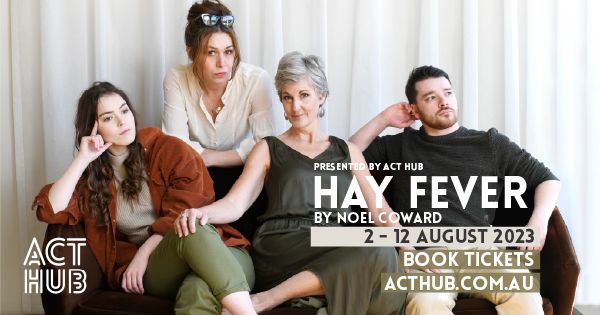 |
| The Bliss Family in Hay Fever |
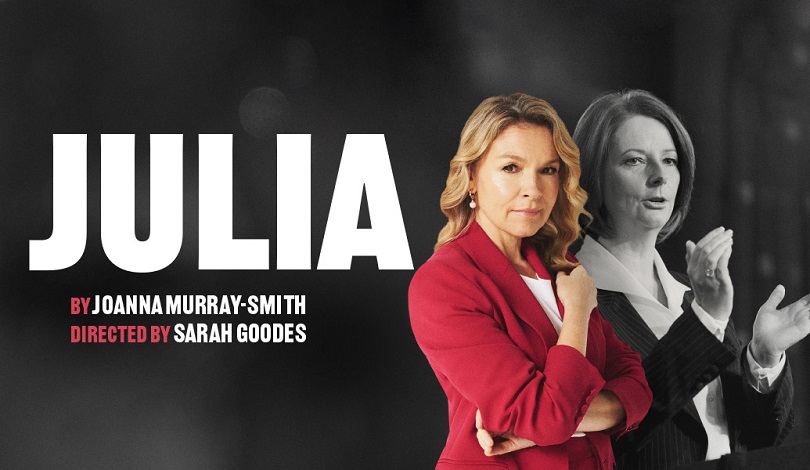
- Julia - Canberra Theatre Centre & Sydney Theatre Company, The Playhouse, Canberra Theatre Centre: Apparently the Canberra Theatre Centre had to fight to get this premiere by Joanna Murray-Smith, and their efforts are well rewarded. Justine Clarke plays Julia Gillard in an almost one-woman play as she revisits scenes from her personal life and political career. It's not an impression so much as an embodiment, hitting the highs (successfully passing 561 bills through parliament) and lows (the oppositional slurs and sexism) with strength and perfect emphasis. Aided by well-chosen projections, director, Sarah Goodes teases out all the subtlety behind the speeches and the meaning behind the memorable moments. Of course it all leads up to that anti-misogyny speech which brings this house to its feet with justified applause.
- King Lear - Echo Theatre, The Q: Echo Theatre's King Lear is a stark interpretation of one of Shakespeare's most challenging plays with some bold and visionary directorial choices (Joel Horwood). With the startlingly dramatic soundscape (Neville Pye) and the bleak setting (Kathleen Kershaw), this production places us truly in the Wasteland. Karen Vickery assumes the fragile balance of performative arrogance and ultimate insecurity of the titular character with a wealth of strength and experience. The supporting cast sell their stories through clarity and costume (Helen Wojtas), with the subplot of Gloucester's (Michael Sparks) literal and metaphorical blindness to the intentions of his sons, Edmund (Lewis McDonald) and Edgar (Josh Wiseman) clearly mirroring Lear's oblivion. As an added bonus, the Dover cliff scene makes more sense than in any performance I have previously seen.
- Ukulele Man - Canberra Cabaret Festival, ACT Hub: Marcel Cole brings this cabaret act to Canberra on the back of award-winning performances on the festival circuit. Directed by Mirjana Ristevski, he plays the part of 1930s/40s English entertainer, George Formby, accompanied by his ukulele and his mother Katie Cole, who plays his mother, wife and any other characters and musicians as required. With equal amounts of humour, pathos, wistful yearning and practical acceptance, not to mention expert timing and endearing renditions of Formby favourites (When I'm Cleaning Windows, Leaning on a Lamp Post, With My Little Ukulele in My Hand), the performance is fully deserving of the standing ovation it received. Turned out nice again.
- The Visitors - Canberra Theatre Centre, Sydney Theatre Company & Moogahlin Performing Arts, The Playhouse: Jane Harrison reimagines the crucial moment when local elders meet on 26 January 1788 to decide what to do about the fleet of ships that appears to be arriving in the harbour. Do they welcome the visitors as is their custom, or do they ask them to move on. And what happens if they stay? A solid ensemble of talented actors present their arguments on a sandstone rock stage as if in one of those endlessly tedious work meetings where hierarchical structures bubble beneath the surface, personal resentments are barely concealed, and nothing actually gets decided. Costuming is a mix of modern business suits and indigenous apparel, sounds are the calls of the forests, and the light is bright to the point of glaring. As a political satire, there are moments of brow-beating didacticism (it is exactly the sort of theatre we will be told 'everyone should see'), but it is mainly humorous and thoughtful provoking discussion and consideration - and isn't that part of the purpose of theatre?
- You Can't Tell Anyone - Canberra Youth Theatre, Courtyard Studio: Written by Joanna Richards, this is a really interesting and original play with a opportunities for a varied cast to display their talents. Director Caitlin Baker employs a range of technical choices to create atmosphere and tension. The young cast deliver the smart and realistic dialogue to provide humour and immediacy as they gather at school graduation to consider future options. Deciding to play a party game, Paranoia (it would make a much better title, incidentally), in which the participants must provide answers to questions revealing what others truly think of them, a supernatural element creeps in making them all even more uncomfortable. The feeling of being between two worlds (as a metaphor for the threshold of adulthood) is made almost palpable through effective set (Kathleen Kershaw), atmospheric sound (Patrick Haesler) and lighting design (Ethan Hamill).
.jpg) |
| The cast of The Visitors |
.jpg)