Showing posts with label The Merchant of Venice. Show all posts

Friday, 15 December 2017

Friday Five: Recent Theatre Excursions

And here are another five shows I have seen and enjoyed, to various extents.

David Pearson as Sweeney Todd
  1. Sweeney Todd: The Demon Barber of Fleet Street produced by Dramatic Productions at Gunghalin College Theatre - The staging of this show is problematic, as the pivotal scenes (such as the action in the barber's shop and the hellish production detail of the pie-shop) are shunted too far up-stage to receive the full attention they deserve. As is often the case with amateur musicals, director Richard Block has largely jettisoned acting ability in favour of singing voices. David Pearson as the titular barber has strong presence and a commanding voice, but doesn't bring sufficient contrast to his performance, striking the same sneering pose throughout. Kate O'Sullivan in an understudy role as Mrs Lovett has better acting chops than most, although she struggles a bit with the higher register. Demi Smith is the complete opposite bringing a piercing clarity to her singing that is noticeably absent from her dialogue; Lachlan Agett as Antony Hope does neither, and Max Gambale's Judge Turpin does a fine job of bring the sleaze and cynicsm. While some of the set pieces (No Place Like London; Pirelli's Miracle ElixirGod, That's Good!By the Sea) are entertaining, they are incongruous with the tone of the whole, and generally filling the stage with chorus members doing a number does this show a disservice. It should contrast the demonic with the divine, but instead comes across as dull and dismal.
  2. The Merchant of Venice produced by Bell Shakespeare at The Playhouse, Canberra Theatre Centre - My problem with Bell Shakespeare is that they often re-interpret the bard's plays to fit their own sensibilities by re-arranging the words and forcing modern meanings into the text. Admittedly The Merchant of Venice is a tricky play with its tones of antisemitism, but the ending is generally one of couplings, suggesting a more tolerant and understanding future, not one of heart-rending guilt. When Jessica says 'I am much ashamed', it is in Act II and refers to her dislike of being seen in male clothing by her lover. Bell Shakespeare moves these lines to the end of the play as she rocks back and forth and pretend they reveal her feelings about the treatment of her father, Shylock. This may work for schools (and the slick production values and strong acting styles will certainly please teens used to one-dimensional characters and plots) but is insulting to the intelligence of anyone who appreciates the intrigues and subtleties of Shakespeare.
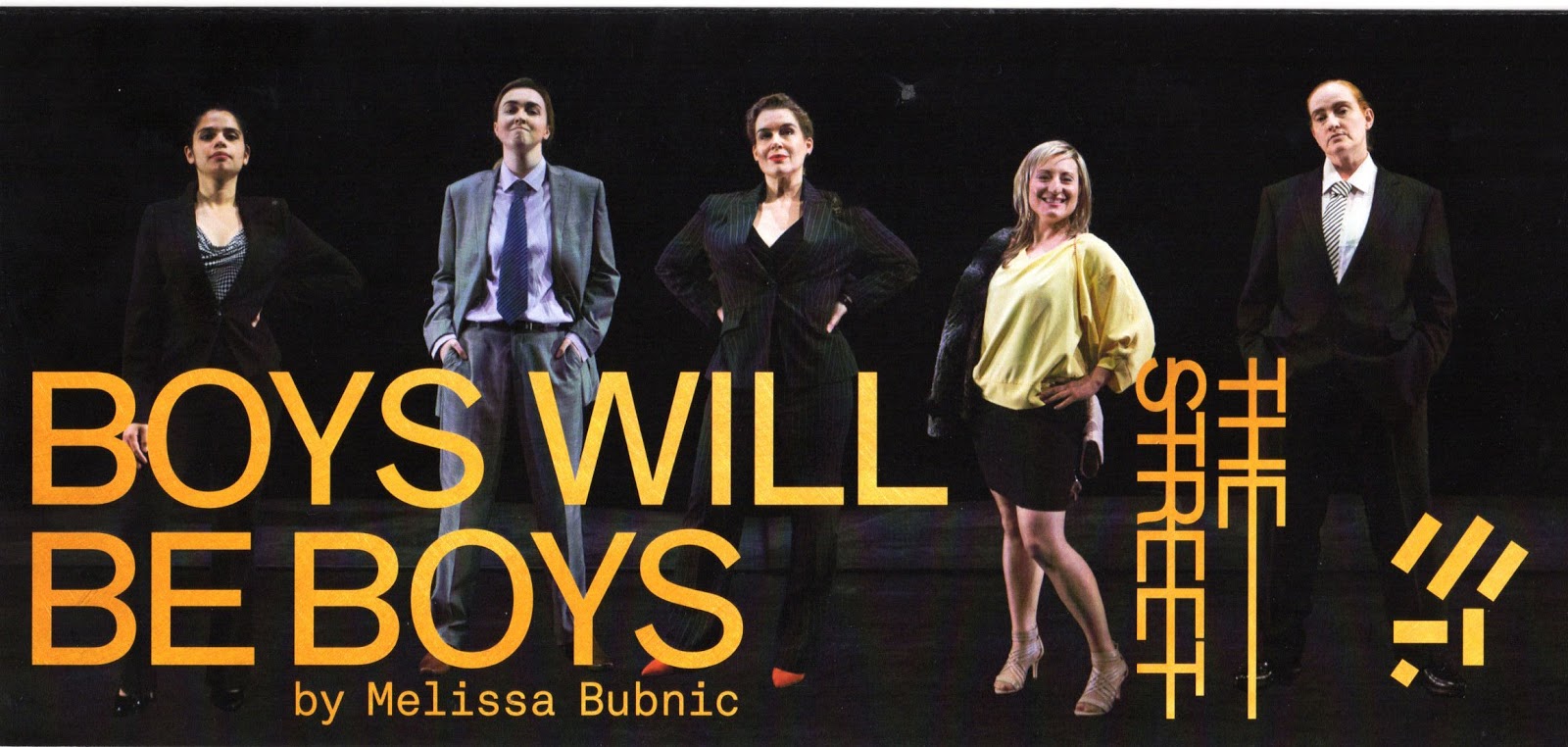
  3. Boys Will Be Boys produced by The Street at The Street - Caroline Stacey directs this hard-hitting boardroom drama in which all the men are played by women in sharp suits and cutting dialogue. The world of financial politics is clinical and unforgiving with no room for compassion, and everyone has a price. The stark set of mirrors and neon reflects the emptiness of the characters' souls, but there is also nowhere to hide. This is a problem for some of the weaker actors who are simply not strong enough to wield the crushing testosterone wrecking balls indicated by the text. Pippa Grandison stands out as Astrid, the woman with the most at stake who strikes the hardest deals and dares reveal a softer side only in song.
  4. Love/ Chamberlain produced by Moral Panic and Ainslie and Gorman Arts Centres at Ralph Wilson Theatre, Gorman Arts Centre - Playwright Bridget Mackey imagines that Courtney Love and Lindy Chamerlain might have a lot in common. Despite coming from contrasting backgrounds with seemingly disparate outlooks, they were both pilloried by the media for not responding to grief and trauma the way women are expected to react. In her play directed by Cathy Hunt, Love (Emma Macmannus) and Chamberlain (Heidi Silberman) meet several times in several contexts as they jump back and forth in time across the Federal Highway; strewn with the paper detritus of old news. They are aided and abetted by the versatile barb barnett in a dozen different and well-developed roles, but even as the Oracle (dispensing advice from a cardboard booth like Lucy in Peanuts) she doesn't have all the answers. It's great to see new work by local theatre artists, especially when it is as thought-provoking as this.
  5. Australia Day produced by Canberra Repertory at Theatre 3 - What is the purpose and relevance of the national celebration? Jonathan Biggins opens this can of worms in his satire set in a fictional country town. Lofty ideals clash with political expediency, torrential rain and an outbreak of food-poisoning. Anyone who has ever sat through tedious committee meetings will appreciate the contrasting personalities and sensitivities encompassed in the preparations conducted in a scout hall, which is freezing in the winter and boiling in the summer. The set is basic, and so is the acting and the direction by Cate Clelland, but this is not necessarily a criticism, as the script is allowed to take centre-stage where it belongs without distracting interpretations or excessive 'input'.
Tuesday, 14 June 2011

Our Man in London: The Merchant of Venice


The Merchant of Venice
RSC, Stratford upon Avon

The Royal Shakespeare Company has recently spent over £100m on redeveloping its site in Stratford. That’s probably more money than Liverpool FC’s current crop of players is worth. The redevelopment has seen the main theatre extended and stage layout remodelled. It now has a stage which thrusts out into the audience even more so than at the Globe. The tiered seating also feels much like the Globe albeit with a permanent roof, but remember this is the Midlands and the sun has not been sighted in Stratford this century. I have no idea how the new theatre compares to the old one but by all accounts it is a vast improvement in every way.

The Merchant of Venice is another of Shakespeare’s problem plays (I am starting to think that they are all referred to as problem plays!). The main difficulty with this one is the overt anti-Semitism and racism. When I studied (I use that term lightly) this play as a student I felt uncomfortable about some of the language and feel just as unsettled by it now. Trying to tell myself that I needed to place the play in the context of the when it was written did not help. But setting this production in modern day Las Vegas somehow made it more palatable. Having spent a New Year’s Eve in Las Vegas undertaking some ‘field research’ one I can verify that unpleasant behaviour and language is rife there.

Shylock was presented as a property magnate, Antonio as a David Cameron lookalike with mobster friends and Portia as a dippy southern belle. The clown, Launcelot Gobbo, was reinvented as an Elvis impersonator. How on earth did Rupert Goold pitch this to the powers that be at the RSC? Before the performance I could not imagine how they were going to make this work, but in practice it was genius.

Once I had got used to the corny faux American accents and the occasional Elvis song (and at one point even Journey!) the dialogue increasingly seemed to fit the extreme characters and audacious stage set designs. For example, the competition to marry Portia whereby suitors choose between one of three caskets hoping to find her portrait inside was brilliantly turned into a game show called Destiny. The masque scene where Jessica escapes her father’s (Shylock) house is a New Orleans style mardi gras carnival which involves one of the characters delivering some of the dialogue with a Yoda impersonation. Batman and Robin are also present, of course.

Cast performances were strong all round, particularly Patrick Stewart’s Shylock and Susannah Fielding’s Portia. Patrick Stewart struck the right balance between being a Las Vegas character but also definitely separate from all the others. Remove the odd prop and his accent, clothes and dignified behaviour could have been used in many a Merchant of Venice production. Whereas Susannah Fielding’s extreme Portia perfectly suited this production but could not have fitted any other. Somehow this polarisation worked, probably because it clearly conveyed how Shylock is behaves and is treated as an outsider.

A clear sign to me that this daring production worked is that now I cannot imagine the play being delivered any other way. I come away from most Shakespeare plays with ideas about how I would do it differently but I really can’t imagine a better way of doing this one. Then again I might have replaced the Journey song with something a bit less ridiculous.

I never knew the Midlands could be such fun!

Next month I am off back to The Globe to see Much Ado About Nothing. Watch this space…

Adieu... from Our Man in London

Wednesday, 1 July 2009

Shakespeare's Greatest Hits


All the World's a Stage
Circa Two, 29 May - 27 June

Ray Henwood’s presentation of Shakespeare’s greatest hits is a comfort for a cold evening. That there is nothing out of the ordinary is not a criticism – rather it is because, as he explains in one of his many addresses to the audience, that the bard’s conceptions have passed into common parlance.

Dressed in a morning suit against a simple curtain for a backdrop, Henwood illuminates the stage with a range of speeches, soliloquies and sonnets inspired by Sir John Gielgud’s Ages of Man. He begins with the prologue from Henry V in which the chorus begs to ‘on your imaginary forces work’. For the next 90 minutes, Henwood takes us on a veritable round-the-bard-trip as promised.

He recites some beautiful poetry with evident passion in a voice you could listen to all day. Explaining that even the non-beautiful creations get the poetry, he portrays characters as diverse as Caliban (The Tempest), Angelo (Measure for Measure), and Lorenzo (The Merchant of Venice). The Queen Mab speech from Romeo and Juliet is spirited and full of fun.

Each section is introduced with a few words or a brief discourse. In a segment on the nature of sleep, Henwood ranges from Macbeth’s – ‘that knits up the ravel’d sleeve of care’ – to Prospero’s – ‘We are such stuff as dreams are made on; and our little life is rounded with a sleep.’ The simple but effective lighting (Jennifer Lal) generally remains true to the ethics of the limited technical intervention, as actor and director (Peter Hambleton) alike choose to paint pictures with words.

As you would expect, Henwood is particularly captivating as Lear and Henry V. He includes lots of Henry V including the infamous ‘Once more into the breach’ speech and the ‘little touch of Harry in the night’. The best of these snippets is when he plays both Falstaff and Prince Hal imitating Henry IV (Henry IV: Part One).

Attempting to persuade us that there are as many strong female as male characters (which is patently untrue) Henwood gives us Lady Macbeth on receipt of the letter from her husband narrating what greatness he has been promised. He is not entirely convincing in this role, not just for the obvious reasons, nor does he seduce us as Iago (just as an aside – Peter Hambleton’s Iago is actually the best I’ve seen in New Zealand), although he draws attention to his complexity.

Shakespeare was a master at creating complexity of character – ‘what a piece of work is a man’. This always reminds me of the Blackadder episode in the second series in which Edmund has his Aunt and Uncle Whiteadder over for dinner, at the same time as hosting a drinking party. When his aunt takes him to task after someone stumbles in wearing comedy breasts, ‘Edmund! Explain yourself!’ he replies, ‘I can’t. Not just like that. I’m a complicated person, you see, Auntie.’

Shakespeare’s characters are not representative of a certain singular trait and Ray Henwood is excellent at embodying diversity. Nowhere is this more pertinent than in his Shylock, who is more than ‘just a Jew’. He gives an interesting insight into the character – there are other Jews and other money-lenders who weren’t hated as Shylock was. It was more his disposition than his religion that was despised, yet, with our (entirely understandable) fear of Nazism, we worry that this loathing is anti-Semitism.

No one else in the Shakespeare canon is a stereotype, so why do we assume he is? As Henwood points out in one of the more intriguing passages of the evening, surely this says more about the audience, with our modern sensibilities, than it does about the bard.

Other interludes are the sonnets which provide a quality counterpoint to the plays, and the morsels from other works. Having directed the opening scene of Terry Pratchett’s Wyrd Sisters, myself, I found this as recognisable as Shakespeare’s works. Less familiar, although equally enjoyable, to me was the short excerpt from Rinse the Blood off My Toga.

Mainly All the World’s a Stage was like ‘An Evening with William’, channelled towards the fans with little from the more obscure works or the comedies. Like a concert where you only really want to hear the hits and not the worthy stuff from the experimental album, this was clearly a success with the mainly elderly audience. Having said that, this would work really well in schools as an introduction to Big Bill.