It’s hard to drive into a place when you haven’t got a map. The only thing I can find to locate from is the train station and it’s tough to get there when the streets are one-way but not marked as such. Finally we reach an information place to gather up leaflets and I am sent off on a scouting mission to find a suitable café.
On my travels I pop into the covered market to go the toilet and I get stuck. All sorts of things run through my mind; can I climb out of the window? Not really as I’m on the second floor. Could I phone someone? Who? My dad’s phone doesn’t work here and Him Outdoors didn’t bring his. I could ring the helpdesk and try and speak to someone at our hotel but I don’t know what the operator’s number is in Italian. And I don’t know any Italian to ask a question even if I get through. And what could they do in Rimini about me being stuck in a toilet in Ravenna anyway?
 I think of shouting for help, but I don’t know what that is in Italian either. Eventually I pound on the door calling, ‘Help!’ I am trying to stay calm and not panic, although I can feel the stress level rising. There is much gabbling of things I don’t understand and then the door flies open to reveal a party of bemused tourists, in a queue that reaches all the way back down the steps. I hurry past and return to my parents.
I decide to abandon the coffee and go straight for a beer at lunch to restore myself. I accompany it with an insalata mare which consists of baby octopus, squid rings and all sorts of other fishy treats. Suitably fortified from further mishap, we set out to explore.
According to the Lonely Planet, “The city had been the capital of the Western Roman Empire ever since 402 when the ineffectual Emperor Honorius moved his court from Rome because Ravenna’s surrounding malarial swamps made it easier to defend from Northern invaders. However, the barbarians simply walked around him and marched into Rome in 410. Honorius was unable or unwilling to react, preferring to vegetate in Ravenna until his death in 423, and the city finally followed 50 years later.”
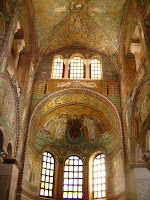 This doesn’t sound mightily inspiring but the city is famed for its mosaics that adorn its churches and monuments, eight of which are Unesco World Heritage Sites. I like the look of the buildings with their red brick and the contrast of the green or oxidised copper – was this intentional or did the architects/builders stumble upon the colour combination by happy accident? My top five tourist sites (and sights) are:
1. Basilica di San Vitale – the red brick façade which looks impressive in the sun but fairly nondescript otherwise, belies a “dazzling internal feast of colour”. Mosaics represent scenes from the Old Testament and apart from the cupola which is painted, everything else is indeed a dazzling vision of millions of little tiles stuck to every conceivable surface – that DIY project must have taken many a wet weekend!

 2. Mausoleo de Galla Placida – a mausoleum constructed for Galla Placida, the half-sister of Emperor Honorius, although it’s unlikely she ever lay here – that’ll be “the ineffectual” Emperor Honorius again. The Lonely Planet says, “the light inside, filtered through the alabaster windows, is dim yet, supplemented by a single central lamp, is sufficient enough to illuminate the city’s oldest mosaics.”
 The roof has a specific number of stars (four hundred and something) which represent something I’ve forgotten. It’s true that when they light up with sunshine they are something to behold. Apparently during the summer months you can tour these at night – I’m sure the effect will be very different.
3. Basilica di Sant’Apollinare Nuovo – this contains the largest surface area of mosaics from the Byzantine period, or some such spurious claim. Apparently the procession of 26 martyrs heading towards Christ in majesty with his apostles on one wall, and the complementary one of virgins on the other are typical examples of the Byzantine style. I like the three wise men bearing gifts and the boats in the Chinese harbour.
There is a school for making mosaics here which would be fun, but I wonder how difficult it is? Don’t you just sketch a picture (and let’s face it, none of them are particularly realistic) and then just stick some stones on? Like cross-stitch or paint-by-numbers, it’s very intricate and meticulous, but is it creative and talented? I suppose, as father says, you have got to draw the picture first.

4. Battistero Neoniano – the most ancient monument of Ravenna, this dates to the 4th or 5th century BC and is thought to have started life as a Roman bathhouse. It was converted to a baptistery in the 5th century. The image in the cupola depicts John the Baptist baptising Jesus in the River Jordan, the personification of which looks on. The concentric circle features the twelve apostles and there are eight little alcoves around the marble fountain, each with fabulous mosaics of their own.
 5. Museo Arcivecovile – this is a small museum in the Archiepiscopal Palace with works from the old cathedral, which has been destroyed. The most impressive of these is the intricately carved throne of the 6th century carved by Byzantine artists and considered to be “one of the greatest ivory masterpieces of all times” according to their tourist literature.
Ravenna has heaps of festivals, none of which are in evidence when we attend. There is a Dante festival – he wrote most of The Divine Comedy here and is buried in a tomb with an eternally burning lamp. Florence supplies the oil for this as a perpetual act of penance for having him exiled (in 1302 – he lived in Ravenna until his death in 1321).
 There is a festival of music and dance; one of authors “shows and parties with murder”; a Nightmare Film Fest; walks with mystery; jazz festivals; a festival for October or autumn featuring concerts, horror stories, fireworks and wine tasting; European heritage day with guided tours of archaeological excavations; a marathon in November; a Japanese festival featuring cinema, board games, cuisine, performance arts and origami; a wine festival promoting Sangiovese di Romagna; debates between philosophers and awards for publishing houses; and festivals for both bread and chocolate.
It would seem that it terms of pulling the tourists, there is always something happening in Ravenna – sounds a bit like Arrowtown!
.jpg) At Café L’Arté in Acacia Bay, Taupo, everything is made from mosaics. In the ‘mosaic room’ is an armchair, sofa, fireplace, table and standard lamp in shining stone fragments.
At Café L’Arté in Acacia Bay, Taupo, everything is made from mosaics. In the ‘mosaic room’ is an armchair, sofa, fireplace, table and standard lamp in shining stone fragments..jpg)
.jpg) It’s also a gallery where there are insects, birds and flowers on pottery spikes among natural blooms. Wooden ruru, kerepu and kingfishers perch on benches.
It’s also a gallery where there are insects, birds and flowers on pottery spikes among natural blooms. Wooden ruru, kerepu and kingfishers perch on benches..jpg) Piles of gaudy individual painted stones are threaded together to form pebble pillars. Clunky jewellery incorporates sparkling mirrored spiders. Bullrushes with leaves of corrugated iron provide a cool contrast to the soft furry buds of the real things.
Piles of gaudy individual painted stones are threaded together to form pebble pillars. Clunky jewellery incorporates sparkling mirrored spiders. Bullrushes with leaves of corrugated iron provide a cool contrast to the soft furry buds of the real things.


