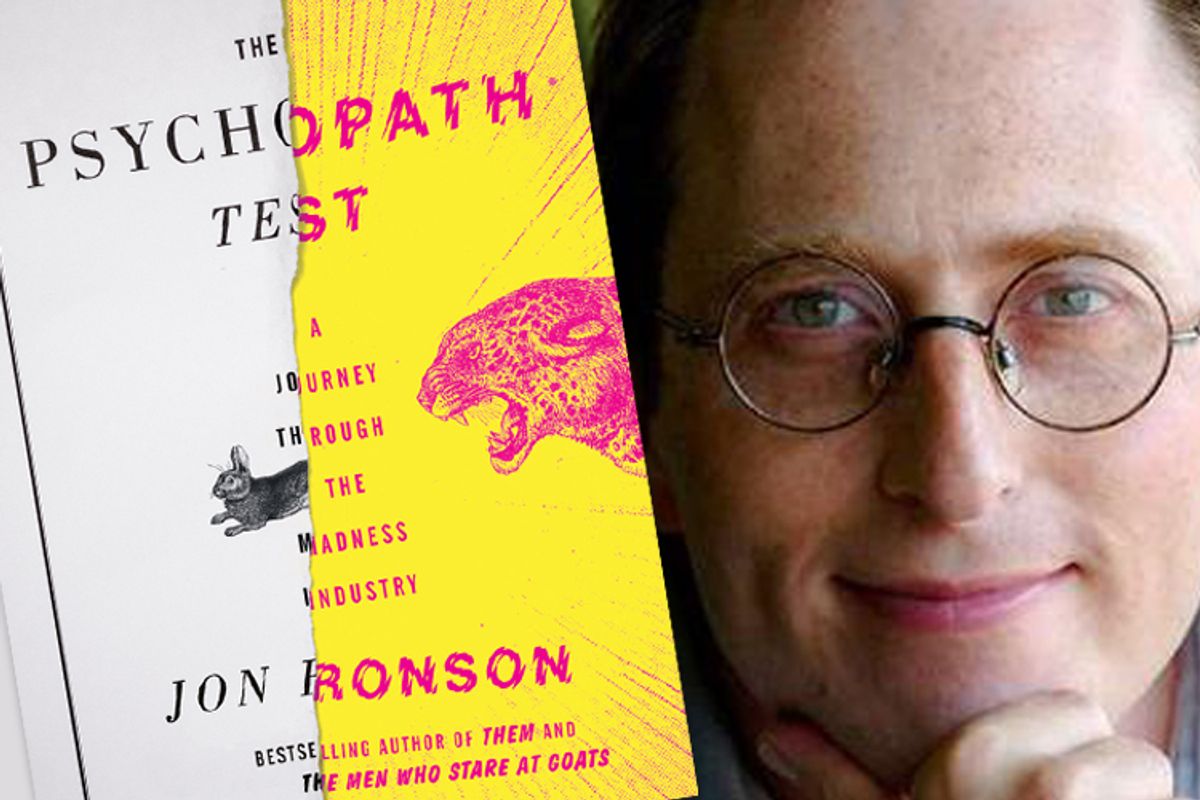
The Psychopath Test: A Journey Through the Madness Industry by Jon Ronson
Riverhead Books
Pp. 272
We have a lot of examples in
popular culture of what it looks like to be ‘mad’. The mental health industry
has become increasingly prevalent and topical. Journalist Jon Ronson explored
this phenomenon through a series of interviews and other research methods to
publish this highly accessible study in 2011. While many people now
self-diagnose, due to the availability of tests and checklists, others exhibit
psychopathic behaviour almost undetected, and often end up running companies or
countries.
He begins with the premise that
it can be harder to persuade people you are ‘sane’ than it is to convince them
you are ‘mad’. Ronson is allowed access to one of the most notorious
psychopaths, incarcerated in Broadmoor Clinical Lunatic Asylum, Tony, who is
allowed to read his own medical files and pass them on to Ronson. Tony claims
that he faked madness and now no one believes he is sane when he tries to deny
it. “Tony said faking madness was the easy part, especially when you’re
seventeen and you take drugs and watch a lot of scary movies. You don’t need to
know how authentically crazy people behave. You just plagiarize the character
Dennis Hopper played in the movie Blue
Velvet.”
Often psychopaths can present as
totally charming, which makes it difficult to detect. Ronson says, “The moment
I’d first seen Tony, he had strolled purposefully across the Broadmoor Wellness
Centre in a pin-striped suit, like someone from The Apprentice, his arm outstretched.” (That particular TV
reference is unintentionally relevant). Dressing smartly and being personable
(“Glibness/ Superficial Charm”) is the first indication on the most available
test; the twenty-point Hare Checklist, devised by Canadian psychologist Bob
Hare, “the gold standard for diagnosing psychopaths.” The checklist is included
in the book , so that readers can take it for themselves. Find it here: http://www.clintools.com/victims/resources/assessment/personality/psychopathy_checklist.html
It is common to redefine the psychopathic
traits on the checklist as Leadership Qualities and the crossover can be a very
fine line. In examining ‘lack of remorse or guilt’ and ‘callous/ lack of
empathy’, Ronson highlights CEO Al Dunlap, formerly of Sunbeam. It is evident
that if this book had been published ten years later, Donald Trump and Jeff
Bezos would have been prime case studies. Ronson wonders whether highly driven
and successful people are actually insane, and if what makes psychopaths so
scary – no fear, filter, no conscience – also makes them good executives. Hedge
funds, pension funds and investment banks advise their clients which companies
to invest in, and they rejoice in job cuts and applaud as research facilities,
tech areas and training centres get destroyed. Psychopathic behaviour is on
prominent display on Wall Street.
Mental health disorders are
listed in the DSM (Diagnostic and
Statistical Manual of Mental Disorders), which lists mental disorders. It is
used by clinicians, researchers, psychiatric drug regulation agencies, health
insurance companies, pharmaceutical companies, the legal system and
policymakers. Robert Spitzer, who worked on DSM-III
explained that the idea was to list potential new mental disorders and a
checklist of their overt characteristics. “It seemed a foolproof plan. He would
eradicate from psychiatry all that crass sleuthing around the unconscious.
There’d be no more silly polemicizing… Instead it would be like science. Any
psychiatrist could pick up the manual they were creating – DSM-III – and if the patient’s overt symptoms tallied with the
checklist, they’d get the diagnosis.”
DSM-III sold more than
a million copies, mainly to civilians rather than professional psychiatrists. “All
over the western world people began using the checklists to diagnose
themselves. For many of them it was a godsend. Something was categorically
wrong with them and finally their suffering had a name. It was truly a
revolution in psychiatry, and a gold rush for drug companies, who suddenly had
hundreds of new disorders they could invent medications for, millions of new
patients they could treat.” As one psychiatrist Ronson interviewed confirmed, “A
surfeit of checklists, coupled with unscrupulous drug reps is a dreadful
combination.”
Ronson
can’t help but test himself and starts to worry that, as a journalist, he might
meet some of the criteria. One of his interview subjects tells him, “Finding
patterns is how intelligence works. It’s how research works. It’s how
journalism works. The search for patterns.” He also considers that in the very
act of researching and writing this book, he might be contributing to the way
that madness is packaged and presented for entertainment. “I was writing a book
about the madness industry and only just realizing that I was a part of the
industry.” He probably doesn’t think about the paradox too deeply. After all,
that way madness lies.