Showing posts with label Madness. Show all posts

Tuesday, 13 April 2021

There's Method in It: The Psychopath Test


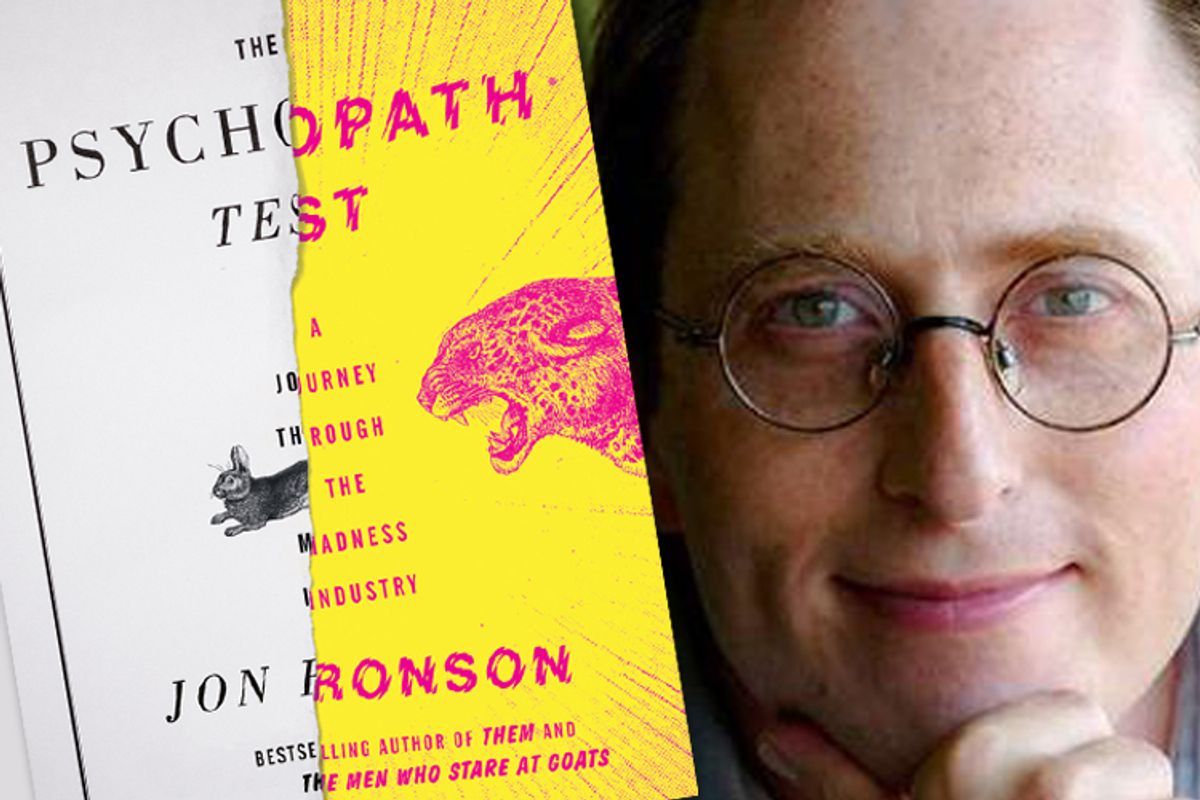
The Psychopath Test: A Journey Through the Madness Industry by Jon Ronson 
Riverhead Books
Pp. 272

We have a lot of examples in popular culture of what it looks like to be ‘mad’. The mental health industry has become increasingly prevalent and topical. Journalist Jon Ronson explored this phenomenon through a series of interviews and other research methods to publish this highly accessible study in 2011. While many people now self-diagnose, due to the availability of tests and checklists, others exhibit psychopathic behaviour almost undetected, and often end up running companies or countries.

He begins with the premise that it can be harder to persuade people you are ‘sane’ than it is to convince them you are ‘mad’. Ronson is allowed access to one of the most notorious psychopaths, incarcerated in Broadmoor Clinical Lunatic Asylum, Tony, who is allowed to read his own medical files and pass them on to Ronson. Tony claims that he faked madness and now no one believes he is sane when he tries to deny it. “Tony said faking madness was the easy part, especially when you’re seventeen and you take drugs and watch a lot of scary movies. You don’t need to know how authentically crazy people behave. You just plagiarize the character Dennis Hopper played in the movie Blue Velvet.”

Often psychopaths can present as totally charming, which makes it difficult to detect. Ronson says, “The moment I’d first seen Tony, he had strolled purposefully across the Broadmoor Wellness Centre in a pin-striped suit, like someone from The Apprentice, his arm outstretched.” (That particular TV reference is unintentionally relevant). Dressing smartly and being personable (“Glibness/ Superficial Charm”) is the first indication on the most available test; the twenty-point Hare Checklist, devised by Canadian psychologist Bob Hare, “the gold standard for diagnosing psychopaths.” The checklist is included in the book , so that readers can take it for themselves. Find it here: http://www.clintools.com/victims/resources/assessment/personality/psychopathy_checklist.html

It is common to redefine the psychopathic traits on the checklist as Leadership Qualities and the crossover can be a very fine line. In examining ‘lack of remorse or guilt’ and ‘callous/ lack of empathy’, Ronson highlights CEO Al Dunlap, formerly of Sunbeam. It is evident that if this book had been published ten years later, Donald Trump and Jeff Bezos would have been prime case studies. Ronson wonders whether highly driven and successful people are actually insane, and if what makes psychopaths so scary – no fear, filter, no conscience – also makes them good executives. Hedge funds, pension funds and investment banks advise their clients which companies to invest in, and they rejoice in job cuts and applaud as research facilities, tech areas and training centres get destroyed. Psychopathic behaviour is on prominent display on Wall Street.

Mental health disorders are listed in the DSM (Diagnostic and Statistical Manual of Mental Disorders), which lists mental disorders. It is used by clinicians, researchers, psychiatric drug regulation agencies, health insurance companies, pharmaceutical companies, the legal system and policymakers. Robert Spitzer, who worked on DSM-III explained that the idea was to list potential new mental disorders and a checklist of their overt characteristics. “It seemed a foolproof plan. He would eradicate from psychiatry all that crass sleuthing around the unconscious. There’d be no more silly polemicizing… Instead it would be like science. Any psychiatrist could pick up the manual they were creating – DSM-III – and if the patient’s overt symptoms tallied with the checklist, they’d get the diagnosis.”

DSM-III sold more than a million copies, mainly to civilians rather than professional psychiatrists. “All over the western world people began using the checklists to diagnose themselves. For many of them it was a godsend. Something was categorically wrong with them and finally their suffering had a name. It was truly a revolution in psychiatry, and a gold rush for drug companies, who suddenly had hundreds of new disorders they could invent medications for, millions of new patients they could treat.” As one psychiatrist Ronson interviewed confirmed, “A surfeit of checklists, coupled with unscrupulous drug reps is a dreadful combination.”

Ronson can’t help but test himself and starts to worry that, as a journalist, he might meet some of the criteria. One of his interview subjects tells him, “Finding patterns is how intelligence works. It’s how research works. It’s how journalism works. The search for patterns.” He also considers that in the very act of researching and writing this book, he might be contributing to the way that madness is packaged and presented for entertainment. “I was writing a book about the madness industry and only just realizing that I was a part of the industry.” He probably doesn’t think about the paradox too deeply. After all, that way madness lies.

Tuesday, 6 October 2020

Playing the Gothic Game: The Turn of the Screw


The Turn of the Screw by Henry James
Silver Burdett Company
Pp. 118

Originally published in 1898, The Turn of the Screw still delights and terrifies readers over 120 years later. The enduring appeal of the novella is due to James’ mastery with form and style as he uses Gothic tropes to exploit deep-seated fears and phobias. An unnamed governess narrates the story of how she takes her first position at Bly, a remote country house, and begins to fear that it is haunted by the previous employees, the valet, Quint, and the governess, Miss Jessel. She fears the spirits intend to harm her young charges and she is determined to keep them safe, with disastrous consequences.

The Gothic conceits are all present in a way that would be familiar to contemporary readers, and suggest that James is playing with them. The possible presence of ghosts in an isolated mansion (Mrs Grose, the kindly but dim-witted servant, is the only other living occupant) with dark corridors and darker secrets is a ruse recognisable to readers of popular fiction from The Castle of Otranto and The Mysteries of Udolpho (mentioned specifically in this novel) to Jane Eyre and Dracula (published the previous year). It also employs the device of a framed narrative, such as in Wuthering Heights, Frankenstein, and The Legend of Sleepy Hollow, in which we are told of a story told to someone else in the words of a manuscript a governess had left behind. This third-hand tale is introduced with chilling and thrilling glee as a typical ghost story; “The story had held us, round the fire, sufficiently breathless, but except the obvious remark that it was gruesome, as, on Christmas Eve in an old house, a strange tale should essentially be, I remember no comment uttered.”

Angelic children have become a mainstay of modern horror, and eight-year-old Flora and ten-year-old Miles are clearly prototypes as, “Both the children had a gentleness that kept them – how I shall I express it – almost impersonal and certainly quite unpunishable.” They are almost impossibly delightful with “their more than earthly beauty, their absolutely unnatural goodness”, although this may simply be an inexperienced governess’ interpretation of childhood.

The tension is increased throughout the tale, like the titular turning of the screw, as there are hints of paranoia and madness. For all the elaborate language, nothing is definite and everything remains in shadows. The metaphor is made explicit as the governess suffers from insomnia, stalking the halls with a candle in the middle of the night.

A Freudian interpretation would suggest hysteria and sexual repression: Quint and Miss Jessel were discharged for conducting an illicit affair, from the knowledge of which the children must naturally be protected. There is certainly a suspicion of surveillance, and the governess feels she is being observed, and judged, by the spirits on her performance. The central issue of the story is whether the ghosts are real, and the governess’ efforts in protecting the children are justified, or whether she is going mad, in which case they are at risk from her, and her consideration that they are linked to unspeakable evil is a reflection of her tormented psyche.

At the end of the nineteenth century readers were far more likely to believe in ghosts than they are now, although we are perhaps more understanding of psychoses.  Because James refuses to choose a definitive solution to his mystery, the tale of terror is compelling either way. It continues to be popular because we like a good scare, and this one is a ripper.

Tuesday, 12 May 2020

That Way Madness Lies: The Warlow Experiment


The Warlow Experiment by Alix Nathan
Serpent's Tail
Pp. 276

This novel is based on the true story of an eccentric Victorian gentleman, Herbert Powyss, who conducted an experiment; he placed an advert in a newspaper asking for a man to volunteer to be placed in isolation in his cellar for seven years with ‘every convenience desired’ but ‘without seeing a human face’. John Warlow was the only person who answered the advert, ‘a semi-literate labourer with a wife and six children to provide for’. Alix Nathan imagines how this experiment might have worked, or not, and she has created a rich novel of mental manipulation. She imagines that Powyss wants to see how a mind would cope without social contact and write up his findings to present to the Royal Society.

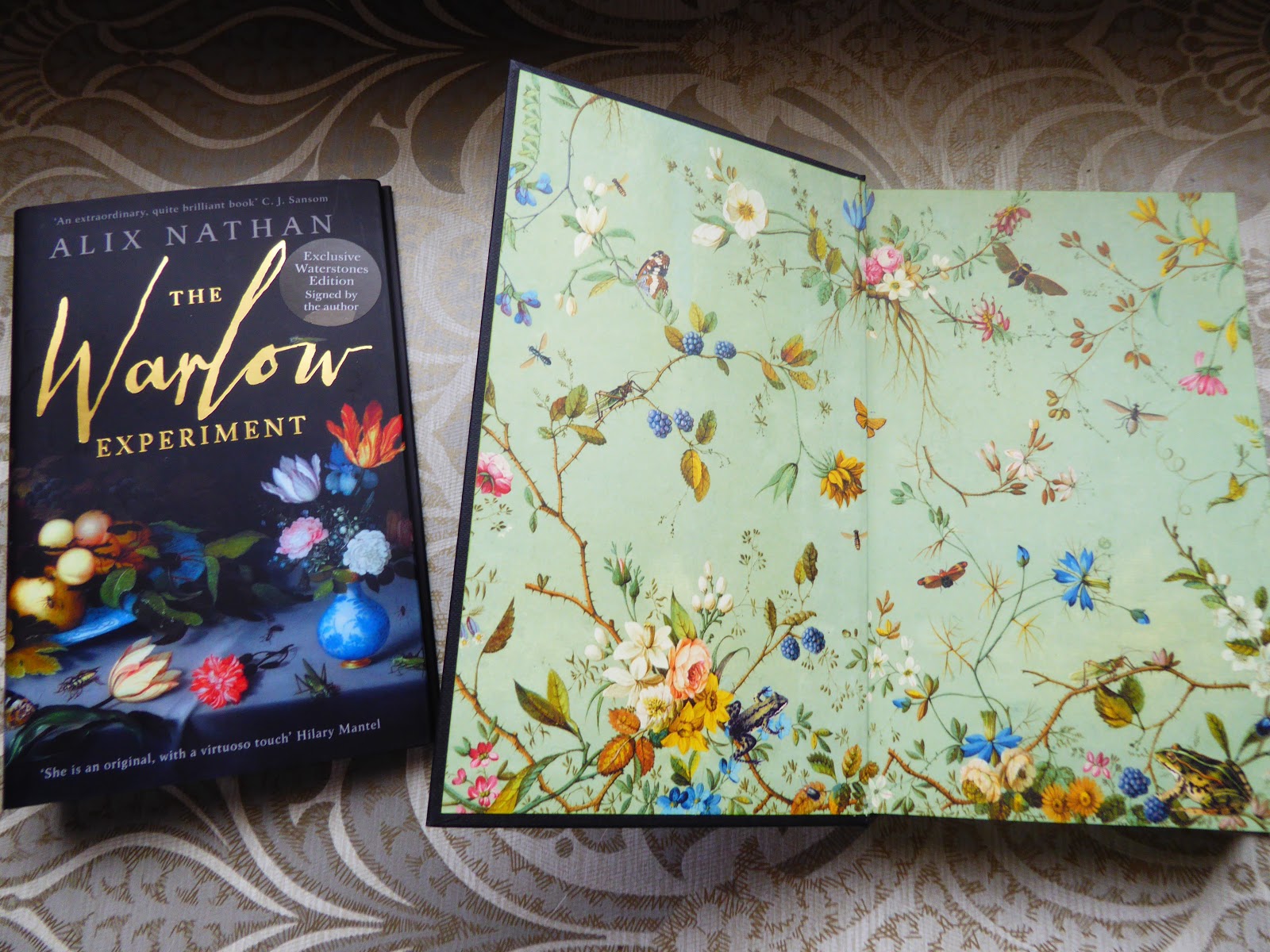
Powyss is typical of his era in that he likes to collect and catalogue things. He imagines that a human would be no different to his plants, “where so often he’d exerted order and precision, used good sense and experience, where reason had ruled”. Many of the metaphors are flora-related; he also hangs paintings on his walls of the Dutch masters and the cover of the book is a Flemish Vanitas image with fruit and flowers surrounded by insect life. Even the endpapers are glorious depictions of wildlife on wallpaper, representing both the care with which Powyss took to furnish Warlow’s underground apartments, and the never-ceasing ecological effects of co-existence.

Everyone in the house is affected by the presence of the man in the cellar, including the cook and the butler. The novel frequently switches perspective mid-chapter from Powyss to Fox, his old schoolfellow, or Hannah, Warlow’s wife, to Catherine, the housemaid. As one expects, madness ensues, and there are clear echoes of Frankenstein, Pygmalion, and even Jekyll and Hyde. Science without nature is abhorrent and potentially impossible. Life is fragile and unpredictable. Alix Nathan’s book is a superb rationale for the Ethical Conduct of Human Research Committee.

Wednesday, 5 October 2011

Quick Quintet: You Make Me Feel Like Dancing

There is a lot of music that I love and a lot of bands that have shaped my life. We all have an inner soundtrack and The Jam, The Pogues, The Smiths, The Damned, The Cure, Pulp, Blur and Oasis all feature highly on mine. 

You know how it is - there are certain songs that no matter where you are or what you're doing, or how tired you are, you just have to get up and dance. They may not even be your favourites, but they have a certain rhythm or connotations that cannot be ignored. I blame other people for most of them...

5 Songs I Have to Dance to:
  1. Debaser - The Pixies; Manchester Academy and anywhere in Manchester when I was a student with the Essex Girl - those were the days, my friend...
  2. Baggy Trousers - Madness; doesn't everyone our age? It's guaranteed to turn any do into a flashback to the primary school disco
  3. Groove is in the Heart - Deee-Lite; Thermal Girl is entirely to blame for this one
  4. White Riot - The Clash; not played very often, but for years this was my Friday-night-going-out-song. It's fast, furious, frenetic and gets me every time
  5. Sweet Child O' Mine - Guns N' Roses; partly the fault of Our Man in London, I remember a particular gig in 1987, and it fires up my inner rock-chick