Showing posts with label dance. Show all posts

Wednesday, 1 March 2023

My Newest Favourite Thing: Relay League by Angelica Mesiti

"Appel à tous. Ceci est notre dernier cri avant notre silence éternel." - Calling all, this is our final cry before our eternal silence

A few years ago when I was at the Orange Regional Art Galley, I came across this fascinating artwork comprising music, movement and sound. Initially I didn't understand it at all  but found it intriguing, so I read the information panel that accompanied the artwork. I discovered it to be about Morse code and other forms of communication - a subject that interests me deeply, so I spent some time in the gallery interacting with the artwork. The following words are from the information panel. 
Relay League, a term for a telegraphic transmission from one receiver to the next, takes as its departure point a Morse code message transmitted by the French Navy on 31 January 1997 to signal the imminent demise of this communication method. Morse code, a system of dot and dash radio signals, often utilised as a language of distress at sea, was phased out after 130 years in favour of new digital communications. Inspired by this final poetic phase, Mesiti interprets its original dots and dashed through music, choreography, and non-verbal communication.


The first of the three-channel works features the musician-composer Uriel Barthélémi translating the Morse code message into a percussive score that permeates throughout the gallery. The second shows a unique form of dialogue and exchange between two dancers, Emilia Wibron Vesterlund and vision-impaired Sindri Runudde. Together the pair has developed an intimate and corporeal language that communicates movement and gesture. Emilia guides Sindri's understanding of choreography through the touch and feel of her body against his. 


The third depicts the dancer Filipe Lourenço interpreting Uriel's percussive sounds in a new  choreography that directly references silence and vision through gestures loosely drawn from the vernacular of folk dance. This final work reveals a dialogue playing out between each of the performers, and the dots and dashes transmitted throughout the gallery produce a subtle dissonance so that the work continually slips back and forth between cohesion and dissolution. Relay League leaves a sensory impression of a language that has been transformed into a code, which in turn iterates as a score, a performance and a haptic exchange, enabling multiple acts of translation across time and space. 


Mesiti's practice chronicles our present condition. She continues to grapple with experiences such as crisis and displacement - whether economic, political, social, cultural, or otherwise - and confront the emotional states of distress, vulnerability and uncertainty. Relay League involves a fundamental humility, bringing to the surface aspects of human subjectivity that are often obscured from view. To this end the work offers a counterpoint: more than simply making visible the forms through which language and expression are silenced, she allows these complex and vital tools of human relations to materialise in ways that emphasis our need for empathy, compassion and connection.
Morse code was used as an international standard for maritime distress until 1999 when it was replaced by the Global Maritime Distress and Safety System. The final commercial Morse code transmission in the United States was on July 12, 1999, signing off with Samuel Morse's original 1844 message, 'What hath God wrought'. Everything sounds better in French (the distress signal Mayday comes from the phonetic equivalent of them asking for help, after all). And for those wanting a proper review of the art installation, there is one here, written by an art critic who understands these things.

Friday, 31 January 2014

Friday Five: Music to my ears

The last ice cream van at the edge of the world by Curly
The other weekend we went for a run in what turned out to be the heat of the midday sun. We weren't deliberately being Mad Dogs and Englishmen, but various events meant that was just the way it was. It was the middle of a heatwave (five days of temperatures over 37 degrees) and we ran out of water. It wasn't meant to take so long, but the last two kilometres took me 20 minutes. I was breaking out in a cold sweat and felt nauseous and dizzy. 

When we returned to the carpark I was guzzling the water we had in the car when I heard the tinkling of an ice-cream van. At first I thought I was hallucinating but no, the vehicle appeared playing a distorted version of Greensleeves and I was soon eating a cool, sweet treat that picked me back up and refreshed me after my endeavours. Never before have I been so happy to hear that ghastly tune, and it made me think there are certain musical interludes which have special connotations and for which I will always be grateful.

Yes, the photographer chopped our heads off, but see how we look like we know what we're doing!
5 Tunes I will never tire of hearing:

  1. The Gay Gordons - I'm not a fan of bagpipes unless they're played in Scotland and played well. This, however, was the first dance I ever danced with Him Outdoors as we met in Edinburgh and went to a ceilidh at Hogmonay, and so it was our wedding dance. I insisted that my sisters get everyone up dancing as soon as possible as we didn't want to be left out there like a pair of numpties and I figured that however drunk you are, you can dance to this, even if your waltzing is appalling.
  2. You'll Never Walk Alone - goosebumps for obvious reasons
  3. The British National Anthem - when they play that as they raise the union flag, my heart stirs. I know some people (i.e. Billy Connolly and all his disciples) think it's a dirge and would prefer the theme tune to The Archers, but I feel pride in my country when I hear it from military honours to medal ceremonies.
  4. The theme tune to The Archers - reminds me of my mum and the happier aspects of my childhood.
  5. Debaser by The Pixies - my best mate and I had a pact at university - whenever this came on in the club we would have to dance no matter what we were doing. I got so much whiplash from that song and I love it!

Wednesday, 5 October 2011

Quick Quintet: You Make Me Feel Like Dancing

There is a lot of music that I love and a lot of bands that have shaped my life. We all have an inner soundtrack and The Jam, The Pogues, The Smiths, The Damned, The Cure, Pulp, Blur and Oasis all feature highly on mine. 

You know how it is - there are certain songs that no matter where you are or what you're doing, or how tired you are, you just have to get up and dance. They may not even be your favourites, but they have a certain rhythm or connotations that cannot be ignored. I blame other people for most of them...

5 Songs I Have to Dance to:
  1. Debaser - The Pixies; Manchester Academy and anywhere in Manchester when I was a student with the Essex Girl - those were the days, my friend...
  2. Baggy Trousers - Madness; doesn't everyone our age? It's guaranteed to turn any do into a flashback to the primary school disco
  3. Groove is in the Heart - Deee-Lite; Thermal Girl is entirely to blame for this one
  4. White Riot - The Clash; not played very often, but for years this was my Friday-night-going-out-song. It's fast, furious, frenetic and gets me every time
  5. Sweet Child O' Mine - Guns N' Roses; partly the fault of Our Man in London, I remember a particular gig in 1987, and it fires up my inner rock-chick

Thursday, 29 April 2010

Ring out the bells


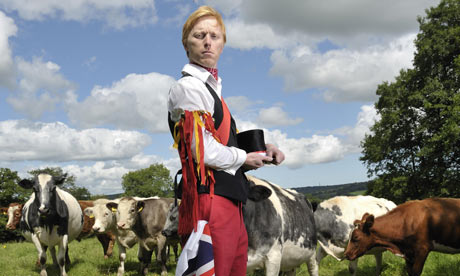
I have a confession to make: I love Morris dancing. Now that we’ve got that out of the way, we can focus on Morris: a Life with Bells On, a wonderful mockumentary that affectionately examines the ‘seemingly innocent pub pastime for bearded men with hankies.’ It is filmed through a series of interviews set up in such crisp conditions they appear like portraits done by old masters, where every item in the picture is significant.

This film had a very low budget (the American scenes are clearly not overseas, and the flight there is obviously a model aeroplane) but the production values are still very high and the cinematography is excellent. The changes in depth of focus and sharp close-ups are a welcome relief from the shaky blurred vision that plagues most documentaries. And green and pleasant lands and the Compasses Inn in Wiltshire, where most of the filming was done, make a fine backdrop to the action.

The story follows Derecq Maximillian Twist and his troupe of Morris men, the Millsham Morris. At 32, Derecq is at the peak of his dancing life. He may seem like a mild-mannered tractor mechanic from West Dorset but he is consumed by his passion for ‘the Morris’. Apparently, the term ‘Morris’ covers a multitude of sins and there are a variety of styles, including Borders, Rapper and Clog Dancing, but the Cotswold style is “the distillation of masculinity – it epitomises and embodies the essence and magic that is the essence of Morris.” So says Professor Compton Chamberlayne (Harriet Walter), Emeritus Professor of International Folk Dance at Cambridge. She exudes academic authenticity and is so convincing that you are left doubting what is real and what is absolutely made up?

Derecq introduces his team to the documentary maker, Jeremy (Aidan Mcardle) in a line-up like a proud sergeant showing off his troops to the Queen. They number Will Frosser (Jasper Britton), the foreman; Muff Barcock (Clive Mantel), Point Man 1, who has been “dancing for 40 years and still dances like a gazelle”; Plush Gurney (Richard Lumsden), Point Man 2, who came from ballroom dancing and struggles with his fitness; Boothby Pagnell (Adam Ewan), Point Man 3, who “came from ballet dancing but we won’t hold that against him – everyone has to dabble in the dark side” – besides, he has the top-five hanky work in the country; and Lydiard Spurling (Andy Black), Point Man 4, who is on a cultural transfer from Newcastle and no one understands a word he says.

You have to be asked to join, by showing sufficient calibre and letting your interest be known. Jean Baptiste (Dominique Pinon), substitute Point Man, “dances like a demon, especially after a couple of pints of cider” (i.e. Onan’s Revenge or Wookie’s Hole). A fabulous reconstruction reveals the tempest in which he was caught when he was a fisherman – he washed up on Dorset shore and decided to stay, and married the landlady of The Travellers’ Inn. With its well-drained, level ground, this is the perfect place to dance.

Between them Derecq Twist and Professor Chamberlayne explain that “Morris asks many questions of a man – mentally and physically.” It is apparently a dangerous, contact sport, not just about keeping fit; you need to have “nerves of steel and reactions like lightning’ and a dubious taste in jumpers. The Millsham Morris troupe has a nutritionist and is aware of potential injuries, such as splinters, chipped teeth and cracked knuckles. It is essential to warm up properly and get the blood flowing – they share a hilarious joint training session with the local basketball team – and they take it very seriously indeed; “It takes the three ‘p’s – ‘Passion, practice and a desire to be the best’.”

The dances themselves have evocative names such as Leeks on Fire; If You Please; Tubs of Lard for My Old Lady; A Farthing for the Frenchman to Pass By and Peaches on the Parson’s Nose. They are all demanding and it is recommended that you consult your physician before beginning a dance programme. But the most challenging of them all is the Threeple Hammer Damson in which there are 427 separate moves from all the Morris Dancing disciplines combined. It is too daunting for most – “It is not, nor should it be, easy to achieve” – but to dance it is Derecq’s greatest ambition.

Derecq is also interested in the world of dance outside Morris and attempts to combine other elements (such as Brazilian Maurizio). “Much is within; much without – it will take from anywhere.” He finds inspiration for his free form ‘New Morris’ from other cultures, people and cider, which is very important to interpretation. “The use of any drug is dangerous; organic cider particularly so.” There is a hint of Gareth from The Office as he introduces innovative styles and balletic jumps into his new code. “Someone will end up in hospital – guaranteed.”

With his pursuance of originality, however, he has “ruffled a few highly-placed feathers in the Morris world” and finds himself monitored for deviation. Quentin Neely (a delightfully pompous Derek Jacobi), in his city office overlooking the gherkin on the Thames, maintains that Derecq is bringing Morris into disrepute. Neely denies that Morris should be allowed to change and develop like any other dance; change is only a good thing if it is managed properly. His main objection is that the foreign influence is unwelcome. “Morris is, to its core, English, English, English!”

And so Derecq is rusticated – removed from Her Majesty’s Morris Circle – and forbidden to dance. The laws are reluctantly enforced by Endeavour Hungerfjord Welsh (Ian Hart) the squire of The Moss Side Morris. In DMs and braces they look as though they have stepped out of A Clockwork Orange but they show great sensitivity as they withdraw the staves and confiscate the hankies and ruggles. Seeing Derecq so dispirited is too much for Jeremy who breaks the cardinal rule of documentary making – “I intervened”.

Jeremy arranges for Derecq to fly to California and work with the outrageously camp Orange County Morris (OCM). Of course, he never actually leaves the studio and the backdrop is studiously fake as Derecq deadpans, “Beverly Hills is a bit like Torquay with traffic and palm trees – but a bit sunnier.” He finds the climate a bit of a shock – “I’m used to dancing in all weathers in Dorset, except sunshine.” Unfettered by tradition and with a rich benefactor, Miloslav Villandry (Greg Wise in a remarkable velour pants-suit), the OCM flout convention with their screamingly funny outfits and light-weight carbon-fibre staves.

With the help of their publicist, Sonja (Naomie Harris) with whom Derecq begins a relationship, they decide to incorporate Derecq’s skills into their act and perform to wild acclaim at the Sonomoa County Folk Festival. The practice scenes are like Dirty Dancing meets The Full Monty and the dancers explain that the UK and USA are ‘Two cultures divided by language but united through dance.’ Their routine is full of blinding lights, pelvic thrusts and gyrating rhythms calling upon Boyzone and Michael Flatley. Commercialised with trainers rather than clogs, the union flag intertwines with the stars and stripes, and the punters have never seen anything like it.
Spurred onto greater successes, the OCM turn professional, but Sonja accepts a job as a political press secretary and moves to Iowa. Derecq follows her there and the film drags in this section – at least one scene in a bowling alley could have been cut. There is no appetite for Morris in the mid-West and though he may teach it at weekends, he has sacrificed it to love. Jeremy wonders if his interference was a bad thing as it is terrible to see a formerly mighty Morris man reduced to the devil’s dance – line-dancing in Iowa. Derecq is just a West Country boy at heart – “I love to do a dance with the boys, and have a pint of cider and a game of cribbage afterwards.”

So does Dorset hold more sway over him than his new love? For some inexplicable reason, I actually found that I really cared! It’s not just the romanticised music (original score by Richard Lumsden), reminding me of Brassed Off, which is superb, right down to the rap version of a Morris tune over the final credits. It’s not just the sheer quality of the acting, the sublime scenery or the intelligent direction, although all of the above are outstanding.

Above all, the film weaves an excellent story around a much-maligned art-form. Celebrating the earth, the harvest and general fertility, Morris dancers who performed outside pubs in England were guaranteed a free beer – and who can argue with that? It is heartening to see many closet Morris fans shaking their bells in celebration, and it leads me to question why the public ridicule the Morris and revere the haka? Despite the popular perception, I’d rather take a fun fertility ritual than a threatening war dance any day.

Tuesday, 20 April 2010

They Got Rhythm

Good Morning, Mr Gershwin – Compagnie Montalvo-Hervieu/ France

St James Theatre, 17-20 March 2010

Why wouldn’t you use words to express yourself? Perhaps because you are underwater, acting a mime, haven’t learned to speak yet, are lost for words being struck dumb through emotion; perhaps you and your community have never been given a voice. Compagnie Montalvo-Hervieu explore all of these options and more as they dance their way through a passionate tribute to George Gershwin.

The backdrop to their frenetic movements is a series of projected images of people underwater; they run in slow motion and primary colours, or they swim naked above sandcastles which are later destroyed by rain. The French are much less prudish about full-frontal nudity than we, but even so, there are a disproportionate number of perfect breasts and waxed  (female) genitals. Swimming naked is a liberating expression of humanity in its purest form with a feeling of freedom and weightlessness, which may also be the essence of dance, but the visuals can become distracting.

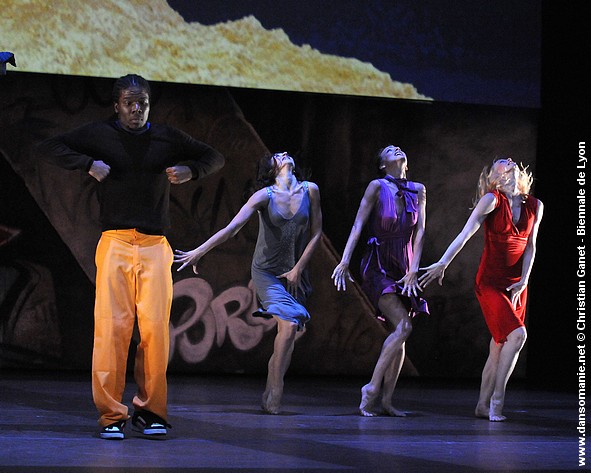
Just as Gershwin flitted between many forms, incorporating high culture and tradition, so the dancers sweep boldly through artistic genres. We are treated to an evening of mime, tap, ballet and hip-hop where we are equally likely to see a break-dance dance off to a graceful movement en-pointe; a group gyrating like jerky mannequins or finger-clicking gymnasts performing the splits as though on acid.

Barriers between art-forms are swept aside and boundaries blend. The high energy and bright palette of a vibrant Broadway musical are obvious in numbers such as Strike up the Band. Clockwork musical figures wind up to I Got Rhythm while a shadow silhouette dance provides Let’s Call the Whole Thing Off with elements of comedy. A tap-dancing crab; a bathing belle with a beach ball, and a gargling diva all bring new interpretations to familiar melodies and have the audience laughing and humming along.

The mood alters dramatically with a soulful gospel section from Porgy and Bess. The black dancers of the company huddle around a shack while the projection behind depicts a cyclone with malevolent waves threatening to crush and destroy their tiny haven. This is the best use of the screen; once again when it switches to scenes of public lynching, children crying, race riots and violent protests it paradoxically loses its impetus.

Summertime is intensely harrowing amidst these surroundings. Although the music is known for its powerful harmonies, the dancers perform isolated solos, drawing attention to the racially-charged times in which Mr Gershwin lived. If dance is a form of expression, then Good Morning, Mr. Gershwin is the ultimate emotional outlet.

Friday, 30 May 2008

Ballet costumes

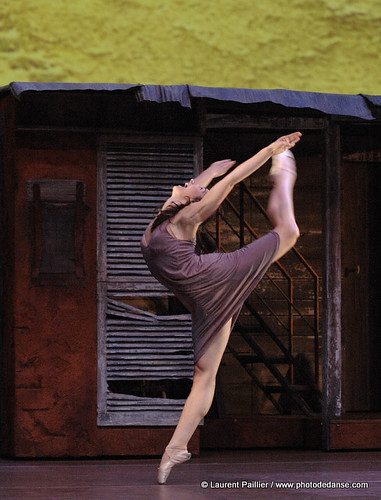
Last month the very beautiful and very talented Kate Venables (pictured front, rehearsing Banderillero - photo by Maarten Holl) took us on a tour of the Royal New Zealand Ballet (RNZB) headquarters at St James Theatre in Wellington.

When I was a little girl I used to want to be a dancer, despite the fact that I was clearly never going to have the grace, poise and slender strength of these amazing athletes – my father reinforced this by calling me ‘the sugar plum elephant’ each time I not-so-nimbly pirouetted down the stairs.

It’s partly the costumes that attract me. They’re so beautiful and so practical, having to withstand the rigours of vigorous activity while looking simply exquisite. I thought this was a perfect opportunity to get a peek behind the scenes, and I spied upon an entire room for making costumes, where materials, threads, and silent sewing machines wait on stand-by ready to spring into action.

Kate showed us that dress from Cinderella – the white satin tutu designed by Tracy Grant Lord studded with about 60,000 small, sparkling Swarovski crystals in a delicate rose design. It is shown here worn by Katie Hurst-Saxon in a photo by Rob Kitchin.

Kate also showed us a jacket and explained that there are three settings of hooks and eyes so that it will fit whichever principal is dancing the role. Sometimes the part doesn’t necessarily go to the ‘best’ dancer, but the one who fits the costume, although this isn’t too much of an issue as many of the dancers are equally talented, and equally tiny!


The costumes for Romeo and Juliet are being worked on at the moment. The costume budget for a major show is about $70,000, so it pays to be able to reuse things. The RNZB owns the performance rights to certain shows – like Romeo and Juliet, and Swan Lake – that they put on periodically; by the third time they might actually make money on one.

Kate also showed us the shoe cupboard and explained how dancers try all sorts of methods to soften the pointes of their ballet shoes. These are made from layers upon layers of cardboard, and the dancers bend them back and forth, whack them with hammers, soak them in water – anything to mould them to their feet and attempt to make them more comfortable. Dancers have a limited number of shoes, so when they have got them the way they want them; they write their name on the pair they have individually customised.

The shoes hurt and pinch when they dance. Many dancers get foot infections – the fiery red fungus creeps between their toes and can spread up their legs. When they finish a show their shoes can be full of blood and pus, and all the while they smile and look pretty. It is such a tortuous art form!

Despite all the back-stage horrors, the façade that gets presented to the public is magnificent and beautiful. I see that the RNZB are auctioning off some of their costumes from Queen’s Wharf in the last weekend of June. Even if you’re not interested in buying anything, I recommend you get down and have a look, inviting a little make-believe and glamour into your life.